Navigating Public Space in Marina Del Rey.


In the 1960s, the swamps of south Venice became a multi-million dollar building project that culminated in what we now call Marina Del Rey.

Pleasure boats, yacht clubs, nautical facilities, circular high rises with balconies overlooking the harbor, landscaped roadways with palm trees, office buildings, pharmacies, tennis courts, a hospital, a fire station, a library; and many restaurants overlooking the yachts, sailboats and motor boats.

A district devoted to tanning, drinking, carousing, love making, and living the good life amongst airline pilots, stewardesses, restaurant workers, aspiring actors, and retirees. The 1960s dream of accessible pleasure for anyone white with a convertible.

They even built the 90 Freeway to get people in fast, before the boat left the dock. Imagine the high quality of life 60 years ago, when a new freeway was affordable and considered the highest and best use of land.

From its inception, Marina Del Rey feigned a public purpose while raking in the dollars fencing off the best parts for private use of yacht clubs and apartment dwellers. Docks are locked up and there are many barriers to prevent the use of the harbor for the general public unless you are there to purchase a dinner and drinks on a boat, bar or restaurant.

Over the years, there have been community projects to create usable public space, such as Yvonne B. Burke Park on the north side of Admiralty Way which has athletic equipment, bike roads and jogging paths. That park too has recently been incarcerated when Bay View Management built a cinder block wall that closed a public access point behind a Ralph’s store on Lincoln Boulevard. 

God forbid a pedestrian in a park might access a supermarket on foot.

Other luxury apartments, understandably fearful of crime, vagrancy and violence, have illegally built obstructions along their land to prevent the park from becoming a way to enter their properties.

Every few hundred feet, the green parks become parking lots. An athlete running, riding a bike or rolling skating will eventually stop at a busy road where vehicles speed by at 60 miles an hour. And other cars and trucks will be entering the parking lots or exiting, creating additional hazards for the non-driver.

The big, popular restaurants, anchored in seas of asphalt, offering seafood, steak, alcohol, valet parking, and private parties to corporate diners and red nosed, melanomatous men in Tommy Bahama, have all gone out of business. Café Del Rey and Tony Ps with their crumbling, dated, Brady Bunch style restaurants are empty. The cigarettes, cigars, Aramis and lounge singers gone with the wind.

The great pandemic meltdown which has stolen our lives, taken our movie theaters, pillaged our department stores, and defecated upon our civic dignity, has now obliterated the big dining establishments of Marina Del Rey.

These popular places, that seemed immune to time, forever serving enormous plates of grilled lobster, prime rib, baked potatoes, cheesecake, ice cream sundaes and voluminous cocktails are now dead. Silent as Hiroshima after the bomb, these outposts of high on the hog, intoxicated living were ailing, out of fashion, and are now exiled from our spartan, self-consciously healthy era.


For a pedestrian who is trying to stroll one mile of the harbor west from Bali Way to Palawan Way, with the boats in view along the south walkway, there are several private obstructions that make it impossible to complete the walk.

I speak from experience as my friend Danny and I did the walk today.

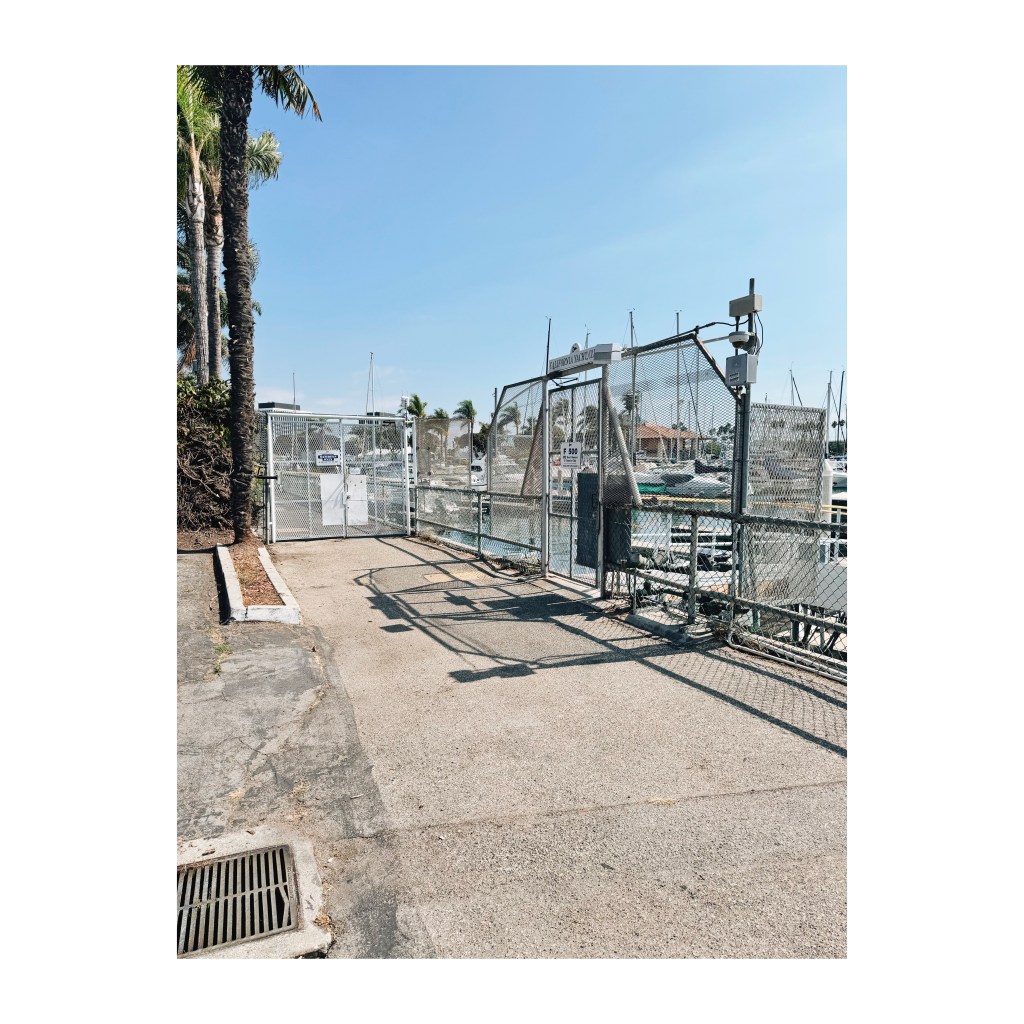
The California Yacht Club locks up the walkway with their own use of the property. 

One is forced to detour to Admiralty Way with the unused parking lots of the long-gone restaurants on one side, and the near-death experience of speeding cars on the other.

To reenter the harbor walkway, you find the Los Angeles County Fire Department Station #110 (4433 Admiralty Way) and walk behind the building to rejoin the path along the water to once again enjoy the public recreational qualities that are supposedly there for everyone to enjoy, not just yacht members.

The Marina City Club encompasses three early 1970s high rises which are entered securely by several guarded driveways on Admiralty Way. This complex has swimming pools, tennis courts, a convenience store, but is threatened by similar structural defects that brought down the Surfside, Florida condominium in 2021, killing 98 persons.

For now, residents who own property there pay high HOA fees, and even those who bought in cheaply face repairs that will surely cost collectively in the hundreds of millions of dollars to make these three, 55-year-old buildings safer in a location where tsunamis and earthquakes are always visiting unexpectedly.  

Concluding the walk today, we went north along a dirt path on the west side of the Oxford Basin “Wildlife Refuge” which connected to Washington Boulevard.

As we passed a vagrant man sprawled on wall, shopping cart and garbage nearby, my friend Danny shouted, “Get going, walk faster.”

Danny had spotted a handgun in the vagrant’s hand.  

Just another reminder, if any is needed, that nobody should assume that this is a safe area, regardless of how much homes sell for. The demoralizing and unsanitary aspects of Los Angeles are all around, because we live in perhaps the dirtiest metropolis in the United States, one that believes public trash camping is a civil right and mental illness is only a danger after it kills.

How this city will present during the 2028 Olympics is something Orwell would have pondered.

Before the Luck Ran Out.


The first job I had in Los Angeles was working at Barley Corn Entertainment, a small documentary production company in Valley Village.

It was the summer of 1994. OJ had just not killed his ex-wife and the young waiter who was returning her sunglasses. I was living in Studio City for $400 a month, and the new job as a PA paid $450 a week.

The woman who hired me, Lisa, was in her mid 30s, married to one of the owners, Sean. She was green eyed, tall, broad shouldered and drove a dark green Range Rover from her home in Pacific Palisades.

She brought along a little white Pomeranian dog to the office every day, a novelty to me, being from the Middle West and the East Coast where dogs were large and stayed at home.

Lisa was a line producer, a job she mastered in daily calm, always even tempered, even when she got cross. She commanded runs and released funds, met with producers, writers, editors, and researchers, and still had time to walk across the street to Gelsons for a cup of coffee and a large spinach salad. Her day ended at 5 or 6, and she would go down to the parking garage and drive an hour back to her enchanted life on Enchanted Way in Pacific Palisades.

There was a Christmas party at their home in 1994. I arrived at the 1960s ranch house, built on a terraced lot, like every other house, little plots of splendor overlooking the Pacific, lots along a hilly street stacked and placed like many dinner plates on the arms of a hash house waitress. 

We were all young and in awe at the $600,000 home with sliding glass windows that opened to a small patio that overlooked the mist and the ocean. 

I drank a lot, and Lisa forbade me to drive home.

I went to bed on the white sectional in the living room, and awoke under a baby blue cashmere throw with a headache. Lisa made coffee, and then Sean invited me to leave “when it was convenient.”

Lisa and Sean, Sean and Lisa, Pacific Palisades. Range Rovers, small dogs, lovely houses that always sat in the temperature range of 58-68 degrees. 


My co-worker, Julie, was the daughter of two negligent Marin County hippies and had gone to live with her maiden aunt in Santa Monica during high school. She adored Lisa and Sean and hoped that one day she too would live in Pacific Palisades, perhaps leveraging her BA from UCLA and weekly production check to buy a house on Enchanted Way.

A few years later Julie met Aaron, a wealthy man who lived on Lachman Lane in the Palisades. She moved into his house, and they made plans to marry. I went to their house, sat by the pool, and talked with Julie about a reality show idea we never produced.

Aaron wanted Julie to sign a prenuptial agreement before marriage. Julie asked her friends what they thought, and the consensus was “he doesn’t really love you.” They broke up and Aaron married someone else, a compliant wife who signed an agreement, and they may have lived happily ever after.

Julie met a hard drinking Missouri man on a production shoot in Wisconsin, married him, had a baby girl, moved to Kansas City, got divorced after a year, and spent the next 15 years in Missouri pining for the lifestyle she lost. She and her teen daughter moved back to the aunt’s condo in Santa Monica last year.


Kevin, circa 1995, was a producer at Barley Corn, a year older than me, married to Cori, and they lived in a house in Pacific Palisades. 

He looked like a young Dick Nixon, was kind of a dick swinger at times, bragging about his $400,000 house bought with the wife’s parental endowment. 

I hadn’t seen him in 28 years, but there was a reunion of Barley Corn folks last summer. I asked him about his house, his $400,000 house. 

“It ain’t $400,000 anymore! We sold it and bought a much larger place near the village in Pacific Palisades!”


In the 1990s I also took a comedy writing class at the home of Bill Idelson on Brooktree Lane in Rustic Canyon.

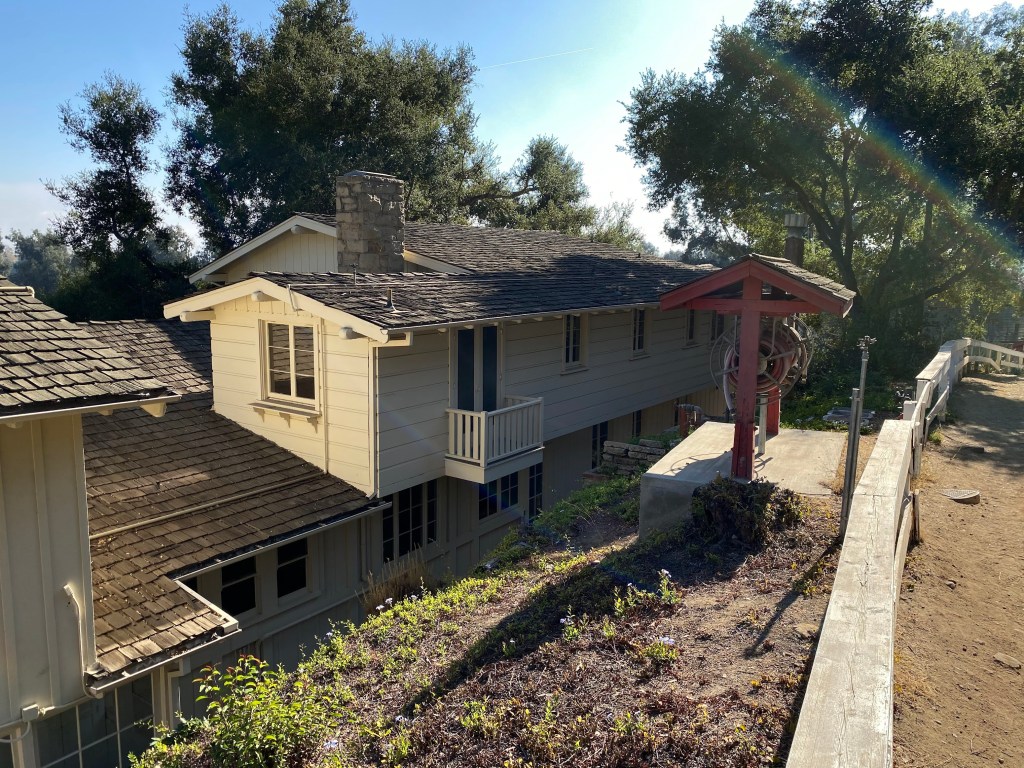
It was a mid 1950s wood house in a redwood grove next to a creek. It was designed by Mario Corbett and photographed by Julius Shulman. (his photo below).

Idelson, an actor, also had a successful career penning sitcoms, and he had a formula, much of which I forgot, except for his drawing of a man and a moon. “How he gets to the moon is your story!” he said.

We would sit on the patio next to the creek, and with the sounds of water and nature, get instructed.

Idelson had a grown son, a handsome, athletic blond guy who said he would ride the creek during rains in his raft straight down to the ocean.

That was Pacific Palisades: the successful sitcom, the gorgeous house, the beautiful surroundings, the happy-go-lucky son who rode the rain water for fun.


Pacific Palisades does things to people who live there and people who don’t.

For those of us who only live there vicariously, it is sprinkled with celebrities, hiking trails, valet parking, croissants, gourmet coffees and cheeses, blond boys in collared shirts, hot yoga, scented candles, soccer matches, Will Rogers, polo ponies, Eucalyptus trees, gardeners and caterers, brand new big white houses with black windows and electric steel gates, and smooth faced women in sunglasses driving large SUVs 60 miles an hour down Sunset on their way to Lululemon. There is never smog, heat, homelessness or obesity. The maids commute two hours to clean 10,000 square foot houses that are empty because their owners live in New York City. 

It was, until a few days ago, something you venerated and worshipped, like Harvard University (before October 7, 2023), Berkshire Hathaway, or inheriting ten acres of land atop Mulholland. If only you had that Ivy League degree, or ten $677,000 Berkshire Hathaway shares, or lived on El Medio Avenue so you could walk to the Temescal Canyon Trailhead. You might someday hit it big, marry that blonde girl, date the personal trainer stepson of that HBO celebrity with a lot of fame and money, sell that show, invent that software sold for millions to Meta, or become a partner of that law firm in Century City, if only you had one of these or that you could be the happiest person on Earth and live in Pacific Palisades.


Since I moved to LA in 1994, there was always a sense to me that people migrated to places rather than improve the ones they lived in. They sometimes did this by changing names, from North Hollywood to Valley Village, or Valley Glen; or converting West Van Nuys into Lake Balboa.

To this day, Los Angeles, for miles and miles, is neglected, filthy, violent. It has no nice parks, hardly any real neighborhoods to walk around. It costs a fortune to live here, to rent or buy is oppressive. People sleep in tents, or on bus benches, they rob stores, and start fires because they are so lost and miserable. 

Seemingly not so in Pacific Palisades. Charming, safe, family friendly, delightful. Nothing catastrophic or out of control. The powers that be lived here and kept it well-tuned and well-functioning. Until January 7, 2025.

Once in a generation weather. Except it happens around the globe every week in different horror scenes. One month it’s Lahaina, the next month it’s Greece, Spain, Western Canada.

But Pacific Palisades? Our Pacific Palisades? Where we go for hikes, where my nephew goes to school, where my gentle, wine sipping bosses lived, where I brought my parents to Rustic Canyon so they could see “the real California?”

We kid ourselves thinking our good luck is our own doing, that we may escape losing our health or our home. We really do live by the whims of fate.

There is one migration that seems innocent, but it is, in a sense malignant, many people of means seeking to escape the bad air hellhole of greater Los Angeles, and it leads to Sunset at PCH where there is no more land, paradise promised at the end of the continent.

Now it is temporarily destroyed. 

Thank God for those who have survived. Life matters most.

We have seen these fierce wind driven fires and their atomic destruction. 

How one small spark can end one era and perhaps usher in another one that may be more humane and sustainable. 

Chinatown in the Rain. Part I.


Chinatown is particularly poignant in the rain. 

The old and tired streets are washed in puddles. Pagodas, lanterns and the color red are reflected in asphalt. 

Everywhere there are old signs, some neon and some plastic, reminding us of families and times from long ago. 

There are old people with canes, umbrellas and face masks out shopping for hot soup and vegetables.

And packs of visitors waiting in line for take-out dim sum.

There are many empty parking lots selling parking spaces for $5 a day.

A big sign advertises Grandview Gardens, Cantonese Food next to a grass filled lot that might have once contained a restaurant. A history of this place is found online. It closed in 1991. 

Thirty-three years ago.

Grandview Gardens: an old sign like a cemetery headstone. Should it not be another restaurant or apartment or apartments over a restaurant? 

Don’t we have a critical, crying need for housing?

Everything moves so fast in Los Angeles. We come here young and eager and wake up neither.

But everything vital and necessary for the humane needs of humanity is tied up in litigation, neglect, bureaucracy, politics and abuse. For years and decades things decline but politicians are always promising the end of homelessness, the end of pedestrians dying in crosswalks, the end of hate, the dawn of tolerance, a new city of walkable, clean, affordable and safe neighborhoods. But I don’t have the funds to move to Vienna, Austria and neither do ten million other Angelenos.

Yet we drive fast, passing thousands sleeping in tents on garbage filled streets and tell ourselves that everything is normal. Another day of murder, another day of car crashes on the news, another walk through a community that has some thriving businesses and many others dying or dead. Have a smoke, get high, meditate. What else can you do?

In the civic imagination, Chinatown is one of Los Angeles’s happier places. Nobody thinks ill of it, they long to come this neighborhood, hobbling along in D- condition, months out of a pandemic that still haunts it. 

City Hall is a ten minute walk away.

Those Fantastic Clouds


In Southern California, we are so used to living under full sun with no clouds, that the presence of an impending storm is a revelation. The illumination inside our house changes, and there are real shadows hitting the walls and the sofa again just as there are in other real cities around the globe.

Introspection and thoughtfulness, a pause in the frantic, occluded light, the end of the year.

It takes days for the rain to come. We know it’s coming, the way we knew the virus was coming in February 2020, like a slow-motion freight train. But precipitation, no matter how meager, is a benevolent threat we can get excited about.

Yesterday we were still in the midst of a refreshing cycle of weather: cold nights, cool days, sun and partial sun, rain and no rain.

Around 4 pm I looked outside and saw a stunning sight of a gold leafed tree against a blue, pink, and gray sky. It would only last a few minutes so I grabbed my XE3 camera and ran out.

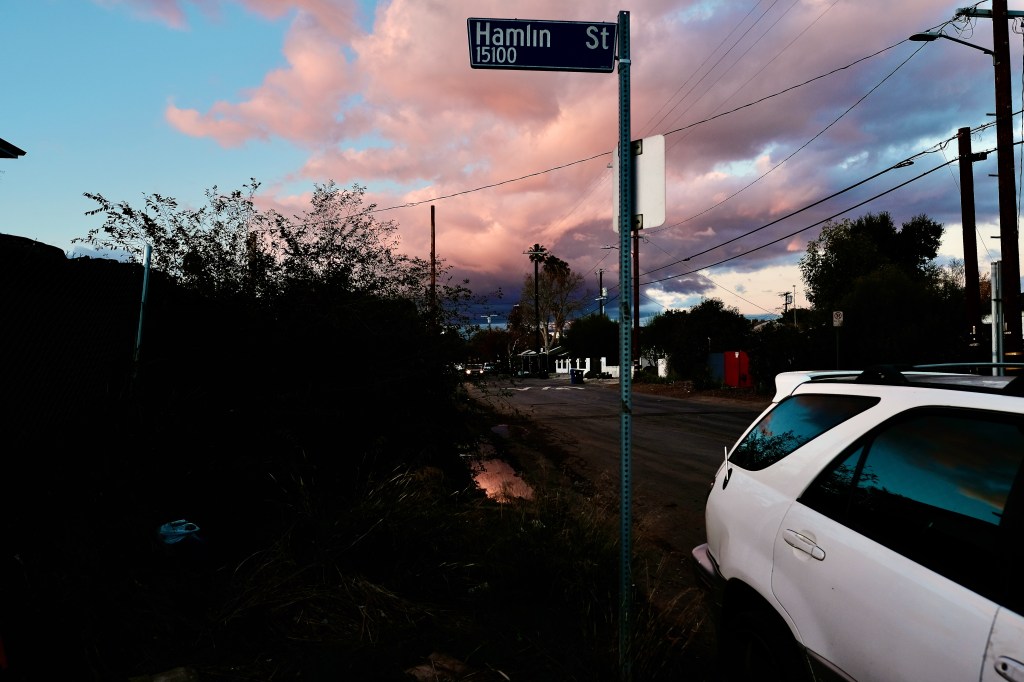
It was a strange hour. There was a menacing helicopter chopping up the sky, and reckless, going back home drivers speeding down Columbus and Hamlin in monster trucks. 

Death was just beyond my driveway so I wandered out cautiously.

Somewhere along crudely unpaved Columbus, where there are no sewers or curbs, I could see the vast sweep of the northern sky and those fantastic clouds miles away.

Middle of June


It is only mid-June but already the extreme heat has landed in Southern California.

Every week there is another “record breaking” temperature in thousands of places, not only here but around the world.

To an older Angeleno, June once meant days of haze, overcast and cloudy.

The Pacific Ocean was cooler, even cold. The truly hot times did not start until late August.

Now the ocean is warmer, semi-tropical, and the clouds that emanate from the sea are the clouds we see in the sky, and they are the clouds one sees in places like Miami and Houston. There is “monsoonal moisture” and the air is thick, even in the morning, making the heat more intense.

I’m not a meteorologist but something is very strange in the skies these days.

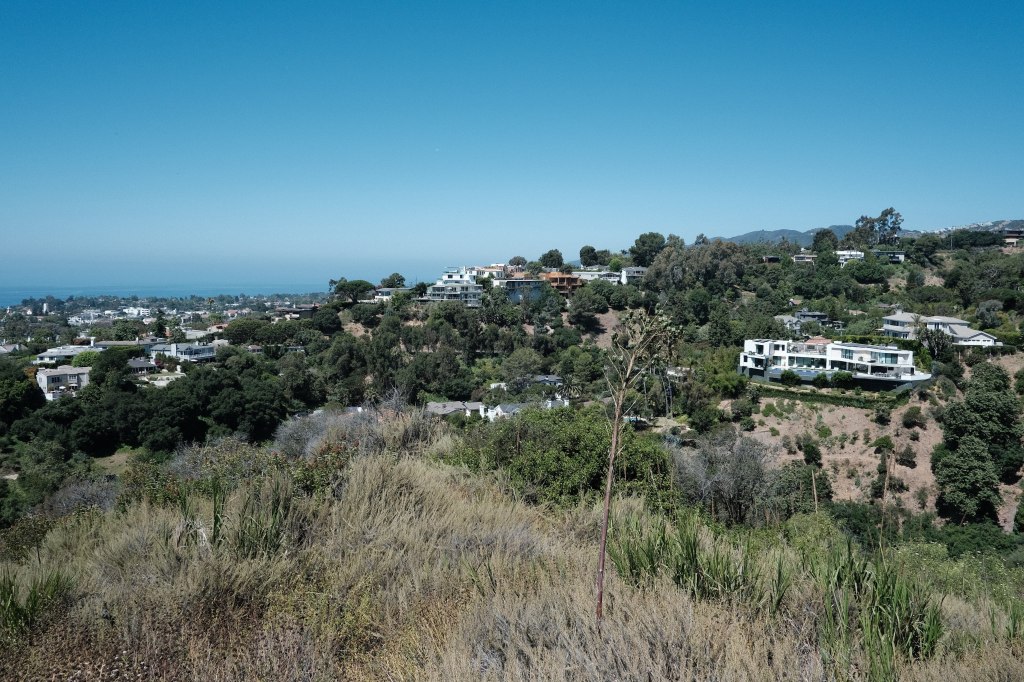
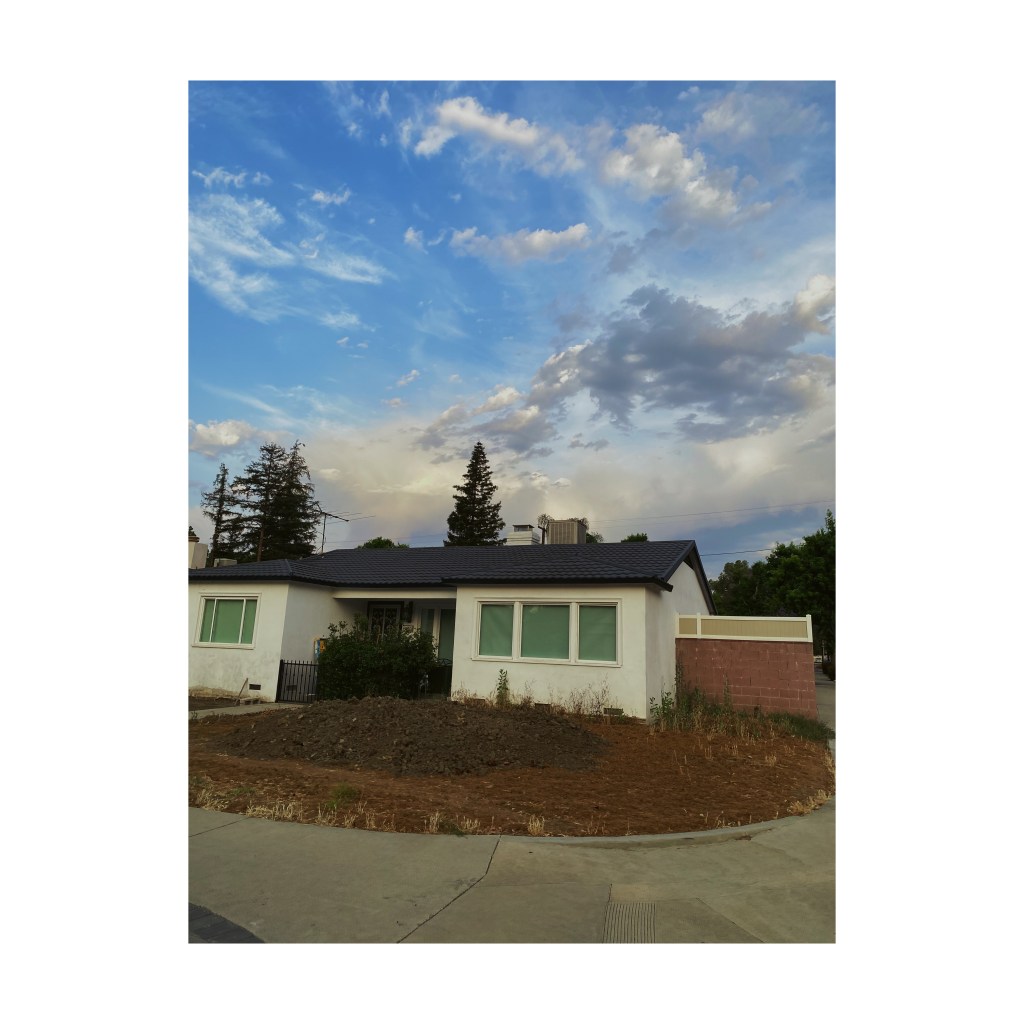
This is what the “Kester Ridge” neighborhood looked like around 6:30 am today.

Squandered Opportunities


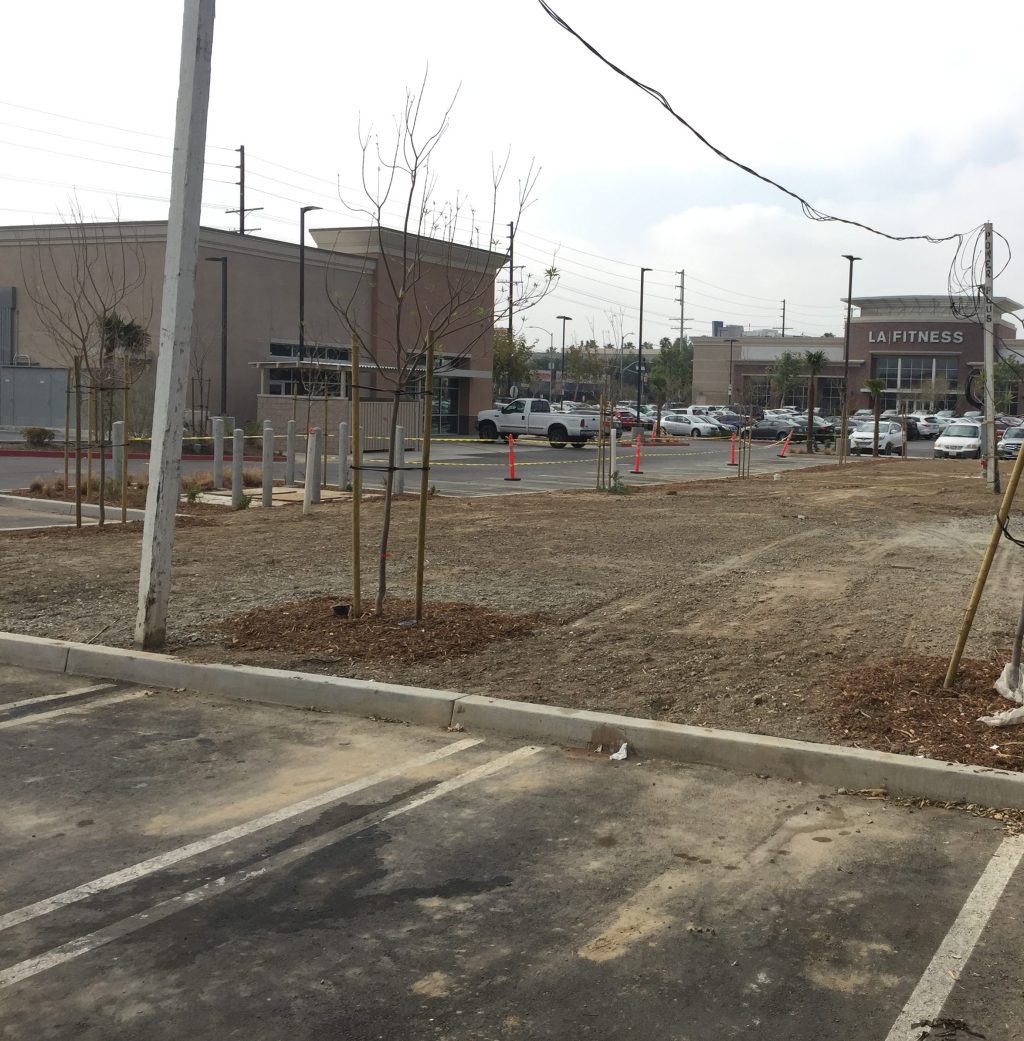
Nearing completion, now, is a one-story mini-mall on the north end of the LA Fitness parking lot near Sepulveda and Erwin.

Pleasantly innocuous, in a beige/brown way, the mall (with circa 1999 cornice) is being landscaped, pretty extensively, all around, with various trees and shrubs to decorate the sea of asphalt.

Zoned commercial,  this is also next door to a Wendy’s, also recently naturalized, with new water saving plants and a modernistic, horizontally striped renovation. Customers who feast on industrial meat, sugary soda, and frozen French Fries, all trucked in from Iowa, will do so surrounded by native California succulents.

This is all bordering the Metro Orange Line Parking Lot, 50% of which is occupied as a storage center for not-yet-sold new Keyes Automobiles. This scientifically zoned area is irrationally sited along an efficient, pleasant bus line that runs on schedule and connects Van Nuys to Hollywood and Downtown Los Angeles.

Left over in the new mini-mall layout is a rectangular island of land that, in my imagination, I envision as a small apartment building or even a white, wooden Colonial house, a residential arrangement that provides living space for people who can walk next door to the gym, stop for milk at CVS, ride their bikes on the bike path, and most importantly, are there to populate, energize and humanize a sea of parking spaces.

I picked “Colonial” to lovingly pander to the nearby residents of privileged, filmed upon Orion Ave. hoping they might not object to an 18th Century House with a garden in front, housing a nice coffee place or a fort-monthly locale for filming Target and Walmart commercials.

Why not build something on this open spot like these below:

But, for now, the neat, empty rectangle of land is unoccupied with forms either natural or man-made.

This waste of land, and the time-wasting, perpetual, irritating and circular question, “Where will they park?” dominates the beginning and end of any discussion of new apartments, housing or commercial building in Los Angeles.

If there is no room for 1,000 New Hummers in that New 200 Unit Apartment…then I say, to hell with it, let people sleep on the street in tents!

What exists, when it’s built, is a battleground of short-tempered drivers circling parking lots, looking for parking, even when there are 2,000 or 3,000 spaces provided for their temporary storage!

So the opportunity for a new, innovative, and imaginative kind of development, one that integrates the commercial and the residential, is again squandered.

Why?

What have we got to lose?

We are already losing.

SaveSave