Shulmanism


The world needs another book on the late photographer Julius Shulman (1910-2009) like it needs another Katherine Heigl movie, but there I was, last night, driving to Woodbury University, to attend a book signing for the new Rizzoli photography book, “Julius Shulman and the Birth of a Modern Metropolis” by Sam Lubell, Douglas Woods, Judy McKee (Shulman’s daughter) and illustrated, of course, with Mr. Shulman’s voluminous and gorgeous architectural images.

In an auditorium, a large screen was set up in front of the audience. At a long table sat Craig Krull, whose gallery sells Shulman’s infinitely reproducible photographs for thousands a piece; a woman from the Getty Research Institute/ Julius Shulman Archive; Judy McKee, Julius Shulman’s only child and the executor of his estate; authors Sam Lubell and Douglas Woods; and architecture critic and author Alan Hess.

Shulman’s photography was the clearest and finest representation of the California dream after WWII. Through his lens, the world saw a state of endless innovation and mass-market modernism where mobility and technology might remake the lives of millions under the glowing sunshine.

Architects Neutra, Eames, Koenig, Lautner and Beckett hired Shulman to promulgate, promote and propagandize modern building and modern design. Through the 1950s and 60s, every freeway, every parking lot, every shopping center replacing every bulldozed orange grove was an opening to a grand and glorious future. The lone skyscraper in a sea of parked cars was held up as a model of how life should look. And Shulman was the master who made the desert of Los Angeles bloom.

The skyscraping of Bunker Hill, the lifeless streets of Century City, triple-decker freeways– they all were shot at the end of the day: shadows, textures and gleaming surface.

Mr. Krull called Mr. Shulman “the most optimistic man I’ve ever met.” Like Ronald Reagan or Arnold Schwarzenegger, Shulman loved the Golden State and kept his company with the most successful and accomplished men of his time.

The speakers last night, acolytes and worshippers, reinforced each other. The academic praised the archivist who saluted the authors who thanked the gallery who paid homage to the photographer.

Like Scientology, that other great religion of this region, Shulmanism demands fealty and loyalty to its founder and his work. To ask why Los Angeles has never lived up to its photographic glory is to risk blasphemy. To ask why Shulman, who lived for almost a century, did not turn his very observant eye, onto the less attractive parts of LA, is to insult the very vision and mythology he produced.

Mr. Krull also said that Mr. Shulman never thought his photographs were worth so much until the checks came in. Photography is reproducible… but oil painting, sculpture and the Hope Diamond are not. No doubt, Mr. Shulman knew that each of his negatives could turn out 3 million photographic prints. But art collectors and art sellers must be smarter than the rest of us. And Shulman’s work is the gift that keeps on giving. Publishers, filmmakers, galleries are going to go on licensing Shulman for as long as they do Warhol, Presley and Monroe.

Projected onto Shulman is the very ideal that modernism was moral. Once upon a time, myth-makers imagine, architecture was about making the world a better place. By omitting broken down and shabby Los Angeles, and posing happy children, well-dressed wives and various home furnishing accents, Shulman decorated and embellished his structural subjects. With biblical fervor and pixelated proof, these photos demonstrate to believers that paradise did indeed exist in post-war Los Angeles County.

At the end of the presentation, one of the authors spoke about his favorite photograph in the book: a 1930s image of a thriving and ornate corner of downtown Los Angeles with streetcars and pedestrians.

His name’s Gary. He takes pictures of L.A. – LA Observed


His name’s Gary. He takes pictures of L.A. – LA Observed.

Kevin Roderick writes:

“I’m happy to announce that LA Observed is the new home of Gary Leonard’s long-running series of Los Angeles street photos. They have run under the banner of Take My Picture Gary Leonard in the late CityBeat, the late New Times and the very late L.A. Reader. Yes, I’m aware there’s a pattern there. But we’re not going anywhere, and Gary thought the web would be a good next stop. TMPGJ will run occasionally in the image spot on the top of the front page, bearing Gary’s usual signature and caption. He’s been photographing Los Angeles for 40 years, first making a name for chronicling the city’s punk clubs and nightlife. He’s focused mostly on Downtown now, and has a gallery called Take My Picture on the same block of Broadway as the Orpheum Theater and Broadway Bar.”

Los Angeles’ History: the Whittington Photo Collection.


This slideshow requires JavaScript.

“The “Dick” Whittington Studio was the largest and finest photography studio in the Los Angeles area from 1924 to 1987. Specializing in commercial photography, the Whittington Studio took photographs for nearly every major business and organization in Los Angeles; in so doing, they documented the growth and commercial development of Los Angeles. Clients included Max Factor, the Broadway, Bullock’s, and May Co. department stores, the California Fruit Growers Association, Signal Oil, Shell Oil, Union Oil, Van de Kamp’s bakeries, Forest Lawn, Sparkletts Water, CBS, Don Lee Television, Goodyear Tire and Rubber, real estate developers, construction companies, automobile, aircraft, and railroad companies, and drive-in theaters. Another notable client was the University of Southern California, which contracted with the Whittington Studios for coverage of athletic and other events. The collection consists primarily of roughly 500,000 negatives; the rest are photoprints.”

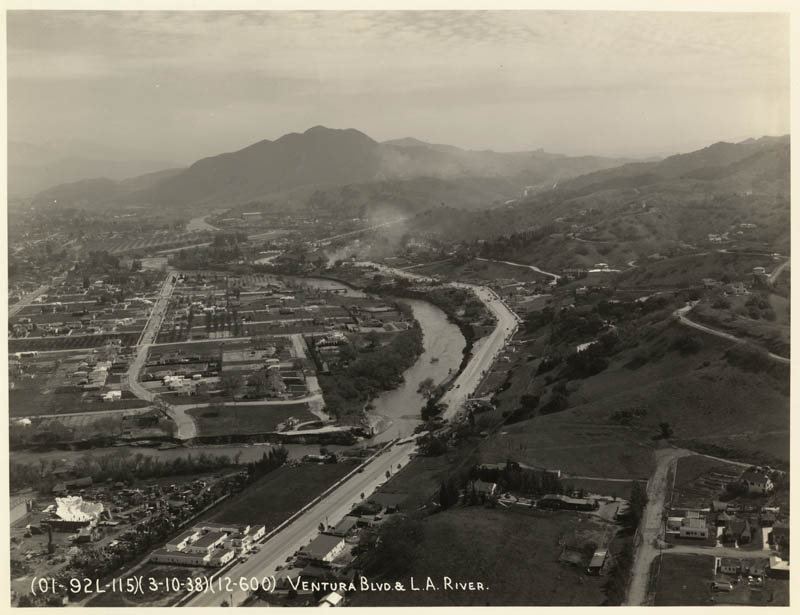
Studio City, 3/10/1938: After the Flood.


Studio City, March 1938

Photo: California State Library

The 1938 Southern California Flood was one of the most catastrophic in our state’s history.

In late February and early March, 5 inches of rain fell. At least 115 people died and over 5,600 homes were destroyed when rivers (not yet channeled in concrete) overflowed and buried buildings, bridges and automobiles in a tsunami of mud, debris and rapidly flowing water.

The photo above is an aerial view of Studio City, aiming towards Universal, east of Laurel Canyon, showing the after-effects of the storm. River bridges over Vineland, Tujunga and Colfax were destroyed. Republic Studios (CBS Studios) is in the lower left corner. Dilling St. snakes in an “L” formation from West to East river. Ventura Blvd. is the larger road.

For those of us, who mourn not only the loss of life and property in 1938, the photograph provides a more elegiac and sad reminder of a time and place lost.

The San Fernando Valley was once a much less crowded place of many fine homes on large lots, with farm animals- horses and chickens- surrounded by acres of citrus, walnuts, and avocados. Garbage was burned, without guilt, in backyard incinerators. People lived “green” without political intent. The hills were not yet defaced with billboards and ugly condos, and one could look miles across the smogless valley and see mountains. People had cars, but they also walked to corner markets, rode bicycles to school, attended movies in neighborhood cinemas, and left their doors unlocked. Nobody went to the gym; their lives were active and exhausting enough.

After World War II, the deluge: massive development, poisoned air and water, freeways, and the plowing over of verdant groves.

And today we live in a place where only our homes are sacred, but the public element is degraded.

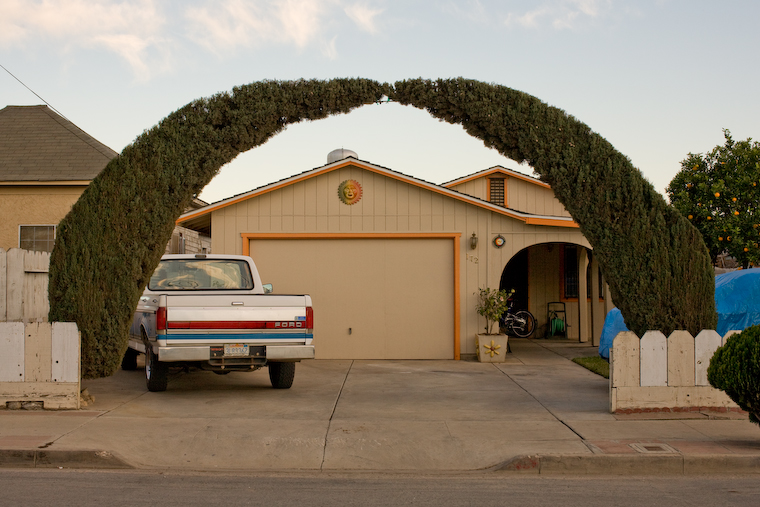
Liz Kuball: California Vernacular


California: strange, off-kilter and right before our eyes.
As photographed by Liz Kuball.

This slideshow requires JavaScript.

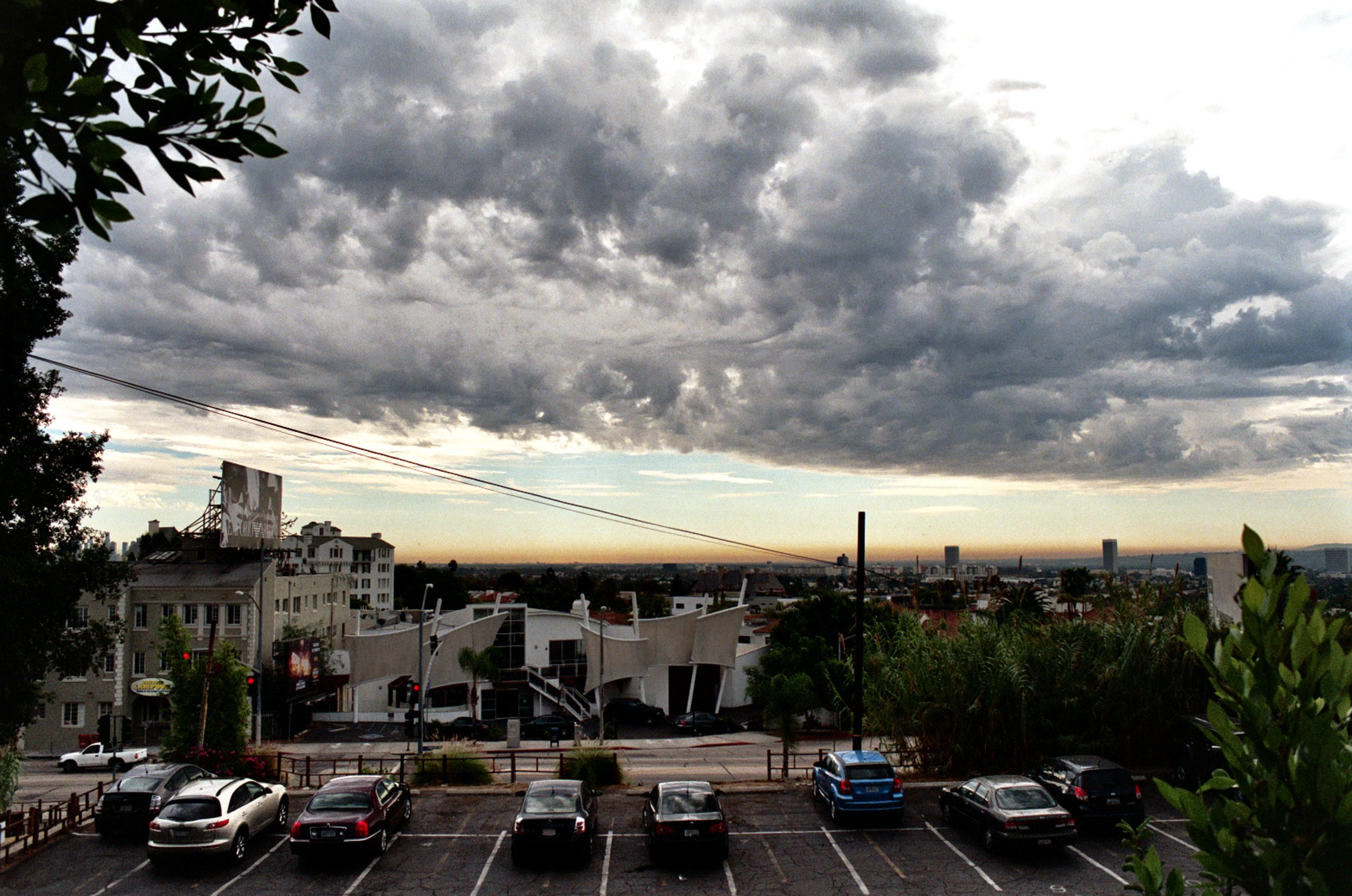
Gathering-Storm


2992587031_2820011737_oGathering-Storm.jpg, originally uploaded by Here in Van Nuys.

Our weather, of late, metaphorically reflecting the condition of our nation.