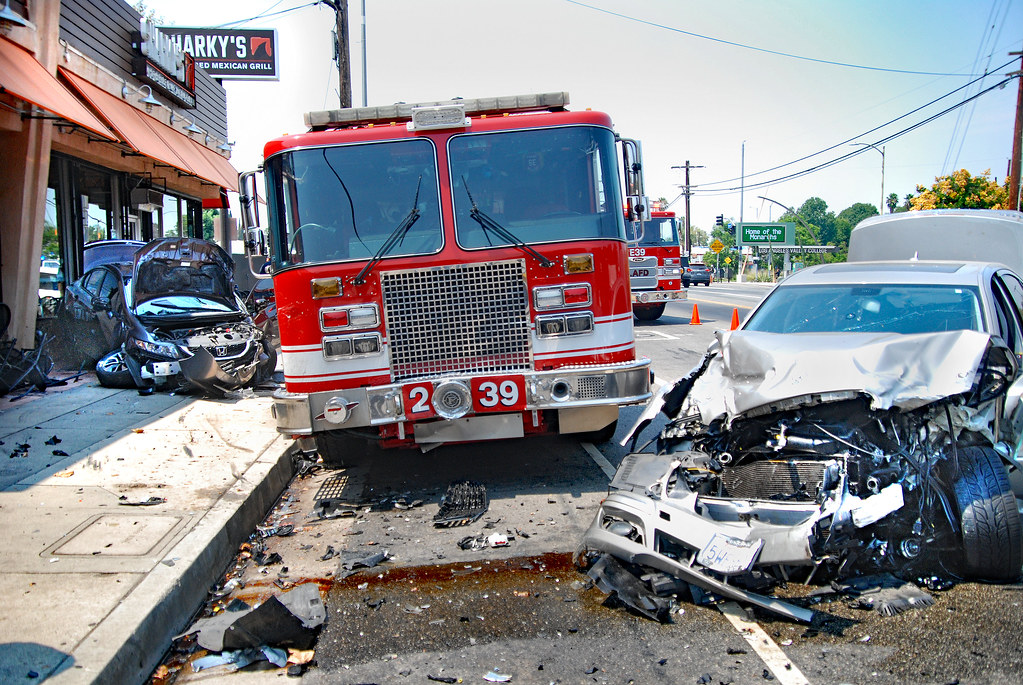
Speeding, eight lane wide streets, bike accidents, car accidents, injuries and death.


© Photo by Mike Meadows via Flickr.

Essay reprint.

Why Do Firefighters Oppose Safe Streets?

By Josh Stephens  

February 25, 2024

Ballot Measures StreetsWalkability

A few days ago, I drove from west Los Angeles to Whittier, a leafy suburb founded by Quakers on the eastern edge of Los Angeles County. Just east of downtown Los Angeles, I got on the 60 Freeway and took it to the 605.

I kid you not, every single billboard along this route advertised one of two things: insurance or accident attorneys.

I lost count of the latter. There was Jacob Imrani, Anh Phoong, Sweet James, Morgan & Morgan, and the dean of Los Angeles accident attorneys, Larry H. Parker, who’s been “fighting for you” seemingly since the days of covered wagons. Pirnia Law sponsors UCLA athletics and appeals to the fraternity crowd with the most bro-y slogan in legal history: “putting the ‘lit’ in litigation.” The Pirnia billboard I saw on Friday promised, “We run L.A.,” whatever that means.

(An aside: if you’re going to be an accident attorney in Los Angeles, it is, apparently, mandatory for you or your avatar to have facial hair, ideally a goatee.)

These billboards all make for an ugly drive. Granted, it wouldn’t have been any less ugly if they advertised something else, like soda pop, cigarettes, or, well, cars. What’s remarkable is that, in a county with a $750 billion GPD, these are the only businesses that seem willing to spend money on outdoor advertising. Sadder still: there is a robust market for their services.

Our society is as litigious as it is dangerous.

Between 2013 and 2022, Los Angeles County averaged around 54,000 fatal or injury crashes annually (the vast majority being injury-only crashes). I’m pretty sure the only people who celebrate those statistics are the attorneys. And yet, the crashes persist.

One city in Los Angeles County is attempting to do something about car accidents and, especially, the hazards they pose for pedestrians. On March 4, voters in the City of Los Angeles will consider Measure HLA, an initiative that would force the city to implement its Mobility Plan 2035, which was adopted in 2015. Backers of Measure HLA say that the city has implemented as little as 5% of the plan. Meanwhile, some 300 deaths take place annually on the city’s streets.

HLA promises a revolution in active transportation and the pedestrian realm. We’re talking about enhanced sidewalks and crosswalks; street furniture; trees; dedicated bus lanes and upgraded transit stops; bike lanes; traffic calming; and more. It’s the sort of mobility bonanza that activists and progressive planners have dream about. It could turn at least a few of Los Angeles’s ugly, dangerous thoroughfares into places that people where people just might want to hang out.

HLA will not be cheap. A recent analysis by Los Angeles City Administrator Matt Szabo estimates it will require $3.1 billion. Supporters dispute that number and, of course, argue that the promise of lives saved and streets beautified justifies a major investment.

Now, our friends on the billboards haven’t come out against Measure HLA, as far as I know. Even they aren’t brazen enough for that. And yet, someone else has — the firefighters of the Los Angeles Fire Department.

Let that irony sink in for a moment.

The firefighters claim that many of these street improvements could interfere with emergency responses. “Every second counts. The road diets slow down our firefighters,” Freddy Escobar, president of the United Firefighters of Los Angeles City Local 112, told the Los Angeles Times. “And it will be so much worse with HLA.” In other words: we don’t want a hook-and-ladder truck getting hung up on a bulb-out or squeezed by a bike lane.

I give due respect to emergency responders, and I get that the firefighters have their priorities–especially when it comes to saving lives. But the mobility plan isn’t merely about aesthetics. Its point, in fact, is to save lives: not by responding to accidents but by preventing them in the first place.

In 2023, 336 people died in traffic-related deaths in the City of Los Angeles (half were pedestrians). Meanwhile, between 2014 and 2019, the average number of deaths from accidental structure fires was 14. I hardly want to pit one sort of tragedy against another. But, let’s face it, governance is always about priorities.

And, indirectly, Measure can improve public health by promoting walking and biking and even by fostering social relationships. It’s a lot easier for neighbors to get to know each other when they’re walking down the same sidewalk than when they’re both racing to make the yellow light. And, however harrowing a fire may be, at least most of them are accidental and isolated. Measure HLA attempts to undo an entirely intentional, nationwide disaster.

The firefighters thus miss the city for the buildings.

It’s not the first time, though. Many cities’ street dimensions are already dictated by the size and performance of fire trucks. And, last year’s successful AB 835 made the case that fire codes that require most multistory buildings to include two stairways (for emergency egress) severely constrain the way residential buildings can be designed and, indirectly, make California cities uglier and more expensive than they’d be if buildings were allowed to have only one stairway.

I’m not an expert on emergency response. But I’ve been involved in urban planning long enough to know that, in too many instances to cite, the very people who are trained, paid, and empowered to design our cities somehow get shoved aside. Meanwhile, veneration for emergency responders — much of it well earned — has often given them, and their unions, unduly loud voices in the civic discussion.

Not this time, though.

What’s especially bonkers about the firefighters’ opposition to HLA is that they are almost alone. The list of groups that have endorsed it is not just long — it’s also among the most diverse you could ever imagine in Los Angeles. Plenty of other unions support it, including the SEIU and the teachers union. Elected officials have lined up in favor of it. Seemingly every mobility, environmental, and social justice organization has too. Democratic groups support it, and so does the Los Angeles County Business Federation. If ever a group could be expected to oppose a measure that de-emphasizes the use of cars, it would be the United Autoworkers — but, no, they’re on the list too.

For all of this enthusiasm, I’m not sure that the mobility plan will cure all that ails Los Angeles’s streets, even if it’s supercharged by Measure HLA. And I certainly don’t know if $3.1 billion — or whatever the true amount is — would be a sound investment. But, the fact that concepts once as obscure and forlorn as “complete streets” and “active transportation” are on the ballot in a famously car-centric city has to be good news, for planners and pedestrians alike. It has at least a chance of making the city safer and more attractive.

Of course, I don’t expect those billboards to come down any time soon, and we’re probably stuck with the freeways too. But we can at least hope that some of those attorneys go out of business.

The Return of Light Rail


Screen_Shot_2017_09_05_at_6.57.53_AM.0Electric_car_in_North_HollywoodVan_Nuys_only_37_years_ago_a_grain_field_in_1911Early_view_of_Van_Nuys_BoulevardVan_Nuys_Boulevard copyVan_Nuys_BoulevardFor the future we now return to the past.

The black and white photos all show how Van Nuys Bl. looked in the period from 1911-1957.

Yesterday there was announcement from Metro.

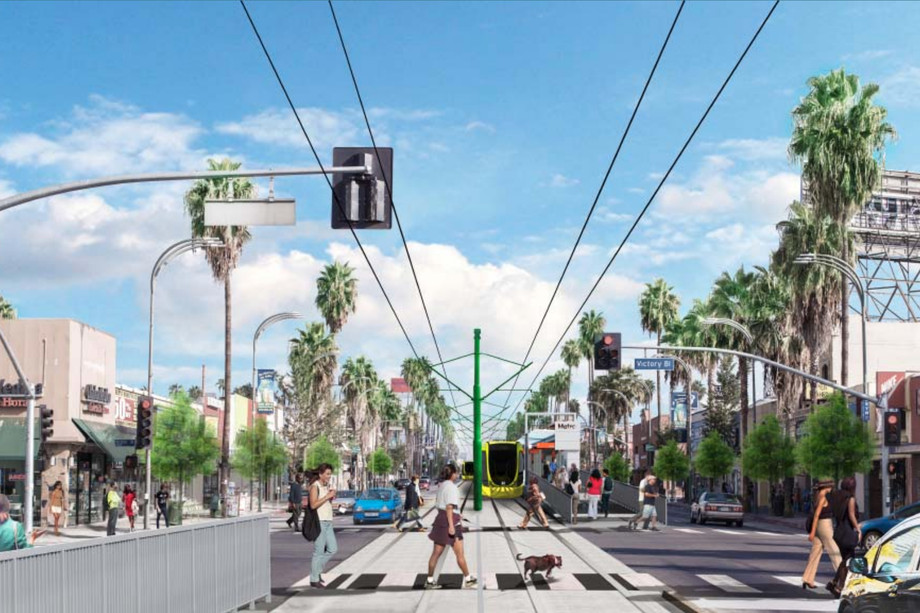
Metro will build a 9-mile-long light rail down the center of Van Nuys Boulevard, stretching from Sylmar to the Orange Line Van Nuys station near Oxnard St.

The light rail service yard for train maintenance will be built near Raymer St along the Metrolink tracks in the “Option B” area. “Option A” near Oxnard and Kester, that would have destroyed 58 buildings, 186 businesses and 1,000 jobs will not happen.


From the inception of Van Nuys in 1911 until the late 1950s, an electric rail car connected Van Nuys, North Hollywood and Hollywood and provided a means of public transportation from this part of the San Fernando Valley to the rest of Los Angeles.

The modernization of Los Angeles, which always put the car before anything else, led to the ripping out of the rail and its replacement with an enormously wide boulevard of ten lanes of asphalt.

Van Nuys Boulevard today is probably in its worst state of economic and social decline in its history. With its empty stores, shabby buildings, homeless men and women and neglected properties it stands as a civic disgrace.

DSCF3189

dscf2649dscf2605dscf2661dscf2640

Hopefully, the light rail will lead to a change in the betterment of Van Nuys, though local leaders, such as Councilwoman Nury Martinez are often lukewarm about public transportation, painting it in fearful terms of criminality and danger, or still characterizing it as a cattle car for maids and dishwashers to get to work, rather than as a means of transportation for every single citizen of Los Angeles to use.

Any incident of crime is unacceptable on a Metro train.

But how many private cars break the law every single day by speeding, running over pedestrians, going through red lights, and taking part in car chases, drive-by-shootings, hold-ups and child kidnappings?


Here is an article from Curbed LA describing the new project:

“Metro is moving forward with plans for a new rail line in the eastern San Fernando Valley.

One of the 28 projects that the agency plans to have up-and-running in time for the 2028 Olympics, the East San Fernando Valley Transit Corridor would run from the Orange Line station in Van Nuys to the Sylmar/San Fernando Metrolink station, about 9 miles to the north.

Metro had considered building the line as a rapid bus route, rather than rail, but on Thursday the agency’s board of directors approved plans that would advance the project as a light rail route similar to the existing Gold, Blue, and Green lines.

“I have long dreamed of a day when we would have more than two Metro train stops,” Stuart Waldman, president of the Valley Industry and Commerce Association, told the Metro board.

He called the line the “largest economic development project in the San Fernando Valley this millennium.”

Most of the line would travel along Van Nuys Boulevard, with trains traveling on tracks built in the center of the road. For the final 2.5 miles of the route, trains would travel on San Fernando Road to the northernmost stop.

Metro expects a trip from end-to-end would take about 29 minutes, and that the train could carry close to 50,000 riders per day by 2040. Eventually, the line could connect with a future transit project through the Sepulveda Pass.

That would give Valley residents significantly more options when navigating the city.

Since the line will be served by light rail, Metro will need to add a service station for trains that travel along the route. The agency had considered putting that facility on a parcel of land close to the Van Nuys station, but local property owners complained that the plan would displace hundreds of businesses.

Now, Metro plans to put that maintenance yard closer to the Van Nuys Metrolink station, where it would have to acquire fewer properties. Some businesses would still be displaced, and several business owners expressed concern Thursday that they could be forced to close up shop.

These businesses would be eligible for relocation fees, and on Thursday Metro Boardmember Sheila Kuehl also asked staffers to look into creating a fund to compensate business owners for disruptions caused by construction of the line.

The light rail tracks would serve 14 stations running through the communities of Van Nuys, Panorama City, Arleta, Pacoima, and the city of San Fernando. The entire project would cost about $1.3 billion to construct. Metro previously considered running a short leg of the line underground, but found that would more than double the project cost.

Now that Metro has settled on a design for the project, the agency will complete a final environmental review before preparing to begin construction.

Under the Measure M funding timelineapproved by LA County voters in 2016—the project would break ground in 2021. Construction is expected to wrap up by 2027.”

The Janitors’ Light Rail.


nury-martinez-dn
Nury Martinez, 2012. (Hans Gutknecht/Staff Photographer)

“If you’re a housekeeper, janitor or dish washer, you need to get to work every day on time,” she said. “Buses don’t move as many people and as quickly as the light rail. That’s why we’re excited about the project that would serve people who are transit dependent.”[1]

“As a mom, I can tell you it’s terrifying to sometimes think of having to get on the Red Line. I won’t for that very reason,” she said. “I don’t have to see the data collection to know that if I feel unsafe to ride the train with my kid, that I’m just simply not going to use it.”[2]

-Councilwoman Nury Martinez


Why are these two quotes important?

What does it matter what Councilwoman Nury Martinez of LA’s City Council District #6, representing Arleta, Panorama City, Lake Balboa, and Van Nuys thinks about public transportation, light rail, who rides it and who needs it?

It matters, I think, because it shows a way of describing non-car travel as something used by people who are the lesser people of the City of Angels: maids, janitors, dishwashers and perhaps even criminals.

Can agents at William Morris, that actor who stars on that sitcom, Hancock Park attorneys, the conductor of the LA Philharmonic, and Dodger Clayton Kershaw also ride trains? I wish they all did!

Strange that a political culture that panders to PC should grossly stereotype transit riders.

The prospect that Van Nuys, long languishing, is under her jittery guidance, and limited vision, is not especially comforting.  A public official who denigrates public transportation is not doing the people’s business very well.

For in her remarks she shows a remarkably retrogressive and depressing view of public transportation as something which is sometimes terrifying, unsuitable for mothers with children, and only made for unskilled workers commuting to low paying jobs in the NE Valley.

There has been, for a long time, an idea that if you had enough money in Los Angeles you would surely travel by car. And today, we have the spectacle of 24/7 traffic produced by a culture conditioned to expect that every journey must begin and end in a car.

Even as plans for expansion of light rail go on all over Los Angeles, there is an equally strong pushback against it.

  • Uber and Lyft are making it possible to take short distance trips by dialing up a ride on your phone.
  • Amazon is delivering everything from chewing gum to sofas with fleets of trucks that are also clogging our streets.
  • Parents who rightly shudder at their children attending a low rated local school chauffeur their kids 25 miles away to “better schools.”
  • Housing is now a luxury commodity but every law that seeks to expand it runs into the “where will they park?” crowd who wants to stop new apartments, new granny flats, new retail stores and multi-family dwellings near trains.

And instead of public officials offering imaginative, innovative and futuristic ideas, we have a throwback to the car culture that is unsustainable.

Los Angeles! This is 2018! This is not 1975, 1965 or 1945!

Light rail and subways are not dangerous. They are not only for criminals. They are not only for the woman who scrubs your floor. Properly policed, intelligently managed, excellently maintained, they can be pleasant, quick and enjoyable.

They are the way we ALL will get around Los Angeles when gridlock by private vehicle renders this city dysfunctional.


[1] https://www.dailynews.com/2018/06/03/heres-van-nuys-through-the-eyes-of-mr-van-nuys/

[2] http://www.latimes.com/local/lanow/la-me-ln-martinez-metro-sexual-harassment-20180124-story.html

Option A: High Level Cabinet Meeting


Peter Scholz

Los Angeles is the second largest city in the United States, but aspects of it can seem almost small town. A sprawl built of people who came from somewhere else, infamous for its superficiality and temporality, it sometimes, surprisingly, produces individuals, deeply rooted in its soil, who live and work here their whole lives, sometimes in an area a few blocks wide.

Such is the case with Peter Scholz.

He was born in Van Nuys, 53 years ago. He lived at 5812 Lemona Ave in Van Nuys, CA. in a German-American family along with Michaela, his younger sister.

His parents, Heinz and Herlinda, had met in Vaduz, Liechtenstein in 1954. They married, and in 1959, emigrated to Los Angeles, where they found work, as driver and maid, in the Sidman Family estate in Beverly Hills. They stayed there only briefly.

Liechtenstein

Motivated by ambition and hard work, Heinz left his chauffeur job to work as a baker. Meanwhile, they had two kids, Peter and later Michaela.

In 1968, Dad opened Scholz Cabinets on Aetna St. in Van Nuys, a location where he did business for the next 20 or so years.

Peter worked part-time with his father, graduated from Notre Dame High School and then enrolled in Pierce College “because that’s where the best looking girls were.” He attended two years and graduated in 1984.

He continued to work part-time with his dad, closely learning the craft of custom cabinet wood making. He was, in effect, going to school overseas, by learning the German way of doing things here in Van Nuys: precisely, exactly, and diligently with strict attention to quality and integrity.

Yet Peter had other ideas and passions in his head. He was excited by art, by creative people, by wealth and Hollywood, and by that whole rich world, over the hill, where sculptures, luxurious homes, paintings and grandiosity were on display.

Remarkably, he didn’t try and become an actor. He didn’t intern at William Morris. He didn’t affect affectation. He still built cabinets. He used his skills in making them to enter a rarified world.

It was the late 1980s, an era of big shoulders, fat cigars, overpowering perfumes (Giorgio, Poison, Opium), Joan Collins, The Brat Pack, Wall Street, Greed is Good, and the explosion of personalities in the art world.

He wanted, somehow, to take the modest and self-effacing excellence he embodied and make custom cabinets and custom showcase podiums for architects, designers and clients in Beverly Hills, Hancock Park, Brentwood, Pasadena, Malibu and Westwood. He was introduced to notables who became clients, such as Eli Broad, real estate mogul, art collector and philanthropist; and Robert Graham (1938-2008), sculptor, born in Mexico, married to actress Angelica Huston.

Jean Michel Basquiat (1960-88)

Eli and Edyth Broad at home with Robert Rauschenberg

Still only in his early 20s, he started Showcase Cabinets, a name reflecting that his creations, his products, were showcases (custom pedestals and bases) to display art, objects, sculptures.

In 1984, at age 20, he married ( eventually divorcing after 20 years), had two kids, Niko and Jessica, and he has two granddaughters as well.

Annie, his girlfriend of eight years, also works in the shop. They live with their son Erik, 14, in a 1950s modern house near Valley College which they gutted and remodeled. It has white walls, a backyard pool, orange front door, and solar shades. The house is filled with a cacophony of eccentric and colorful artwork, sculpture, bright colored chairs and, most imaginatively, a graffiti painted bathroom that seems inspired by the interior of a NYC subway car, circa 1985.

He seems to have started everything, work, marriage, fatherhood, at an early age. In 2009, he also bought the building where he now headquarters Showcase Cabinets, Inc. He and Annie travel, often to her home country, Bulgaria, where they use her family house as a base point to explore Europe, including Greece, Italy and Germany and everything two hours or less from that point.

Annie and Peter

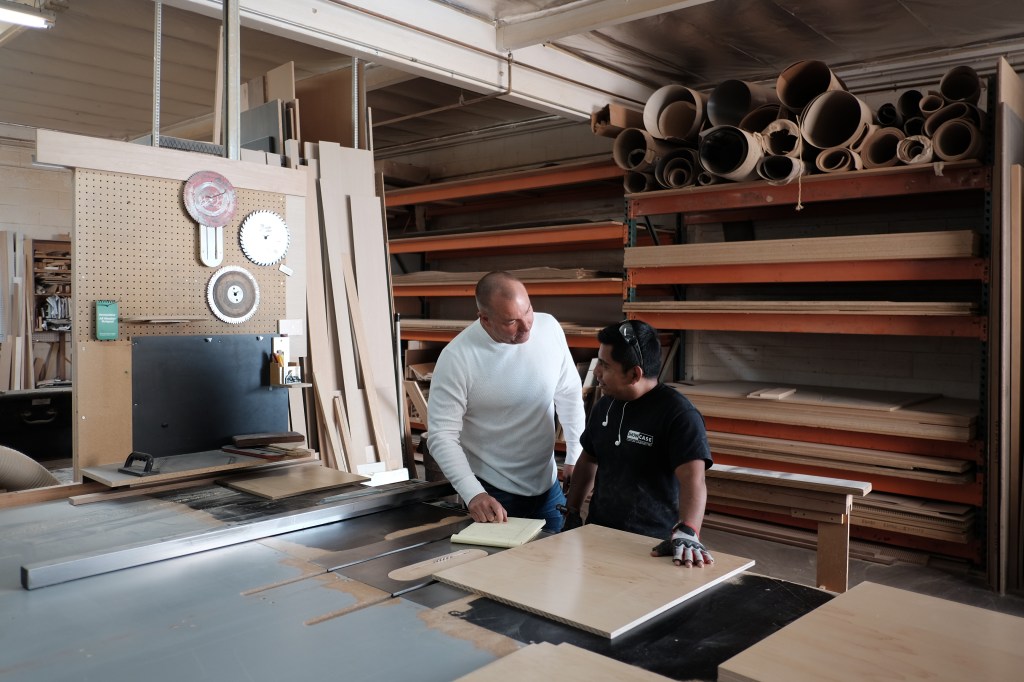
He employees some 10 people in his bright, 4,200 SF, well-run shop. Last year, they invested in a $30,000 Striebig Compact Vertical Panel Saw, made in Switzerland, which is accurate to 1/100 of a millimeter or 0.0003937008 of an inch.

His business, which is very healthy, is all word-of-mouth. In an era of social media, of pretending to be successful by posting doctored images and endorsing products, Peter earns his money in the real world of tangible, material substances made out of trees. There is no need for Photoshop when you rub your hands over a smoothly buffed, 30 foot long, walnut bookcase.

His location, 20 minutes from Beverly Hills, and within easy distance of the 405 and the 101, is ideal for clients, designers and architects who often want to drop by the shop to choose finishes, to see the craftsmen at work, to witness what they are paying top dollar for. And Peter welcomes them. He has everything to show and nothing to hide.

His raw materials come predominately from Valencia Lumber in Lake Balboa and Phillips Plywood in Pacoima. He also sends work to GL Veneer, Inc. in Huntington Park. Showcase gets the orders and this is passed up and down the economic food chain.

He deals with stress through kickboxing, the gym, and yoga.

He has some very nice bottles of Japanese whiskies lining an office shelf, in a room built of concrete block, anodized steel walls, and a one-way detective style mirror to keep an eye on the shop floor.

The wall facing his long desk is decorated with large format photographs of drug busts, tattooed gangsters, guns and illicit substances which his son-in-law, a cop, shot from an Iphone.

There is an air of bad boy badness in Peter Scholz but it seems to be more artistic expression than real life activity. But one would not care to incite him. He acts formidable…. and it doesn’t look like an act. If he were an actor, he could play a felon or a cop convincingly. He exudes menace and kindness equally.

Because he is happy in his life and work he projects his good fortune onto Los Angeles. “There is no better place to live,” he said, without irony.


Option A: Metro Plans to Demolish 33 Acres of Industry for One Big Rail Yard.


Ed Kirakosian, Peter Scholz, Ivan Gomez, Daniel Gomez.

Hanging over all this is the “Option A” scheme by Metro Los Angeles which might condemn Peter’s shop and 185 other small businesses, covering 33 acres, in an area north of Oxnard to Calvert, from Kester east to Cedros. This is ostensibly for a future light rail maintenance yard.

Opposition to the scheme immediately sprung up and Peter produced big yellow banners against Option A now hung all over the area.

Boldly, by instinct, in his customary manner, Peter marshaled his creative connections to hire artist Guy Ellis (#dcypher_dtrcbs) who painted a long mural on the exterior wall of Showcase. It is in the style of 1930s social realist protest. It is powerful and jarring, screaming, in deathly ashen gray, and living bright yellow, a cry against the potential destruction of the area.

If Option A is withdrawn, and the area is permitted to continue existing, Peter has plans to keep the mural up on his building, and even more plans to revitalize the district with the help of his neighbors, friends, investors, architects and innovative developers.

Showcase Cabinets, Inc. and the life and work of Peter Scholz, is yet another reason to drop the idea that wiping out a section of Van Nuys, and scattering her most creative and productive class, is progress at its finest.

#   #   #   #


SaveSave

A Great Wall on Burbank.


“Building-to-street proportion is the relationship between the height of buildings on either side of a street and the width between those buildings. An ideal proportion between these two creates a pleasant and visually interesting public realm. The public realm, therefore, may be considered as an “outdoor room” that is shaped by 
the “walls” of the building heights and the “ floors” of the roadway.

Outdoor rooms with excessively wide roadways or short building heights tend to eliminate any sense of enclosure
 for the pedestrian.”
-Los Angeles Small Lot Subdivision Design Guide, 2014

Our city, with its sprawling boulevards and speeding cars, is often cursed with roads way too wide for pedestrians. Think of six-lane Van Nuys Boulevard, bordered by one-story high buildings, and worse, parking lots.

In some areas of the city, like on Pico Boulevard and in Studio City along Ventura Blvd. planted islands with trees now break-up the wide asphalt. New “outdoor rooms” with a sense of enclosure and protectiveness emerge. These are deliberate and designed for upgrading ugliness.

But sometimes even an ongoing construction project can enlighten and transform a bleak stretch of formerly wide street monotony.

In North Hollywood, on Burbank Blvd. just east of Vineland, DWP has been tunneling and installing a new water delivery system.

Processed with VSCOcam with a5 preset Processed with VSCOcam with e2 preset

And along part of the route where a deep, underground hole was dug, DWP erected 20-foot high, wood and metal-framed walls. It has temporarily transformed the commercial district of that area by slicing the four-lane road into a two-lane and creating, along the sidewalk, a European type shaded alley.

Processed with VSCOcam with a1 preset

Work Area #12, as it is officially known, requires a pit to launch a tunnel-boring machine that will travel south, along Lankershim Blvd. for more than a mile. A new water pipeline will replace the aging 1940s infrastructure.

While the construction is going on, some streets have been closed off, which no doubt contributes to aggravation and inconvenience for some area residents and businesses. But the rerouting and reconfiguration has some pleasant side effects.

On Burbank Blvd. cars now stop twice, before proceeding slowly, down a narrow road whose borders are shaded by high walls and low buildings.

Processed with VSCOcam with e1 preset Processed with VSCOcam with a1 preset
On the western edge of the excavation, two tanks tower above the road, as if heralding a ceremonial gateway into the neighborhood.

And on the south side of the street, the high walls come right up to the sidewalk, creating a shady and meandering path alongside area businesses.

The gift of this unwelcome intrusion allows us to experience a different LA with traffic calming elements. What emerges? Less cars, slower drivers, shaded walkways; walled off from the exhaust fumes and the aggression of speeding motorists. Industrial construction materials in steel, wood and concrete function as street sculpture.

For the time being, a stretch of Burbank Boulevard is a living experiment in rezoning by accident.

Processed with VSCOcam with a1 preset Processed with VSCOcam with a1 preset

Yesterday was CicLAvia


IMG_6876 DSCF0115

Yesterday, Sunday, March 22nd, was CicLAvia in the San Fernando Valley.

Lankershim Boulevard, from Chandler to Ventura, and Ventura to Coldwater Canyon, was closed to cars.

I rode from my house near Sepulveda and Victory to the starting line at North Hollywood Station.

It was foggy.

Mayor Eric Garcetti: articulate, young and progressive, spoke before the opening.

IMG_6871 IMG_6866

It was a perfect San Francisco day to ride bikes in Los Angeles.

Cool, overcast, gentle.

And the sometimes indifferent people were seemingly transformed into better ones.

A cop saw me inflating my bike tire before the race and said, “Let me walk you down to where they have a bike repair station.”

IMG_6857

DSCF0111 IMG_6860

Shopkeepers along the route waved and handed out chapstick, water, and energy bars.

In Studio City, I stopped and ate a Belgian waffle at Waffles DeLiege food truck.

Fortified and energized I turned around and rode the route back to the starting point in North Hollywood. And continued down Chandler.  Making my way home, under trees and cloudy skies, along deserted streets .

IMG_6865