A Proposal to Build Angels Stadium in Van Nuys


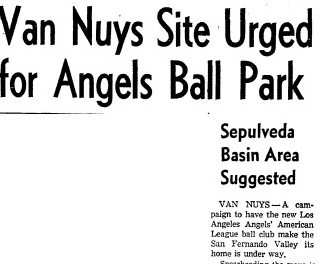
In December 1960, the Van Nuys Chamber of Commerce thought it would be a grand idea to have the recently conceived American League LA Angels play in a brand new stadium constructed right in Woodley Park Van Nuys. 

In the heart of flood basin. But conveniently located next to the 405 and the 101.

They wrote a telegram to club owners Gene Autry and Bob Reynolds imploring them to think about the “level and vacant” 100 acres “available for little or no cost” and adjacent right next to the just completed San Diego Freeway.

“We expect no local opposition to the plan,” said Nelson LaVally, secretary-manager of the chamber, confident that no families would object to the destruction of their local park.

There were two city-owned golf courses and a model airplane field. And the rest of the land “was leased out for agricultural use.”

LA Mayor Norris Poulson (R) supported the idea and liked the idea of a permanent home for the LA Angels in the heart of the largest park, flood zone and bird sanctuary in the San Fernando Valley. 

Councilman Patrick McGee (R) was also in favor of the idea of building a large 50,000 seat stadium with thousands of parking spaces in the middle of Woodley Park. He had given tours of the Sepulveda Basin a few years earlier to another LA ball club owner.

 “I made the same suggestion to Walter O’Malley and Del Webb and the NY Yankees before the Dodger contract was adopted,” Councilman McGee said. 

In 1958, McGee had vehemently opposed the Dodgers’ Chavez Ravine project (which displaced hundreds of Latino families) because it did not provide enough revenue to the city and would give oil revenues to a Dodger youth program, “spending public money for private individuals.”

The councilman thought the hotter valley weather more ideal. Most games would be played at night, and warmer temperatures in the SFV was appealing. Chavez Ravine and Wrigley Field in South LA were “20 degrees cooler”.

But the Angels ruled out the move. And the city’s Recreation and Park Department had other plans to add more 18-hole golf courses, tennis courts and several baseball diamonds.

Once again, visionary Van Nuys business minds and politicians came up with a shallow, ill-conceived and brilliantly self-destructive scheme that produced no results.

A pattern they would follow for the next 60 years. 

Color photos of Woodley Park: Credit to John Sequeira.

Postmistress of Van Nuys


Among the charming relics of the past is a look to what people cared about 62 years ago.

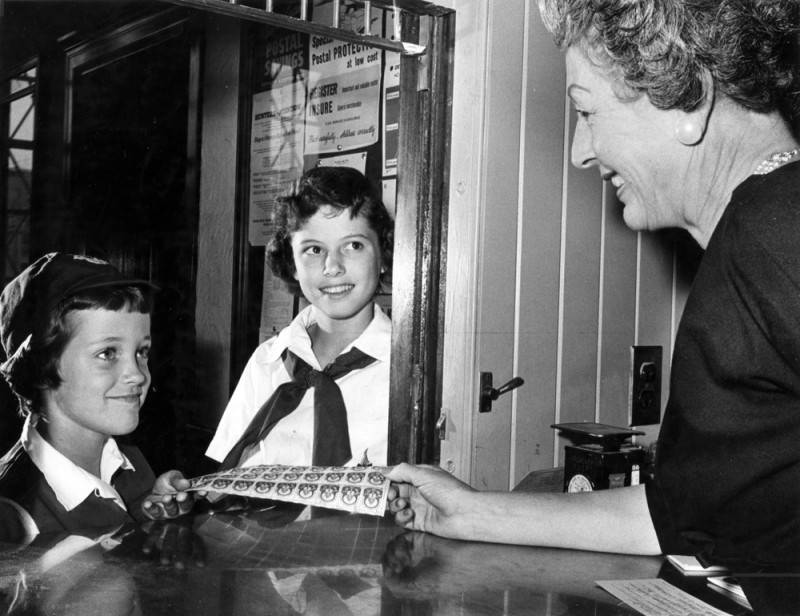
In 1960, the United States Postal Service issued a limited edition of stamps to commemorate the Golden Jubilee (50 years) of the Camp Fire Girls.

Readers of the Valley Times would see the postmistress (yes, that is what she was called) Mrs. Kay Bogendorfer selling stamps to two young Camp Fire girls, Christine Hughes, 8 and Leana Holman, 12.

The girls’ home addresses are listed in the photograph.

The listing of facts, the honorary titles, the respect for young women, the admiration for the post office, all of it was taken for granted.

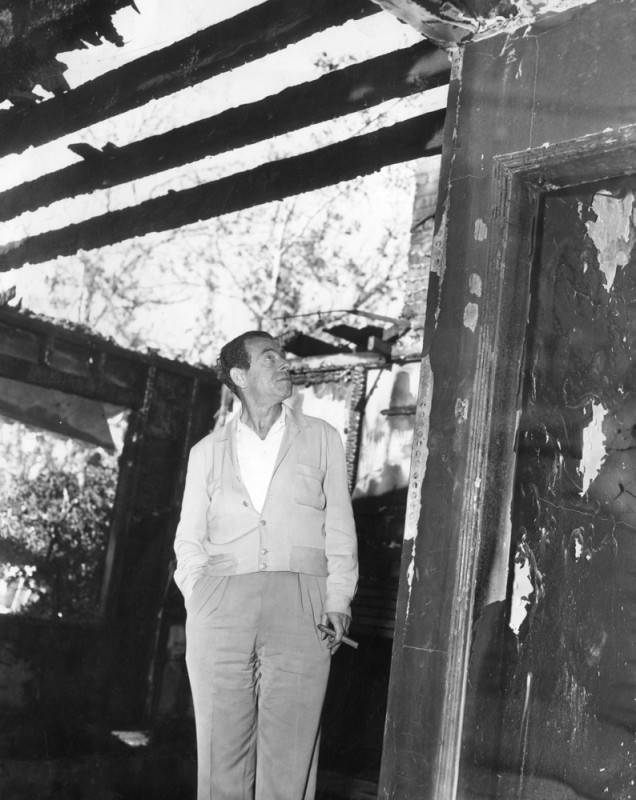
1960: Cigarette Caused Fatal Fire.


4/29/1960: Harry Brandt, 53 (with cigar) stands in the ruins of his gutted Living Room in Van Nuys where his wife Charline, 46, died after a cigarette ignited a house fire. (Photo courtesy of Valley Times Collection at LAPL)

1960: Peace March at Kester and Noble in Sherman Oaks, CA.


Photo by George Brich, Valley Times./ LAPL/Public Domain

At the height of the Cold War, a brave and liberal minded group of progressive people marched through Los Angeles and eventually ended up in Moscow where they worked to defuse tensions between the US and the Soviet Union.

Los Angeles at that time was a conservative, anti-communist city whose main industry, Hollywood, was just emerging from the blacklist and any association with Russia was tantamount to career suicide.

The Committee for Non-Violent Action (CNVA) was an American anti-war group, created in 1957. Its purpose : resist the US government‘s testing of nuclear weapons. It used non-violence to oppose atomic military tools.

The group was often attacked as pacifist and for its welcoming of African-Americans into the fold.


Photograph article dated December 22, 1960 partially reads, “Eight footsore peace walkers marched through the Valley Wednesday on the 11-month tour that will take them from San Francisco to Moscow, Russia. The placard-bearing marchers, who represent the Committee for Nonviolent Action, stopped Wednesday night at Highland avenue and Hollywood boulevard in Hollywood. They will remain in the Los Angeles area until Christmas day when they will resume their march toward Tucson, Ariz. In addition to having their board and room paid for by the committee, which is composed of 60 Americans, the hikers have seven administrators and advance publicity men making the tour with them.” Bruce McIntyre, 20, leads the peace walking team along Ventura Blvd. near Noble Ave.

Van Nuys: September 21, 1960


00118139-1

Among the stranger aspects of modern American life is that we have gotten over old 1950s fears (Communists, homosexuals, fluoridated water, rock and roll) but have now supplanted new, sometimes exaggerated terrors to replace the old ones.

The above photograph by George Brich (LAPL) was published in the Valley Times on September 21, 1960 and read, “Jeanne Avery, 15, 14155 Cohasset St., Van Nuys, adds to the view along palm-lined Van Nuys boulevard, community’s main business street. The community is the largest in the Valley.” Van Nuys is nearing its 50-year anniversary and is being celebrated as one of the most beautiful and productive cities in the Valley.”

Can you imagine the outcry in 2016 if an adult male photographed a 15-year-old girl on the street and published her name and address in the LA Times?

“Thank you George Brich for violating my daughter’s privacy! Now every crazy pervert in the world will know where she lives!”

“This is completely wrong. No young woman, no matter how attractive should be photographed by a stranger and have her address published in the paper!”

In 1960, America had a benevolent and innocent view of itself. It was considered an honor for a teenage student to be photographed in the local paper. And nobody meant anything ironic in describing Van Nuys as “one of the most beautiful and productive cities in the Valley.”

In 2016, the average American, the average person living in Van Nuys is probably photographed hundreds of times a day, in security camera videos, in mobile phone images, waiting in a car at a red light, filling up for gas, withdrawing money at the ATM, driving through McDonalds, or stopping to shop at Target.

But the intentional photograph by camera on a public street has now become a provocative act. Its artfulness, its quirkiness, its freedom has been put on probation. Public photography itself is now under suspicion.An art form and a means of communication has volunteered to restrain and censor itself. Even when no law has been broken, and no privacy invaded. And this in itself is irrational and a denial of our American way of life.

There is nothing against the law in taking a photo of a person on a public street. You don’t need their permission.

They understood that in 1960.


Hayvenhurst Discombobulated: 1960.


Hayvenhurst Boulevard, straddling the western edge of Van Nuys Airport, was pushed out of its formerly north-south straight alignment in the early 1960s. The purpose: to accomodate the expansion and safety needs of the airport.

What resulted is a confoundingly obtuse roadway that twists and turns through industrial streets and ends up connecting with Balboa Boulevard.

In the postwar era, any order coming from men in neckties with important titles was unquestioningly obeyed by the American public.

Hayvenhurst Widening HayvenhurstPhotograph caption dated July 11, 1960 reads, “Re-aligning Havenhurst – Federal Aviation Agency approval was obtained for re-alignment of Haybenhurst avenue, Councilman James Corman announced after conferences with federal officials. Shown at proposed intersection at Roscoe Boulevard are three interested officials (from left) Airport Commissioner Harry Dow, Corman and Public Works chief Ed Cox.”

Credit: LAPL