The Bright Shop by Andy Hurvitz


Case Study House #9, originally uploaded by Here in Van Nuys.

An excerpt from my new short story “The Bright Shop”.

Log Line:

A European refugee designs a new life in 1960s Los Angeles only to see it crumble, near the Pacific, on the edge of a new decade.

Excerpt:

Tail Road runs like a jagged capillary along the top of a mountain ridge, rising up from the ocean near Santa Monica and high up into the canyon. Below it, cliffs, rocks and erosion.

It’s a narrow finger of a road, shaded and hidden, wooded and secluded, a private place, home to a very few, who live behind walls and gates, eucalyptus and ornamental grasses, sprayed in fog and breeze.

Rich are the residents, self-made or self-employed, made wealthy by defending the law- or defying it.

At the western end of Tail Road, just before its precarious termination over Pacific Coast Highway, the one-story, steel and glass, 1957 Seams House sits on a flat, two-acre promontory.

The Bright Shop by Andy Hurvitz


Malibu Near Trancas, originally uploaded by Here in Van Nuys.

Excerpt from “The Bright Shop“, a new short story by Andy Hurvitz

The Student Athlete

On another Sunday with Henry, Tanya sat with her newspaper, atop the wood deck of the Malibu West Beach Club as Henry played in the sand.

A roof rhyming repetition of half circles and hanging globe lights, the beach club’s young, casual, jaunty and informal architecture echoed its members, an athletic, friendly, successful group who worked hard at leisure.

Multi-ethnic, the people included a Chinese born Physics professor, Dr. Hy Loh, 35, who did chin-ups in his speedo; a Malaysian model, Jacinda Pu-See, who had just been cast in a James Bond movie; and Argentine immigrant Dr. Limon Jacobs whose psychological citrus treatment and adherence to a diet omitting yellow fruits was all the rage.

The flighty film colony buzzed the grounds, landing on the deck in their oversized sunglasses and deep tans, puffing and exhaling, taking off in sudden flight and eccentric gesticulation, marking beach territory in lush olfactory waves of Aramis and Chanel No. 5.

Late Sunday afternoon, up on the Coast Highway, Tanya and Henry were driving home, when she saw a tall, muscular mulatto man in a red swimsuit hitchhiking. She had seen him before, back at the beach, flipping, somersaulting, jumping and running in the surf.

Without a thought, she pulled over and told Henry to get in back so the hiker could get in.

He introduced himself as Colton Banning. He told her he was studying at UCLA’s Graduate School of Architecture and Urban Planning. Up close she carefully studied the student’s broadly carved chest, flat stomach, and tawny skin. They made conversation about school, Malibu and Vietnam.

Without concern or caution, she invited him up to the house.

She hoped the architecture might seduce him.

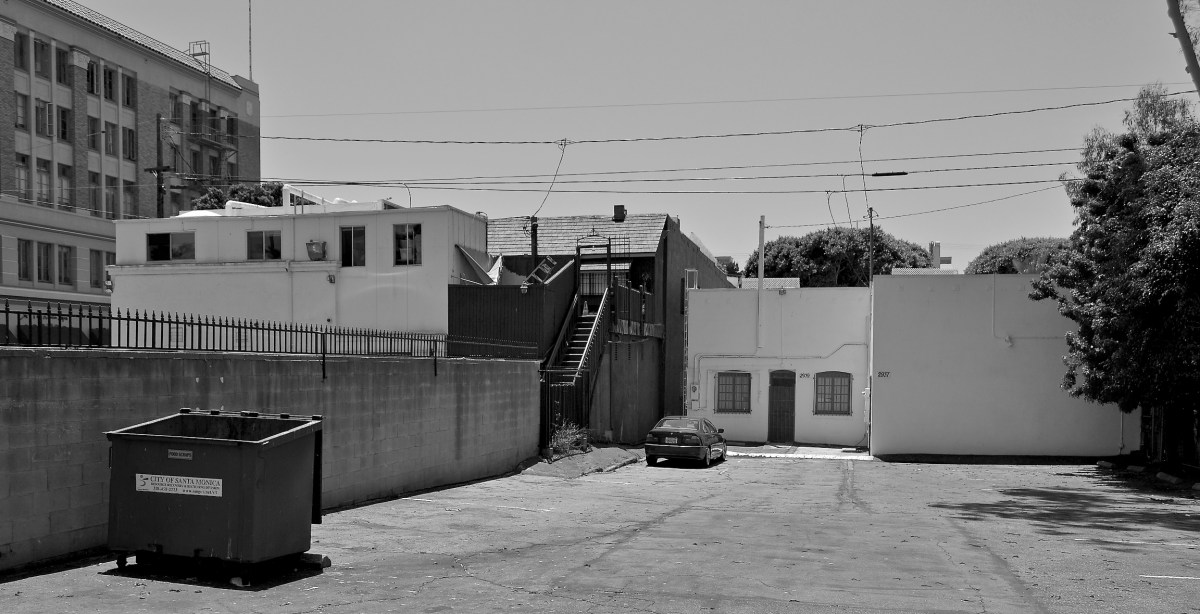
Louie’s Liquor


Louie’s Liquor, originally uploaded by Here in Van Nuys.

Sometimes it seems, driving at dusk, on Reseda and Saticoy Boulevards, there is a liquor store at every corner.

When the heat has broken, people come out of their cramped homes and walk the street in waning daylight.

They are the faces of the world: Latinos, Armenians, Blacks, Koreans, women in hijab pushing baby strollers.

Reseda at dusk is a crummy beautiful place, a land of liquor stores and Dodger billboards, tacos and lotto, Corona and Cerveza, check cashing, bottled water, Marlboro and ice and Western Union moneygram.

America on TV is a white family in a white house with a white picket fence.

But here in Reseda, packed into thousands of apartments and houses, are the teeming people who work all day and take a little walk at nightfall.

Somebodies and Nobodies.


7373935224_f78581f919_o

Adrian/Sepulveda Blvd., originally uploaded by Here in Van Nuys.

Excerpt from “Somebodies and Nobodies”my new short story about a poor athlete, fatherless and street smart, who escapes the California desert and comes to Santa Monica in search of glory and finds himself mixed up between a divorced couple whose failures and successes echo his own life.

“He imagined and wondered, trying to understand his blood-bursting passions. Who was buried deep within his DNA? Who came before him? Whose genes were his?

Sometimes he imagined himself descended from a warrior, other times: a convict, a poet, a dancer; a fighter, a general, a killer, a composer, an explorer, a ship captain, a priest.

He was born poor in the low desert east of Palm Springs, near the saguaro and sagebrush, to Tania Santos, a 19-year-old Mexican housekeeper from Durango, and El Paso born Grayson Waypole, a black man, a 22-year-old cook and expert marksman, dishonorably discharged from the Marines, who was said to be father to 30 children stretching from Indio to 29 Palms.

After Colton’s birth, Waypole went wayward.

Tania was migrant and undocumented. She dragged Colton up and down to all the stifling desert towns where the air is hot and life is hard.

She took a job with the Coachella Valley High School and worked as a cook in the school cafeteria, dumping vats of potato salad, franks and beans into steel trays.

Mother and son lived in a flat, pebble-roofed house on dusty Bagdad Avenue, a place where people parked their pickup trucks in dirt-covered front yards.”

“Somebodies and Nobodies”


An excerpt from my new short-story, “Somebodies and Nobodies”:

Parkour Hour


Colton drove his car into a back alley behind the Last Stop Bar.  He made a pillow out of his sweatpants and tried to fall asleep again.  His nocturnal mind raced with the excitement of that day’s rescue and heroism.

Unable to sleep at that blue hour, a time when food trucks make their deliveries and only rats and cops wander the streets, Colton drank black coffee, bit into a day-old rye bagel and got out of his car.

Along Main Street were rows of tightly packed, one-story buildings.  He picked one, grabbed a window security bar and hoisted himself up onto the roof.

There the young sentry stood, still bleary and sleepy, looking across dozens of dark rooftops. He rubbed his hands together, stretched out his legs and calves, and accelerated into an acrobatic sprint.

He ran and ran atop multiple roofs, rubber on tar, easily catapulting over skylights, over and around small protrusions, air-conditioning, water pipes and vents.

Packed with self-assurance, he dove across dozens of the little stores like an escaped felon, without falling or tripping, in grace and speed.


He landed back, hard, on top of the Last Stop Bar. He sat down on a milk crate to catch his breath.  Out of the darkness he heard a hoarse male voice.

“Hey you. Get down. I’ve got a gun in my hand and I’ll blast you!”

Colton disarmed doubt with deference, raised his hands up and stood warily and cautiously near the gutter. “Sir, I am just practicing. I’m not a criminal. I promise.”

Short Stories by Andy Hurvitz


It’s tough to write and tough to get others to read my short stories. 

I recently set out to challenge myself to write three short stories based upon the music of a composer whom I admire, the late Billy Strayhorn.

Somehow the songs from “Billy Strayhorn: Piano Passion” entered my sub-conscious and inspired me to write.  I listened to the music and let my imagination breathe.

In “A Flower is a Lovesome Thing” a peaceful gardener is taunted by a neighborhood thug, a small tale that involves the Armenian genocide and a young man’s death on the streets of Los Angeles.

“Something to Live For” takes us to Woodland Hills where a department store clerk, working in a dead end job, comes to idolize a rich, older, mysterious man with a tragic past.

“Lush Life” paints a story of a sour success, a Los Angeles decorator who seeks to ruin a rival by destroying and seducing the rival’s client, and, in the process degrading and demoralizing himself and others.

In my work, I again return to familiar themes of Western anomie and people adrift online and in life, searchers and artists and wanderers who yearn for approval and recognition but often end up shamed and despised.

There is a strong urge in America to build up and build out, but there is also a corollary force of self-destruction, manifested in our long working hours, obesity, and what Mencken called “our libido for the ugly”:  the billboard, fast-food, freeway and condo wasteland.

I won’t be so arrogant as to proclaim my fiction true, only to modestly state that I hope some truth is present in my writing.

I try to entertain and create and write something of value and artistry. It is a small pin on the map.

But I would rather start with a small diamond circle of integrity than create a large circle of lies encompassing the globe.

The dehumanized environment of sprawl, the mania for fame, the race for riches, the destruction of nature and the cheapening of life, the debasement of entertainment and the loss of privacy, these are some of the themes stamped onto my work.