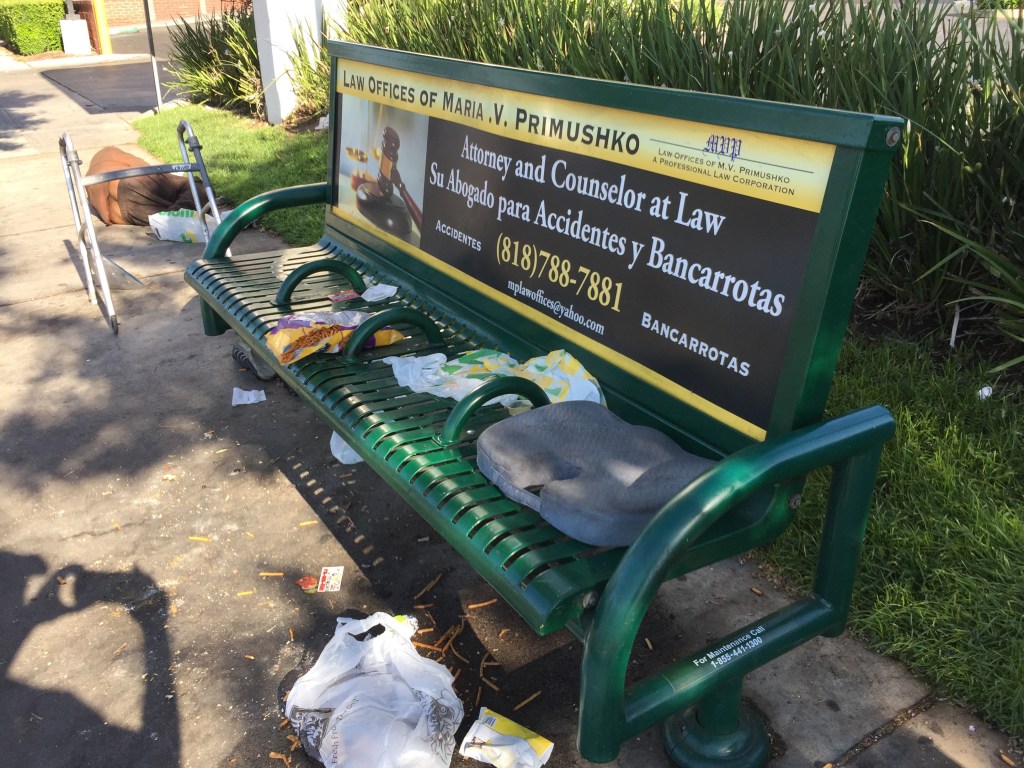
The Bus Bench


“Despite a growing population and a booming economy, the number of trips taken on Los Angeles County’s bus and rail network last year fell to the lowest level in more than a decade.

Passengers on Metropolitan Transportation Authority buses and trains took 397.5 million trips in 2017, a decline of 15% over five years. Metro’s workhorse bus system, which carries about three-quarters of the system’s passengers, has seen a drop of nearly 21%.”- Los Angeles Times, Jan. 25, 2018.


Let’s imagine a 62-year-old woman, Berta Gonzales, who lives in Van Nuys, near Victory and Sepulveda, who still works, as she has for the last 55 years, doing whatever she can to bring in cash for herself, her husband,  her two adult children and six grandchildren.

She works as a housekeeper, and she takes the #164 bus, every morning, at 7am, from Victory/Sepulveda to her job near Warner Center, a commute of 33 minutes.

When she gets off the bus in Woodland Hills, the temperature these days is around 80, but when she leaves her job, after cleaning bathrooms and vacuuming floors, doing laundry and dusting, around 2pm, the thermometer might be 110.

Last year she twisted her ankle when she slipped on a freshly mopped floor.  She hobbled around on a special shoe, using a crutch to walk, and she tried to stay off her feet if she could. She has no medical insurance, of course.

In the morning, when she waits for the bus, next to the bench without any sun protection, she is made to stand. Because there is a drunken, sick, filthy man sleeping on the bench, with all of his dirty clothes, his smell of urine, feces, body odor and beer, as well as half eaten and discarded food such as spaghetti, pizza, and empty alcoholic cans.

This is his spot. All the legitimate and necessary uses of the bus bench must be thrown out because his sickness and his selfishness, whether deliberate or accidental, is the most important thing catered to.

He has been here for months, if not years. Last year he fell down on the sidewalk and paramedics came to gurney him away. Then he came back for good.

This homeless person, multiplied by thousands, living on bus benches, is not an inducement for increasing bus ridership. Thousands of potential riders will see this lawless, unsanitary and unsafe barbarism all over LA and make up their minds to do anything to NOT TAKE A BUS.

Berta is like dozens, if not thousands of people who encounter this situation every single day. They are hard-workers, struggling to earn money, riding public transit as their well-meaning, liberal political servants wish them to do.

But put yourself in Berta Gonzales’s shoes and ask yourself: if you had a choice would you want to ride a Metro bus when this is the first sight you see every single morning?

Because Los Angeles does not enforce quality of life laws, there is a cascading affect impacting every other activity: traffic, air pollution, and longer commutes.

It is surprising that the plight of bus riders, many of whom are Latino, has not seized the identity politic podiums of those in city government who are always screaming loudest about injustices suffered by whatever is trending on Twitter that day.

Does grotesque, citywide neglect of sick people and working people and commuting people merit no outrage?

Who is responsible for keeping mentally ill people in dire need of treatment off bus benches and getting them into permanent hospitalization and shelter?

Who?

I know it’s not this blog.


Waiting for the Bus on Sepulveda


Bus Stop Crebelley, Vaud, Switzerland © 2013 Gerald Verdon
Bus Stop
Crebelley, Vaud, Switzerland
© 2013 Gerald Verdon

Later this year, friends and family from Zurich, Switzerland will visit here in Van Nuys. In that lovely nation public transport is dignified, clean, cheap and abundant. (see photo above)

The visitors will see Los Angeles with Swiss eyes, a city where trash sits on Sepulveda in both human and inhuman formations. Only Disneyland and Magic Mountain will come close to presenting an ideal city. That’s our American dream.

But for the bus riders who must wait in the sun, without protection, for 30 or 45 or 60 minutes, before a bus arrives, for these people trudging up to work at low paying jobs putting bagels into bags, or unloading boxes, imagine how their day starts before work?

Imagine they must sit here at the beginning and sometimes the end of their day. And think of what this says about Los Angeles, that our bus system is so neglected that people are treated no better than garbage.

What do Mayor Garcetti and Councilwoman Nury Martinez plan to do about this?

734 Bus at Sepulveda and Busway, Van Nuys, CA.  By Andy Hurvitz
734 Bus at Sepulveda and Busway, Van Nuys, CA. By Andy Hurvitz

IMG_2713

IMG_2714

In the Blistering Sun, Waiting for the Bus Next to the Gas Pumps


photo-1

photo

An elderly woman, waiting for a Metro Bus, is forced to seek shelter from the blistering sun next to the gas pumps at Vanowen and Sepulveda, breathing in fumes as she tries to avoid heat exhaustion.

Baking in the Sun, Waiting For the Bus.


Riders at METRO RAPID LINE 734 in Van Nuys.

Despite upgrades and vast physical improvements in buses, trains and modes of public transport in Los Angeles, there are still glaring and inhumane gaps in the Metro System that seem to be devised to torture and humiliate the people who ride them.

One of them is this garbage-filled, plastic bench waiting area at Metro’s Rapid Line #734 stop in Van Nuys near Oxnard and Sepulveda. It is a direct connection for riders who come from across the street off the Orange Line and intend to travel north on Sepulveda. Sometimes as many as 30 people stand here and wait, baking in the noxious Valley heat, next to a bench that can accommodate only three.

Out in the sun, out in the rain, riders stand; without overhead shelter or trees, in front of the oil soaked parking lot of Pet Boys, where cars inside service areas are treated better than humans standing outside.

To add insult to injury, most of the riders are dressed in all black, a hue which absorbs the most sunlight.