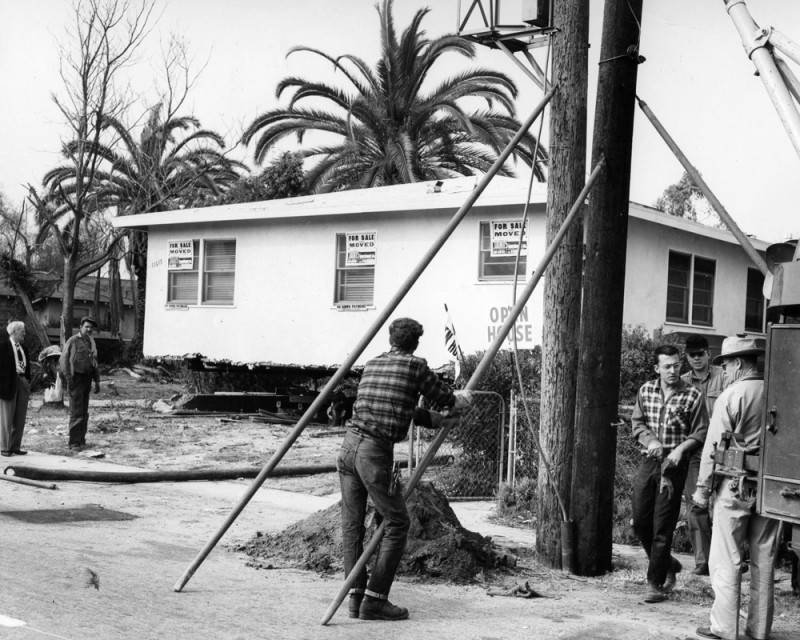
Clearing Away Parks and Houses for the Hollywood Freeway.


In the 1950s and early 60s, the expansion of the Ventura and Hollywood Freeways was accomplished by massive bulldozing of parks and houses.

North Hollywood, never rich in parkland, suffered the loss of some 20 acres of parkland to accommodate the construction of the 170 which today slices through and forms a new border between more affluent “Valley Village” and less wealthy North Hollywood.

It was cheaper to take parks than pay private property owners to seize land for the highways. Yet there were also many thousands of buildings moved or destroyed when California embarked on its mad program to make us completely dependent on motor vehicles.

Today we live in a reality that we think is normal but was paved and paid for by our elected ancestors. Car chases, global oil with wars and climate change, air pollution, shopping centers that took away orange groves, every five-minute traffic reports, the self-defeating obsession with oil prices, the decline of walking and the promotion of obesity are all linked in some way to the freeway system.

Our fervor to ride our cars to the Starbucks and drop our kids off at school, empowers Saudi Arabia, Russia, Iran. 

Our question for every apartment building and every house built in California: where will they park? Nothing architectural or aesthetic, nothing about the urgency of housing, only one thing on everyone’s minds:

Where will they park? Where will they park? Where will they park? Where will they park?

If by some miracle there was a proposal to build Rockefeller Center in the middle of a parking lot in Van Nuys behind rows of empty storefronts, there would still be only one question: where will they park?

We would rather live in environmental degradation than rethink our freeway and road addictions.

But in the 1950s every destructive program was considered an improvement.

Photo credits: LAPL/Valley Times.


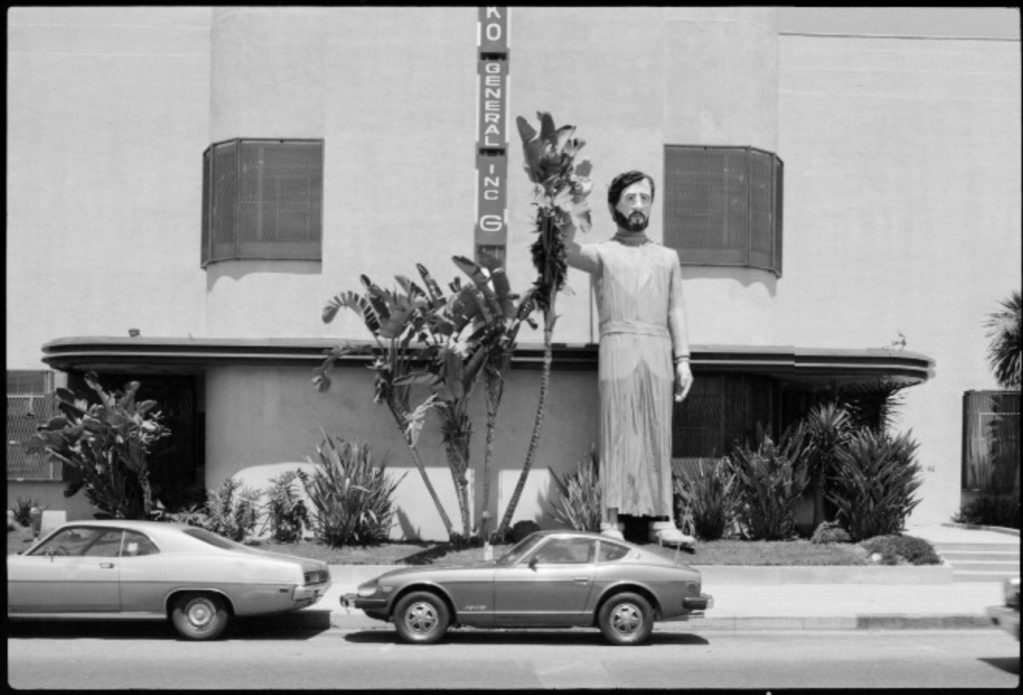
1975 Los Angeles by Ed Ruscha


The Getty has 45,856 digitized photographs of Los Angeles by Edward Ruscha.

I went to look at just a part of it, May 1975 (3,724 images). 

There are black and white photographs of entire stretches of streets in our city, for example every structure along Melrose Avenue for miles.

Many who possess far greater insights than I will concoct profundities about these pictures, connecting them to politics or music or the decline of the West.

They will project onto the photos whatever template of modern ideology they wish. 

But I think these photos just are. They are the exact thing they show. And that is what makes them brilliant. For they are the essence of Los Angeles, a homely and free place of ambition and anomie.

There is 3910 Melrose Avenue with a circa 1964 Pontiac parked in front of a 1920s Spanish Style house with arched windows, topiary and a cement walled lawn.

At 7168 Melrose there is a commercial building, with a 1960s decorative screen covering over a 1920s red tiled roof and stucco façade.

Most of the photographs juxtapose car and architecture. That is the recipe. It makes us long for youth, ache for what has passed, and imagine what it might be like to drive a ’74 Camaro down spotless Melrose, listening to a Doobie Brothers 8-Track, and stopping off to pick up a bag of gourmet Brazilian nuts at Iliffili.

Sex was open and advertised in 1975. Cock of the Walk had live sexy males in private rooms. It was next door to Madam’s Cat House with sexy girls in private rooms. If you messed up your clothes you could slip in quickly next door and change into a new pair of old jeans at Hollywood Used Clothing

Bundi’s at 8525 Melrose had stylish looking clothes. Just outside, a bus bench advertises the Jewish funeral services of Malinow Silverman.

Along 8650 Melrose, a 1969 Cadillac convertible, and a 1964 Chevy Impala coupe, are parked on the curb in front of several young, hip stores offering haircutting, needlework, a rock gallery, and Ruthe Lee Richman’s Art in Flowers.

A few doors down, Irving’s Coffee Shop served Pepsi-Cola. What kind of menu did they have ? Imagine your dining choices in 1975 Los Angeles, a 90% white city prior to the mass immigration and cuisines of Vietnamese, Filipino, Burmese, Persian, Haitian, Korean, Guatemalan, Honduran, Brazilian, Malaysian, and Sri Lankan peoples.

Imagine a city where so much was tolerated but where nobody lived under bridges or slept alongside freeways, and bus benches were used by bus riders.

Having trouble sleeping? Stop by International Water Beds. Writing letters to friends? Pick up some custom letterhead at Melrose Stationers. Is your cane chair falling apart? Frank Lew at 706 N. Orange Grove will repair it.

There are a lot of photos to look at. Like everything else these days we compare it to 2020. Even 2019 seems more like 1975 in the take-for-granted-liberties we had before the pandemic. 

And now we close with these lyrics:

Freedom’s just another word for nothin’ left to lose

Nothin’, don’t mean nothin’ hon’ if it ain’t free, no no

And, feelin’ good was easy, Lord, when he sang the blues

You know, feelin’ good was good enough for me

Good enough for me and my Bobby McGee[1]


[1] Kris Kristofferson-songwriter

Janis Joplin-singer

Van Nuys: City of Parking Lots


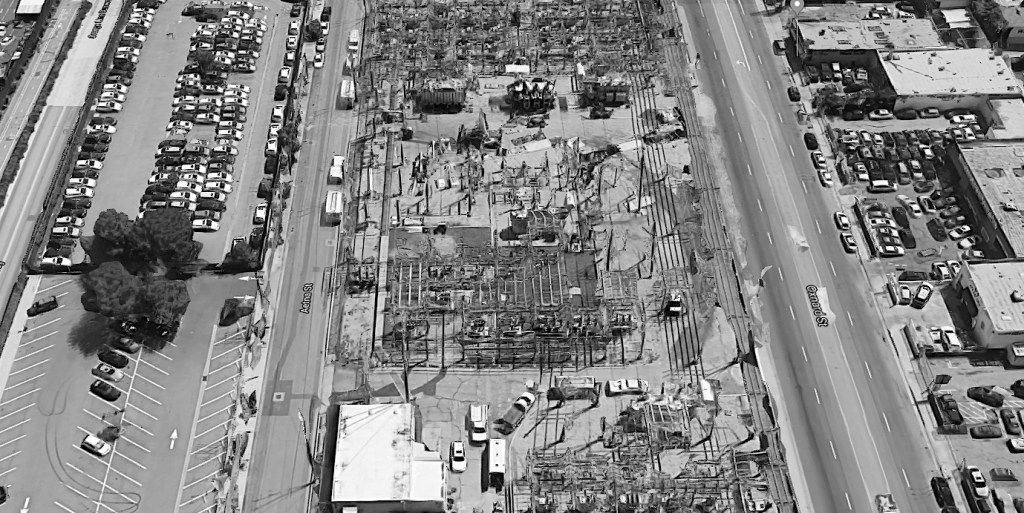
Between Oxnard and Vanowen, on either side of Van Nuys Bl. fully 75% of the land is taken up, not by buildings, but parking lots.

Near Oxnard, on both sides of the Busway, parking lots are used mostly for storage of unsold, new cars from nearby Keyes dealerships.

Along the civic center, there are enormously underused concrete parking lots, several stories high, built in the 1960s.

Civic Center Parking

Moving north, beyond Vanowen, near Kittridge, there are wide open parking lots behind shuttered businesses where perhaps 25% of the spaces available are used for cars.

Think about these parking lots when people complain that Van Nuys is too crowded, that we don’t have room for more apartments, that we don’t have space to house homeless persons, that we cannot find room for parks, that we simply don’t have land for urban gardens or nature spaces.

Think about these parking lots, see them in your head, when people complain that there is nowhere to park, that we spend too much time in traffic, that our air quality is low, that we are baking in a hot area where there are not enough trees even as the Earth warms.

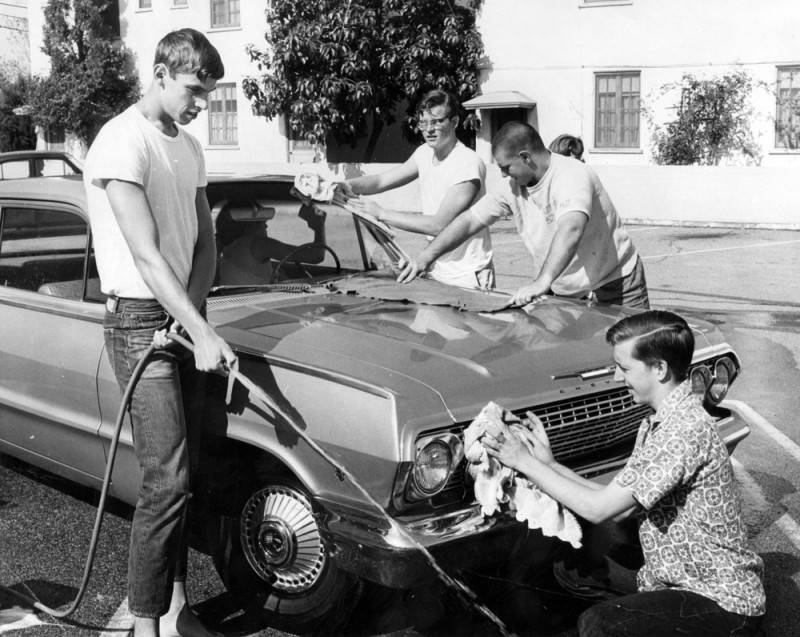
Vintage Car Washing: Los Angeles, CA.


The care, the compassion, the concern; the love, the affection, the authentic empathy for the automobile knows no bounds in Los Angeles. For here, the health and well-being of the car is of utmost concern to every red-blooded man, woman and child.

In our city, a neglected, dirty, abused, uncared for car is truly a moral crime, something that our citizens would not tolerate.

Since the car emigrated to Los Angeles, from France and Germany, early in the 20th Century, it has found a home here.  The sincere regard for all wandering vehicles has produced an outpouring of health care for all cars unrivaled by any civilized nation.  All races, creeds, religions, every poor and rich person, regards the vehicle as Their Supreme God.

And in every district of Los Angeles, outside of every school, restaurant, home, and hospital, the car is thought of first. Its needs are regarded before any triviality which might impede the happiness of the car.  Even when there are empty factories, abandoned malls, the car retains its parking lots. Even roads falling down, streets pockmarked by potholes, they are allowed to carry the car, because the supremacy of the auto goes before any other infrastructure needs.

When crazy buildings to house people are proposed by cowardly developers, the first question at community meetings is always the holiest and most sacred one:

“Where will they park?”  

No car ever goes without fuel, no car is ever without a parent looking after it, all precious water from our aqueducts is used to baptize and cleanse the car so that it can go on as the King of Los Angeles. Every drop of air we breathe, every sound we hear, every place we want to go, our car must come first.

Let the icebergs melt, let the polar bears and penguins die off, let 117 degrees become the new normal in Los Angeles, our car must continue to be our primary mode of life and liberty.

We know no other way. We will accept nothing less.

Following are some vintage car wash photos from the files of the LAPL:


Van Nuys Arts Festival


Last Friday Night Van Nuys was young, joyous and celebratory.

It gathered, under the spire of the Valley Municipal Building, to drink beer, watch live music, eat, and walk amidst motor vehicle works of art.

Police and fire personnel mingled with guests, in a display of civic pride.

The homeless were there too, seemingly taken care of, fed on their benches beside their belongings.

For one night, the pedestrian mall where nobody walks at night, a lost dystopia, was dressed up for a party. And Van Nuys, at its very heart, seemed to regain its footing as a good, decent, well-regarded town.


The Lost Art of Selling Auto Parts.


Back when Los Angeles was younger, at the dawn of the automobile age after World War I, tires, gasoline and cars were sold in buildings and displayed in a manner befitting a jewelry store.

Among the rich archives of the USC Digital Library, are photographs of local businesses, who put extraordinary artistry into their signage and architecture to draw in customers, while projecting an image of modernity attractive to the growing city.

Many of these photos come from the Dick Whittington Studio.