A Proposal to Build Angels Stadium in Van Nuys


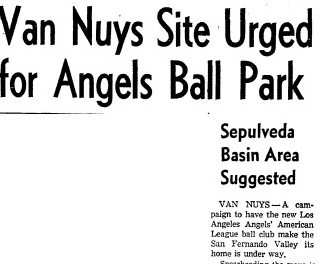
In December 1960, the Van Nuys Chamber of Commerce thought it would be a grand idea to have the recently conceived American League LA Angels play in a brand new stadium constructed right in Woodley Park Van Nuys. 

In the heart of flood basin. But conveniently located next to the 405 and the 101.

They wrote a telegram to club owners Gene Autry and Bob Reynolds imploring them to think about the “level and vacant” 100 acres “available for little or no cost” and adjacent right next to the just completed San Diego Freeway.

“We expect no local opposition to the plan,” said Nelson LaVally, secretary-manager of the chamber, confident that no families would object to the destruction of their local park.

There were two city-owned golf courses and a model airplane field. And the rest of the land “was leased out for agricultural use.”

LA Mayor Norris Poulson (R) supported the idea and liked the idea of a permanent home for the LA Angels in the heart of the largest park, flood zone and bird sanctuary in the San Fernando Valley. 

Councilman Patrick McGee (R) was also in favor of the idea of building a large 50,000 seat stadium with thousands of parking spaces in the middle of Woodley Park. He had given tours of the Sepulveda Basin a few years earlier to another LA ball club owner.

 “I made the same suggestion to Walter O’Malley and Del Webb and the NY Yankees before the Dodger contract was adopted,” Councilman McGee said. 

In 1958, McGee had vehemently opposed the Dodgers’ Chavez Ravine project (which displaced hundreds of Latino families) because it did not provide enough revenue to the city and would give oil revenues to a Dodger youth program, “spending public money for private individuals.”

The councilman thought the hotter valley weather more ideal. Most games would be played at night, and warmer temperatures in the SFV was appealing. Chavez Ravine and Wrigley Field in South LA were “20 degrees cooler”.

But the Angels ruled out the move. And the city’s Recreation and Park Department had other plans to add more 18-hole golf courses, tennis courts and several baseball diamonds.

Once again, visionary Van Nuys business minds and politicians came up with a shallow, ill-conceived and brilliantly self-destructive scheme that produced no results.

A pattern they would follow for the next 60 years. 

Color photos of Woodley Park: Credit to John Sequeira.

Option A: An Open Letter to Ms. Sheila Kuehl


“Sheila James Kuehl (born February 9, 1941) is an American politician and former child actor, currently the member of the Los Angeles County Board of Supervisors for the 3rd District. In 1994, she became the first openly gay California legislator and in 1997, she was the first woman to be named Speaker pro Tempore in California.[2] Kuehl most recently served as a Democratic member of the California State Senate, representing the 23rd district in Los Angeles County and parts of southern Ventura County. A former member of the California State Assembly, she was elected to the Senate in 2000 and served until December 2008. She was elected to her supervisorial post in 2014. In her capacity as Supervisor, she also sits on the Metro Board, First 5 LA, and is the County appointee to the South Coast Air Quality Management District.” – Wikipedia


Thursday, October 26, 2017

Metro Los Angeles Board

Re. Metro “Option A” Plan for Light Rail Yard in Van Nuys


Dear Board Members:

As you are aware, Metro Los Angeles is planning to erect a light rail service yard in Van Nuys. “Option A” is one of four sites proposed by the agency.

“Option A” would seize land NE of Kester and Oxnard, along four blocks, covering 33 acres, and demolish 186 buildings straddling the Orange Line Busway. For the purpose of this letter the area will be called “Kesterville.”

We are vehemently opposed to this plan. Here is why:


  • 186 small, family run businesses, employing an estimated 1,500 workers, occupying affordable, mostly rented space would be destroyed.
  • It would leave a gaping hole of emptiness blocks from downtown Van Nuys, obliterating plans for a denser, walkable area.
  • Option A will take out yet another engine of well-paying, highly skilled jobs and products, made in America, employing many immigrants and local residents.
  • It needlessly destroys a successful, close-knit pocket of creativity and commerce, manufacturing, and makers of unique goods and services found nowhere else in Los Angeles.
  • It will reduce fair priced, rentable industrial space in a city starved for it, in an area that is already served by public transport and contains more affordable housing.
  • Option A will subtract from the city what it is seeking to promote region wide: affordability, mobility, economic innovation, small business, local industry, ethnic diversity, and community cohesiveness.
  • The Van Nuys Neighborhood Council opposes Option A.


Within this dense, vital district are found a historic music recording studio, a maker of top quality metal hardware utilizing 3-D printers and advanced machinery, several fine custom cabinet builders and their craftsmen, an expert stained glass artisan whose work embellishes homes, churches and historic buildings, a restorer of Vespa motorbikes whose facility is the only one of its kind east of Pennsylvania, and a 20,000 SF shop where vintage Mustangs are serviced and restored. There are painters, carpenters, builders, and experts repairing racing boats, and several professional recording studios for musicians.

MacLeod Ale, a craft brewer of UK style ales, opened in 2014 and has become a highly successful and respected beer maker. They are located on Calvert St. adjacent to the Option A area.

Kesterville is a place of creativity, productivity, sustainability and viability. Organically, without government coercion or corporate ownership, it is an incubator of ideas and products. It has been alive for decades, growing more prosperous and doing well in the heart of the oldest part of the San Fernando Valley.

If Kesterville is destroyed, it will recall the most heartless obliterations in Los Angeles history: the razing of Chavez Ravine for Dodger Stadium, the flattening of historic Bunker Hill for corporate behemoths, and the bulldozing of West Adams for the Santa Monica Freeway.

Dodger Stadium, 1961. On land formerly housing poor Mexican families at Chavez Ravine.

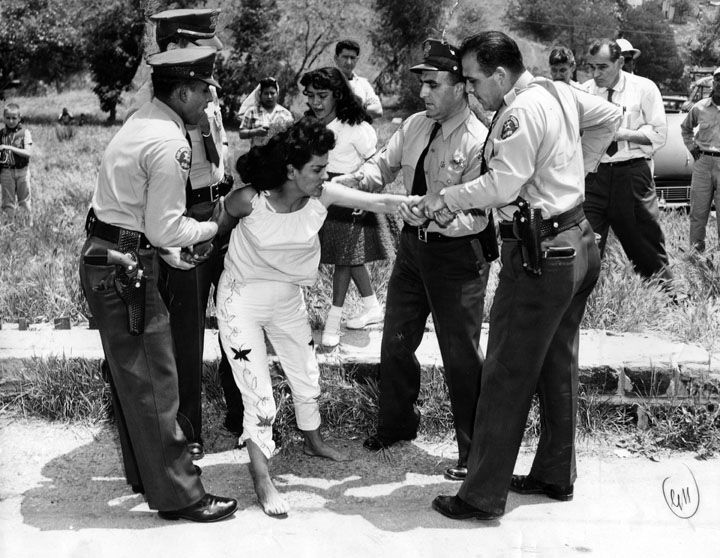
1959:Evictions from Chavez Ravine.

1959: Families are Forcibly Evicted from Chavez Ravine to Make Way for Dodger Stadium.

1935: Boys in Chavez Ravine

Van Nuys has already suffered social, economic and environmental neglect. Why compound the injury by robbing it of yet another burgeoning and blossoming area that could become a new district of small businesses, restaurants, cafes, and even urban, in-fill small housing?

We urge you to respond to this civic emergency by opposing “Option A” and the demolition and eviction of sound businesses that support many thousands of families struggling to survive in a brutal time of economic insecurity.

We are in favor of light rail, and public transportation in general, but ask that it be constructed with greater sensitivity to the community so that it is compatible within the urban landscape and causes the least amount of damage to communities within our city.

Sincerely,

The Business District of “Option A”

Van Nuys, CA

91411


Chavez Ravine: 1958


082658 07 11, originally uploaded by dboo.

Bostonian Nick DeWolf made a trip out here in 1958 and happened to capture this condemned house in Chavez Ravine. A poor, but close knit neighborhood was destroyed for the construction of Dodger Stadium.