A Twelve-Acre Parking Lot


Erwin at Sepulveda, Metro Orange Line Parking Lot.

When the Metro Orange Line opened in October 2005, it was a stunningly different type of transport system which combined a bus only road with a landscaped bike path that ran alongside. It cost about $325 million.

It connected North Hollywood with Woodland Hills, and eventually carried over 30,000 riders a day. Since 2015, due to Uber and Lyft, ridership has fallen to about 22,000 a day.

Hundreds of homeless encampments have sprung up on the bike trail.

But Metro forges ahead!

There are plans to create gated crossings at intersections to speed up bus travel. There are long-term ideas to convert the entire system to light rail and also build elevated bridges over Van Nuys Boulevard and Sepulveda.

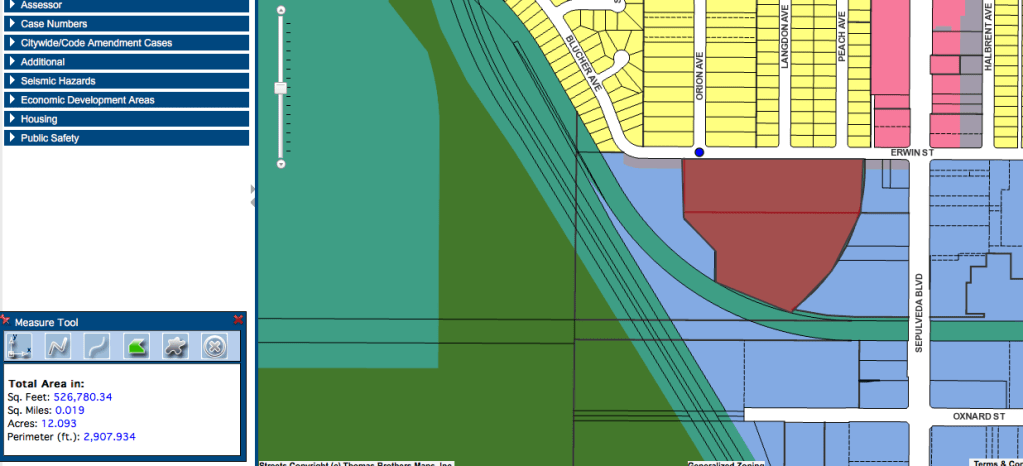
In Van Nuys, at Sepulveda and Erwin (north of Oxnard), there is a car parking lot for the Orange Line Metro riders. It is over 526,000 square feet, paved in asphalt, planted with trees and shrubs, and comprises over 12 acres.

Today, over 2/3 of it is used as an outdoor storage lot for Keyes Auto.

Red area is the parking lot of the Orange Line. It is now used predominately to store autos from Keyes Audi. (Source: ZIMAS)

The Sepuvleda/Erwin site is “Exhibit A” in the DNA of Los Angeles, because the right thing to do would be constructing 10-20 story apartments along the public transit route and creating incentives for residents to ride buses, take trains and use bikes for daily commuting.

Singapore Housing Estate with parks and nearby public transportation.

If LA were Singapore, Tokyo or Toronto we would do that.

Instead our city languishes and fights and wishes to preserve a 1950s idea of everyone going somewhere by car. 

And thousands of new cars are lovingly housed on land paid for by public taxes which should be used as housing and parks for the greater good of this city.

Nothing beneficial for Los Angeles ever happens overnight. It takes years of planning and legal battles, for example, to build assisted or low cost housing, or parks. 

One can imagine the fury and fear that might arise if a 12- acre park and housing development were planned on this parking lot ranch.

Imaginery view from Sepulveda and Erwin looking west. In reality, Singapore.

What, by miracle of God, might be possible here in terms of a park or high-rise group of apartments, placed near the bus line, with a buffer of trees, water features, and gardens between the new residential city and the single-family houses to the north of the site?

Yet here, alongside a public transit route, taxpayer funded Metro Los Angeles chooses to rent its land for an auto dealership. How does that benefit the surrounding residents?

For people who are obsessed with traffic, imagine that thousands of vehicles are parked here ready to be turned on and put onto the roads. How does that feel Van Nuys?

If the new planned housing estate were policed, regulated, secure, and it also provided a new park wouldn’t that be an improvement?

Orange Line Metro Parking Lot at Sepulveda/Erwin

Option A: Just Plain Places


This blog has written 13 other times on “Option A”, a Metro LA proposal by the public transportation agency to wipe out 33 acres of industry in Van Nuys, near the junction of Oxnard and Kester, and replace it with a light rail service yard. It would destroy 1,000 jobs, displace 186 businesses and flatten 58 buildings.

Though the scheme has been public knowledge since September 2017, property owners, workers, renters and the neighbors near here still stand on thin ice, awaiting official June 2018 word whether this whole district is sentenced to death, or if another site (B, C, or D), near the Metrolink tracks up on Raymer Street will be chosen instead.

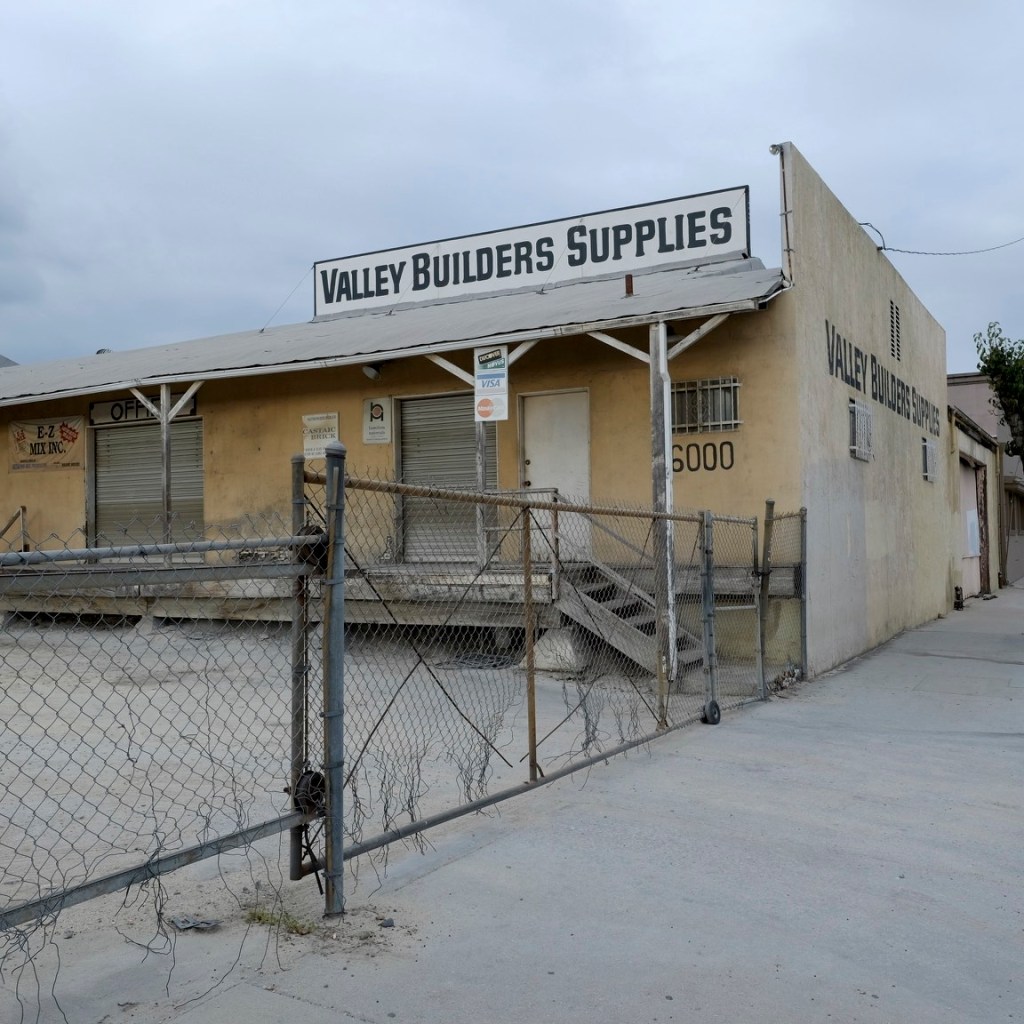
A photo walk around here yesterday, along Oxnard, Aetna, Bessemer and Calvert, to document some buildings that may be gone in a few years, was also an opportunity to show that this area has great potential beyond its current light industrial use.

In gravel yards, on cracked and broken asphalt, under decaying wood, on treeless, depopulated and narrow roads, there are ingredients for a nice urban area of some new housing, some new cafes, some places where trees, lighting, discreet signage and pavement of cobblestones could bring an infusion of 24/7, urban, walkable, bikeable activity to the neighborhood.

It is already an incubator of creativity with makers of exquisite decorative hardware, superb custom cabinetry, music recording studios, Vespa and Mustang restorers, stained glass makers, welders, boat builders, and kitchen designers. These businesses, incidentally, are staffed by mostly local owners and workers, many of whom are but minutes away, or take the bus or even walk to work.  Rents are currently affordable, often 50 cents, $1 or $2 a square foot.

MacLeod Ale, maker of fine British style beers, since 2014, is on the north side of Calvert and is not threatened with demolition but its existence and success is a testament to the potential for innovation in this area.

Ironically, the very wonderful addition of a landscaped bike path and the Metro Orange Line bus in 2005 is now threatening the area because of future conversion to a light rail system. Yet the “Option A” district is thriving, even if it is shabby in places, because it is a work zone of skilled, employed, productive people.

Politicians who often talk ad nauseum about “diversity”  should come here with mouths closed and observe men and women: Mexican, Armenian, Norwegian, German, Persian, Guatemalan, Salvadoran, Irish, Scottish, Israeli-Americans, all the hyphenations of ethnicity and gender, who don’t care about where anyone came from, but only about where they are going in life.

This is Los Angeles. This is diversity. This is economic prosperity. This is within walking distance of “downtown Van Nuys.”

Yet short-sighted officials, bureaucratic ignoramuses with grandiose titles, flush with public money, would consider wiping out the very type of neighborhood whose qualities are needed, wanted and venerated.

Option A must not happen. This is what it looks like now.

Imagine what it could look like with the right, guiding hands of investment, preservation, planning and protection.


SaveSaveSaveSave

SaveSave