SB 79 and Our Hood


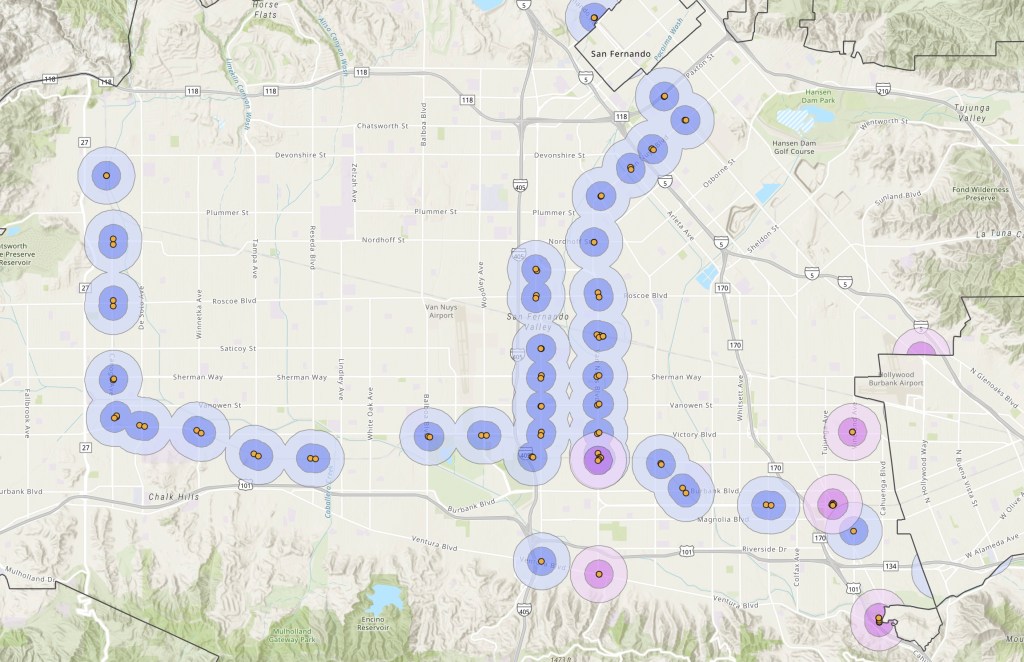
SB 79 is a new law, authored by State Senator Scott Wiener, approved by the legislature, and recently signed by Governor Gavin Newsom, to allow the state to overrule local zoning laws and permit the construction of multi-family housing on lots which are zoned for single family housing when these properties are within a half or quarter mile of a bus or light rail stop.

In Los Angeles, the law will allow much denser and higher development along not only wide boulevards, but inside old, intact, single-family streets, “side streets” which never had apartments or multi-unit housing.


A guide to the law along with maps is here.

Tiered density: The allowable height and density for projects are determined by the quality of the transit stop and the project’s proximity to it.

Tier 1: Applies to projects near high-frequency commuter rail or heavy rail transit, like BART and LA Metro.

Tier 2: Applies to projects near light rail and bus rapid transit lines.

Along Sepulveda and Van Nuys Boulevard the proposed zoning map looks like purple bullet holes that radiate from transit stops. These circles are centered around the transportation stops and take no consideration into the historic or local character of any neighborhood. 

For example, I live on Hamlin Street which is a “Tier 2” zone because we are within a ¼ of Sepulveda Boulevard bus stop. My street, built on old walnut orchards, from 1936 onwards, is lined with palm trees, and then curves along with oak trees. The street has two-hour parking because of its proximity to Van Nuys High School.

If the law succeeds, my section of Hamlin Street would allow 65-foot-high buildings (six and half stories).

But the part of Hamlin Street a few hundred feet east from me would remain single family.

West of Sepulveda, south of Victory, is the beautiful and often filmed Orion Avenue with large colonial style houses planted with rose bushes and ranch fences, the location for many commercials seeking “a typical American street” that doesn’t exist anymore. With SB 79, the east side of the street could be obliterated with apartments that destroy the very beauty residents and film makers pay dearly for.


Yesterday, I had a real life encounter of what Hamlin St. and other locations nearby could become when I parked my car near 3052 West Boulevard in the Jefferson Park neighborhood of Los Angeles, east of Culver City. I was there to visit a new, multi restaurant creation, Maydan Market.

This area was given an economic boost by the Expo Line, a light rail system that connects downtown with Santa Monica. The good parts are investment, cleaner streets, the lowering of crime and the raising of the cultural and civic activities. 

The ugly parts are the disfiguring, ad hoc apartments that pop up on formerly coherent streets of 1920s bungalows. My eyes hurt looking at 3045 West Boulevard, a black and gray box suspended over a cinderblock faced garage, with a massive four story high open-air staircase on the side of the building. It looms like a monster over the street, with no respect or sensitivity to the vernacular that had existed here for 90 years.

Am I a hypocrite for decrying liberalized zoning that will change my backyard? Yes, I am. Sort of.

This blog has argued for years for the construction of new, multi-family buildings to replace unused parking lots behind abandoned shopping centers, or where there is a sea of asphalt like the Orange Line parking area along Sepulveda which was constructed for thousands of vehicles and is now empty.  I have fought for the idea of an architectural, coherent, community wide style that would incorporate history and embrace modernism but do it without destroying but enhancing the community of Van Nuys. 

And I’ve always cast a cold, unforgiving, forensic eye on the political neglect of Van Nuys by elected officials who seem to always be performing social media acts of kindness for oppressed groups while neglecting the needs of residents in this district. 

There are commercial zones galore that cry out for taller residential buildings along the wide boulevards of Van Nuys and greater Los Angeles. The one-story tall shops with parking lots in front are so defunct and useless that their very presence destroys civilized life and endangers the health of pedestrians. 

There are blighted buildings, such as this one at 7101 Sepulveda, that have been empty for years, packed with derelicts, unable to be demolished, yet crying out for replacement. As a bitter pill, the residents in the tree lined, charming, quiet streets behind must now expect multi-family housing to replace their 1940s ranchettes.

What do our elected leaders in Sacramento do with the quandary of building more housing? They embrace a fantasy of destroying single family homes and backyards. 

Will your neighbors and you, the elderly couple in the corner house, desire to ride buses (with homeless, drug addicts, crime?) and come home, late at night, from a bus stop on Sepulveda, and enter a new world of yet more cars, loud music, marijuana, dumped mattresses, and YouTube/TikTok/OnlyFans influencers smoking on the balcony next door? I doubt it.

Is that the paradise of tomorrow? Circles on a map, purple splotches of political malfeasance, indicating nothing but more mayhem, disorder and chaos.

I hope I’m long gone, either from life or Van Nuys, before this happens. 

Culver City Awakened.


After a long hiatus, we ventured Sunday morning down to Culver City to walk around the new buildings and the architectural oddities.

Once a stronghold of flat, inland dullness, a largely white town peppered in a monotony of starter ranches and stucco apartments, barber shops, taco stands, model trains, gun stores, and typewriter repair shops, Culver City has undergone a two-decade long makeover into a town of light rail, bike and bus lanes, restaurants, lofts, luxury restaurants, furniture, art displays and wine bars.

29 is the median age for work, and 69 is the median age for owning a house. And everyone else of any age is welcome as long as you wear yoga pants and carry a small dog.

In the last two years, all the formerly open parking lots near the Expo Line have been filled in with large, modern architecture: residential and commercial.

The Helms Bakery area used to be the only area that imitated urbanity, but today we walked through it, and there were few pedestrians. But all the old furniture stores were open, and Father’s Office was getting ready for service. An electric bike was parked outside of the Kohler Store, a man and a woman conversed next to a fountain, and through my camera’s viewfinder 1930s Hollywood was alighted in 2022.

Washington Bl. is now a multi-use roadway with specific lanes for cars, buses, bikes and pedestrians, an oddity of our region that takes some mental and focal readjustment.

A thin, blond woman in mask carried a shopping bag and waited for the light to change near Shanti Hot Yoga (“We’re open again! 7 Days of Yoga for $7”).

On the corner of Washington and National, adjacent to the elevated rail, there were new buildings, each one different but not too different: modernism with steel, glass, angles, some wood and some plants, and strong, assertive street walls.

On National Blvd with its spotless sidewalks and young trees, we walked, tranquilized and medicated, by train sounds and light breezes. A paved bike path coexisted with a train that hummed down the tracks high up on a concrete overpass. 

Sunshine was rampant and inescapable.

We were the only pedestrians. 

I had that disembodied sensation one only finds in Los Angeles: isolation and excitement, boredom and anticipation, urban exploration in a landscape of sunshine and emptiness. 

At “Nike Corp – Extention Lab”, 3520 Schaefer St. steel girders and compressed lumber presented an incomplete cathedral of construction. The wood was blond and warm. The materials seemed ready to be pounced on by that shoe brand’s rubber sneakers.

We walked south one block to Hayden Avenue, to a junction of ugly brilliance: Samataur by Eric Owen Moss, the architect whose offices and deconstructed designs decorate the entire street.  

Before the pandemic I would have hated this discordant scene, but now I rejoiced, for the chained off tower and the accompanying office blocks survived intact: startling, grotesque; yet unique in their ambitious awfulness: empty parking lots, cinderblock walls, dark glass windows. 

And a sign called “Clutter.” Without any.

These are the workhouses for young, multi-cultural creatives of dazzling imaginations whose languages are only taught at MIT or art colleges. I’m sure these well-compensated bees have worked on my brain many times as I play video games or buy a bottle of gin with the most gorgeous and award-winning fonts, or scroll through Netflix. They are all 29, tall, and play frisbee on the roof and bring their dogs to walk and I really do hate them all. 

They work for companies where Tyler, Dylan, Ashley and Rebecca, must list their preferred pronouns after their names and every company has a mission statement that begins with “we believe every human being has the right to…”

On the west side of Hayden, 3535 is another Eric Owen Moss, a multi-story stucco structure from 1997 with protruding supports that fly out of the building, angled walls angled for entertainment. Everything is decorative irony, not form follows function, but form for forms sake. Tenants are graphic design and media companies. This is a perfect setting for sons-of-bitches startups, Tesla influencers, wellness lubricants, Armani jackets and collectible sneakers.

At 3585 was Sidlee. This conglomeration was perhaps the most interesting of all the oddities along Hayden Avenue. 

The company, which describes itself in the most inscrutable and amorphous ways[1] has seemingly vacated this arrangement of forms and textures scattered along a parking lot like a museum of sculptures. 

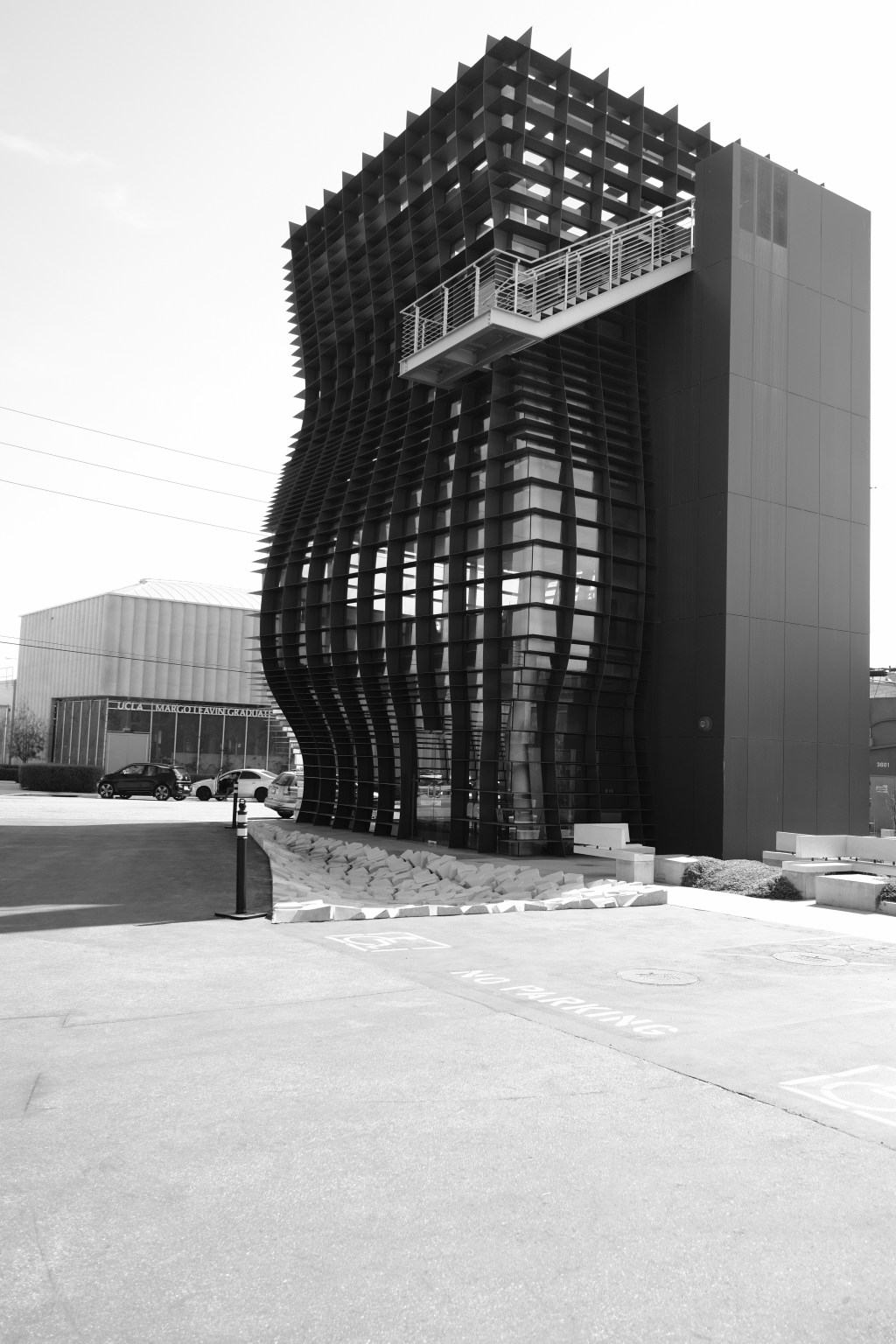
Vespertine, (dinner for two: $650) a luxury restaurant of museum like dishes, was the tenant of a tall glass building encased in protruding, undulating sheets of horizontal and vertical steel. It was built next to a river of concrete rocks like a dry stream; nearby, a four-story tall steel tower sculpture supported rows of steel cactuses in steel pots suspended 40 feet in the air; a concrete park was furnished with cushy concrete seats and shaded by shaved down cats tails. 

If the ghosts of director Michelangelo Antonioni, and actors Monica Vitti, and her still living co-star Alain Delon came to film a sequel to “L’Ecclisse” (1962) this would be their location.

Another strange fact of 2022 was the absence of security guards. I could walk up to any building and take photos. This was impossible from exactly September 22, 2001 to March 20, 2020, when Fear of Arab Terror was replaced by Fear of Invisible Virus

There were signs everywhere for masks and Black Lives Matter, and everywhere I looked I knew I was living in the here and now of 2022, poised somewhere between the past and the present, never quite certain of reality, but walking in it every step of the way.

END


[1] “Deep-rooted in the United States since 2012, Sid Lee Los Angeles has become a thought-leading hot shop for the country’s most iconic brands. With an extensive network reaching all the way to New York, our L.A. team delivers work that matters for a global clientele. This multi-faceted team at the epicenter of content and innovation offers fully integrated solutions supported by the weight of Sid Lee’s global collective.”

The Nowhere City Goes Somewhere


DSCF1002

Yesterday, near downtown Santa Monica, on a strangely cloudy and drizzly summer morning, I drove west, unintentionally, into blocked roads, past barriers and bulldozers.

Men were tearing down buildings, punching holes in plate glass windows and digging trenches.

The long winding humanitarian project known as the Expo Line had made its way from central Los Angeles, sweeping through Culver City, catapulting by bridge and track into West Los Angeles and finding itself and its destination next to the Pacific.

DSCF1014


DSCF1001 copy

The empty shell of Midas, a beautiful Spanish Revival structure, lay in ruins, a stomach full of bricks and wood, its ornate ornament ready for obliteration.

50 years ago, the novelist Alison Lurie wrote a novel, “The Nowhere City” set in some places along the soon-to-be-demolished houses in the path of the Santa Monica Freeway.

Yesterday, near downtown Santa Monica, I saw the sequel to that book.

After half a century, the Nowhere City Goes Somewhere: on foot and bike and rail.

DSCF1011


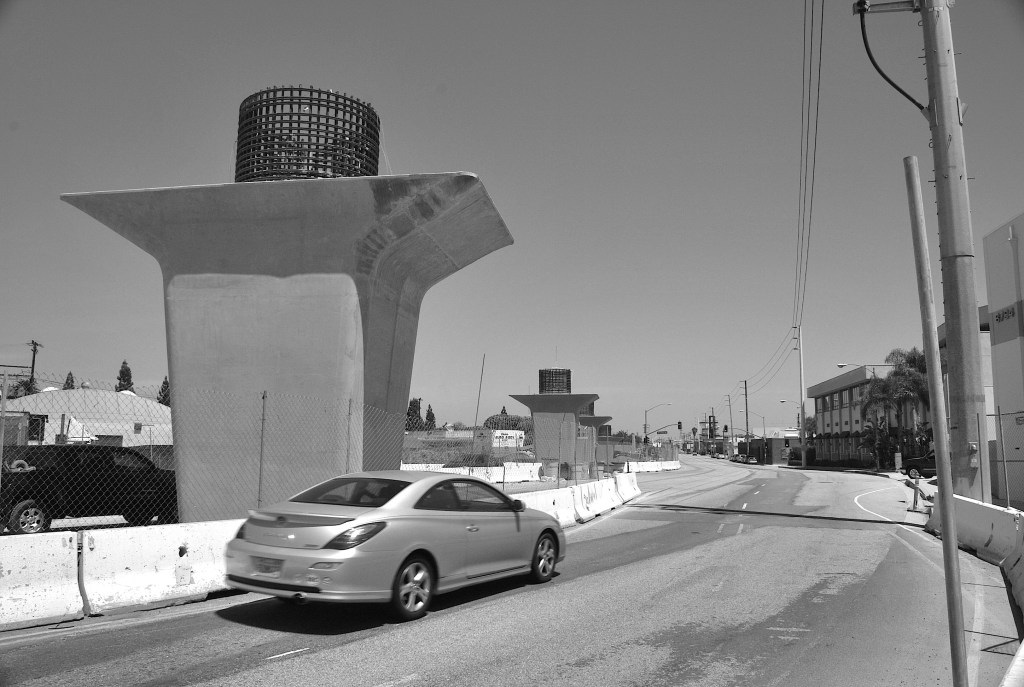
Expo Train Construction in Culver City, CA.


The “Hayden Tract” neighborhood of Culver City. National near Washington Blvd.  The construction of the Expo Train. has provided a boon to this area and will provide a new alternative way of life to this section of LA.