The Fire Last Time


______________________________________________________________________________

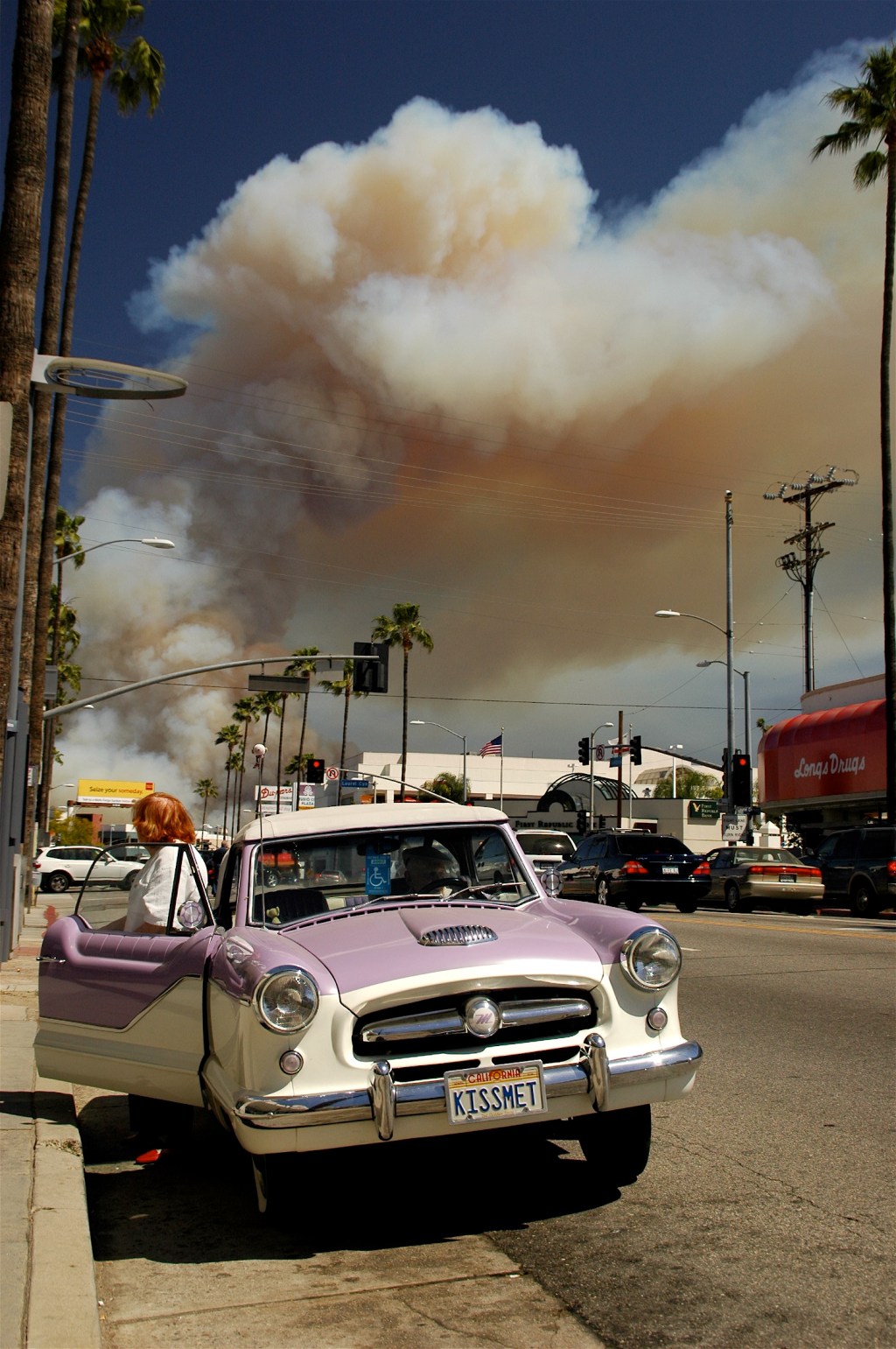
On March 30, 2007 there was a fire burning in Griffith Park.

And I was walking in Studio City when a red-haired woman drove up and parked on Ventura Bl. in an odd little purple car, a Nash Rambler. Her license plate read “Kissmet.” I’m sure she is someone, or was someone, quite beloved, judging by her car and plate.

Yesterday, 13.7 years later, there was another fire burning above Warner Brothers Studio near Barham. And the same atomic plume of smoke went up in the sky and theatrically filled up the space between the rows of palm trees along Ventura Boulevard.

There was no Nash Rambler in yesterday’s photograph, and by comparison, in content and style, the new image is quite unexciting and unremarkable.

When fire threatens Los Angeles, the first thing we think of is our loved ones, and then our homes, and lastly our cars.  

Or perhaps it’s the reverse.

Panorama of Possibilities.


Down on the streets, LA is a mess, a tent city of encampments, trash, shopping carts, RVs and civic disorder.

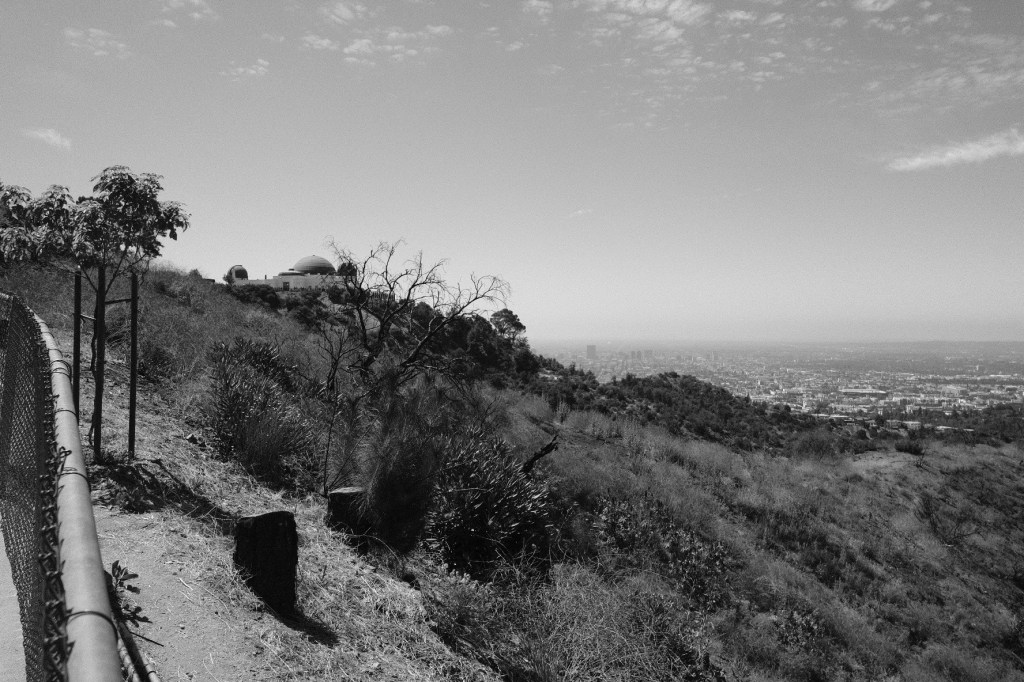
But on the way up the trail to Griffith Observatory, the city assumes its old panorama of possibilities.

Filtered out of these photographs are the humans and their rulers who make this city so perplexing.

Here is the white cloud sky, the one lone palm on the hill, the pine tree, the arid and rocky slope descent, the dome of an Art Deco landmark, the white buildings in the distance, the hiking trails, the Hollywood sign, the graceful Grecian frieze on the cylindrical tower of the observatory.

Here is Los Angeles aspiring to a vision of grace, aesthetics, science and civic ennoblement. 

Here is where the young visit vowing to move to start their adulthood. They’ll stand along these vistas and dream of tomorrow. 

“Just wait, you’ll see, I’m going to make it!”

Griffith Park, Griffith Observatory,“Rebel Without a Cause,” James Dean and Natalie Wood, Hollywood Stars; and the stars in the sky: Sirius, Canopus, Arcturus, Alpha Centauri. 

Look back, look down, look up, look out. 

Griffith Observatory was finished in 1935, in the midst of the Great Depression.

Think of that year, 1935: thin in resources, rich in imagination, practical in execution.

That’s why this was all built, not only Griffith Observatory, but the entire project called the City of Los Angeles.

Down on the streets, LA is without leaders, a tent city of encampments, trash, shopping carts, RVs and civic disorder.

But up here are found the better angels of the City of Angels.

Observations Atop the 134 Bridge After the Storm.


LA River/Griffith Park

After many days of successive, concussive waves of rain swirling into Los Angeles, the hills in Griffith Park were wet, green, and soaked.

I walked there, yesterday afternoon, along the bike path, and the bridle path, at the point where the 134 roars alongside the LA River.

LA River/Griffith Park griffith-park-after-rain-6

The storm, now depleted, had moved east, sent into exile. And in the distance, under dark clouds, I saw the Verdugo Mountains, the flat roofed towers of Glendale, and all the man-made highways and power lines: showered and renewed, glistening and spot lighted by sun.

The littered homeless encampment on the island in the middle of the river was vacated. There was nobody else around but me, except for a lone man riding a child’s bike.

griffith-park-after-rain-2

A bridge over the waters and the freeway, a bridge under construction, its metal rods exposed, a messy conglomeration of concrete, lumber, fencing and plywood, that incomplete, torn-up bridge evoked others before her time destroyed by floods.

Angelenos in the 1930s and before lived in fear of the river and put their hope in President Roosevelt. Now we trust the river and fear our president.

Once we trembled under the fury of nature. Now we shudder under the drama of political malfeasance.

After 1940, the army conquered the unpredictable river, contained its fast water, and controlled its deadly fury.

Tomorrow, we trust, we hope, will fold out and reveal itself as it did in Genesis.

“Now the springs of the deep and the floodgates of the heavens had been closed, and the rain had stopped falling from the sky. The water receded steadily from the earth. And God said

never again will I destroy all living creatures, as I have done.

 “As long as the earth endures,

seedtime and harvest,

cold and heat,

summer and winter,

day and night

will never cease.”

LA River/Griffith Park

A Quiet Enclave


DSCF0020

There’s a little area of Glendale or east Burbank or whatever you want to call it, a quiet neighborhood nestled into the confluence of Griffith Park, Victory Blvd, and Riverside Drive.

Old, snug, shaded, smelling of horse and hay, hit with the low, dull roar of the nearby 134, its winding houses and cottages are silent, eccentric, redolent of the old Western town, and completely out of tune with the flash, bang and sprawl city of Los Angeles.

I’m drawn back here. Especially on days like yesterday when the skies were dark, and gray clouds spread over the San Gabriels in a convincing display of more ominous meteorological conditions.

It was cool and autumnal when I turned up Winchester Avenue and parked near Riverside.

Hidden in the crook, under large trees, I found a sprawling, two-story high, hacienda apartment with a red tiled roof, white painted brick and a lush green lawn obliviously and joyfully unworried by drought. Adirondack chairs, twig chairs, plastic chairs, and a barbecue threw off an impression of eternal leisure and life without worry. A 1965 Turquoise Chevy Chevelle sat on the driveway: as if yesterday was still today and what was old was still young.

California, up until about 1960, built apartments that looked like well-to-do homes. You might live here poor, work as a waiter, scrape by on next-to-nothing, but you were surrounded and intoxicated with hope and dreams and a stage set of domestic happiness. Your aspirations were given to you the moment you arrived at Union Station. Only later did you realize they would be taken away.

DSCF0017

IMG_7672 IMG_7671


DSCF0026 DSCF0035 DSCF0041 DSCF0046 DSCF0052 DSCF0057

The streets are clean in Burbank and Glendale, often spotless.

Coming from Van Nuys, which gives a social excuse to every ill around us, it is remarkable that Burbank and Glendale are run so seemingly well, with a presentable public face that is simultaneously progressive and traditional.

Streets are swept. Windows are washed. Alleys are paved. Walls have no tags or markings. There are no shopping carts of clothes tied to trees. There are no tent cities of the dispossessed under the overhangs of buildings.

DSCF0027


Processed with VSCOcam with q2 preset

IMG_7666

And there are many small motels here. But I didn’t see prostitutes and pimps and hookers and johns and the sex community walking along Victory in Glendale.

Maybe the laws are tougher here. Maybe the police and the courts and the residents work together. Whatever they are doing here they are not doing on Sepulveda Boulevard.

At a public safety meeting last week in Van Nuys, held jointly by Councilwoman Nury Martinez and LAPD Chief Charlie Beck, the issue of homelessness came up. Ms. Martinez spoke to a resident complaining that public sidewalks are now taken up with the private possessions of individuals. The Councilwoman said the courts had sided with the people who tie their shopping carts to trees and put up tents in the alley. “You can’t haul away their belongings.”

Legally, the illegal is legal.

And that is the way the new world works. What would have been unimaginable in 1945, 1955 or 1965 is tolerable today because everyone knows that toleration—not the law—is the highest principle liberalism can aspire to.

The inhumanity and injustice of allowing people to live on sidewalks and eat trash and set up tents anywhere, that must be tolerated because “we are understanding.”

Maybe it would be inconvenient for him, but Mayor Garcetti should allot some time in his schedule to drive way out to Glendale from LA City Hall and contemplate what they are doing that provides some space for civilization and contemplation that is missing in much of the San Fernando Valley and greater Los Angeles.

IMG_7669

Oblivious to the Fire.


Oblivious/ March 30, 2007

In shooting the fire yesterday, I have to admit that 9/11 was not far from my mind. I thought of the contrast of normality v. disaster as in this image.

Fire in Griffith Park.


View near Carpenter/Ventura, Studio City, CA. 3/30/07
View near Carpenter/Ventura, Studio City, CA.
3/30/07

Andrea A. and Phil C., originally uploaded by hereinvannuys.

A cataclysmic scene of disaster in which nobody was killed or injured. Just like on TV.