Pandemic Innovations.


With the pandemic locking the world down until a cure is found, Los Angeles is again leading the way to find out how to do business and stay safe.

Here are some new innovations which are startling in their modernity and imaginativeness:


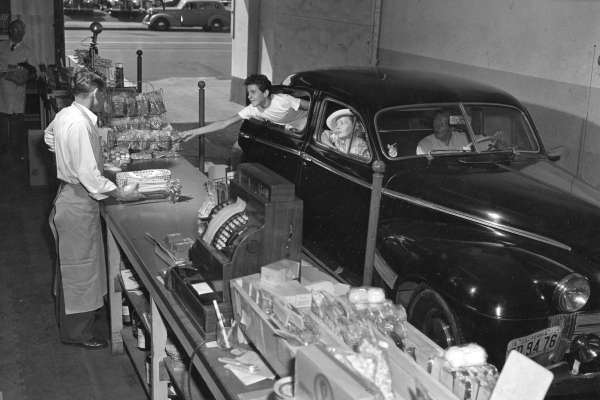
To keep patrons safe, many restaurants are now offering service directly to your vehicle by servers who are now called “carhops.”

To keep customers safe at home, many companies are now delivering food and beverages directly to homes.

The virus is less likely to be spread outdoors than in confined, indoor spaces. With that in mind, many buses in Los Angeles now offer open windows and open air transportation to riders.

The danger of pumping gas, of putting your hands on a surface touched by hundreds of strangers, is one reason why service station attendants have again been added at many locations. With unemployment rising, pumping gas has eagerly become one of the most sought after careers in Los Angeles in the Covid Era.

And lastly, instead of cramming into a closed store with hundreds of other contaminated people, why not put the produce out on the sidewalk where there is less chance of standing near a sneezer or cougher? Sunlight is a natural purifier of the virus too.

Glorious California: Some Photographs from UCLA’s Bartlett Collection.


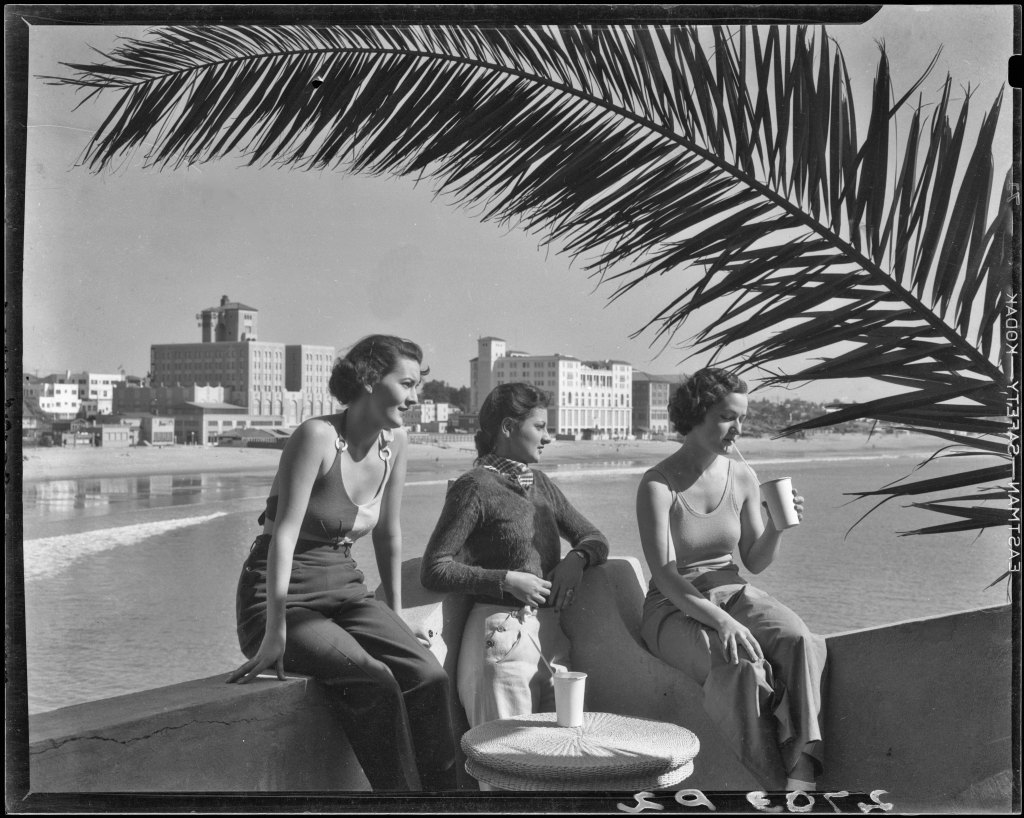
UCLA’s Adelbert Bartlett Collection has superb, hi-resolution images from the work of a commercial photographer who lived from 1887-1966 and worked in Southern California in the 1920s through the 1960s.

It was a time when this state was considered the pinnacle of glory, a place where aviators, sportsmen, golfers, movie stars, and athletes played and worked in brilliant sunshine under smog-free skies; swimming, water skiing, boating and hiking through deserts, mountains and parks.

As we endure cataclysmic natural disasters and allow unnatural disasters, such as homelessness, to overtake our state, we have to look back to how the Golden State operated when economic conditions were truly bleak.

We have brought ourselves, by our own powers, to a time and place of our own creation, and our California is a product of our human strengths and weaknesses, a society which can go up or down, in a natural environment which is now turning deadly as it is heated up by carbon.

Way before people understood that our planet might perish by our own hand and not God’s, California took stock of its good fortune and erected a real place out of fantasy.

How did such phenomenal architecture, science, sports and innovation happen here in the early and mid 20th Century? What can we do to restore the optimism and leadership that once made California the envy of the entire world?

Can we bring back the pristine, polished, glimmering, spotless world that once existed?

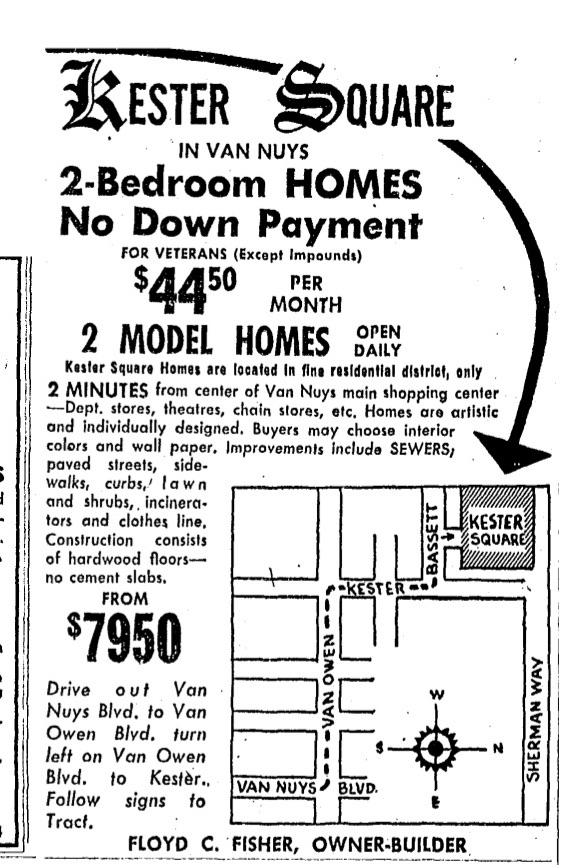
Kester Square: Bassett St/1950


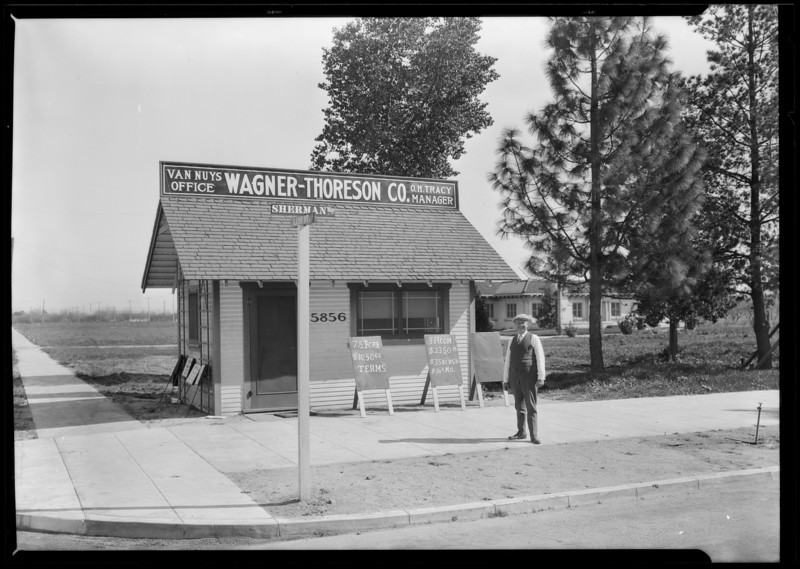
With no down payment, for $44.50 a month, you could buy a brand new, 2 bedroom, 1 bath home in Van Nuys in 1950 starting at $7,950.00 ($83,033.63 today).

Kester Square, a little pocket of 37 new single-family residences, was quickly erected in a few months and planted on old farmland just steps from Kester and Vanowen.

The San Fernando Valley was booming five years after the end of WWII and every smoking factory, every plan to build thousands of little houses on every square inch of land, and the daily, hourly pouring down of asphalt over millions of bulldozed walnut and orange groves was a continual occasion for rejoicing.

In Kester Square, new sewers, paved streets, sidewalks, curbs, lawns and shrubs, along with clothes lines and a backyard incinerator made life very instantly suburban ideal. There was no environmental review, just men in suits with money buying up land and building everywhere.

5/21/50 LA Times

Van Nuys Boulevard, “2 minutes away” from Kester Square, still had chain stores, restaurants, theaters and diagonal parking. It’s ruination, starting with street widening, began in 1955 and it has been on its death bed ever since.

Circa 1950.
1953 Van Nuys Boulevard.

Today when you drive down Bassett St., just west of Kester, a few blocks north of Vanowen, you still encounter a neat, tidy, small home pocket of pleasant houses. The general non-affluence of the area acts as a preservation tool because nobody can afford to or make money tearing down houses and replacing them with oversized uglies.

You would not dare venture out at night to stroll down Kester to Vanowen, but if you stayed home, or went out into your yard, front or back, you would still have a nice place to live, almost 70 years after Floyd C. Fisher, owner-builder, built a couple thousand homes for white veterans and their families.

Vanowen near Kester. Housing in Van Nuys, CA/ 2007.
5 7 1950 LA Times

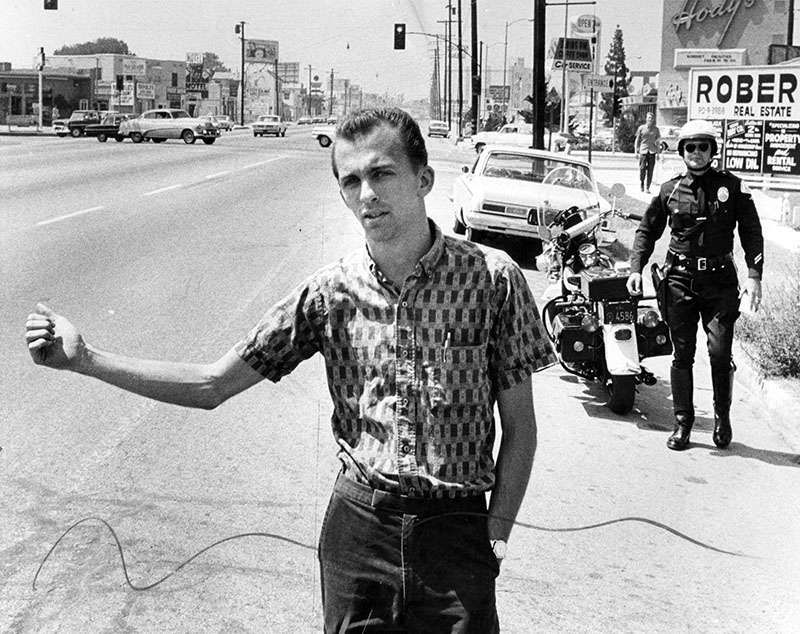
1963: LAPD Warns Hitchhikers of Predatory Homosexuals.


“Photograph article dated July 18, 1963 partially reads, “Valley police have been issuing citations in recent months to teen-agers who hitchhike up and down Van Nuys Blvd. The department is worried because several Valley youths have been the victims of homosexuals who pick them up and refuse to let them out of the car. Capt. Hagan pointed out that hitchhiking is against the law when it is done on freeways or any roadway where the hitchhiker walks out and stands in the roadway. The hitchhiker, however, is within the law if he stays on the sidewalk.” Motor Officer J. E. Nibes is about to tell Jeff Sillifant, North Hollywood, that he’s breaking the law. ”


Vanowen and Laurel Canyon: 1931


Bossout_case_intersection_of_Vanowen_Street__Laurel_Canyon_Boulevard_Southern_California_1931_image_1 Bossout_case_intersection_of_Vanowen_Street__Laurel_Canyon_Boulevard_Southern_California_1931_image_5

From the archives of USC comes these fascinating (Dick Whittington Studio) photos of Vanowen and Laurel Canyon Blvds. in 1931.

What might have become of the vast and verdant emptiness had it been developed with a plan, or a vision, beyond that of buyer and seller and developer?

It would be an intersection harmonious, civilized, aesthetic and humane.

Instead, it is today a monstrous urban carbuncle of cheap, ignorant, lowdown, poisonous ugliness; billboards, traffic, crime, and junk food bake under hot skies and treeless hell.

This lost place wears a name tag provided by the billboard: ignorance.

screenshot_371


Historic Van Nuys: Katherine Avenue and Vicinity


screenshot_366 DSCF0070 DSCF0048 DSCF0047 DSCF0046

Is Van Nuys, as some believe, a hopelessly hellish place beyond redemption?

Perhaps not.

Hidden just east of Van Nuys Boulevard, south of Vanowen, is a secret garden neighborhood of historic houses, quaint architecture and lovely homes. Katherine Avenue is the heart of it, and it has a landscaped traffic circle, a construct of such ingeniousness and calmness that it is a wonder that it is not used everywhere.  Shadier, slower moving, safer, the neighborhood could almost pass for Pasadena.

Along Katherine, and down Kittridge, there are many old houses, some dating back to the early 20th Century, with large gardens and an eclectic bunch of styles: Mission, Spanish, Wooden. Many fly the American Flag on a front porch, a marker of civility, pride and patriotism signaling that our best hope for America begins at home.

Writer and comedian Sandra Tsing-Loh lived here for a few years and wrote a satirical novel about her experience: “A Year in Van Nuys”.  Unfortunately, her humor was less remembered than her brutal depiction of the suffering of having to live in Van Nuys. 14132 Kittridge 14127 Kittridge


Walking this neighborhood I found a Mid-20th Century apartment building on the corner of Katherine and Vanowen which had been stylishly and subtly updated with a good-looking wood and iron security gate. Roofline edging was added, smartly and economically emphasizing dark horizontal strips of wood.  The whole place was neat and well-maintained with an aura of Japan. DSCF0055 DSCF0054 DSCF0053


There are also ugly new projects (14310 Vanowen) that some call improvements, including a gross trend, seen around these parts, of painting plain buildings in burgundy and gold, pasting thin stone veneers on walls and the lower parts of structures, and dropping decorative lanterns into the mix. Security lights are on all night illuminating a deluxe prison. I wrote about this trend last year at another desecration: Kester Palace. DSCF0039 14306 Vanowen


DSCF0011 DSCF0014

Again, what is missing in Ms. Nury Martinez’s Sixth District are big investment and big plans. There is gridlock in Van Nuys because the people who live here are not making enough noise. They are not demanding that their community go in a better direction. The passivity of the area is understandable as many who live here are just surviving and trying to get by. But what about the larger city of Los Angeles and the re-development of the San Fernando Valley? Must it be done so poorly and so haphazardly? How many more years will Van Nuys sit with its empty stores, empty parking lots, filthy sidewalks, and battered down signs?

Mayor Garcetti and Councilwoman Nury Martinez will no doubt be attending LA River clean-ups and “pride” events but will they be building the buildings and businesses in an architectural and civic plan worthy of a “great”city? Will the city which counts among its citizens the wealthiest celebrities in the world say it has no money?

If you walk, as I did, along the better parts of Van Nuys, you will learn that there are people and places worth saving. The powers that be must recognize it.