The Trump Re-Election Campaign in Los Angeles.


On foot to LA Fitness on Sepulveda this morning, I passed Wendy’s near Erwin. 

It was about 7:30 AM, and the restaurant wasn’t opened yet. There were no cars in the takeout lane. 

But there, in the alley, sitting along the curb, across from the takeout window, was an old woman squatting and peeing. Her urine came out and ran down towards the sidewalk. I just kept walking.

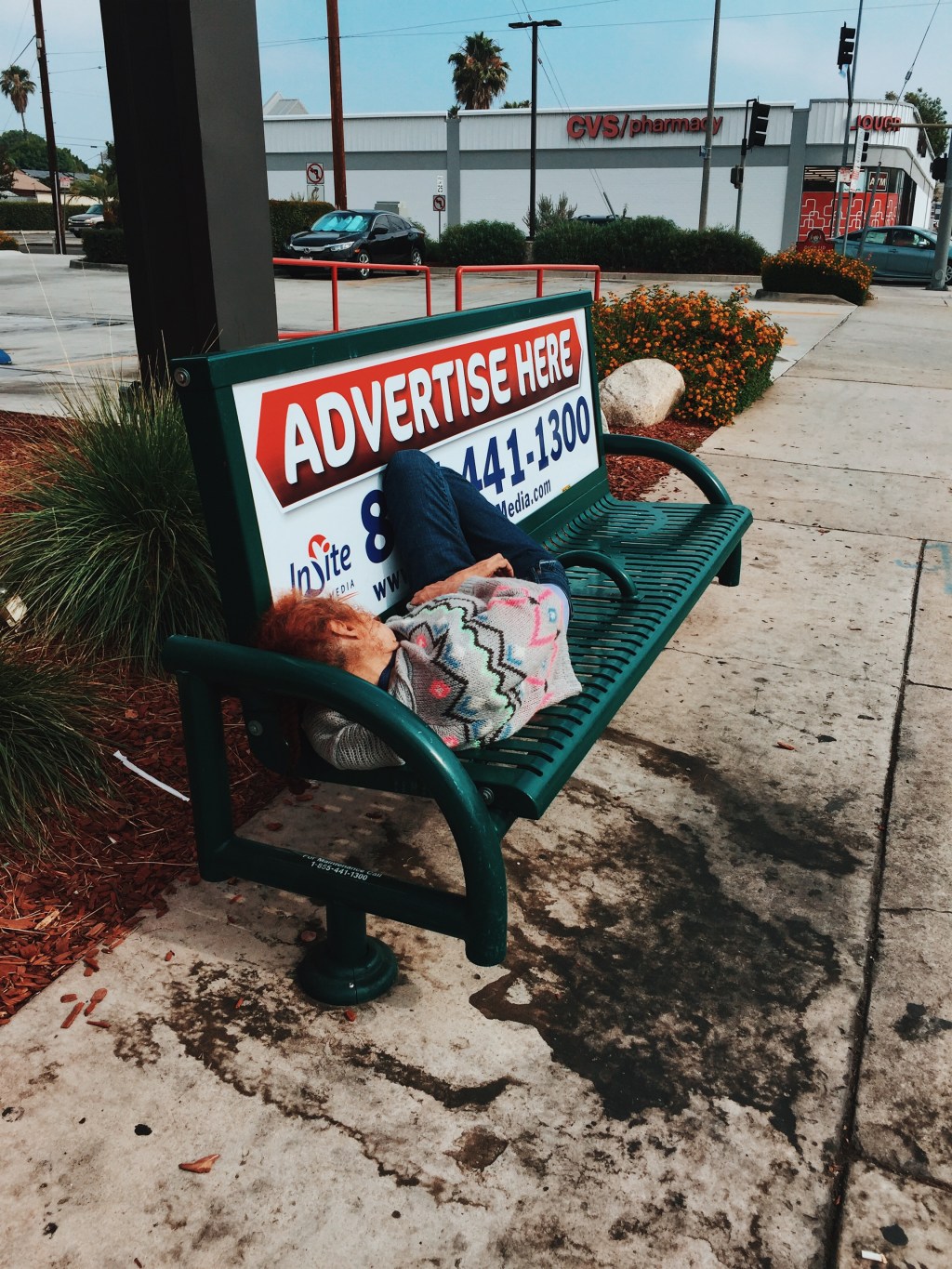
Later on, after the gym, she was asleep on the bus bench.

A temporary home.

There are no adequate words to describe the degradation and humiliation that public defecation brings to both the perpetrator and the witness.

Her normal biological action did not rank up there with the tens of thousands who live in group tents, in trash camps, along sidewalks, under bridges, within public parks in the City of Angels on Hiatus.

Just one of many living in the filth and neglect of our city.

But this is reality in LA and in so many other cities like Seattle, Portland and San Francisco that once thought such acts unthinkable. All these cities hate Trump. And all these cities call themselves sanctuaries.

A sanctuary to me is a holy place, a reverent place, a place kept scrupulously clean because people worship there and respect the ideals that make a place a sanctuary from all the evils of life, all the injustices. Inside a sanctuary there is quiet, and calm and peace and you go there to pray and find solace. There are churches, there are mosques, there are synagogues, there are temples, there are parks and courtyards that are sanctuaries all over the world.

What kind of sanctuary is present day Los Angeles?

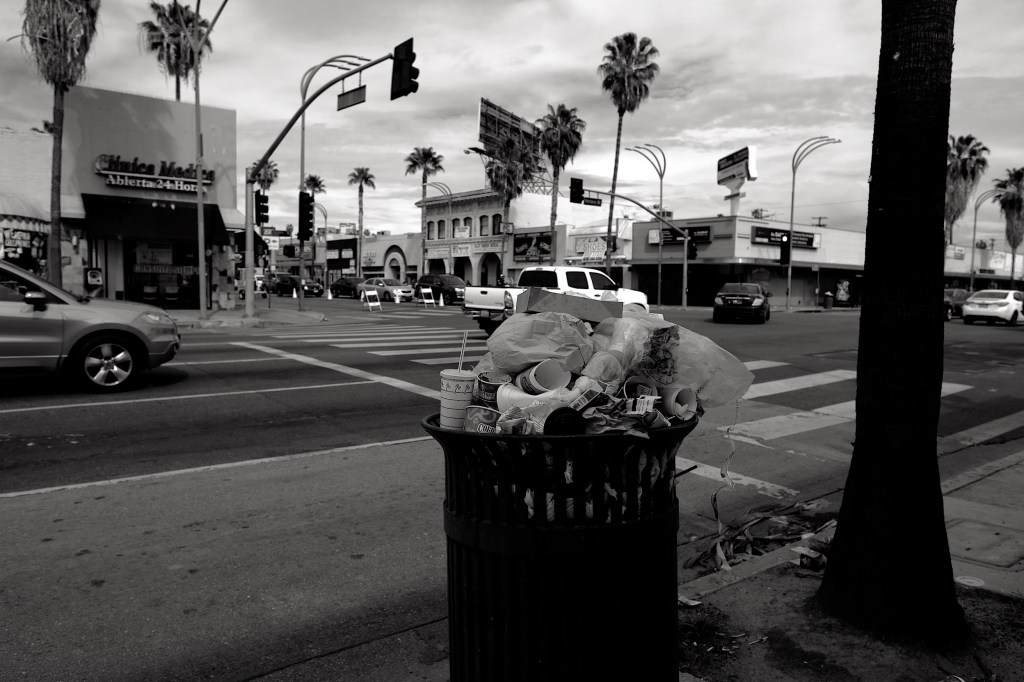
We don’t have a single public park un-desecrated by trash, shopping baskets, sleeping drunks, tents. Perhaps 30% of the bus stops are makeshift homeless homes, pushing out legitimate bus riders who wait on their feet in the blistering sun.

Woodley Park, 2018.

We have a hapless and synthetic mayor, Mr. Garbageciti, whose public pronouncements are so ineffective that they carry the weight of a meme.

In every car and in every kitchen across Los Angeles people of every political persuasion are asking: how can this be happening?

As hated as Trump is in this state, with every illegality and breakdown of law and order, ordinary liberal minded and tolerant people in California are moving away from the Democratic Party ideals of understanding, empathy, government regulation or government program, and hankering for a strong man or woman who will take drastic, emergency and militant steps to stop the disease of allowing people to live and do everything publicly they should be doing privately. 

The surprise that awaits liberals in 2020 is that anyone should be surprised when Trump is re-elected. .

Mayor Garbageciti’s Los Angeles


Last night we went down to Koreatown and found a cheap, excellent sidewalk café serving fresh dumplings at the corner of 6thand Catalina. Golden Pouch has tables and benches along the sidewalk. You walk up and pay at an Ipad and you sit down and wait for your name to be called. Within 20-25 minutes you are eating delicious, steamed, pork, shrimp, vegetable, chicken or spicy taco dumplings.

And as you sit and wait, or sit and eat, you are accosted by a revolving cast of homeless men who come up to your table, some incoherently, and ask for money, or sit beside you and talk about a conspiracy involving mind control, and you try and shoo them away, but they might stay or they might go and you have no control over your private conversation and your evening out. Some lose their temper, they scream, and you have to endure it.

It was a night when Koreatown was bustling, as usual. You could walk from places serving rolled ice cream, fried chicken, yakatori, oysters, cold noodle soup, a cornucopia of Korean, Japanese; bars, coffee restaurants and cafes.

There was a large amount of younger men and women with middle-aged adults, I assume parents, taking their kids out for an evening, possibly kids newly arrived at college, going to USC or UCLA and persuading their parents to go down to Koreatown, a normal experience for any Angeleno, and probably a treat for mom and dad from suburban Columbus, OH.

Yet, all over, sleeping in tents, along sidewalks, in shopping carts full of belongings, are homeless.

Imagine the impression Los Angeles gives to visitors who see this.

This is just Koreatown. Go downtown and you enter a Twilight Zone of lost people in the thousands sleeping on boxes, untreated, uncared for, defecating and urinating and creating mountains of garbage along streets, under bridges, along the river, everywhere.

Mayor Garbageciti is more popularly called Mayor Garcetti but he is truly the mayor who has made this city the American capital of garbage. Under his leadership, parks are garbage dumps, prosperous business districts are garbage dumps, everywhere from Woodley Park in Lake Balboa to Pershing Square are garbage dumps.

He is the Mayor who thinks we should increase the incentive to allow street vending too. Decriminalize it.So sidewalks near Westlake are now full of anybody and everybody selling unlicensed anything on the sidewalk. Every alley near the sellers is full of shopping baskets piled high with garbage.

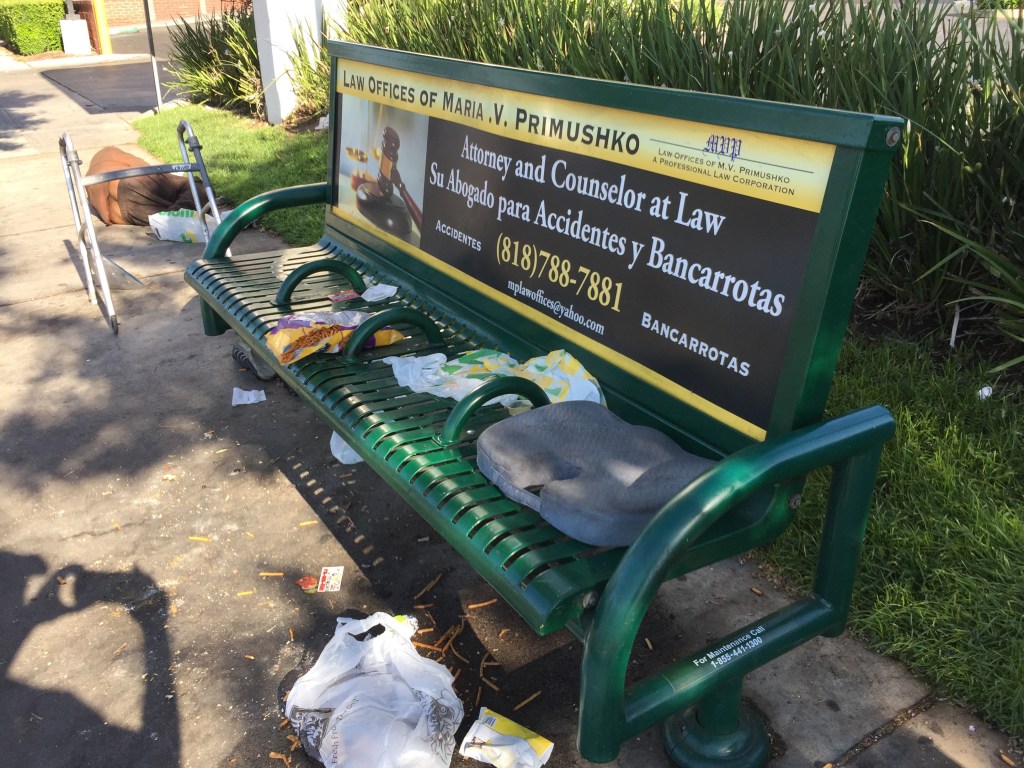
A champion of public transportation, he allows homeless to set up homes on bus benches, causing paying riders inconvenience and discomfort and discouraging and diminishing ridership.

On these days of summer, when the heat is at record setting temperatures and the new humid reality of warmer Pacific Ocean moisture drifts over the city, we must breathe a combination of smog, vomit, dog and human shit, and traipse over streets where the lawful act of walking is less important than unlawful, open air, Calcutta markets.

Nobody is patrolling the streets. Nobody is enforcing the laws. If they are, showing me where it’s working.

Mayor Garbageciti.

There are rumors he is thinking of running for President of the United States.

He can’t do anything about the gross and filthy condition of the city he alleges to represent. Imagine him in office, a cipher hologram of a human, a smiling projection on the wall of an official office, pretending to do progressive things.

Clean up the garbage and the madness in Los Angeles and then you can offer up your national celebrity candidacy.


The Bus Bench


“Despite a growing population and a booming economy, the number of trips taken on Los Angeles County’s bus and rail network last year fell to the lowest level in more than a decade.

Passengers on Metropolitan Transportation Authority buses and trains took 397.5 million trips in 2017, a decline of 15% over five years. Metro’s workhorse bus system, which carries about three-quarters of the system’s passengers, has seen a drop of nearly 21%.”- Los Angeles Times, Jan. 25, 2018.


Let’s imagine a 62-year-old woman, Berta Gonzales, who lives in Van Nuys, near Victory and Sepulveda, who still works, as she has for the last 55 years, doing whatever she can to bring in cash for herself, her husband,  her two adult children and six grandchildren.

She works as a housekeeper, and she takes the #164 bus, every morning, at 7am, from Victory/Sepulveda to her job near Warner Center, a commute of 33 minutes.

When she gets off the bus in Woodland Hills, the temperature these days is around 80, but when she leaves her job, after cleaning bathrooms and vacuuming floors, doing laundry and dusting, around 2pm, the thermometer might be 110.

Last year she twisted her ankle when she slipped on a freshly mopped floor.  She hobbled around on a special shoe, using a crutch to walk, and she tried to stay off her feet if she could. She has no medical insurance, of course.

In the morning, when she waits for the bus, next to the bench without any sun protection, she is made to stand. Because there is a drunken, sick, filthy man sleeping on the bench, with all of his dirty clothes, his smell of urine, feces, body odor and beer, as well as half eaten and discarded food such as spaghetti, pizza, and empty alcoholic cans.

This is his spot. All the legitimate and necessary uses of the bus bench must be thrown out because his sickness and his selfishness, whether deliberate or accidental, is the most important thing catered to.

He has been here for months, if not years. Last year he fell down on the sidewalk and paramedics came to gurney him away. Then he came back for good.

This homeless person, multiplied by thousands, living on bus benches, is not an inducement for increasing bus ridership. Thousands of potential riders will see this lawless, unsanitary and unsafe barbarism all over LA and make up their minds to do anything to NOT TAKE A BUS.

Berta is like dozens, if not thousands of people who encounter this situation every single day. They are hard-workers, struggling to earn money, riding public transit as their well-meaning, liberal political servants wish them to do.

But put yourself in Berta Gonzales’s shoes and ask yourself: if you had a choice would you want to ride a Metro bus when this is the first sight you see every single morning?

Because Los Angeles does not enforce quality of life laws, there is a cascading affect impacting every other activity: traffic, air pollution, and longer commutes.

It is surprising that the plight of bus riders, many of whom are Latino, has not seized the identity politic podiums of those in city government who are always screaming loudest about injustices suffered by whatever is trending on Twitter that day.

Does grotesque, citywide neglect of sick people and working people and commuting people merit no outrage?

Who is responsible for keeping mentally ill people in dire need of treatment off bus benches and getting them into permanent hospitalization and shelter?

Who?

I know it’s not this blog.


Option A: Just Plain Places


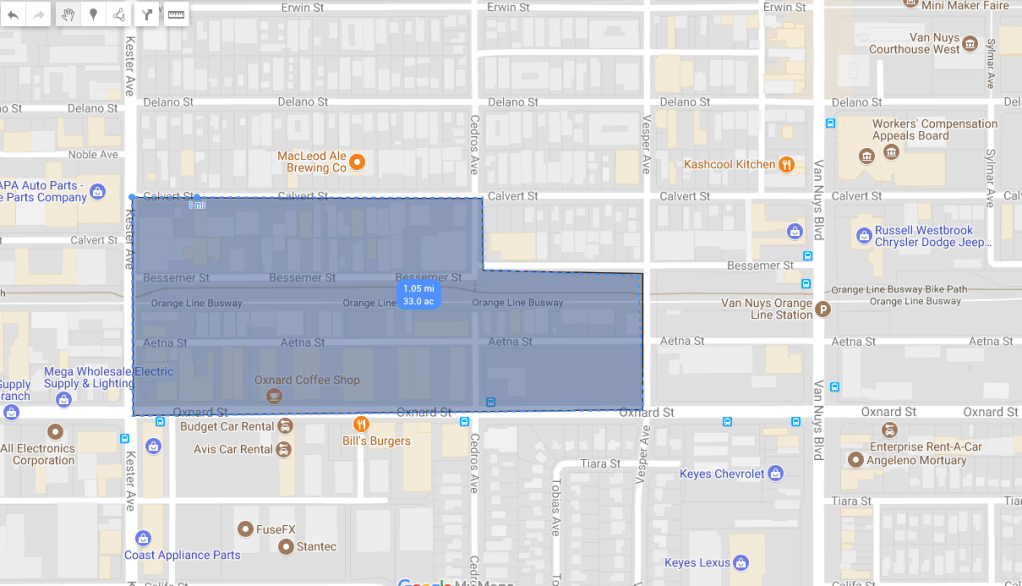
This blog has written 13 other times on “Option A”, a Metro LA proposal by the public transportation agency to wipe out 33 acres of industry in Van Nuys, near the junction of Oxnard and Kester, and replace it with a light rail service yard. It would destroy 1,000 jobs, displace 186 businesses and flatten 58 buildings.

Though the scheme has been public knowledge since September 2017, property owners, workers, renters and the neighbors near here still stand on thin ice, awaiting official June 2018 word whether this whole district is sentenced to death, or if another site (B, C, or D), near the Metrolink tracks up on Raymer Street will be chosen instead.

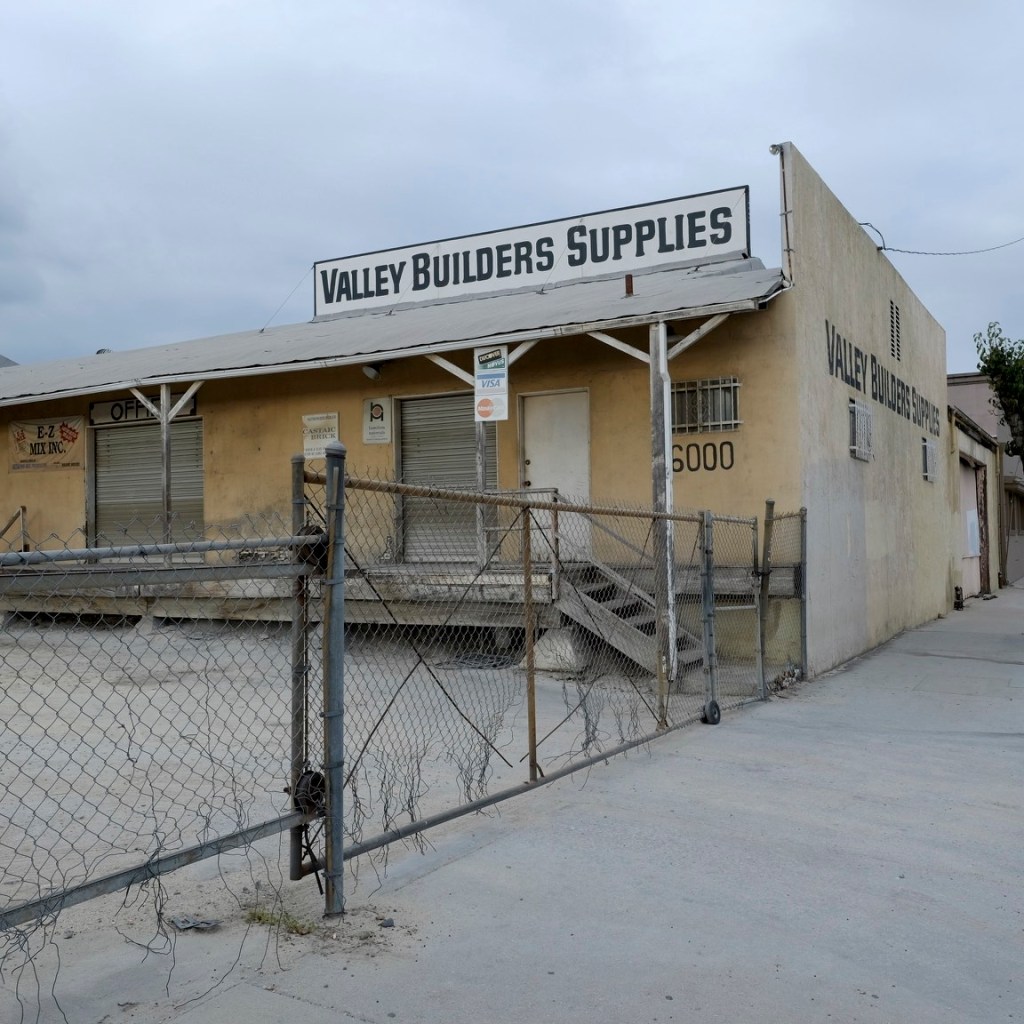
A photo walk around here yesterday, along Oxnard, Aetna, Bessemer and Calvert, to document some buildings that may be gone in a few years, was also an opportunity to show that this area has great potential beyond its current light industrial use.

In gravel yards, on cracked and broken asphalt, under decaying wood, on treeless, depopulated and narrow roads, there are ingredients for a nice urban area of some new housing, some new cafes, some places where trees, lighting, discreet signage and pavement of cobblestones could bring an infusion of 24/7, urban, walkable, bikeable activity to the neighborhood.

It is already an incubator of creativity with makers of exquisite decorative hardware, superb custom cabinetry, music recording studios, Vespa and Mustang restorers, stained glass makers, welders, boat builders, and kitchen designers. These businesses, incidentally, are staffed by mostly local owners and workers, many of whom are but minutes away, or take the bus or even walk to work.  Rents are currently affordable, often 50 cents, $1 or $2 a square foot.

MacLeod Ale, maker of fine British style beers, since 2014, is on the north side of Calvert and is not threatened with demolition but its existence and success is a testament to the potential for innovation in this area.

Ironically, the very wonderful addition of a landscaped bike path and the Metro Orange Line bus in 2005 is now threatening the area because of future conversion to a light rail system. Yet the “Option A” district is thriving, even if it is shabby in places, because it is a work zone of skilled, employed, productive people.

Politicians who often talk ad nauseum about “diversity”  should come here with mouths closed and observe men and women: Mexican, Armenian, Norwegian, German, Persian, Guatemalan, Salvadoran, Irish, Scottish, Israeli-Americans, all the hyphenations of ethnicity and gender, who don’t care about where anyone came from, but only about where they are going in life.

This is Los Angeles. This is diversity. This is economic prosperity. This is within walking distance of “downtown Van Nuys.”

Yet short-sighted officials, bureaucratic ignoramuses with grandiose titles, flush with public money, would consider wiping out the very type of neighborhood whose qualities are needed, wanted and venerated.

Option A must not happen. This is what it looks like now.

Imagine what it could look like with the right, guiding hands of investment, preservation, planning and protection.


SaveSaveSaveSave

SaveSave

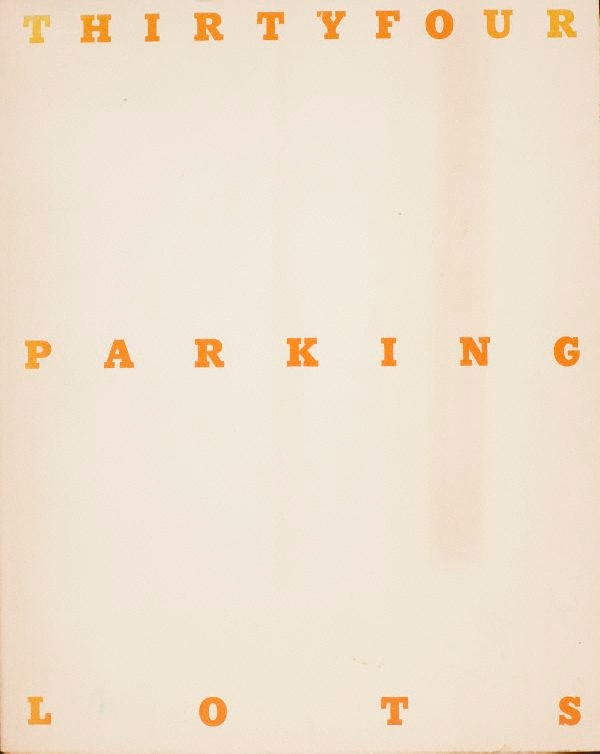
Thirty-Four Parking Lots in Los Angeles (1967)


Thirty-Four Parking Lots in Los Angeles (1967)

I previously wrote about this topic in 2014, but bring it up again as Los Angeles, and the State of California, are now in a furious debate about housing, cars, homelessness and how best to build.

All B&W photographs below are by Ed Ruscha. 


Ed Ruscha’s “Thirty-Four Parking Lots in Los Angeles” was published 51 years ago.

The artist, born in Nebraska in 1937, came to this city in 1956 to study at the Chouinard Art Institute. He also had an apprenticeship in typesetting.

Graduating in 1960, only 23 years old, he started working at an advertising agency doing graphic design. Influenced by the works of Jasper Johns, Robert Rauschenberg, Andy Warhol and Roy Lichtenstein, Ruscha was featured in a 1962 survey called “New Painting of Common Objects.”

That year he published “Twentysix gasoline stations” and later “Every Building on the Sunset Strip.” (1966)

He was the first, or perhaps the most notable artist, to create a deadpan, earnest, unesthetic photography of built Los Angeles. He looked, without pretense, at the sprawling, cheap, roadside city of billboards, car washes, instant apartments and filling stations and wrapped up his black and white photographs into little, smart, best-sellers.

Ruscha was talented and knew how to sell things, always a winning combination in the city of angles. (intentional)

The 1960s was a dirty flood of bitter reckoning that hit America and threw cold water on its made-up, powdered face.

Assassinations, sexual relations, racial issues, drugs, protests, music, environmental desecration, Vietnam: the entire decade blew up a contented self-image.

A nation, which thought itself a beacon of light onto the world, was forced to reconsider its own grotesque violence and misunderstand it.

Confronting Los Angeles, Ruscha presented a homely city with a picture book full of raw honesty.

State Board of Equalization 14601 Sherman Way, Van Nuys, CA.

May Co. 6150 Laurel Cyn NH

Inside “Thirty Four Parking Lots in Los Angeles” are some aerial shots of ordinary Van Nuys, North Hollywood and LA in 1967, with those enormous oceans of parking lots floating boat-like buildings.

Up in an airplane, looking down, Ruscha captured lines and boxes transposed upon the land, asphalt which looked, on its surface, much like the curtain-walled office buildings of that era.

Goodyear Tires 6630 Laurel Cyn NH

Good Year Tires at 6610 Laurel Canyon in North Hollywood occupies only a dot atop a long “I” shaped land-mass of parking.

Dodger Stadium

Dodger Stadium is buried deep within the hot skins of asphalt, a vaginal shaped structure where men played ball.

7101 Sepulveda, Van Nuys, CA.

And 7101 Sepulveda, a now abandoned office tower near Sherman Way, has trailers and motels on its perimeter, as well as plenty of free parking. Today, this area often hosts large encampments of homeless people, so the peripatetic ways of Van Nuys have historical precedent it seems.

Eileen Feather Salon 14425 Sherman Way, Van Nuys, CA.

14425 Sherman Way was called the “Eileen Feather Salon” and has but one long building fronting Sherman Way with parking in back.

Today, that corner is a cacophony of grossness and visual pollution including donuts and Denny’s. Signs are everywhere. And the weary eye becomes nostalgic for the simple joy of a lone building and its parking lot set down on arid land in the once less populated San Fernando Valley.


7128 Van Nuys Bl. 8/5/14

We are now engaged in a great civic debate about housing, and public transportation, and some voices hope (mine included) that denser buildings along bus and train lines will help alleviate high rents and homelessness.

Yet we never quite escape the trap set by the automobile: where to drive it, where to park it, how to best accommodate its needs.

Every single debate about new buildings always begins and ends with parking. Tens of thousands sleep on the street, families cannot afford rents or mortgages, developers are hamstrung providing parking for everyone and their guests, and Los Angeles dies a little each day from auto related illnesses.

Every time we think we are biking or busing more, something sinister comes onto the scene, and we now have 100,000 Ubers and Lyfts clogging the roads, and making our lives more hellish even as we praise their conveniences.

We plan a light rail down Van Nuys Boulevard and the auto dealers like Keyes stop it at Oxnard. They still run things. They destroy the city, and they are congratulated and worshipped for it. Thousands of their new cars are stored at outdoor transit adjacent parking lots built by Metro with taxpayer funds. Ironic.

Every time we imagine we are free of the car, we are forced back into it to chauffeur little white kids to school in better neighborhoods, to commute to $10 an hour jobs, to spend three hours every day in our vehicle so we might live in a house that consumes 50% of our income. Madness.

Ed Ruscha’s simple aerial photographs of parking lots are still a fact-based statement of what this city is. And how we are all swallowed into it.

Goodyear Tires 6630 Laurel Cyn NH

Option A: What the Neighbors Think.


A light rail service yard in Washington state.

Metro is planning a light rail train down the center of Van Nuys Bl. extending from Pacoima to Van Nuys, stopping at Oxnard St. Less probable is a dedicated bus line.

Their final decision, as to what type of transport to build (bus or train) and where to service these will come in June 2018.

Four areas in Van Nuys are under consideration for eminent domain demolition and the building of a light rail maintenance yard.

These are called the “Option” areas and they are A, B, C, and D.

Options B, C, and D

B, C, and D all straddle the existing Metrolink heavy passenger rail tracks along Raymer St. near the former GM plant on the Van Nuys/Panorama City border.


OPTION A:

Option A

Only “Option A” is located in another area: this is a 33-acre spread of light industry comprising 186 businesses, 58 structures and as many as 1,000 workers who are located NE of Oxnard and Kester along Oxnard, Aetna, Bessemer and Calvert Streets.

This blog has reported extensively, since September 2017, on the “Option A” community: a unique, productive, and innovative group of entrepreneurs who make fine decorative hardware, custom shelving; record music, weld metals, clean carpets, fashion artistic stained glass, and restore vintage Mustangs, Vespas and large yachts.

Skilled craftsman at Pashupatina

Garrett Marks, CEO, Mustangs, Etc. (est. 1967)

Peter Scholz, owner Showcase Cabinets (est. 1987)

Simon Simonian, Progressive Art Stained Glass Studio

Kristian Storli, Owner: Bar Italia Vespa

Steve Muradyan of BPM Custom Marine

They employ local workers, many of whom walk to work. There are immigrants here, but there are also people who started companies 30, 40 and even 50 years ago who would be forced to move from their little supportive community and fight to rent new space competing against cash rich marijuana growers who are swallowing up space for their noxious, lethargy inducing, industrial scale weed.


I was curious what residents in the area think of “Option A” so I went online and visited Next Door.

My Next Door app page has 2,000 community members from Burbank Bl. north to Roscoe, from the 405 to Hazeline.


I posted a question asking if people opposed or supported “Option A.” Overwhelmingly, by a vote of 87% to 13 (94 total votes), they said they were against it.


Peter Scholz and employee at Showcase Cabinets


 Here are some of the comments:

“It seems like a giant repair yard would be an eye sore and would attract litter, homeless encampments and shady activities since it will have very little activity especially at night. I don’t see how that is worth uprooting all these businesses who contribute to our community and have been here for all of these years.”

“I prefer local businesses any day. Plus, with numerous new apartment buildings popping up all around the area, we have potential for more retail/cafes to move in to the buildings up for lease. However, if all of that space gets used up by ugly rail yards, then the Van Nuys economy will never thrive to its full potential. I’m sick of this city being treated as a dumping ground.”

“The downside of Option A is not only a large rail yard in main area of Van Nuys (which MTA promises would be modern and attractive) but as well, that it would take out approximately 200 small and thriving Van Nuys businesses that each employ, one, two, three, five or more employees, whereas the other two main options hold a minuscule number of businesses. Eminent domain [against] all these businesses in the heart of VN would hurt us in several ways, besides uprooting the businesses and the citizens who work there, there are limited number of commercial properties currently available close by, so many of the businesses could not relocate close by, would not be able to keep locale clientele. For many who live nearby, if new properties could be found, commutes would be added. And for all those businesses relocating outside our community, or for those that would simply be forced to fold, Van Nuys would lose a healthy business tax base. Again, the other two options provided by the city for the yard (if needed based on what the final decisions are) do not suffer from anywhere near the same extent of overall downside.”

“I own a house on Hatteras near the Option A area. And I also rent a building on Aetna which would be demolished. If this happens I will sell my house, which I just purchased two years ago and I will move out of Los Angeles. There is not a reason in the world to pick our district for demolition when so many jobs and lives are at stake. If Nury Martinez allows this she should be recalled.”

Clearly, people who live near the Option A zone are insightful and understand how important it is to preserve small business in Van Nuys. They know that an enormous, gaping hole would not revitalize Van Nuys, but further degrade it.


The community residents, as well as the businesses near Kester and Oxnard, are united in opposing the destruction of viable businesses and local jobs.