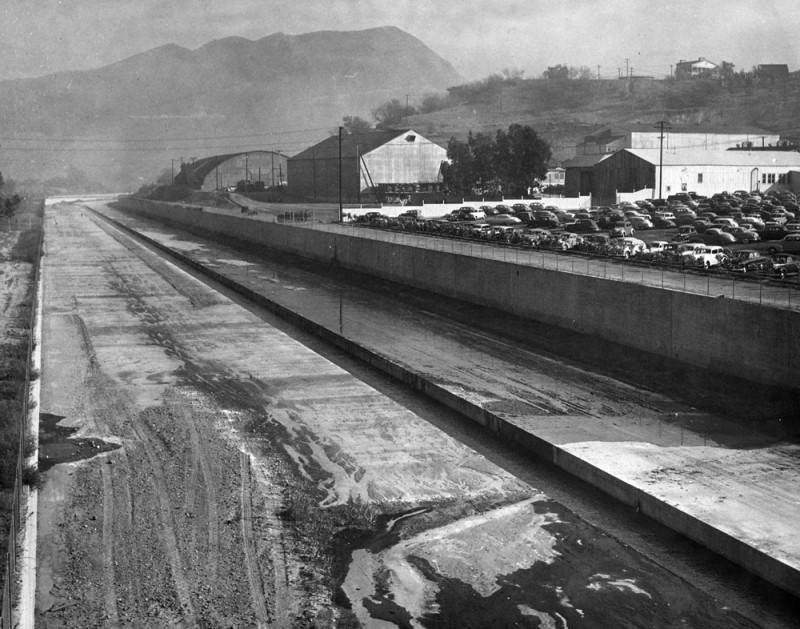
1949: A $72 Million Dollar Flood Control Plan to Waterproof SFV


Van Nuys Blvd. 1938 flood

Flooded area at Ventura Boulevard and Colfax Avenue in Studio City. 1938 (LAPL)

After March 1938 Flood: Lankershim Bl. looking north near Universal City. Photo: by Herman Schultheis


After the disastrous 1938 floods, the City of Los Angeles worked with the State of California and the Federal Government, specifically The Army Corps of Engineers, to encase the rivers of Los Angeles in a waterproof lined concrete sewer to expel waters during the rainy season.

These December 1949 photographs, archived at the LAPL in the “Valley Times Collection”, show the splendid progress of turning natural riverbeds into something distinctively man-made without natural life.  The cost, at the time, was $72 million, which is perhaps $800 million today, but sounds like a bargain, since the Getty Center mountaintop gouge and railroad itself cost $1.3 billion dollars upon completion in 1997 and the widening of the 405 five years ago was a $1.6 billion dollar project that has since added one lane in each direction and shaved 10 seconds off each commuter’s journey.

And let us ponder that our latest crisis, homelessness, will be remedied by taxpayer dollars close to $5 billion.  Not the Federal Government, not the State of CA, but taxpayers, you and me will shell out to well-meaning bureaucrats and post-collegiate interns, $4.6 billion to build housing — 10,000 units in 10 years — and “provide supportive services” for homeless people.  When every person in need on every continent around the world, every down and out person from every state, city and town in the US, Canada and Mexico, arrives in Los Angeles, we will see how well this plan goes down.  It once was against the law to dump garbage in parks, to set up tent cities on sidewalks, to sleep on benches, under bridges, but now this is a behavior eliciting “compassion” because that’s how you are directed and asked to speak of it. You must not condemn what your own eyes tell you is wrong.  Let it grow, let it expand, then create new programs to fight it, until it becomes unstoppable.

A city that once built hundreds of miles concrete rivers to stop flooding, cannot erect temporary shelters and police the filth and disorder and rampant grossness of the ever growing homeless situation. 1949 was a different time, for Angelenos were not intimidated and cowered into attacking threats that endangered the growth, health and well-being of this city.

Lankershim and Cahuenga

Riverside and Whitsett
Laurel Canyon Bl. near Ventura.

The concreting of the LA River in the San Fernando Valley allowed the development of housing right up to the edge of the old slopes. No longer would houses and apartments face potential destruction from heavy rains and overflowing waters.  Soon the freeways would come through, another onslaught of concrete that helped transform the San Fernando Valley from a place of horses and orange groves to one of parking lots and 10-lane local boulevards.

Today, in many parts of the LA River, most notably in Frogtown and along some sections of Studio City, there are naturalizing effects going on, and residents are biking, hiking, and even boating where it is permitted in the once fetid waters of the river.


The Rains.


LA River at Fulton Av. Bridge, Studio City, CA.
Fulton Ave. Bridge at the LA River, Studio City, CA
Fulton Av. Bridge/LA River/View South
Photo by Andy Hurvitz
Front Door Rain
Photo by Andy Hurvitz

The rain.

Coming down in sheets, in cycles, ad nauseum.

Sheets of soaking wet weather slicing across the Valley.

I drove down to Studio City.

By the time I got to Whitsett and Magnolia it was dry.

I parked near Fulton and the LA River and shot some photos.

I went to Peet’s Coffee and met some friends.

I ordered a double espresso..

Then the sky darkened and the palms along Ventura blew and the rains came.

The rain abated and I ran to my car and drove home.

At my home computer, I sat and waited for the next cycle of storm to begin.

Then my mother called from the Marina and said she saw a fabulous rainbow.

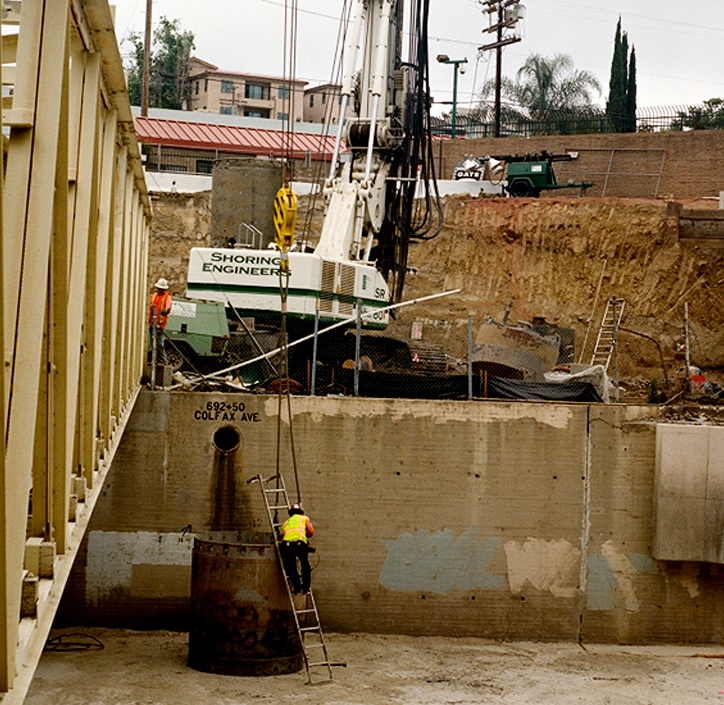
Construction: Colfax Avenue Bridge, Studio City.


This slideshow requires JavaScript.

On August 1, 2007 a Mississippi River bridge collapsed and killed 13 in Minneapolis, one that utilized the same design as the now dismantled Colfax Avenue Bridge in Studio City.

The City of Los Angeles – Department of Public Works – Bureau of Engineering, is now constructing a new crossing over the LA River.

Their website description:

“The scope of this project consists of replacing the existing Colfax Avenue steel-truss bridge, consisting of one traffic lane over the Los Angeles River, with a new concrete-arched box-girder bridge. The new arched box-girder bridgewill be approximately 28 feet wider than the existing bridge to accommodate one traffic lane, a 5-foot-wide bike lane, and a 7-foot-wide sidewalk on each side of the new bridge, as well as including a 10-foo-wide painted median.”

The estimated costs (paid for largely out of Federal money) is 5 million dollars. Completion will be sometime in 2011.

Photos show an old, steel pedestrian bridge adjacent to the site where the new concrete bridge will be located.

River of Plastic/ Rio de Plastico


Riding my bike around the Sepulveda Basin today, I was startled and sickened to see a river lined with trash.

Plastic bags literally covered every branch, every limb, and every single tree along both sides of the banks; devouring, like some gruesome movie monster, nature.

The amount of garbage is so extreme, so massive, so overpowering, that the camera’s lens is unable to completely capture the visual tragedy.  Like Haiti after its quake, a photographer must decide whether to shoot wide angle, thus diminishing the particular atrocity, or to go close-up, possibly denying the vast destruction all around. I shot these images both far and close to record the appalling filth and criminal neglect of the river.

There are other sections of the LA River, formerly encased in concrete, now undergoing naturalization. This area of the river, which meanders gently through the San Fernando Valley acts as a flood basin and wildlife preserve.

The City of Los Angeles has abrogated its moral and legal responsibility by allowing and ignoring this environmental catastrophe.

One weekend of box office receipts, from the theaters showing AVATAR in the nation of Moldavia, would probably be enough to pay for a LA River clean-up. Two weeks of Ellen DeGeneres’ paychecks might finance the annual salary of 20 city workers assigned to protect the river. 1/44th of suspected comedian Conan O’Brien’s $44 million dollar pay out might save the lives of thousands of birds.

The pictures on this page were shot around Balboa Boulevard in Encino.

Along the Wash.


Banks of the LA River: Near the 101 and Vineland

A few weeks back, I explored some of the LA River as it meanders under concrete overpasses and alongside freeways.

There is a paucity of decent parkland in Los Angeles, as anyone who lives here can attest. Looking at an overhead map of the San Fernando Valley, one sees blocks and blocks of development, only sometimes interrupted by a small park.

Chandler Near Tujunga Park N Hollywood

The great freeway builders of the 1950s rammed their roads through the parks because it was easier and cheaper to do than buying up private property. As a result, North Hollywood, with its river and public green spaces, now plays host to an eternal hellish drone of smoke, noise, litter, violent driving and environmental catastrophe.

In Van Nuys, the 405 slices through parks, a wildlife sanctuary, past the Sepulveda Dam and through the Woodley Park area.

There are forces now, benevolent ones, like the Friends of the LA River, who are trying to reverse the damage done by the entombing of the river in the early 1940s, and the paving over by traffic engineers in the 1950s and 60s. They are planting trees, promoting walking and nature, and building bike trails. The most affluent area of the San Fernando Valley, Studio City, has seen the most upgrades along the LA River.

The Wash Near Vineland &101

But mostly the river and water and wash is ignored, standing mute, alongside the vehicles and the onslaught of cars and trucks, whose main goal is getting somewhere faster.

L.A. River: After the Rain