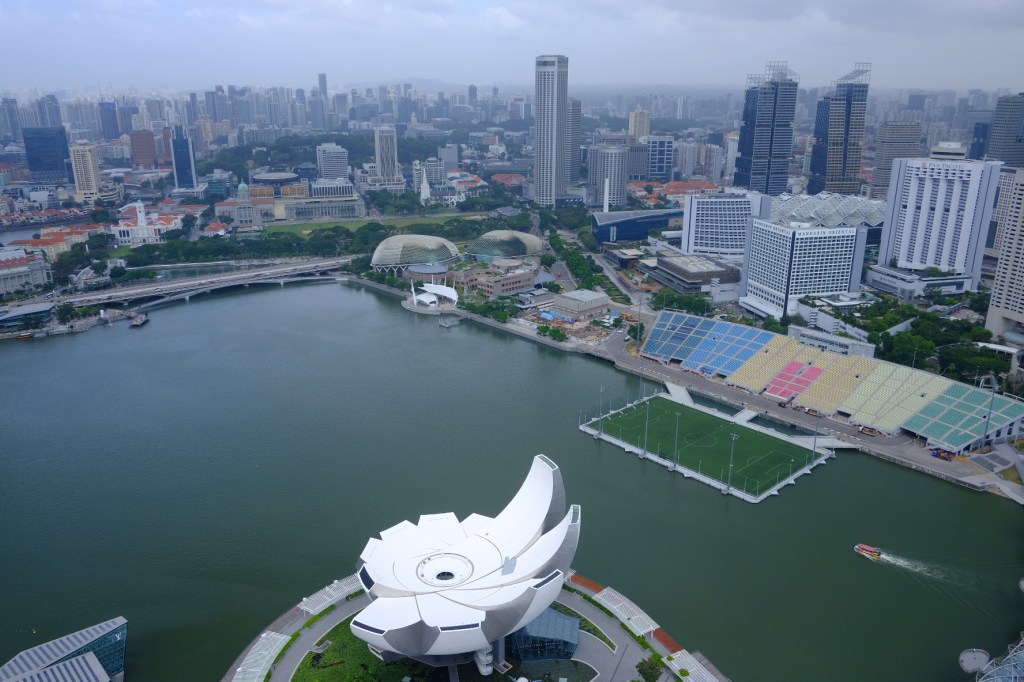
In Singapore.


In Singapore, which I just visited for four days, I do not remember seeing any decorative streetlights, but I might have been looking, instead, at spotless plazas, copiously planted parks with enormous trees and bright flowers; or perhaps I was riding the air-conditioned MRT, easily navigating between scrupulously clean stations, labeled in easy-to-read signs, navigable by newcomers and citizens alike.

One day we walked up to the MacRitchie Reservoir where students, in the water, directed by coaches, were practicing and exercising rowing. They worked hard and still smiled. At the clubhouse I saw posted rules and regulations and fines for violating the laws of the recreation area, and still, all around me, everyone was peaceful and happy. Why shouldn’t they be? They were surrounded by order, nature, and safety.

I was unaware, until I returned to Los Angeles, that our city was removing fines for overdue library materials.

In Singapore, next to transit, are great food halls, called “Hawker Centres” which gather, under one roof, superb eating establishments: affordable, delicious and regulated by government inspectors.  We ate at two:  Tiong Bahru and Old Airport Food Centre.

The hawker centres date back to the 1960s, when the new government of Singapore, in order to insure cleanliness, hygiene and food safety, put all the street food into these mass eating halls.

In 2019, Los Angeles made it LEGAL to sell food on the street, so the lady who just finished cleaning her cat’s litter box and will shortly make your guacamole, can also sell it from her blanket next to MacArthur Park and not get arrested. 

Often when people talk about Singapore, people who don’t live there, they bring up draconian laws that sound utterly terrifying. Death for drug dealers, chewing gum is illegal, and a recently enacted “fake news” law that might curb free speech.

Singaporeans I spoke to didn’t think about these laws, or believe they hampered their freedoms. Perhaps they were too happy enjoying the liberties of crime free streets, or sidewalks without homeless encampments.  They probably were also feeling good while availing themselves in superb health care or government subsidized housing.

Incidentally, Singapore has public housing. Rules are that the residents must be legal citizens or permanent residents. 82% of the housing in Singapore is government run. So here we have a refutation of the tired conservative/liberal ideology that poisons American minds. There is such a thing as desirable government housing. And there is such a condition as limiting the use of these buildings to those who are lawfully in the country.

Singapore is rated number one or number two in education for its schooling. An 8-year-old boy, a son of a friend, helped me program my mobile phone so I could get internet coverage all over the city.  Just one example of intelligence at a very young age that comes to mind. 

What else can be said to praise laws, rules, order, safety, and yes, penalties, punishments and respect for social order?  Can our nation, and our city, emulate Singapore? Or should we look to Mississippi, El Salvador and New Delhi for our future plans in transit, education, housing, health care and sanitation?

On the day we came back to Van Nuys, two men were shot and wounded nearby.  Four were killed here in 2019 according to the LA Times.  

“According to UN data, Singapore has the second lowest murder rate in the world (Data excludes tiny Palau and Monaco.) Only 16 people were murdered in 2011 in a country with a population of 5.1 million.”-BBC News  In 2017, 11 people were killed in Singapore.

Am I freer in Los Angeles or do I live inside a city prison of another kind?

Cinnamon Politics.


Cinnamon Politics

A few months ago, I walked into a Santa Monica dry spice store that my friend and I had dismissed a few years earlier.

It seemed ridiculous to us, that people, in the farm-fresh and organic era, would buy dried spices and spice blends at premium prices, and also waste money inside a store where the edibles sat in glass bottles in the burning Western window sun, becoming milder, less fragrant and more tasteless by the day.

Yet the business lived on, as culinary mediocrity often does in Los Angeles, eventually thriving in its insipid rendition of gourmet flavoring for chef lite hacks.

But then I came back into the spice store a few weeks back. I gave it another try. Maybe I was wrong.

I bought something called Northwoods Spice: salt, black pepper, paprika, thyme, rosemary and garlic, which the company describes as perfect for chicken or fish.

It cost about $13 for seven ounces. And I used it once or twice with no noticeable or discernible improvement in my food. In fact, the food had come out worse with the addition of the Northwoods Spices, giving baked chicken the flavor of something my mom might have cooked in 1975 Lincolnwood, IL served with Uncle Ben’s rice and creamed corn.

Equality’s Front Lines

Today, that company sent out an email with an entirely different agenda. They were giving away either a magnet or a cookbook called LOVE PEOPLE with any $10 purchase.

Penzeys.jpg

Further down the email, the owner and alleged author of the email, Bill, talked up his support for “people on the front lines of the continuing struggle for equality.”

Who, really, are the “people on the front lines of equality?”

To some they are students screaming to take down President Woodrow Wilson’s name at Princeton University. To others, like me, equality is often accomplished in a quiet or modulated voice: teaching, reading, praying, thinking, writing, to postulate ideas and reform minds, and argue, through logic and insight, for the reform of certain societal inequities such as equal pay for women and men.

The mob, screaming and tearing up for You-Tube, is the curse of our time. The Arab Spring, so liberating online, has burned up in the Saharan sands and splattered blood from Jerusalem to Paris to Mali. Millions protest. But not one speaks freely.

But, here in America, The Spice Man speaks freely.

He tied in the struggle for equal rights to the strange events in Ferguson, MO, where, in 2014, Darren Wilson, a police officer, shot to death Michael Brown, a black man who had just robbed a store and roughed up its owner.

A grand jury later decided not to prosecute Officer Wilson. And rioting followed after this legal decision.

So why bring this tragic event into a way of advertising your spices? The killing was an epic event, a turn of racial history, an explosion of anger, an invocation for rioting, an example of passion gone amok. To employ this police/pigmentation tale of violence to market spices reduces its enormity to triviality, and grounds it down into mere cocoa powder.

The seller of garlic powder, turmeric and thyme, whose exposure to worldwide aromatics evidently endows him with insight into all senses of the human condition, then compared police reform to Catholic priesthood reform, linking the two institutions, which have no relation or logical connection, but obsequiously praising The Catholics and The Cops for “coming a long way from protecting their own no matter what, to understanding that not everyone has what it takes to do the job.” Perhaps The Spice Man and his unessential oils belong in the latter category.

A scandal about police brutality, a scandal about child abuse, and now (to my mind) a scandal of a salt salesman using the most controversial and unsettled issues of our time to push his product.

Bill’s presumptuousness, his wise ignorance of imagining that his clientele shares his views on the proper role of police, on racial profiling, on police tactics, on law enforcement-all of it- sickened me because it used sensitive and philosophically critical issues in the service of selling spices.

In this strange marketing email, he also praised the Milwaukee police department for “an incredible forward-thinking outreach to our city’s homeless community.” In old America, before the 1980s, the police arrested people sleeping on the streets, not only because it was illegal, but also because it was unsanitary and unsafe. And gutters, park benches, alleys and dumpsters were deemed not fit for human habitation.

Strangely, there are still people, (like me) who think that there should be a law against allowing people to set up home on the sidewalk. Tolerance of it allows it to grow and become a movement of its own, normalizing the cruelty and barbarism of it, and giving a free pass to liberals to walk from their Range Rover with the handicap sticker on it, right into Studio City Lululemon on Ventura Boulevard, past the old lady who has slept on the metro bench for six months.

So now the police, as cited in Milwaukee, are expected to be the ambassadors of graciousness to the mentally ill, and to people made mentally ill by living outdoors in urban filth.

But back to The Spice Man.

He thinks he knows his customers. He thinks he knows them because sells them political opinions, set out in marketing blasts, better kept to himself.

He ought to make a better product before he jumps ahead to planetary reform.

Spices, kept out for too long, lose their potency, like old bromides.


Reporting Housing Code Violations in Los Angeles


One great tool, that the City of Los Angeles and its Department of Building and Safety provide, is an online form that can be used to report housing code violations.

Some of the quality of life problems that plague this city are actually reportable violations. These include those garage sales that go on 52 weekends a year at the same address; inoperable vehicles stored on a front lawn; nuisance structures that are boarded up and abandoned; empty lots with overgrown weeds; illegal dumping; illegal signs; etc.

Here are some additional categories that practically encompass the definition of what it means to live in the city of Los Angeles:

  • ADULT ENTERTAINMENT (CLUBS, CABERETS, BOOK AND VIDEO STORES) IN AN UNAPPROVED AREA.
  • AUTO REPAIR (MAJOR) IN A RESIDENTIAL ZONE.
  • BLOCKED OR NONEXISTENT EXITS, PASSAGEWAYS, YARDS OR WINDOWS.
  • COMMERCIAL AUTO REPAIR ESTABLISHMENTS IN VIOLATION.
  • COMMERCIAL JUNK YARD (INCLUDING AUTO DISMANTLING) IN VIOLATION.
  • COMPLETED UNAPPROVED CONSTRUCTION (WITHOUT PERMITS AND INSPECTIONS).
  • EXCESSIVE VEGETATION: DRY WEEDS, UNTRIMMED TREES, ETC.
  • GARAGE CONVERSION INTO A DWELLING OR STORAGE WITHOUT APPROVALS.
  • GENERAL BUILDING MAINTENANCE REQUIREMENTS IE; BROKEN WINDOWS ETC.
  • GRAFFITI VISIBLE FROM THE PUBLIC WAY.
  • HOME OCCUPATION (BUSINESS OPERATED FROM A DWELLING UNIT).
  • VIOLATIONS PERTAINING TO HOTELS AND/OR MOTELS.
  • INADEQUATE PARKING SPACES.
  • MISCELLANEOUS COMPLAINTS THAT ARE NOT OTHERWISE CATEGORIZED.
  • NOISY FIXED EQUIPMENT IE: POOL EQUIPMENT, AIR CONDITIONERS ETC.
  • OFF SITE ADVERTIZING (BILLBOARDS) WITHOUT THE REQUIRED PERMITS.
  • ON-SITE ADVERTISING EXCESSIVE SIGNAGE ADVERTISING GOODS OR SERVICES AVAILABLE ON SITE.
  • OPEN EXCAVATIONS, PITS AND OTHER HAZARDS.
  • OPEN STORAGE (STORAGE OF ITEMS OUTDOORS) IE; CONSTRUCTION MATERIALS.
  • OVER HEIGHT FENCES IN THE REQUIRED YARDS.
  • PACK RAT CONDITIONS.
  • PARKING IN THE REQUIRED FRONT YARD OTHER THAN ON THE DRIVEWAY.
  • POOL CLARITY AND OTHER POOL MAINTENANCE ITEMS.
  • POOL ENCLOSURE NON EXISTANT, IN NEED OF REPAIR, OPEN GATES, ETC;
  • PROPERTY NEEDS PAINT OR WEATHER PROOFING.
  • RECYCLING CENTERS OPERATING IN UNAPPROVED LOCATIONS OR AFTER HOURS.
  • SECURITY BARS PREVENTING REQUIRED EGRESS.
  • STORAGE OF INOPERATIVE VEHICLE(S) ON PRIVATE RESIDENTIAL PROPERTY.
  • STRUCTURAL HAZARD; IE. FAILING SUPPORT OR RESTRAINING SYSTEMS.
  • TENNIS COURT LIGHTS, FLOOD LIGHTS, ETC.
  • TRASH AND DEBRIS ACCUMULATION.
  • UNAPPROVED ALTERATION IN A HISTORICAL PRESERVATION OVERLAY ZONE.
  • UNAPPROVED CONSTRUCTION IN PROGRESS.
  • UNAPPROVED USE OR OCCUPANCY.
  • VACANT BUILDING OPEN TO UNAUTHORIZED USE.
  • VACANT LOT WITH TRASH AND DEBRIS.
  • VIOLATIONS NOT OBSERVABLE FROM 7:00AM TO 3:30PM MON.-FRI.
  • YARD SALES NOT MEETING ACCESSORY USE AS DEFINED IN SEC. 12.03 L.A.M.C.
  • LA Sheriff Threatens a Photographer for Taking Photos in the MTA.


    We live in a time where acts that were once considered harmless and innocent, such as photographing children at play, are now judged by some to be prurient and perverted. The same is true now for shooting pictures in certain public locations.

    Photographing people in public has been part of the photographer’s arsenal for over 125 years. The “terrorism” bug that has been up this nation’s ass since 9/11 has provided an excuse to employ thousands of security badge wearing goons to enforce a sense of security in every location from public libraries to train stations. Most of these very bored officers have nothing to do all day, and they seem to relish the excitement of exerting their authority and making innocent people feel powerless. In the end, nobody is actually any safer, and our civil liberties and right to freely roam and create pictures is hampered and harassed.

    In reality, photography is one of the best ways to defuse terror because it opens up understanding and communications between people all over the world. Flickr is where the Israeli photographer befriends the Pakistani photographer. Photography only puts fear at risk.

    Killer Texts


    don-susan1-IMG_0874

    Mad Men’s Don Draper and Suzanne Farrell
    Photo courtesy of AMC

    A story in the NY Times today reports that British courts sentenced a young woman to prison for texting while driving, an act that unintentionally caused the death of another young woman, whose car had broken down by the side of the road.

    Driving in Los Angeles, I am acutely aware of how many drivers continue to talk on hand-held phones and may also be texting. On the freeway, I estimate about 1 out of 2 are talking.

    Dazed and Confused on Magnolia

    The other day, I was driving west on Magnolia near Van Nuys Boulevard. A woman in an SUV, with a car full of dogs, was plodding along in the right lane, at about 20 MPH. As I passed her, I could see she was texting.

    When my car reached the red light at Van Nuys Boulevard, I tried a little experiment with the SUV texting woman behind me.

    I did not accelerate when the light turned green. She was right behind me, and completely absorbed in her texting. In my rear view mirror, I watched as this utterly self-absorbed driver did not honk or care that the light had turned green. Her only reference as to whether it was time to accelerate was my bumper. She had no compelling need to drive, because she was texting.

    For years, I have wondered why the LAPD allows drivers to speed through red lights. The only intersection where the law is enforced is at Van Nuys Boulevard and Burbank, and the mustached motorcycle cop who writes tickets here, at the least crowded time of day, has an easy job, pulling over motorists who make a right turn on red without stopping. (I was one of these last year). It is an easy way to boost revenue. But in terms of danger, it does not measure up with the 60 MPH red light runners who run through Chandler at Woodman.

    I’m still waiting for the real enforcement of the motoring laws. We all drive in safer cars these days, but in terms of our safety, it is as dangerous on the roads now as it was when a gin soaked Don Draper got into his ’62 Cadillac and headed up the Taconic State Parkway.