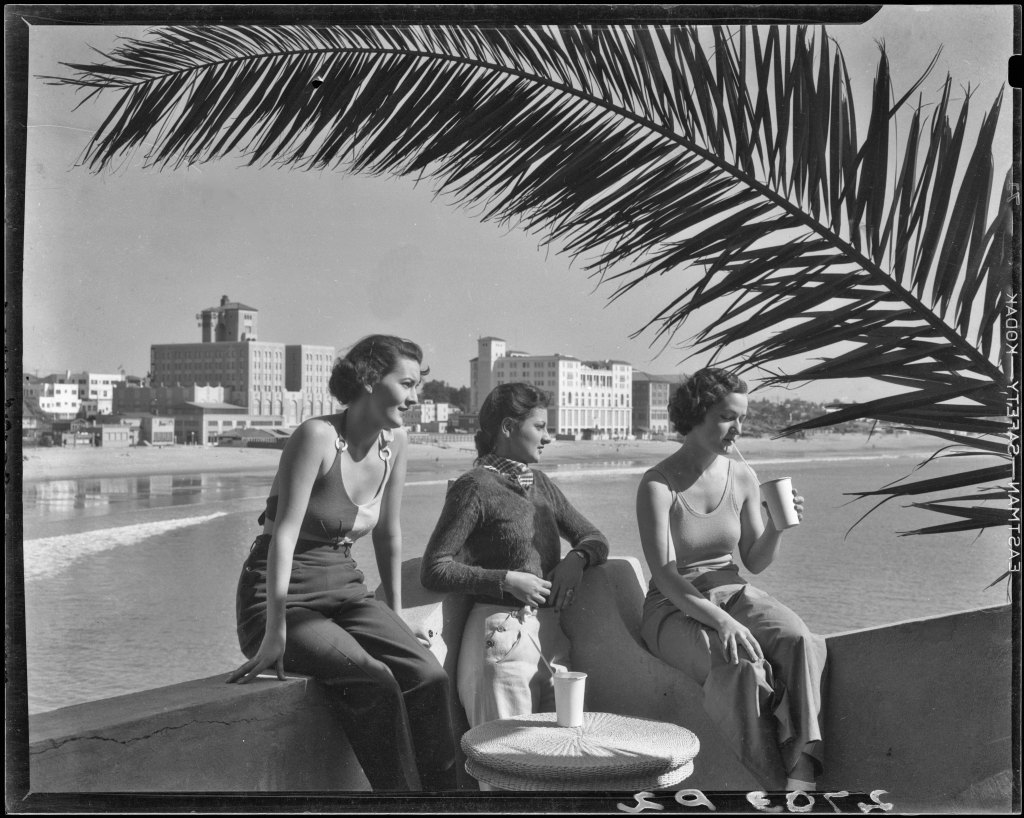
Glorious California: Some Photographs from UCLA’s Bartlett Collection.


UCLA’s Adelbert Bartlett Collection has superb, hi-resolution images from the work of a commercial photographer who lived from 1887-1966 and worked in Southern California in the 1920s through the 1960s.

It was a time when this state was considered the pinnacle of glory, a place where aviators, sportsmen, golfers, movie stars, and athletes played and worked in brilliant sunshine under smog-free skies; swimming, water skiing, boating and hiking through deserts, mountains and parks.

As we endure cataclysmic natural disasters and allow unnatural disasters, such as homelessness, to overtake our state, we have to look back to how the Golden State operated when economic conditions were truly bleak.

We have brought ourselves, by our own powers, to a time and place of our own creation, and our California is a product of our human strengths and weaknesses, a society which can go up or down, in a natural environment which is now turning deadly as it is heated up by carbon.

Way before people understood that our planet might perish by our own hand and not God’s, California took stock of its good fortune and erected a real place out of fantasy.

How did such phenomenal architecture, science, sports and innovation happen here in the early and mid 20th Century? What can we do to restore the optimism and leadership that once made California the envy of the entire world?

Can we bring back the pristine, polished, glimmering, spotless world that once existed?

Photographer Development.


Leland Lee Portrait, originally uploaded by Here in Van Nuys.

I was back in Palm Springs yesterday, planted like a palm tree amidst the gorgeous oddness of its windswept spotless streets, sitting at Starbucks amongst groups of people who looked as if they were from an elderly Mid-Western tribe.

On this day I was acting, as I always do when working, as a videographer. A writer friend had invited me along to assist him for an interview with 94-year-old Leland Lee, a photographer, who had shot the concrete space ship Elrod House in 1969.

The Elrod House, designed by John Lautner in 1968, is a home so iconic and so very weird. Like the latter part of the decade in which is what built, The Elrod is unhinged and sybaritic, self-absorbed and spacey, built for joy and sex and parties, featured in a James Bond movie and now on sale for $14 million.

Giant egos surely must have matched horns in the desert, 43 years ago, when architect and client carved and bulldozed the massive circular house onto a high mountain overlooking Palm Springs.

Architect and client are long dead, but living, still very much alive, is short, smart, stylish and self-effacing Leland Lee, who was only born in 1918, and achieved Mid-Century acclaim for assisting Julius Shulman in the photography of Los Angeles at its Post-War acme.

I have always hated the title “assistant”, having worn the dog collar myself, but here was an accomplished individual whose body of work burned up in a fire 10 years ago, but who still carries himself with a noble kindness and generosity.

Brown leather pants, a white linen jacket and printed silk shirt with a purple necklace, this was what he was wearing yesterday, and if clothing can give some indication of character, than Leland must be an eccentric, artistic, self-confident person, and that is how he introduced himself yesterday.

We drove up a long road and passed guards who ushered us into a cave-like driveway, and we entered the dark, soaring, circular living room where Leland’s framed photographs hung on the walls, and where we would film him as he spoke about each image.

What emerged from the interview was his quiet verisimilitude and the dignity of a gentleman who, without exaggeration and with calm exactitude, spoke about his photography and his life; his triumphs and his tragedies, with focus, clarity, deliberation and observation.

I was there, almost to witness and maybe to absorb a moral lesson of life, one that I have to teach myself continually, that non-conformity and truth, the willingness to be honest and to avoid grandiosity, those qualities that I think I have, will not always pay-off monetarily in the end. The 94-year-old cheerfully admitted he had never signed a contract before, and he didn’t seem to live for legal and financial judgment.

I have been battling, for many years now, between self-destruction and self-creation, wondering whether my own self-expression, in print and photo, was endangering my future. For surely Googling “Andy Hurvitz” might reveal the truth of who I was.

And then I met Leland Lee yesterday, and saw a man who had got on and survived, and did it in his own way, not always triumphantly, but truthfully.

1871 S. Aquanetta Drive.


1871 S. Aquanetta Drive., originally uploaded by Here in Van Nuys.

A photo I took, along with others, from a Thanksgiving weekend spent in the Palm Springs area.

Some people hate Palm Springs, saying it is too hot, too sterile, too artificial.

Perhaps it is, but at twilight, when the sun is setting behind the mountains, there is nowhere I’ve been that feels so calming, so warm, so otherworldly.

There is something special about the desert, even the irrigated desert, and along with the green golf courses and the stucco clone houses, there are also special and completely original neighborhoods, dating from the 1950s, where the fine art of strange architecture and sculpted plants transports one into a reverie of light and form, which I have tried to capture photographically.

The Almighty was merciful in creating only one place like Southern California. For better or worse….

And we who inhabit this imperfect, flawed and destructive region, we occasionally are seduced and awed by a light and a moment to realize that we are also blessed to live here amongst human creativity, human imagination and nature’s nature.

This was Palm Springs yesterday and this is the way it was and will always be.