The Parking Police


Sorry, garage is full at this time.


A few years ago, informally, someone named our section of Van Nuys, “Kester Ridge” even though there is no elevation here, only a continuation of the same elevation that runs from Victory to Vanowen and from Kester west to Sepulveda.

But everyone believes and uses the imaginary name, invoking it to conjure up community coherence.

The area is generally well-kept, anchored by grander houses along Hamlin St. that were built in the late 1930s when 18 acres were carved out of walnut groves. Now many of these homes are being carved into concrete ranchettes with car repair in the garage, and backyards denuded of trees and replaced with driveways and black Hummers. But the bucolic air of the recent past still remains if you drive down Hamlin without looking right or left.

To the north are well-maintained, solid ranch houses along such streets as Kittridge, Haynes, Saloma, Lemona, Norwich, Noble and Burnet.

These are tree-lined streets and the people who live here try to keep their homes clean. The average price of a house is somewhere around $800,000, though they rarely go over a million or less than $600,000.

Most houses have security cameras and alarms, and almost every home has been burglarized, but people are vigilant.


The recent developments along Sepulveda, the tearing down of old prostitution motels like The Voyager, would seem to foretell something positive, but new, 200 unit apartments, five stories tall, with hundreds of new parking spaces and modern, looming architecture, has instead created unease and worry in this area.

Last night, at Valley Hospital, in the community room, representatives from Councilwoman Nury Martinez’s office and a gentleman who works for the City of Los Angeles government and advises on parking restrictions, spoke about potentially creating permitted parking on our single-family residential streets.

This action would, homeowners hoped, stop the proliferation of cars and other vehicles that are now crowding the curbs, especially on streets closer to apartment buildings.

But in order for the licensed, fee-based system of placards and registration to take place, 75% of all the residents in the area would have to agree that paid parking by permission only was their preference.

That blew the gasket and infuriated attendees. They now understood that 75% of apartment units on Victory, Sepulveda, Vanowen and Kester would have to join in the clean curb party and sign a petition saying they wanted to rent out annual permits to park along formerly free streets. That will never happen.

Apartment dwellers depend on nearby streets to store their cars at night and get to work in the morning. Just like everyone who stays in a house.

There is no way to reason with people in Los Angeles who want unclogged streets, nobody parking on their street, the ability to get downtown in 20 minutes, and enough parking for every trip to the gym, Costco, 99 Ranch Market and Trader Joes.

Explain to them that $4,000 a month rental houses and $3,000 a month apartments will require perhaps four or five adults to split the rent, each with their own car.  The less rentable housing that exists, the less apartments that are built, the more these rents will increase.

Victory Bl. east of Sepulveda, Van Nuys, CA 5/10/18

Why are some people sleeping in tents? Or cars? Or RVs?

Every political and social problem evaded ends up costing us in other ways.

Along Victory Boulevard, west of Sepulveda, as along many other streets, I witness the morning rush hour of single occupancy drivers sitting still as they wait for the light to change at Sepulveda, right in the midst of “Midvale Estates” where there are only single-family houses.  If apartments cause congestion, why is this picket-fenced bastion of Ozzie and Harriet clogged?

As for parking, there are very few people who still park their car inside their garage. The garage is now a storage unit for boxes, belongings, etc. The cars that are once sat inside are now on the driveway, and perhaps the curb.

Sorry, garage is full at this time.

A tiny, white house is rented. And the people who live there have four cars, and none of them are parked inside the home.

There is also conspicuous consumption in this city, a style of showing off cars that means that vehicles are put outside where everyone can see you are making it with your BMW and Mercedes even though you haven’t held a full-time job in three years.

That is repeated all over Los Angeles.

Los Angeles is the second largest city in the United States, yet many who live here cling to the vision that it should function like an efficient, low-density town in the Midwest.

The car should be everywhere, at our disposal every hour of the day, yet it should somehow disappear if it belongs to someone else.

When visionaries present a city of road diets, bike lanes, denser housing near transit lines, that’s when the panic starts.

And we go back to planning our lives around everything for the car. And idle in rage.

SaveSave

SaveSave

SaveSave

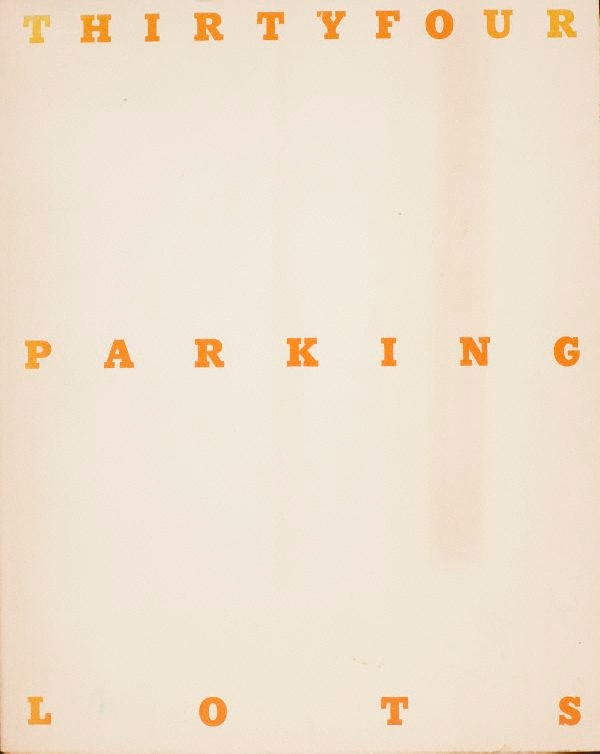
Thirty-Four Parking Lots in Los Angeles (1967)


Thirty-Four Parking Lots in Los Angeles (1967)

I previously wrote about this topic in 2014, but bring it up again as Los Angeles, and the State of California, are now in a furious debate about housing, cars, homelessness and how best to build.

All B&W photographs below are by Ed Ruscha. 


Ed Ruscha’s “Thirty-Four Parking Lots in Los Angeles” was published 51 years ago.

The artist, born in Nebraska in 1937, came to this city in 1956 to study at the Chouinard Art Institute. He also had an apprenticeship in typesetting.

Graduating in 1960, only 23 years old, he started working at an advertising agency doing graphic design. Influenced by the works of Jasper Johns, Robert Rauschenberg, Andy Warhol and Roy Lichtenstein, Ruscha was featured in a 1962 survey called “New Painting of Common Objects.”

That year he published “Twentysix gasoline stations” and later “Every Building on the Sunset Strip.” (1966)

He was the first, or perhaps the most notable artist, to create a deadpan, earnest, unesthetic photography of built Los Angeles. He looked, without pretense, at the sprawling, cheap, roadside city of billboards, car washes, instant apartments and filling stations and wrapped up his black and white photographs into little, smart, best-sellers.

Ruscha was talented and knew how to sell things, always a winning combination in the city of angles. (intentional)

The 1960s was a dirty flood of bitter reckoning that hit America and threw cold water on its made-up, powdered face.

Assassinations, sexual relations, racial issues, drugs, protests, music, environmental desecration, Vietnam: the entire decade blew up a contented self-image.

A nation, which thought itself a beacon of light onto the world, was forced to reconsider its own grotesque violence and misunderstand it.

Confronting Los Angeles, Ruscha presented a homely city with a picture book full of raw honesty.

State Board of Equalization 14601 Sherman Way, Van Nuys, CA.
May Co. 6150 Laurel Cyn NH

Inside “Thirty Four Parking Lots in Los Angeles” are some aerial shots of ordinary Van Nuys, North Hollywood and LA in 1967, with those enormous oceans of parking lots floating boat-like buildings.

Up in an airplane, looking down, Ruscha captured lines and boxes transposed upon the land, asphalt which looked, on its surface, much like the curtain-walled office buildings of that era.

Goodyear Tires 6630 Laurel Cyn NH

Good Year Tires at 6610 Laurel Canyon in North Hollywood occupies only a dot atop a long “I” shaped land-mass of parking.

Dodger Stadium

Dodger Stadium is buried deep within the hot skins of asphalt, a vaginal shaped structure where men played ball.

7101 Sepulveda, Van Nuys, CA.

And 7101 Sepulveda, a now abandoned office tower near Sherman Way, has trailers and motels on its perimeter, as well as plenty of free parking. Today, this area often hosts large encampments of homeless people, so the peripatetic ways of Van Nuys have historical precedent it seems.

Eileen Feather Salon 14425 Sherman Way, Van Nuys, CA.

14425 Sherman Way was called the “Eileen Feather Salon” and has but one long building fronting Sherman Way with parking in back.

Today, that corner is a cacophony of grossness and visual pollution including donuts and Denny’s. Signs are everywhere. And the weary eye becomes nostalgic for the simple joy of a lone building and its parking lot set down on arid land in the once less populated San Fernando Valley.


7128 Van Nuys Bl. 8/5/14

We are now engaged in a great civic debate about housing, and public transportation, and some voices hope (mine included) that denser buildings along bus and train lines will help alleviate high rents and homelessness.

Yet we never quite escape the trap set by the automobile: where to drive it, where to park it, how to best accommodate its needs.

Every single debate about new buildings always begins and ends with parking. Tens of thousands sleep on the street, families cannot afford rents or mortgages, developers are hamstrung providing parking for everyone and their guests, and Los Angeles dies a little each day from auto related illnesses.

Every time we think we are biking or busing more, something sinister comes onto the scene, and we now have 100,000 Ubers and Lyfts clogging the roads, and making our lives more hellish even as we praise their conveniences.

We plan a light rail down Van Nuys Boulevard and the auto dealers like Keyes stop it at Oxnard. They still run things. They destroy the city, and they are congratulated and worshipped for it. Thousands of their new cars are stored at outdoor transit adjacent parking lots built by Metro with taxpayer funds. Ironic.

Every time we imagine we are free of the car, we are forced back into it to chauffeur little white kids to school in better neighborhoods, to commute to $10 an hour jobs, to spend three hours every day in our vehicle so we might live in a house that consumes 50% of our income. Madness.

Ed Ruscha’s simple aerial photographs of parking lots are still a fact-based statement of what this city is. And how we are all swallowed into it.

Goodyear Tires 6630 Laurel Cyn NH

The Snack Pit.


Olivia DeHavilland in "The Snake Pit" (1948)
Olivia DeHavilland in “The Snake Pit” (1948)

There were plenty of pizzas and sodas at last night’s meeting of the Van Nuys Neighborhood Council.

Exasperation was the theme of the meeting.

Ten tables long, the Van Nuys Neighborhood Council has now grown, along with waistlines, to encompass twenty people; and the length of the officials with made-up titles now almost pours out onto the sidewalk.

As usual, there were older white women bemoaning the appalling conditions of Van Nuys, including people sleeping on the streets and the poor condition of trash containers on Van Nuys Boulevard, where no humans shop, walk or eat unless they are forced to.

This being Los Angeles, the heartfelt sympathy and emotionality was in evidence for those problems related to the automobile. The situation for one resident was dire. This man lived in a one-car garaged house on a certain street with two hour parking. He had no driveway. His vehicle was being ticketed. Couldn’t someone help him he asked in a ten-minute exchange.

First I cried because I met a man with no eyesight, then I cried because I met a man with no garage….

A woman got up to talk about someone and something that had touched her heart. She was almost in tears, but I had trouble understanding what brought her to the brink.

Another man who runs the “LICK” Committee spoke about by-laws and promised to help the man who lived in the house with the garage on the street with two-hour parking.

An elderly man got up and said it was not right. And a half hour later his wife got up to speak and said it was wrong and should not be tolerated. What it was was anybody’s guess.

Outside the meeting, Van Nuys Boulevard, Heart of Van Nuys, was deserted, its eight lanes of traffic and empty shops somehow not appealing to hipsters, late-night dinners, and romantic couples out for a date.

Despite the utter evident failure of Van Nuys as a civic and commercial entity, the Assemblyman Adrin Nazarian spoke to the gathered on all the issues he was working to solve and his agenda seemed at times to be larger than the Planet Earth.

Transportation funding, cutting tobacco use, gun control legislation, minimum wage increases, climate change action, renewable energy, earned income tax credits, cap and trade issues, green spaces, affordable housing, earthquake warning systems, VA drug prices.

Assemblyman Nazarian checked off an impressive list of issues whose resolution, if that day comes, promises a heavenly San Fernando Valley free of expensive housing where green spaces and reliable public transport shuttle people around to health care; where affordable drugs and professional medical help is there for one and for all, legal and illegal, young and old, vet and non-vet.

Two hours into the meeting, a sour faced group of old men in tan, anxious to present their proposed hundreds of units of housing to the VNNC, had barely any time to talk of the truly huge changes that might be coming to Van Nuys Boulevard.

And the architect with the $20 million apartment and retail project was told to come back next month as time had run out.

I forgot to mention the board members arguing about plastic bags.

Priorities always at the VNNC Snack Pit.


Keyes Van Nuys Rents METRO Busway Parking Lot.


DSC_3232

DSC_3233

DSC_3235

DSC_3238

screenshot_279

The publicly financed METRO has found a new way to earn some cash.

They are renting out about one-third of the Orange Line Busway parking lot to Keyes, Keyes, Keyes, Keyes in Van Nuys.

The lot, at Erwin near Sepulveda, was built, in the LA way, for bus riders to park their cars while they ride their bus and bike.

Someone very wise and very powerful at METRO must have concluded that most bus riders don’t own automobiles. So why not earn some bucks renting an enormous expanse of asphalt, planted with many hundreds of trees that lies fallow and unused?

The lovely neighborhood which abuts this lot to the north has been justifiably paranoid about proposed development plans which have included hundreds of town homes, office buildings, and potential additional retail stores. Hemmed in by the 405 Freeway, nightly helicopters, noxious fumes, prostitutes, trash, illegals and pimps on Sepulveda; oil storage tanks, psychics and speeding psychotics, the homeowners in these rose-covered cottages can do little about their immediate environment but rent out their properties to movie companies.

Perhaps a very large car park, rented out on public land to private industry, is a good thing. Nobody makes noise. Parked cars are silent and quite neighborly.

So for now the publicly paid for land is being used in that most characteristically Angeleno way, as a home for cars.

Link

Handicap Parking Abuse.


Lululemon


Image

One of the more egregious and self-centered driving behaviors in LA involves the abuse of the handicapped parking placard.  It is especially prevalent in the richer sections of the city, such as Beverly Hills, Encino and Studio City.  It is almost predictable that if a brand new BMW or Mercedes with a blue sign is parked in a disabled zone, it will be a con.

Such was the case today in front of Lululemon, a sports clothing store selling $98 spandex clam diggers and the $58 Yoga Halter top.  A 40-year-old woman, athletically bounced out from the store, hopped into her Center BMW SUV and sped off down Ventura.

Parking Lights: Century City, Los Angeles.