Densmore and Stagg, N. of Saticoy.


Drive west on Saticoy St., past the 405 and turn right/north, onto Densmore Avenue. 

You are still, according to Google Maps, in Van Nuys. (all apologies to Lake Balboa, which seems to have some fourteen boundariesaround its neighborhood.)

On Densmore, near Stagg, you’ll find, as I did, a neat, monotonous, hard-working district of small companies; mostly hidden behind bricks and barred windows.

Creative Age Productions at 7628 Densmore is there. They publish beauty magazines. Nailpro, Eyelash and Dayspa are some of their best-known publications. These titles are often competing with mirrors for customer attention.

They are neighbors with: Superior Shipping Supplies, New Rule Productions, Regency Fire Protection; and Kedem Properties, 7752 Densmore, which sounds like a Kosher wine but is actually a commercial property company. 

Black Sheep Enterprises, at 15745 Stagg, manufactures theatrical and stage drapery, a specialty one cannot buy off the shelves of Target.

The Katsu-Ya Group at 15819 Stagg owns nine sushi restaurants around the Southland. They are incongruously housed in a white and brown brick Mexican style building with arched designs.

Katsu-Ya Headquarters at 15819 Stagg St.

And the American Rubber and Supply Co. at 15849 Stagg St. has been in business since 1947 and is a supplier of industrial rubber products. Your car mat, your yoga mat, and your kitchen mat, next to the kitchen sink, might have all come from here.

New Rule FX at 7751 Densmore makes special effects props and supplies for movies, TV and theater. If you need piles of fake US currency, realistic cheeseburgers in rubber, or a room full of exploding balsa wood furniture , then this is the place to shop.  Their free-floating, fantastical, imaginative fantasies are constructed behind a dismal, prisonlike façade of white cinderblocks and steel bars.

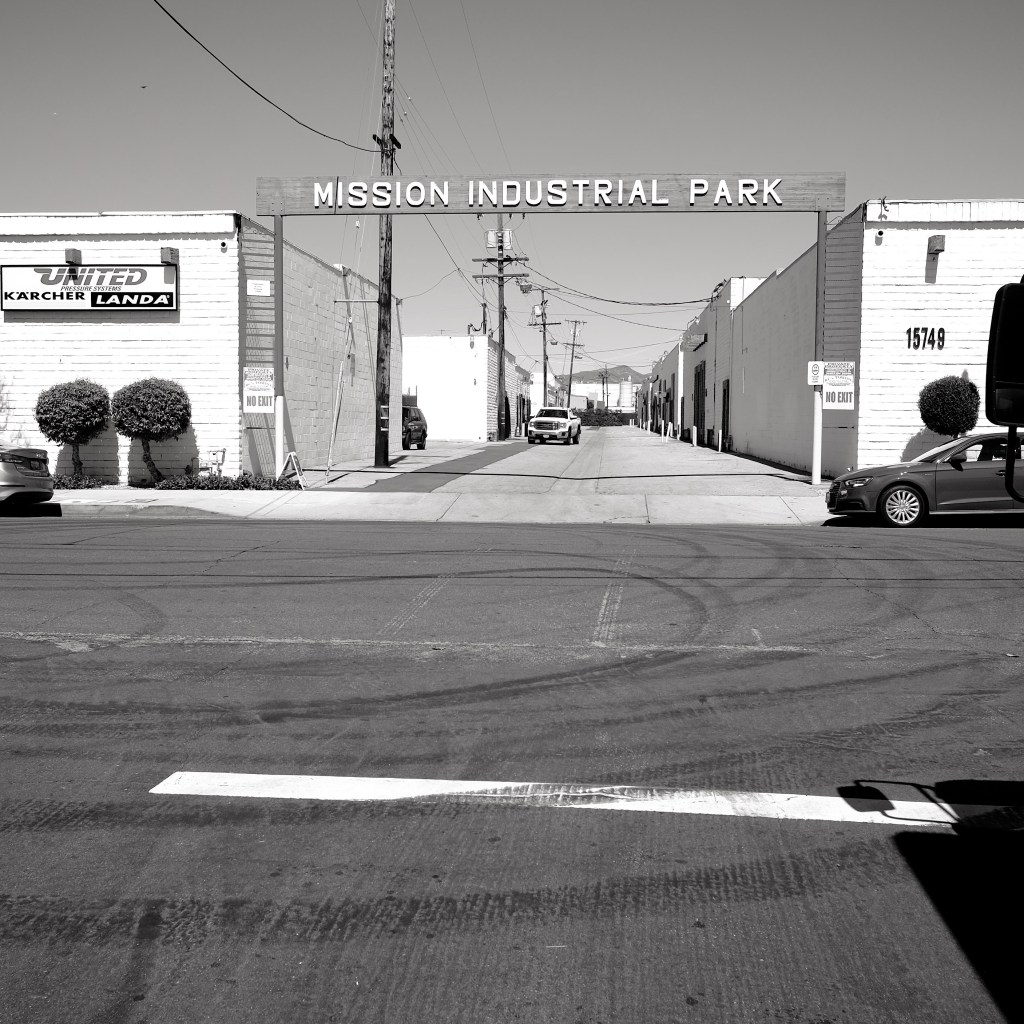
Where Stagg St. bisects Densmore Ave is Mission Industrial Park, announced by a two-posted, two-fisted, old Western kind of sign with raised letters on a wide wooden board hung 20’ high over the street.  It welcomes you to a white-walled alley of various buildings presumably under one owner who felt compelled to establish an identity for her vastly unremarkable assemblage.

Mission Industrial Park.

We went all around here, on public sidewalks, a few days ago, to shoot some photos for a mens’ fashion brand called Magill Los Angeles.  

James and Carter were the models.

Along Densmore Av. Carter (L) and James.

James was 19 and had long blonde hair and said he was born in South Los Angeles but had moved with his father to North Dakota. He was now living in New York City and visiting Hollywood to strike up a modeling career. He had the dazed and confused 70s aura from juvenile and stoned Reseda. He works at McDonalds now but may well be famous in 2029.

Carter, actor, came from North Carolina and was well-read, articulate and sensitive to both words and pollen.

James

The day was sunny, the wind was blowing, the boys were happy and we went to eat tacos later at Tacos Hell Yeah which they said was their best ever meal in LA.

Tacos Hell Yeah
7607 White Oak Ave, Reseda, CA 91335

____________________________________________________________

Those industrial compounds, like the Stagg/Densmore District, are the hidden places in the San Fernando Valley that nobody knows about. 

Tidy, productive, industrious, they are the old lifeblood of Los Angeles, where your late Uncle Bernie, with the cigar in his mouth and the bad gallbladder, set up shop after the war and bought a three bedroom, rock-roofed ranch up on Zelzah Avenue with a delightful kidney-shaped pool.

He had little patience for tears, or men who didn’t know the difference between a wrench or a pliers, having served up ice cream at Montgomery Ward until he enlisted in ’42 and saw action at Guadalcanal. He was never bored, because he was always busy, and you vowed you would never become Uncle Bernie but you’ve done quite worse, haven’t you? He had work and a family, and a company, and a paid for house and you made fun of it, but now life laughs at you.

Aside from the work that goes on inside these shops, there is nothing to do in this area for someone in search of stimulation. Densmore and Stagg and parts around here are boring, without street life. Yet men and women in these enterprises are engaged in work, absorbed in inventions, and creating products that are, in many respects, quite interesting.

Along Stagg St.

Magill: Target/N. Van Nuys
(Not near the Densmore/Stagg/ Mission Industrial District)
James on the Raymer St. Bridge, Van Nuys, CA.

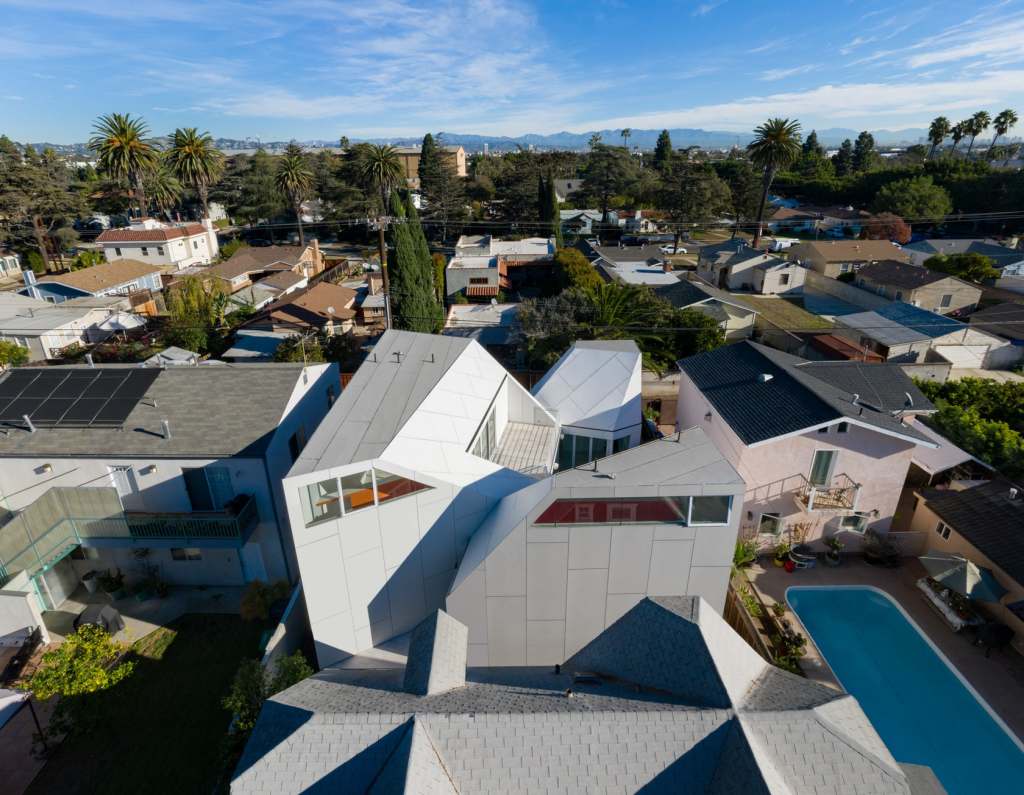
Glamorous Granny Flat.


All photos: Eric Staudenmaier

The Accessory Dwelling Unit (ADU) is a second house built in the backyard of a first house to provide additional income for a “single family” homeowner.

Los Angeles has now legally liberalized the lawto allow these types of dwellings to go up all over the city. The moral reasoning: this will increase the supply of housing in a city where rents, not to mention costs, are skyrocketingly expensive. 

The so-called maximum square footage of the ADU is 1,200 SF but the one on this page is 1,600 SF.

One can imagine less beautiful and less artful types of ADU’s going up all over this city. 

The $99,000 vinyl and stucco ones that will go up in Van Nuys will be built without architects. Hector and his crew will dig, hammer and nail and the Home Depot and Ikea will supply. Four recent college grads from film, acting, and comedy schools will move in and split the $4600 a month rent with parental assistance.  

So the tenants will not be someone’s granny.

What will likely occur is a kind of typical Los Angeles situation. Property owners will build in the backyard and in a slapdash way shove driveways in front, destroying trees and lawns to create more parking. Security gates and cinderblock fences and concrete will serve as front yard landscaping.

More renters will mean more cars, so almost every street that once was clean of vehicles, will have bumper-to-bumper cars belonging to renters who live in the backyard house. Curbs will be full of McDonalds wrappers and discarded beer bottles.

That’s the Van Nuys way.

I don’t, ironically, object to ADU’s. If every ADU looked like the one on this page, it would be wonderful for architecture in Los Angeles to see a proliferation of fine design.

But the bottom of the barrel ugliness that is the norm, not to mention the cost of construction, ensures that the homely, crowded, poorly thought out ADU will prevail. 

And the ADU on this page will never become the home of a working family. It is, most likely, a guest house for an affluent owner, or perhaps an $8,000 a month rental. So increasing the ADU supply will hardly affect the supply of normal, affordable rentals in Los Angeles.

Credits: Architizer

FIRM

FreelandBuck

TYPE

Residential › Private House 

STATUS

Built

YEAR

2019

PHOTOS

Eric Staudenmaier

One Story Town


One Story Town is Sepulveda Bl., from Oxnard St. north to Victory Bl.

It is 2,569 feet long, almost a half a mile. It encompasses the Orange Line Metro Busway, LA Fitness, Costco, Wendy’s, Chef’s Table, The Barn, CVS, Dunn Edwards, Bellagio Car Wash, Wells Fargo Bank, Enterprise, Jiffy Lube and other small businesses selling used cars, folding doors, RV rentals, Chinese food, hair cutting, and ceramic tile.

The Southern Pacific freight trains once ran through the present day Orange Line, and they fashioned the district into a lumber- oriented, light industrial area. Such behemoths as Builder’s Emporium were located here, and the stretch of Oxnard that borders the old rail line has retained an industrial use.


The zoning designations for almost all the parcels along Sepulveda are commercial. They prohibit residential within walking distance of the Orange Line, and they prohibit it even though buses run up and down Sepulveda!

A beautifully maintained bus stop perfectly sited for long waits in 110 degree heat.

Available online for public research, is the Los Angeles’ ZIMAS, a website run by the Department of City Planning. Here one can select a parcel, for example, 6206 Sepulveda Blvd., where The Barn furniture store is located, and see that it occupies two parcels totaling 44,250 SF. It is not, according to ZIMAS, in a transit-oriented area, nor is it designated as a pedestrian oriented one, nor is it part of a community redevelopment one.

Someday the owners of The Barn, which has sold, since 1945, brown stained furniture in heavy wood to seemingly nobody, may choose to sell their business. And here there is enormous potential to develop a first-class residential and commercial building just steps from the Orange Line.

Residents of Halbrent St. just east of The Barn and other businesses, are on the ass-end of parking lots, illegally parked homeless RVs, and are subject to the use of their street as a speedway for cars entering and exiting Costco. Maybe, just for once, Halbrent St. might see a better development on its west side.

Every single one of the businesses, up and down Sepulveda, between Oxnard and Victory, is located, by observation, in a transit- oriented area. Yet ZIMAS states they are not.

Perhaps that will change as Los Angeles reviews its zoning, and permits taller, denser, more walkable development within a 5-minute walk from public transit.

At dusk, with the early October sun hitting the one-story buildings, there is a homely, lowbrow, neat banality to the structures along this stretch.

This is not the worst of Van Nuys. It is generally tidy. But nobody living nearby, some residing in million-dollar homes, would come here to mingle, to socialize, to sit and drink coffee, eat cake, shop or walk with their kids after dark.

Studio City has Tujunga Village.

Tujunga Village, Studio City, CA. Photo by John Sequiera.

And we, in Van Nuys, have, this:

The One Story Town: what is it and what could it be? Might this district, one day, contain vibrant restaurants, outdoor cafes, beer gardens, garden apartments, parks, trees, flowers, fountains? Why not?

In planning for 2027, 2037, 2047 and beyond why would we keep the preferences of car-oriented, suburban dreaming, 1975 Van Nuys, in place? Why are thousands of parking spaces at the Orange Line Busway used to store cars for Keyes Van Nuys? Is this the best we can do?

Could not a group of architects, developers, urban planners, government leaders and vocal citizens devise a Sepulveda Plan to transform this wasted opportunity into something better, or even ennobling?

Where is our vision? And why are we so starved for it when we live inside Los Angeles, the greatest factory of imagination, illusion and improvisation the world has ever seen?


Day of the Bulldozer


dscf0486
6500 N. Sepulveda

On N. Sepulveda Blvd., between Victory and Vanowen, three apartment projects are now underway.

At 6500 N. Sepulveda, the former site of the notorious Voyager Motel is completely cleared. It was a crack-y whorehouse of ill repute. But also a patriotically, quadrennially decorated neighborhood-voting place. It burned in a gratifyingly appropriate fire earlier this year.

The 53,382 square foot parcel is now void of anything natural or man-made. It is simply flat, vast and magnificently empty. It emulates Van Nuys, as it might have been in the late 1940s, when tracts of orange and walnut groves were bulldozed to make way for ticky-tacky houses and shopping centers.

An apartment is planned for this site. I don’t remember its design, but if it follows any of the other projects in Van Nuys it will come by way of big and boxy, designed by big and boxy men, near architects who also moonlight as junior builders, and amateur bankers. It will be three or four stories tall and cover every square inch of land. Parking will be provided in excess of what is needed because the most important feature of any project in Los Angeles is how many parking spaces are provided. We need more parking. And just a reminder: Please make sure there is parking. Everywhere.

dscf0484
6500 N. Sepulveda

At 6536 N. Sepulveda, on 28,146 square feet, another apartment is going up. This is on that charming stretch of the street where new hookers walk and old couches come to die. Nightly helicopter patrols and pounding rap music enliven the air. A house was recently bulldozed here and gargantuan sized orange bulldozers now occupy the parcel.

dscf0491
6536 N. Sepulveda


At 6725 N. Sepulveda Blvd, on 30,647 square feet, between Archwood and Lemay, another flat and modern multi-family is planned. This was the site of the low self-esteem Ridge Motel, whose police reports and trashy clientele attested to a level of service usually seen only in jails.

4-28-16b
6725 N. Sepulveda 4/28/16

4-28-16
6725 N. Sepulveda 4/28/16


dscf0498
6725 N. Sepulveda 10/24/16

The Ridge Motel, still a menace in its dying days, was kept behind security fencing, like King Kong in captivity. Its campy, catapulting roofline was somehow not in the sights of the LA Conservancy, whose members work tirelessly to preserve other historical buildings such as bowling alleys  in the San Gabriel Valley.

The rose-bushed, picket-fenced hood of working moms and worked-out fathers bordering these three Sepulveda Blvd. properties are relieved that some badness (and discarded condoms) has departed. Some see the Day of the Bulldozer as Saul saw Jesus. Sin cleansed by salvation.

teardown-2
14827 Victory Blvd. 6/14/15 DEMOLISHED

teardown-1
Vintage Auto Repair 6200 N. Kester Ave. 7/9/15 DEMOLISHED

581092427_9a5f27e470_o
The oldest house in Van Nuys, once owned by the original developer, WIlliam Paul Whitsett, is cleared for condominiums. 6/7/07 DEMOLISHED

Bulldozers are like angels in Van Nuys. They are sent by the Good Lord to flatten and knock down anything standing in the way of new banality. Even when they are used to destroy history, they have a mission. They will bring, don’t you know, “jobs” and “opportunities” and “housing” to the San Fernando Valley.

We see the stuccofied greatness of our environment every day, along Vanowen, Sepulveda, and Van Nuys Boulevard. Someone, somewhere is surely looking out over all this destruction and construction, making sure that the architecture and the design enhances our landscape.

Or perhaps nobody is in charge. And we live in a kind of roulette table of a city, spinning a wheel and hoping that the building that lands next to us is a winner.

The Void at the Center


dscf0045 dscf0044

If desolation, emptiness, and gigantism are attributes in architecture, then the buildings around the Van Nuys Civic Center achieve glory simply by virtue of their nihilistic presence.

dscf0031

For here, on the streets bounded by Van Nuys Boulevard, Calvert, Sylvan and Tyrone, is a void at the center of Van Nuys.

As a real place it functions only as a photographic metaphor for enormous potential wasted in sheets of concrete and glass.

"L'Ecclisse" (1962)
“L’Ecclisse” (1962)

Michaelangelo Antonioni’s “L’Eclisse” (1962) set its alienated characters inside the vacated EUR district of Rome, Italy dreamed up during Mussolini’s time. Our Van Nuys, the post-war place of big government, benevolent institutions and perfect planning, came of age at the same time.

But it’s all a miserable failure, a disfigurement, a monstrous banality.

dscf0041 dscf0040 dscf0037

In the middle of the day, there are barren plazas, empty arcades, ribbons of cleared sidewalks.

But even dying, there is a weak, faint cry to just do something. It is chronically ill Van Nuys asking, begging, pleading…. for resurrection and recognition.

In its empty post office, in the blank walled State Office Building, in the rows of vertical windows slit into the yellow brick mass of the James C. Corman Federal Building, in the vast parking lot of gravel, chains, walls and a NO ENTRY sign behind The Superior Court Building, the whole mass and substance of the district is on the gurney in the ER hoping for resuscitation.

dscf0030 dscf0026 dscf0025 dscf0021

At the center of Van Nuys, in the historic heart of the San Fernando Valley, in a place that is now 105 years old, nobody willingly visits . They arrive, instead, in handcuffs or carrying legal papers. They are under subpoena, on jury duty, in custody, filing a complaint or reporting a crime.

And that is our civic center story.


The Once and Future Panorama City.


DSCF0633
In Panorama City near Roscoe and Tobias, a once bustling shopping center, housing a Montgomery Ward and Electric Avenue, sits in desolation and decay.

Acres of asphalt, decorated with some tree islands, surround windowless buildings paint washed in blues, pinks, grays, and greens.

A bustling, prosperous, crowded shopping center closed down and emerged as a 21st Century ghost town. The stores died but the ghosts are alive.
DSCF0644

DSCF0651

Los Angeles is like that. A wagon train of commercial banality moves around the city, setting up camp every decade and replacing what came before it. Melrose and Westwood were hot in the 80s and now it’s Santa Monica. Downtown LA was dead for so long. Now it is ascendant, and should stay that way until about 2030. Culver City is competing against Century City. Pasadena is jogging to keep in place, and upstart Glendale is emulating Beverly Hills.

And Reseda, Panorama City, Van Nuys, and Northridge are on life support.

Up there at Roscoe and Tobias something so vast and so important, a place that hundreds worked in, and thousands shopped at is gone, and waiting for a new huckster and a new plan.

What follows is purely imaginary but may contain some grains of truth.

No doubt, when the powers that be ordain it, it will be “mixed use” and appear gentle and green and village like. There will be fountains and benches and lounges and 14 movie theaters and 2 Costcos interspersed between senior living, child friendly, family welcoming, diversity hiring, green-certified and wifi-enabled promises.

The LA Times and the Daily News will write about it. But nobody will read it. An uninformed citizenry is the best choice for a nation hoping to remain powerless or for a community uninterested, unprepared and unlearned in its own future.

There will be a groundbreaking event with Mayor Eric Garcetti, Councilwoman Nury Martinez, LA Philharmonic Conductor Gustavo Dudamel, the St. Genevieve Catholic Church Choir, the Kaiser Permanente/Westfield Mall Hospital Executive Board, along with LAFD red fire trucks, LAPD black and white police cars and actors Eric Estrada, Mario Lopez, Eva Longoria and Jennifer Lopez. KCAL will interrupt regular broadcasting to cover “breaking news” here.

Today’s event marks the revitalization of Panorama City!

This is a new day for Panorama City with walkable, urban living 20 miles north of the city center.

This will be the finest shopping center between Van Nuys and Pacoima!

When civilization comes to Los Angeles it has to be underwritten by banks, the Chinese Government and the Westfield Corporation.

I imagine it will be centered around walking. But no buses will stop here.

There will be 100 affordable income apartments renting for $2800 a month, and 4,000 market priced units starting at $800,000.

There will be an 8-story tall parking structure for 5,000 cars, and 10 bikes and high-security cameras surrounding it all.

In the 110-degree heat, black spandex clad people will drive here in their air-conditioned SUVs. They’ll eat organic ice cream,  climb artificial rock walls, work out at the new 24 Hour Fitness and emerge to drink ice coffee. They will eat Unami Burgers, drink Golden Road beer, and shop at Crate and Barrel. Every weekend, three new blockbuster films will screen here, and thousands of tattooed fatties in flip-flops will pay $16 a ticket to watch computer generated toys destroy the Earth.

President Donald Trump will send congratulatory messages to the community where nobody voted for him and promise “amazing and unbelievable things” for Panorama City. Forgotten was his promise to deport which would have brought the population of the area to less than 100 people.

Or maybe none of the above will happen, and the big frontier will go on a little longer, a reminder of what shopping center life was like in 1975.

DSCF0659 (1)

DSCF0653