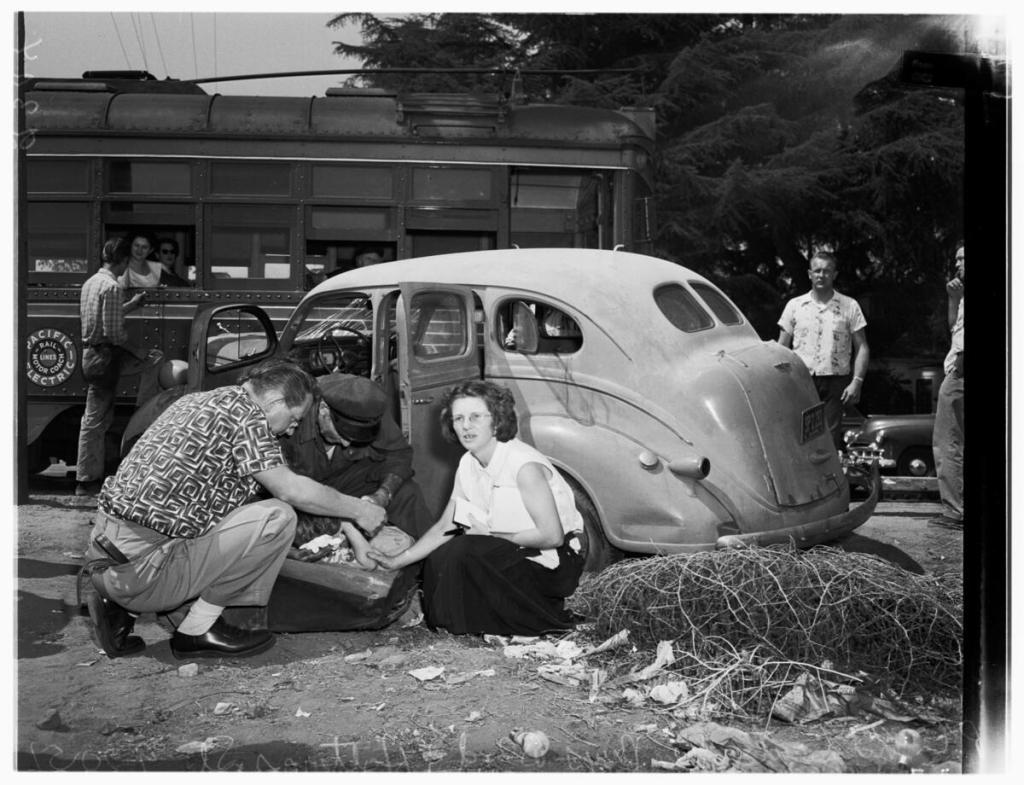
Sept.20,1951: Car Collides with Pacific Electric Streetcar in Van Nuys.


From the time it was established in 1911, Van Nuys was connected to the rest of greater Los Angeles by the Pacific Electric Streetcars that ran up and down Van Nuys Boulevard and traversed Chandler Blvd. to connect to North Hollywood.

The entire apparatus of light rail cars was dismantled by the late 1950s, and Van Nuys was wiped clean of these in 1956. Before the streetcars were taken out, Van Nuys had a thriving business district with diagonal parking, many vibrant stores, clean streets and a congenial sense of optimism and orderliness.

Van Nuys Circa 1945

On September 20, 1951, five years before their demise, an unlucky mother and son were involved in a collision with their car and one of the streetcars. It seems both mother and son survived.

Photos are from the USC Archives. Here is their original text:

“Pacific Electric versus auto (Van Nuys Boulevard and Hatteras Street, Van Nuys), 20 September 1951. Jimmy Quigley; Ann Quigley (mother); E.T. Ophus (motorman).; Caption slip reads: “Photographer: Glickman. Date: 1951-09-20. Reporter: Glickman. Assignment: Pacific Electric versus auto. Van Nuys Boulevard and Hatteras Street, Van Nuys. Passersby comfort Jimmy Quigley as his mother, Ann stands along side of him (in torn skirt). Motorman in picture is E.T. Ophus, who piloted Pacific Electric that hit Quigley’s car”.”

Trade For Print-a new short story


trade-for-print-photo-1


“Trade For Print” is a new short story I wrote concerning an unscrupulous photographer who lures a postal worker into fraud by offering young love for sale.

The piece, entirely fictional, of course, takes place in North Hollywood and moves around on local boulevards and avenues: Chandler, Colfax, Bakman, Lemp and Lankershim.  And includes such storied places as The Federal Bar, SGI Buddhist Center and the North Hollywood Post Office.


Photographer Tom M. Johnson, Lakewood, CA.


Photo by Tom M Johnson

Photo by Tom M Johnson

Photo by Tom M Johnson

Photographer Tom M. Johnson is profiled in today’s New York Times. He shoots images of Lakewood, CA finding profundity inside banality, in matter-of-fact photographs which document an ethically diverse place where neat lawns, plain houses and regular people mingle.

How to Succeed Without Even Knowing


SMASHBOX FACE/OFF, originally uploaded by ClaytonLePanda.

Did you know there is something called A Month of Photography LA featuring exhibitions, lectures, and discussions? The Lucie Foundation is the organizer of many events for photographers and those whose livelihood (or lack of one) is connected to the visual world.

Last night, I drove down to Smashbox Studios in Culver City where black shirted PA’s were busy folding up many hundreds of folding chairs inside vast white-walled spaces. I’ve noticed that much of the long hours spent in production involves unfolding and folding up portable seats.

A panel discussion, attended by over 100 people, listened to “New Media” art directors, photographers, photo agents and a website blogger ruminate on how the “wonderful” new virtual world of photography is being remade by those who live inside Facebook, Twitter and Zineo.

There are many thousands of photographers and would be creatives in Los Angeles, most of who work at jobs and in areas completely divorced from their real passion. But the six persons on stage last night, have somehow made names and money for themselves by positioning their work in the front and center of digital imagery.

Rob Haggart was the moderator. He writes aphotoeditor.com
where he uses his background as the former photo editor of Men’s Journal to advise a photographer on how one might market herself in the iPad era. Soft spoken, silky haired, with a smooth face, black thick frame glasses and a plaid shirt, he radiated a confidence and heft earned from early success and posting daily bromides. He has a company that builds websites for photographers.

Jen Jenkins is the principal of Giant Artists, a photography agency. She has a roster of 8. Eight. Friendly, optimistic, youngish, she looks like a gal who you might meet in an Oakland muffin shop or making organic soap in Portland.

Ms. Jenkins’ clients were also on the panel, Jeremy and Claire Weiss, who shoot photos and blog and Twitter and Facebook and gallery themselves up in Highland Park.

The most corporate and seemingly the most business savvy on the panel was Heidi Volpe, former art director of the LA Times Magazine and now design director at Zinio. She seemed to actually hold and succeed at her corporate creative job, one in a long line of jobs where she chose and promoted and assigned professional photographers. Now she is showing National Geographic how to convert its vast name and assets into digital content.

Kiino Villand is a photographer who has launched an online magazine WSTRNCV. He reminded me of me because I could not exactly tell what exactly he does, what he is selling, or what he is aiming for. His magazine is unpronounceable, but I once turned it up by Googling for “Studio City and Laurel Canyon”.

It finally came around, after 1.5 hours, to open up the questions to the audience. Twitter and Facebook, like Catholicism and Islam, are the great keepers of the mind of man, but one agnostic uttered a blasphemous word: FLICKR.

We had been told for almost two hours about how much social media matters and about how Twitter and Facebook and YouTube are invaluable for photographers. But Flickr, the largest photography website on the Internet, an international creation which links and unites lovers of photography around the globe, is somehow considered lowbrow or “for housewives who post children’s party photos” on it.

The panelists seemed lost in explaining whether Flickr was a detriment or asset to a professional photographer. “Go ahead and do it” or “We deleted our Flickr account” were the answers.

The discussion ended and the crowd of many thin, stubbled-faced young poseurs assembled into slouchy and huggy groups of camaraderie and camera talk. An unusual number of people were handsome and pretty, leading me to speculate that photography, like acting, sex, and marriage, is something to be entered into with blithe ignorance and convincing fakery.

Tomorrow would come again and somewhere someone will be texting and typing, uploading and digitizing, shooting and posing, directing and lighting and trying to succeed without even knowing.

And hopefully getting paid and praised for it.

Larry Sultan: The king of colour photography – Features, Art – The Independent


Larry Sultan: The king of colour photography – Features, Art – The Independent.

William Reagh: Los Angeles 1950’s-80’s.


William Reagh
William Reagh

William Reagh
William Reagh

110[2]

William Reagh
William Reagh

The blog American Suburb X has some great photographs of Los Angeles, shot by photographer William Reagh. Other images of Reagh’s, along with notes, can be found at the California State Library.

The photographs show a city undergoing vast demolition and reconstruction, especially in downtown LA. This was the era of urban renewal and grandiose high-rise projects. Odd movie-set type houses, strange juxtapositions of paper thin stucco cottages and exotic trees, empty moonscapes, sad fluorescent-lit cafeterias, plywood faced storefronts, decaying neighborhoods…this is what it looked like in LA, 40 years ago.
A documentary frankness on film.