Note: Photographer Paul Jasmin (1935-2025) died on May 21, 2025 in his Los Angeles home. I wrote an essay related to his work in 2010. Here it is:
There is a world of old houses on winding streets that wends its way behind Franklin up in Hollywood. I was there yesterday to assist a photographer in styling a shoot with a male model.
I am a photographer myself, but have worked in the fashion industry and love clothing. So my photographer friend and I went shopping on Saturday, down at the Beverly Center, and pulled together handsome wool sweaters, tight plaid pants, exquisitely tailored dress shirts, artful caps, and patterned scarves.
The location was his home: a 1925 Spanish style house with high ceilings, wood beams, and a warren of rooms, balconies, green tiled bathroom; art deco, sunlit and ornate, overlooking the south-facing brightness of Hollywood.
The photographer possessed a fine and expensive array of lights, various strobes, reflectors, electrical voltage devices, screens, flashes, lenses. Expensive illumination I could only dream of.
Around 10am, a young, tall, lean, polite blond man with close-cropped hair showed up. He reminded me of Brad Pitt. He had a slight twang. I asked him where he was from and he said, “Springfield, MO, Sir.” And it turned out he was from Pitt’s same town. “My mom and Brad went to high school together,” he said.
The model talked, as many do, about his busy life.
Suddenly, he was actor, not just a model, and getting parts in various shows. No college for him. He just got in his car and drove to LA and stuff started happenin’. He had a girl, also a model, and she was makin’ lots of money. Good stuff.
We two men, photographer and stylist: bruised, jaded, wiser, middle-aged; heard it from him and hoped it was true. The trajectory of success, the dream of making it, the hope of security, the lure of fame, the imagined life ahead: anything can happen at 23.
I had laid out the various looks and set about getting him into the clothes.
There is only one moment in our lives when we are young, and we do our best to rush through it, blithely unaware and carelessly ignorant of its temporal nature.
So with my admiration and envy, the tall, thin, agile man with the smooth face, metal dog tag, shaved chest and icy blue eyes, slipped into a spread-collared Tattersall shirt, wool tie, blue cardigan, driving cap, brown cords. And then he stepped in front of the camera, while 100 flashes of strobe and lens captured his every microsecond of movement.
He feigned facial expressions of aggression, longing, innocence, passion, anger. He danced around a white-walled backdrop: arms flaying, knees bending, chest puffing.
What followed were his transformations into Klub Kid, English School Boy, American Prep Student, and something that looked like gay Berlin with black combat boots and a high-waisted, tummy tucking, black spandex underwear get-up.
A few hours later, I left the house.
It was a Sunday: cool, clear, crisp, with rain-washed air.
High, white, puffy cumulus clouds floated over red-tiled roofs and magenta tinted Bougainvillea.
I had been working in a Bruce Weber/Paul Jasmin photographic fantasy inside the house. And now I was living one outside. (contd.)
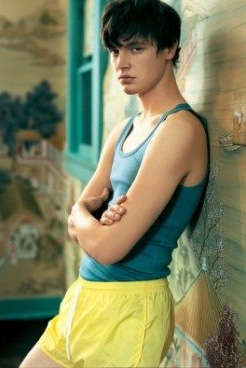
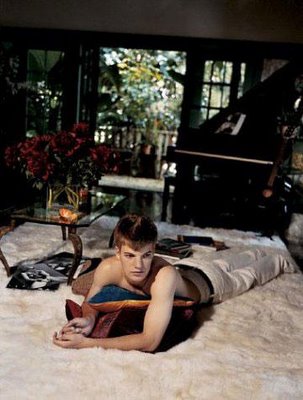
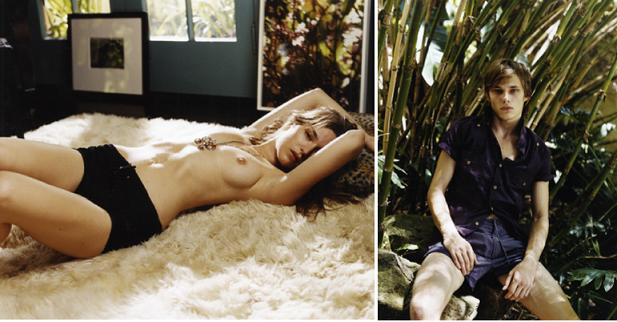
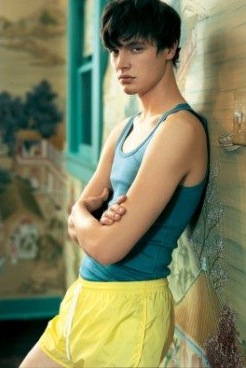
Photograph by Paul JasminPhotos by Paul JasminPhoto by Paul Jasmin
Years ago, Paul Jasmin shot some gorgeous photos inside the home of designer Kevin Haley. As I remember it, the house was somewhere in this same neighborhood. A book, Lost Angels, showed a young man on a white rug in the Haley home. There were other photographs in a room of Chinese painted wallpaper, and romanticized young men and women in front of bamboo gardens.
And I had wanted, so badly, to get inside that house, the same way I had imagined that walking up to 1164 Morning Glory Circle might lead me into the Darrin Stephen’s home and into Samantha’s kitchen.
But those are fantasies, illusions– idiotic tricks—which our media and movie saturated minds play on visitors and residents of Los Angeles.
I think I had once sent a card, the kind with a postage stamp, delivered by a postman to a mailbox, addressed to the famed designer on Pinehurst Road. I wrote him that I admired his work. I had hoped to be invited inside. But he never responded.
“Open House, Sunday 1-4” read the sign at the bottom of Pinehurst Road.
Could this be the Haley House? I walked up the road.
And like some wonderful moment from “Miracle on 34th Street”, the one where Chris Kringle left his cane inside a Cape Cod house destined to be the future home of a young Natalie Wood, the cane was left at my door and the Haley House was for sale ($999,000), and the front gate was open.
I walked up the stairs. On my left, the same shaded garden with the bamboo.
There were two levels to the house, and on the lower level, rentable apartments with old-fashioned casement windows, 1940 stoves, painted in bright colors. I walked in and said, “Hello” but nobody answered.
And then I realized that there was a second floor, and up I walked, and entered into the house where a realtor sat, glumly, looking at his laptop and muttering a tired hello to someone who didn’t matter to him.
But I didn’t care. Because there, in front of me, was the dining room with turquoise painted Chinese wallpaper and the blue woodwork. Just like the photograph! The white, fluffy area rug sat in the middle of the living room, just as it had in Paul Jasmin’s picture, absent the shirtless young man.
On the second floor: exotically painted and intriguingly wallpapered bedrooms, in deep, dark, saturated colors set off with various Oriental lamps, black and white photographs and casually strewn pillows on tufted sofas.
I had, maddeningly, left my own camera in the trunk of my car, not knowing that I would soon walk inside a photograph and tour a fantasy that existed for me only inside a book.
It was only one Sunday in Los Angeles, somewhere in Hollywood, up in the hills, but I saw enough beauty yesterday to keep me awake, long into the night.
“I’m happy to announce that LA Observed is the new home of Gary Leonard’s long-running series of Los Angeles street photos. They have run under the banner of Take My Picture Gary Leonard in the late CityBeat, the late New Times and the very late L.A. Reader. Yes, I’m aware there’s a pattern there. But we’re not going anywhere, and Gary thought the web would be a good next stop. TMPGJ will run occasionally in the image spot on the top of the front page, bearing Gary’s usual signature and caption. He’s been photographing Los Angeles for 40 years, first making a name for chronicling the city’s punk clubs and nightlife. He’s focused mostly on Downtown now, and has a gallery called Take My Picture on the same block of Broadway as the Orpheum Theater and Broadway Bar.”
Under the cover of clouds, I walked along Kester, Sylvan, Van Nuys Blvd., Aetna, and Oxnard streets this morning.
Kester is well-known as perhaps the filthiest street in Van Nuys, with trash-filled curbs, wrecked vehicles, and yards full of debris and neglect. Slumlord owners and indifferent managers create much of the property abuse. The tenants, amazingly, do not. It is not the fault of a renter if a building fails to repair a damaged roof, or if a mini-mall cannot sweep its curb daily.
Sylvan, between Kester and Van Nuys Blvd., is a mixture of older homes, 1950s and 60s apartments, and new construction. Some of the buildings are quite neat and tidy, while others have couches, garbage cans, and discards strewn about.
Van Nuys Blvd. is neither broken down or upscale. It is just simply unpleasant. There is nowhere good to eat; nothing fashionable to buy. Cars speed by, on a six-lane street, under the daytime burning sun and nighttime orange glow of the cobra lamps.
Most of the stores are for bail, legal services, pot dispensaries and do-it-yourself salvation/damnation churches.
A very red-hot dog stand is a bright note on Erwin and VNB right across from the Mall. An apron clad, Asian woman working there, seeing my camera, came outside and motioned me to not photograph the building. Business must be very good there to turn away free publicity.
Aetna and Bessemer, two streets that parallel the Busway, are industrial and contain machine shops, car repair and other functions involving grinding, grease and garbage.
On Aetna at Vesper, there is an elegant, two-story, Art Deco, 1930s structure that must have served some governmental function seven decades ago. It stands amidst the vast asphalt car lots and waiting braceros.
All that is missing from this environment is a plan and the money to remake it. Kandahar, Islamabad and Baghdad stand in front of the line, ahead of Van Nuys, at Uncle Sam’s bank.
A remarkable group of photographs, of old Bunker Hill, 1962, is online. The images were shot by George Mann (1905-1977) an entertainer, vaudevillian and photographer.
The neighborhood, flattened in the 1960s for redevelopment, replaced by corporate skyscrapers, was elegant 100 years ago, then went into a long, bohemian, rooming-house decline. Its eccentric Victorian architecture and oddball residents were no match for the governmental and business power brokers who were determined to obliterate it.
A note: I rented a DVD with the 1961 documentary “The Exiles”, about Native Americans in Los Angeles, and it had a fantastic 1956 USC film about Bunker Hill.
I rode the bus and the train to downtown Los Angeles today. And later sat, with feigned enthusiasm, for a job interview inside a concrete-floored, high-ceilinged art gallery.
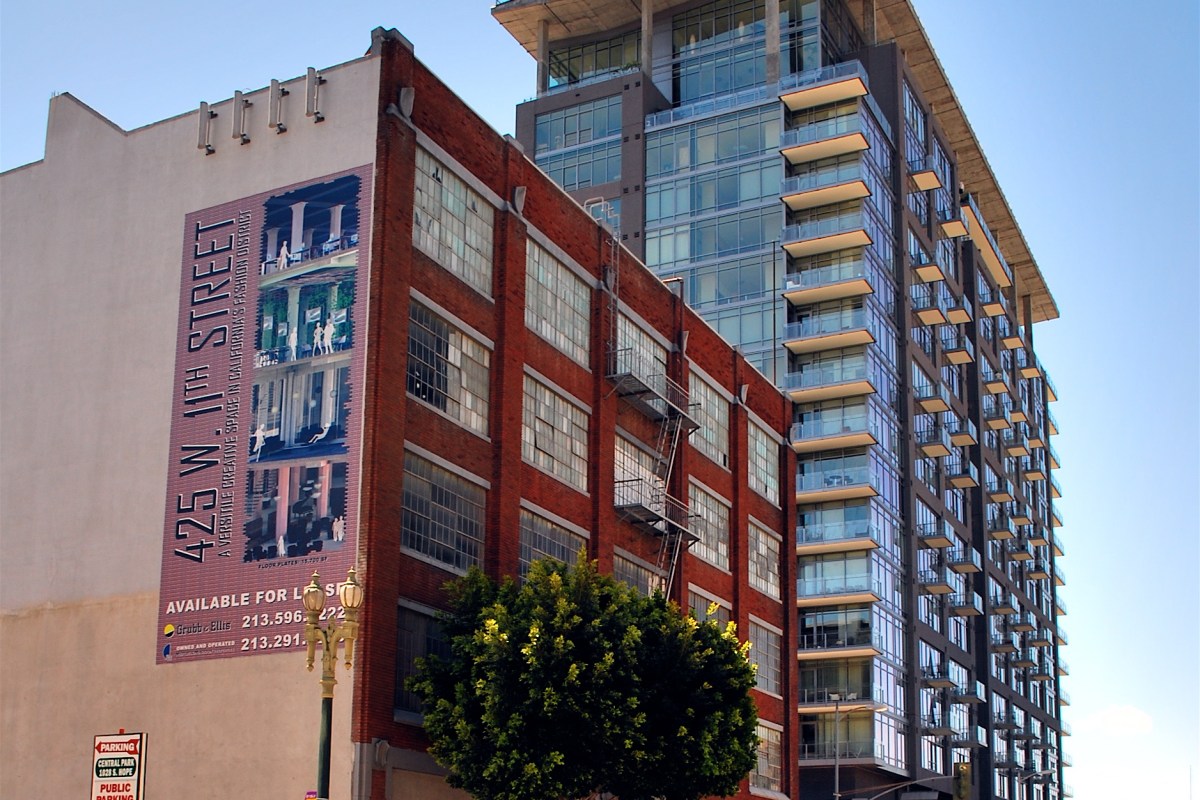
The subway exit was 7th and Hope. The weather was violently windy, blindingly sunny. White fluffy clouds tore fast across the sky. I walked into a shimmering, sparkling, glassy, washed and Windexed world of brand-new, spotless, sleek, shiny and radiant glass towers.
I was in an area east of Staples Center, south of Olympic. Yet its structural newness and callow glibness felt like jejune, milk-fed, blond-haired, salty-breezed San Diego.
Amidst the asphalt, glass, steel and aluminum, I discovered a fair-sized green-park surrounded by tall, right-angled, balcony faced skyscrapers.
Inside the grassy park: an estrogen feast.
Women students from a nearby fashion college, FIDM, smoked cigarettes as they sat along benches and on top of concrete walls. Brimming with energy and youth. A parade of citrus perfumes, vanilla scented shiny hair, shaved and polished slender legs owned by naïve young faces.
Laughing, running, hurrying.
At an empty retail space, intended for future yoga use, I stopped to talk with a workman, renovating and cleaning. He told me he stood on the sidewalk everyday and watched these gorgeous girls walk by.
“90% of them are hot,” he said.
The strong winds continued as I reached the gusty corner where the art gallery stood. Next door, I discovered a Danish bakery where the smell of butter, fruit pastries, chocolate-topped cookies and hot coffee blew out onto the sidewalk.
I arrived at the appointment an hour early, so I continued walking around the neighborhood and found more newness.
Epic spic and span newness.
This slideshow requires JavaScript.
It was Noon, here in downtown Los Angeles, and there were few cars and almost nobody on foot.
Buildings reflective, orderly, tidy: landscaped with fabulously colored flowers, prickly succulents, willowy grasses and rows of upright young trees, water fountains, and little pocket parks unpopulated with humans. Amidst this constructed urban paradise were rows of empty benches.
A wine bar, with outdoor seating, was open on a corner. And not a single person occupied any seat.
A great concept, a superb image, a winking nod to richness, that’s what they built around here.
Those great hypes, of 2004 and 2005: the unlimited prosperity, the exploding stock market, the cheap money, the hustle and con of the hucksters who sold America real estate, stocks, derivatives, credit. These empty, fresh, unfilled, immaculate, twinkling edifices of glass, these are tactile creations and hard monuments of a false and corrupt national binge. Blessed by tax breaks and corporate lies. Unpunished by Washington. Unconscionable billions for bail outs.
Now these resplendent, lustrous buildings sit here, underused and unfulfilled, their once loud voices and enthusiastic promises of urban excitement, muted.
This is just one district of downtown Los Angeles: a great glassy area of spacious, broad streets and tall, unspoiled, spotless, reflective vertical condominiums.
Like everything in this city, it starts out young and full-of-promise.



 Here in Van Nuys
You must be logged in to post a comment.