SB 79 and Our Hood


SB 79 is a new law, authored by State Senator Scott Wiener, approved by the legislature, and recently signed by Governor Gavin Newsom, to allow the state to overrule local zoning laws and permit the construction of multi-family housing on lots which are zoned for single family housing when these properties are within a half or quarter mile of a bus or light rail stop.

In Los Angeles, the law will allow much denser and higher development along not only wide boulevards, but inside old, intact, single-family streets, “side streets” which never had apartments or multi-unit housing.


A guide to the law along with maps is here.

Tiered density: The allowable height and density for projects are determined by the quality of the transit stop and the project’s proximity to it.

Tier 1: Applies to projects near high-frequency commuter rail or heavy rail transit, like BART and LA Metro.

Tier 2: Applies to projects near light rail and bus rapid transit lines.

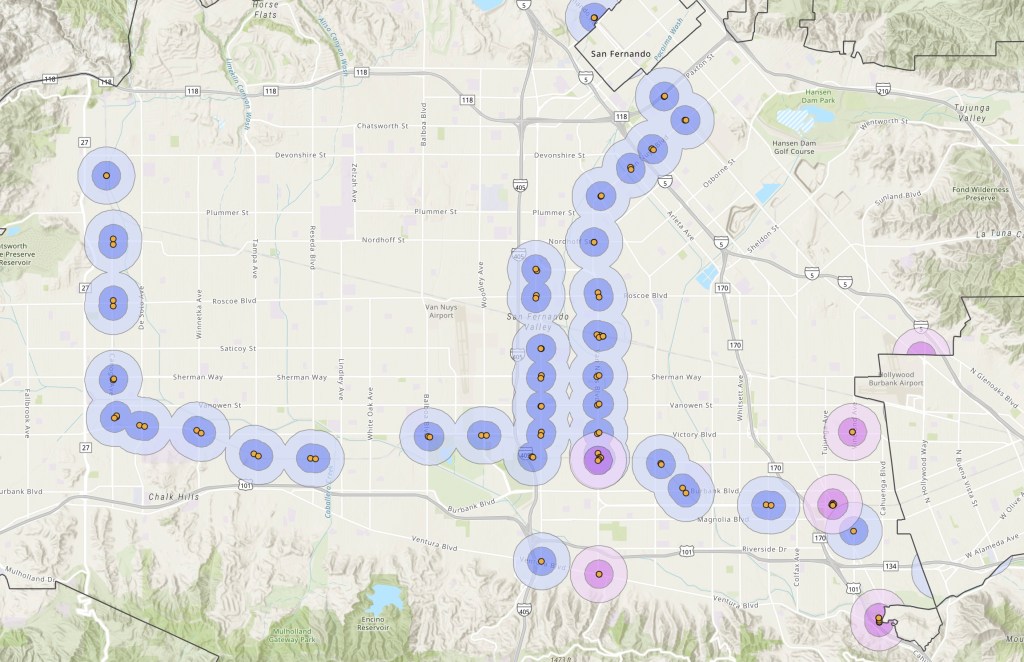
Along Sepulveda and Van Nuys Boulevard the proposed zoning map looks like purple bullet holes that radiate from transit stops. These circles are centered around the transportation stops and take no consideration into the historic or local character of any neighborhood. 

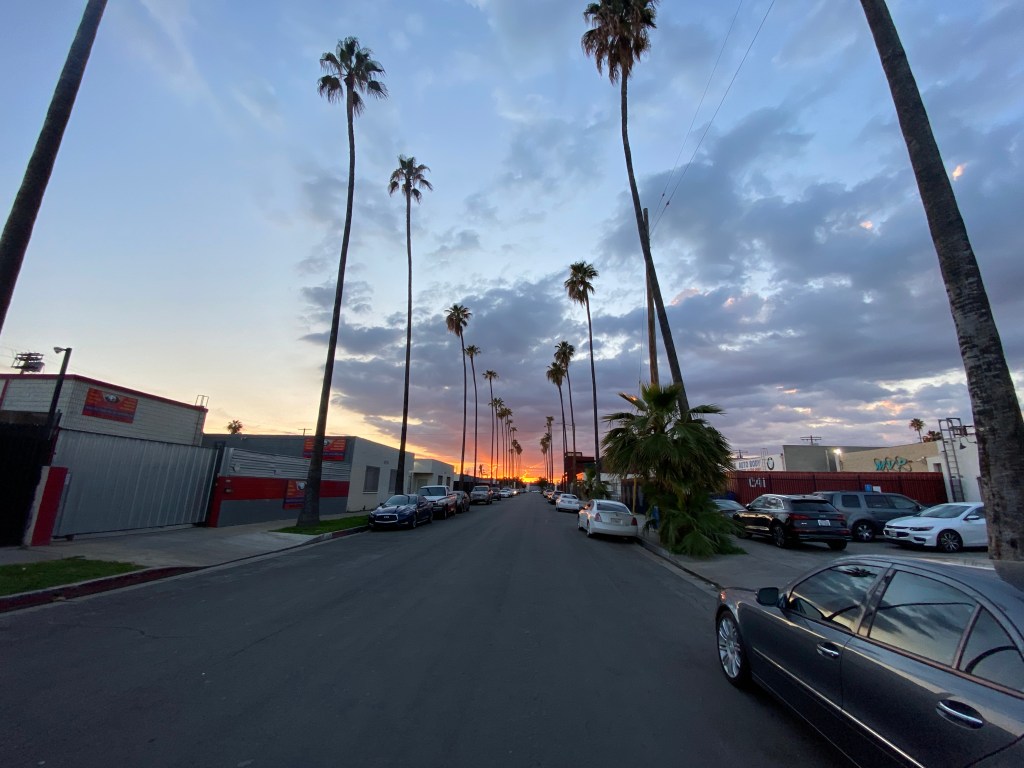
For example, I live on Hamlin Street which is a “Tier 2” zone because we are within a ¼ of Sepulveda Boulevard bus stop. My street, built on old walnut orchards, from 1936 onwards, is lined with palm trees, and then curves along with oak trees. The street has two-hour parking because of its proximity to Van Nuys High School.

If the law succeeds, my section of Hamlin Street would allow 65-foot-high buildings (six and half stories).

But the part of Hamlin Street a few hundred feet east from me would remain single family.

West of Sepulveda, south of Victory, is the beautiful and often filmed Orion Avenue with large colonial style houses planted with rose bushes and ranch fences, the location for many commercials seeking “a typical American street” that doesn’t exist anymore. With SB 79, the east side of the street could be obliterated with apartments that destroy the very beauty residents and film makers pay dearly for.


Yesterday, I had a real life encounter of what Hamlin St. and other locations nearby could become when I parked my car near 3052 West Boulevard in the Jefferson Park neighborhood of Los Angeles, east of Culver City. I was there to visit a new, multi restaurant creation, Maydan Market.

This area was given an economic boost by the Expo Line, a light rail system that connects downtown with Santa Monica. The good parts are investment, cleaner streets, the lowering of crime and the raising of the cultural and civic activities. 

The ugly parts are the disfiguring, ad hoc apartments that pop up on formerly coherent streets of 1920s bungalows. My eyes hurt looking at 3045 West Boulevard, a black and gray box suspended over a cinderblock faced garage, with a massive four story high open-air staircase on the side of the building. It looms like a monster over the street, with no respect or sensitivity to the vernacular that had existed here for 90 years.

Am I a hypocrite for decrying liberalized zoning that will change my backyard? Yes, I am. Sort of.

This blog has argued for years for the construction of new, multi-family buildings to replace unused parking lots behind abandoned shopping centers, or where there is a sea of asphalt like the Orange Line parking area along Sepulveda which was constructed for thousands of vehicles and is now empty.  I have fought for the idea of an architectural, coherent, community wide style that would incorporate history and embrace modernism but do it without destroying but enhancing the community of Van Nuys. 

And I’ve always cast a cold, unforgiving, forensic eye on the political neglect of Van Nuys by elected officials who seem to always be performing social media acts of kindness for oppressed groups while neglecting the needs of residents in this district. 

There are commercial zones galore that cry out for taller residential buildings along the wide boulevards of Van Nuys and greater Los Angeles. The one-story tall shops with parking lots in front are so defunct and useless that their very presence destroys civilized life and endangers the health of pedestrians. 

There are blighted buildings, such as this one at 7101 Sepulveda, that have been empty for years, packed with derelicts, unable to be demolished, yet crying out for replacement. As a bitter pill, the residents in the tree lined, charming, quiet streets behind must now expect multi-family housing to replace their 1940s ranchettes.

What do our elected leaders in Sacramento do with the quandary of building more housing? They embrace a fantasy of destroying single family homes and backyards. 

Will your neighbors and you, the elderly couple in the corner house, desire to ride buses (with homeless, drug addicts, crime?) and come home, late at night, from a bus stop on Sepulveda, and enter a new world of yet more cars, loud music, marijuana, dumped mattresses, and YouTube/TikTok/OnlyFans influencers smoking on the balcony next door? I doubt it.

Is that the paradise of tomorrow? Circles on a map, purple splotches of political malfeasance, indicating nothing but more mayhem, disorder and chaos.

I hope I’m long gone, either from life or Van Nuys, before this happens. 

Who Can Imagine This?


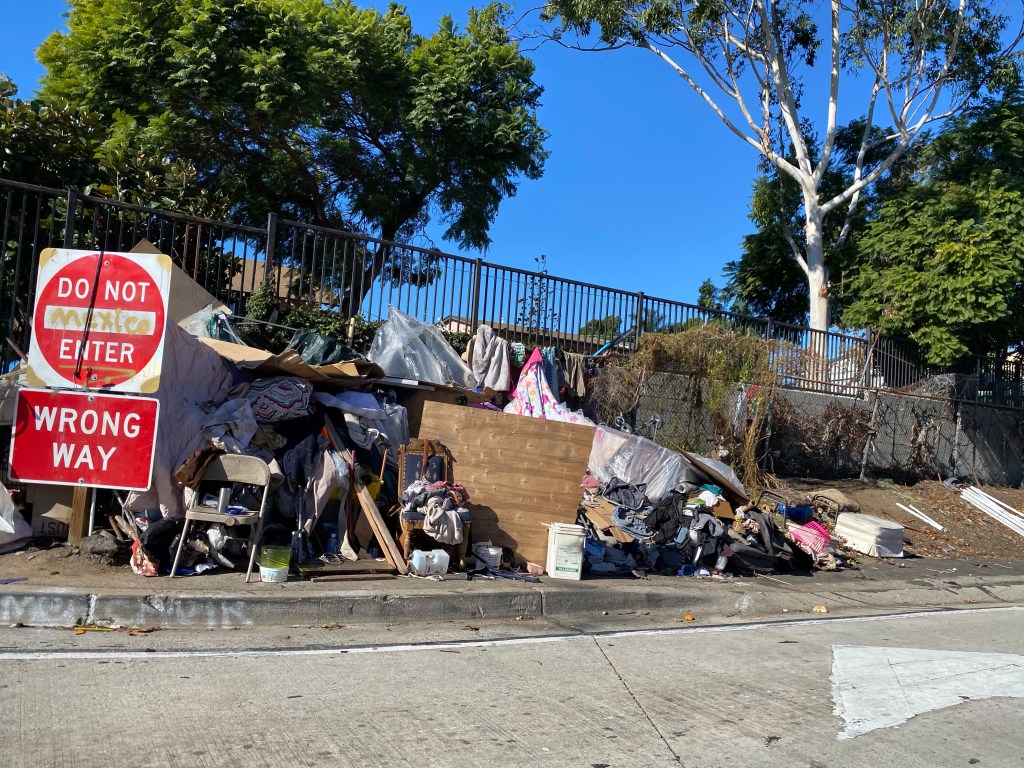
The continuing obliteration and destruction of the Sepulveda Basin area, with daily encampment fires, the hundreds of addicts camping out in garbage dumps of trash;with dogs, vehicles, bicycles, and shopping carts; is still ongoing.

Does anyone remember that this is a bird sanctuary, a watershed area, a lost jewel for the preservation of the ecology of the San Fernando Valley, and a park created for the recreational enjoyment of the community?

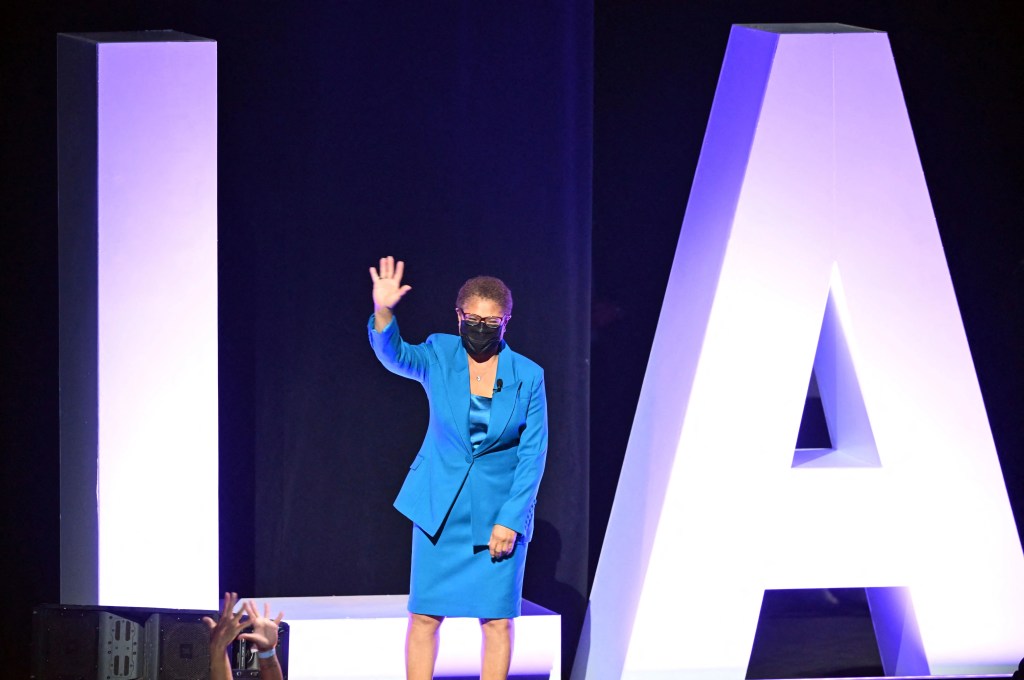
The sainted mayor with the dulcet voice, Karen Bass, had shown up last month for one of her photo ops, as the other trash camp on the east side of the 405 near Oxnard was cleared after five years.

50-75 people had been living there in Burning Man style until the orders came from City Hall that the news media was making a story out of it. This being LA, a problem that couldn’t be solved for five years, was magically disappeared in one bulldozing day.

The mayor spoke intellectually and philosophically, articulating something that perhaps nobody had noticed before:

“This is a notorious encampment,” Bass said. “This is such a dangerous location. I saw propane canisters all over the place. This has been a place of fires. This is dangerous.”

Yet she did nothing about it until it hit Instagram, KCAL and provided yet more catnip for her political enemies.

To live in Los Angeles right now is to inhabit a mental asylum where all officials, from the police, courts, and local government, all deny that they have any legal control over the removal of lethally destructive vagrants from public property. They are powerless, simply without any authority, to stop what any cop on the beat would have jailed in 1962.

Of course, the dark cloud over all this, is the spector of Trump sending in some army to “clean up the city.” The tanks and the soldiers will arrive, and then they’ll be stationed around federal buildings, and the trash camp parties of the Sepulveda Basin will continue. People will launch protests, and the mayor will say, “How dare he [Trump] send in federal troops to patrol LA when we are doing just fine without them!”

The obese ones of the City Council standing behind her will nod in agreement, proclaiming their legal and constitutional rights to run Los Angeles the way they have always run it, with liberty for anyone, all the time, no matter who they are, what they’ve done, or if they even have the legal right to stand on American soil.

Liberty to burn parks! Freedom to destroy public property! Let our glorious experiment in city government live for eternity!

Hollywood Encampments Magically Disappear Before CicLAvia Bike Event.


Obama Fundraiser: Silverlake, October 4, 2008.


For ten years a dead external hard drive lay abandoned in our garage, a device that once backed up our desktop computer from 2007-2012 and then suddenly died.

We cleaned our garage last month and found the dead drive. We took it to a tech in Toluca Lake who retrieved everything for $150.

Now we have tens of thousands of revived photos, seemingly taken yesterday, but actually 14 years old. I’m going through the files now and labeling them.


One folder contained a memorable evening from October 4, 2008. 

On that night, we attended an Obama fund raiser at a private home in Silver Lake along a winding street above Sunset.

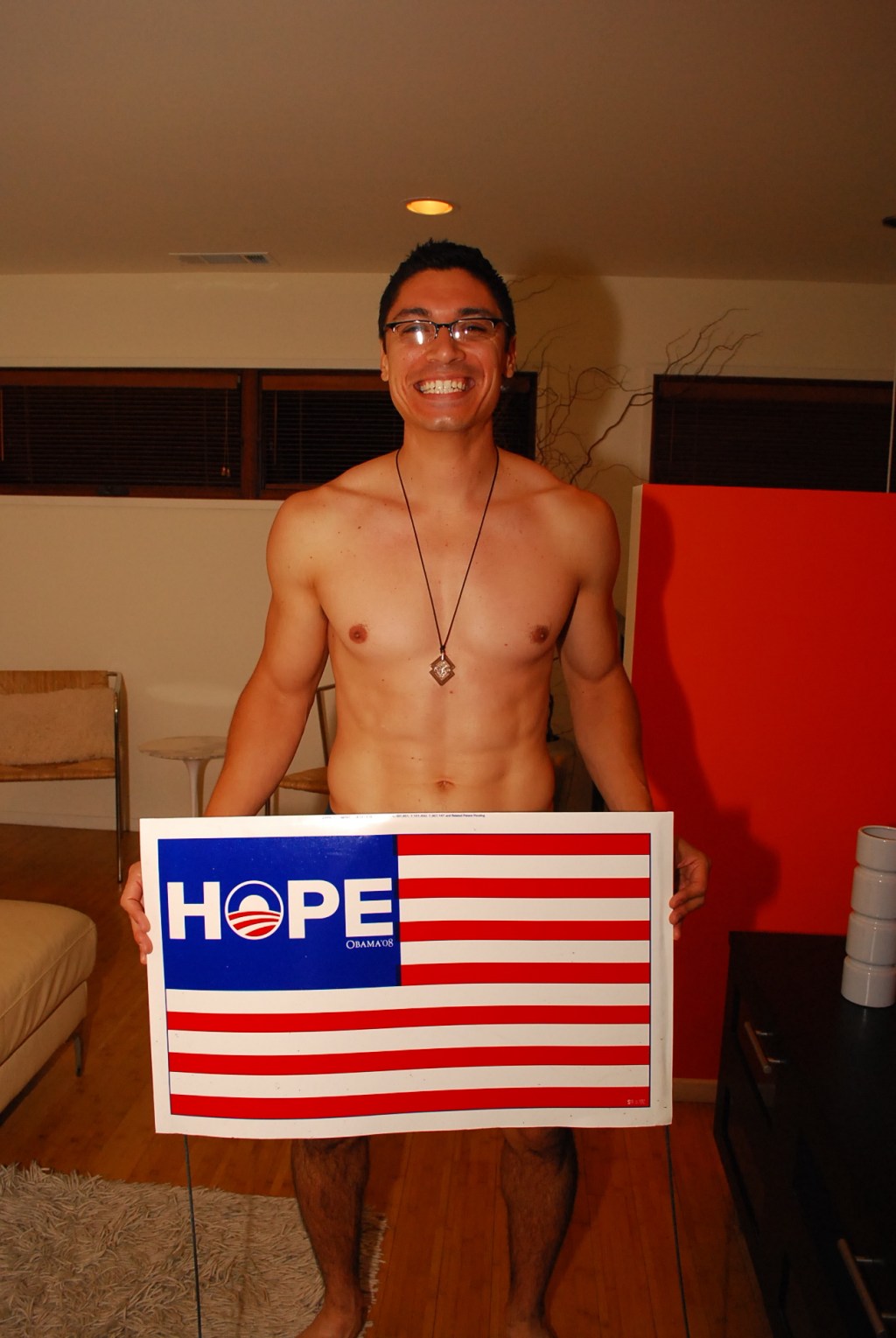
There is my 36-year-old brother Rick with his wife, Pri, and her 27-year-old sister Rue. Muscular, smiling, shirtless Jeremiah and his girlfriend Ivy.

There are good friends and acquaintances in floor dragging denim and long t-shirts under short ones. Fun includes John McCain, Sarah Palin and Dick Cheney piñatas, lots of Shepard Fairey designed HOPE t-shirts with Obama’s face, and me in an Obama mask. There are masks of Biden too.

There is food and drink and Ivy in with her Smart Women Vote Obama button.  

The crowd is gay and straight, black, white, asian, male, female. There are high tech devices like digital cameras that are strictly digital cameras, not smartphones.

There are cute young kids and old dogs snuggled up on the sofa.

What I remember most from the event is that one of the guys there wanted to sleep with me, and a woman who had a high position in production wanted to hire me for photography but never hired me.

Through time all the famous faces from that night are connected in our long political show that never ends, jumping from event to event, begging for analysis, but often falling into irrationality, emotionality and missed opportunities.

The Pandemic Changed Everything.


Since the pandemic began every single one of my relationships were tested. Some failed, some succeeded, some ended.

Sitting at home, mostly in the room with my computer, I scrolled catastrophic headlines.

Outside the world got quieter as people stopped working.

There was one month, April 2020, where it seemed that there was no longer any traffic noise from the freeway, and no planes flew in the sky, and nobody went past my house, except for the few, the lone, the masked.

In the backyard garden, hummingbirds, bees, and butterflies flew around purple flowered plants, oblivious to Covid-19. The wind blew, the air was clean, the sky sparkled, it was the glorious, refreshing epoch of days without cars.

My partner started working from home. We ordered groceries from Instacart. Then, a few months into the pandemic, he went out in N95 mask to buy groceries. And spent three hours washing them down.


An old friend from Chicago, who I stopped speaking to a few years earlier, contacted me on Facebook. “I miss you. And with this pandemic going on, I want to reconnect,” she said.

We talked on the phone. She told me about her catastrophic illness, a brain infection that almost killed her, her hospitalization, her loss of balance, partial eyesight, and the emotional pain of applying to the State of Illinois for disability funds.

Back and forth we texted. Until the texts were too numerous, hurling into the middle of my day, as I was sitting in my house, writing or reading. Did I have to answer them? Did I need to say I liked her choice of basement décor? Did I have to text back when she sent a photo of a pie her daughter made?  Did I have to thumbs up for that Benjamin Moore paint chip?

Somehow, I no longer wanted to be involved with her. Was it the pandemic? Was it the emotions she provoked? I don’t know. I just wanted to be left alone.

And she tried to keep it going, bringing nostalgia into it, reminiscing about old friends, telling me she loved to watch re-runs of Bewitched. The more she reached out the less I wanted to engage. Was it the pandemic? Me?


Aunt Millie was not allowed to leave her room at Lincolnwood (IL) Place. The 96-year-old had to stay inside her assisted living apartment for a year.  We would talk every few weeks. The conversation and facts repeated.

“Are you writing Andy?” she asked.

“Yes. I’m finishing my novel, Exiles Under the Bridge, about two families in 1980s Pasadena,” I answered.

“You’re writing a novel? I didn’t know that. You’re a very talented writer. You should keep writing,” she said.

We would talk again in two weeks. I would tell her I was writing a novel. She would tell me how talented I was. And she would tell me she could not leave her room.  

“Millie! Stay in your room! That’s what they yell at me,” she said.


The months dragged on. The months flew past.

George Floyd was killed, the rioters sacked the cities, the protestors protested masks, business closures, or police violence; others ran red lights, shot guns, launched fireworks, got into fights in grocery stores, yelled about the most corrupt election ever, invaded the Capital as the electoral college was being certified.

The American Flag was weaponized, partitioned, and privatized, held like a spear to fight for liberty in battles against imaginary enemies .

Our world of beautiful wickedness is melting, melting, melting.


I did chin-ups, got to five. I got my bike fixed and pedaled west into the sun. I wrote short stories, finished my novel, sent out my novel, got 130 rejections.

The parks went up in flames, the homeless set fires along the freeways, the windows of the shops were boarded up, the hospitals were full of sick and dying people, and nobody was allowed to swim in the ocean.

The former president pleaded for rage and misunderstanding.

At five o’clock, every single day, Mayor Eric Garcetti spoke; clean shaven, untouched by fervency, updating us on his city’s response to the pandemic.

Some weeks businesses were essential and they were open. Other weeks businesses were non-essential and they were closed. Some wore masks and some did not, some stayed apart and some got together, certainly all were uncertain, guided by magic and intuition.

And I bought a mixer to make smoothies with bananas, ice, blueberries, milk and protein powder.

My best friend invited me to a Christmas party when nobody was vaccinated. I declined. He didn’t believe Covid was that big. In the beginning of the pandemic, he urged people to cough on each other to get us up to herd immunity.

I used to drink beer at the local brewery a few times a month. Now I don’t go. Have I stopped liking beer? Have I stopped liking people? I don’t know. I stay at home and mix up a Negroni or pour a glass of whisky over ice, in the kitchen, alone.

We got our vaccines in January, courtesy of the connected relative who works with a health clinic in South Los Angeles.

We went down there, lining up, in another very poor neighborhood, next to the homeless in their RVs. We stood in line, awaiting vaccinations, as other Hollywood friends and acquaintances of the relative arrived in their Teslas and Mercedes: the thin women with blond hair and $300 sweat pants, the ass hole boomer executives with their 25-year-old girlfriends.

We were the first to get our shots. Hollywood was vaccinated. “The Bachelor” could go back into production.

On February 1st I was fully vaccinated. Only one percent were at that time. I felt guilty. Had I stepped in line before the truly needy?

Now vaccines are available for everyone, but some choose not to avail themselves.

Like my friend Bajoda in New York.

A schoolteacher, a scoliotic, a smoker; 56-years-old, a vaccine skeptic. With a chain-smoking boyfriend who believes that Covid is no worse than a head cold. She was scared. She heard the vaccine could damage your liver.

I yelled at her. Stupid, ignorant, self-destructive, risking your life! She texted the next day and said her daughter made an appointment for her to get vaccinated.

We made up. I told her I only yelled because I care. She texted me a red valentine. If my cruelty and ugly words induced her to get the vaccine maybe it was worth it.

I texted her to find out how the second shot went. I texted again. But she didn’t answer. And I left a message but no answer. And I texted again but no response.

Since the pandemic began every single one of my relationships were tested. Some failed, some succeeded, some ended.


Sometime in early September, Uncle Paul, veteran of Leyte Island and Iwo Jima; widow, father, grandfather, great-grandfather; will celebrate his 100th Birthday. And his son Barry is already planning a backyard blowout in Woodland Hills. Many of the guests will be over 65, 75, 85, or 95.

They are expecting at least 100 or 150 guests. Who wouldn’t want to honor him? Who wouldn’t go to celebrate his birthday? Who would fear the Delta variant in a packed house of old people?


Since the pandemic began, two babies were born in our family: Edwina’s Zoe in Diamond Bar, Jacinda’s Julia in Singapore. Penny is grandmother to both. She lives in Malaysia and cannot enter next-door Singapore. Penny has never met her two new granddaughters.

But later this month, vaccinated Penny and Jacinda, and baby Julia will fly from Singapore to Los Angeles to meet the Americans.

And the joy of seeing them reunited is tempered by the fear of the unknown. How do we overcome it? How will we move on when we suspect and fear closeness to the ones we love the most?

The Pandemic Changed Everything.

Escaping the Haze

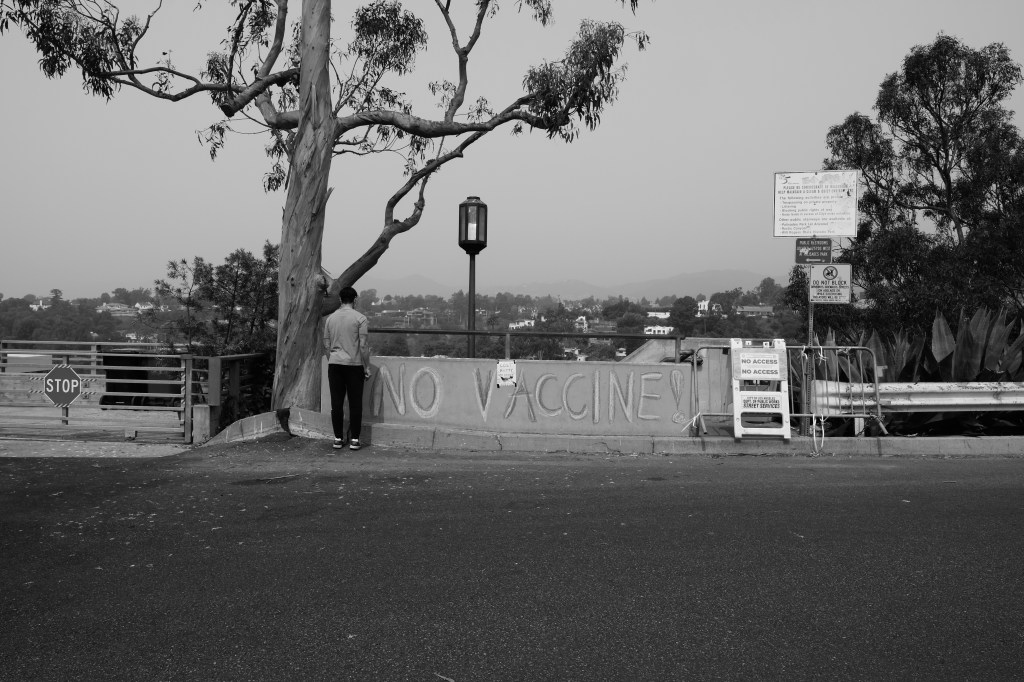
No Vaccine, Adelaide Dr.

Seeking to escape the haze and home confinement, we went where we used to go on Sunday in normal times: Santa Monica.

We parked on one of the wide, flat streets north of Montana, away from crowds. And we walked in masks that we imagined shielded us from dangers visible and invisible.

At Adelaide and 4th, where a palm lined grass island ends at a cliff and now blockaded stairs, someone had written “No Vaccine” on a wall.

This year everything is No: no work, no travel, no movies, no dining out, no socializing, no school, no hugs, no kisses, no bars, no strangers, no baby visits, no old people, and, of course, no vaccine.

Before the pandemic there were many runners here, and they would run up and down the stairs, but the virus put an end to that, and now the bad air ensures it.

This part of Santa Monica is grand, with large houses, of every style and decade from the past 100 years, but everything, under the grayish, smoky skies seemed tired, out of breath, defeated; like the city and the state and the nation.

There were Porsches parked in driveways, and Mercedes speeding past, but there seemed no respite from thoughts of ruin and gloom. Who will save us? Will we burn down? Will we be safe when fascism takes over? Or will the lawless sack the mansions and the stores while hated cops stand by and watch? Will a smart leader emerge? Or shall we suffer under Q-Anon and the conspiratorial voices on Next Door?

Who shall live and who shall die and who shall find the most followers on Instagram? 

Only the Shadow Knows.

Along Ocean Avenue at Georgina there is a restoration of a grand mansion, with construction illustrations of the elegant plans, and other photographs of historic and happier Santa Monica. Why there’s Mr. Pepper Gomez, Muscle Beach Contest Winner, 1950.

On Georgina there are yard signs, some of them angry. “Elect a clown, expect a circus” says one placed inside a long olive tree lined forecourt of a gated house.

Sometime from the 1940s through the 80s, this area was not so rich. There were large houses, but they weren’t expensive, so developers came in and tore down some of the historic ones and put up cheap apartments. 

A 1971 apartment at 129 Marguerita is emblazoned with a strange sign: 129 Career. A door or two off Ocean Avenue, the 2-story building is remarkably plain and homely, with a side alley of individual garage doors, stucco wall and steel windows. Balconies are big and full of plastic furniture. The good life was once available at bargain prices.

And at 147 Adelaide (built 1926) there is a mysterious, long, downsloping, concrete driveway that leads into an old, wood door garage with a five-panel utility door next to it. Two spotlights were on at Noon, and in the distance, haze covered the canyon and the hills and the houses.