The Optimist


The Optimist

If you were to bullet point Mike Hewson’s biography, the list would sound sad:

• Grew up gay in the 1950s
• Drafted into Vietnam as a medic
• Returned to Los Angeles and worked in a hospital
• Cared for his mother during her 4-year ordeal and death from cancer
• Watched his good friends, all young men, die from AIDS.

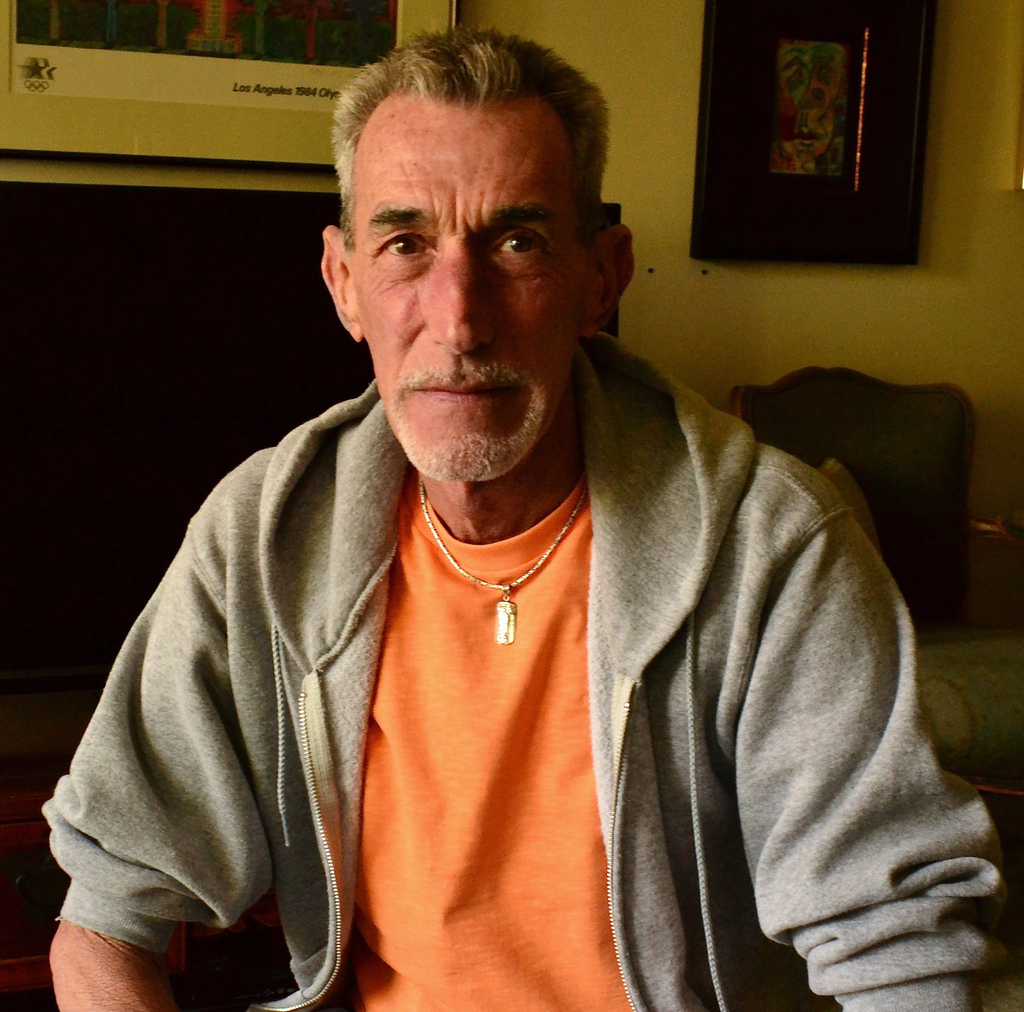
But it was Abraham Lincoln who said, “People are about as happy as they make up their minds to be.” He might have been speaking about Mike, who was born on July 18, 1945, and moved to 16724 Morrison St. in Encino five years later.

He had an ideal childhood, with a stay-at-home mother and a father who worked as printing company salesman, and a younger sister, Deawn.

In those days, Encino was like a small town, with block parties and vast ranches and newly built houses. The 101 and 405 didn’t come through the Valley until the early 1960s.

He went to Encino Elementary and Birmingham High School. His family lineage, including many veterans of many wars, stretched back some 200 years.

He attended Valley and Pierce Colleges for two years and then studied to become an Operating Room Technician.

In 1967, he went into the Navy and later joined the Marines and went off to Vietnam for 27 Months. His nickname was “Flash”.

In his field hospital, 30 miles outside of Dan Nang, near China Beach, he assisted in neurological operations on wounded soldiers. Blood, suffering, the horrors of war, death and truncated and destroyed young men: all of these violent and horrific human tragedies marched before his young eyes.

He got down in the trenches and did anything he needed to do to help his fellow Marines. He was “Doc” but he was GI Joe too, never allowing his higher position to interfere in lending a helping hand.

He told me that everyone knew he was gay, but that he never heard one hateful remark. He believed that a lot of homosexuality went on in the armed forces, but that it was not an issue because survival and fighting mattered most.

Only politicians make an issue of it.

When he came back to the San Fernando Valley, in 1971, he was overjoyed to be back in the USA. He was still only 26 years old, and he went to work at Encino Hospital and lived as a single gay man in the Brady Bunch era.

Active in the Metropolitan Community Church, he also hung out with a group of friends who all died from AIDS. He and another buddy survived the lethal scourge of the 1980s.

Unlike many people who remember so fondly the San Fernando Valley and talk badly about its present condition, he finds that some things have gotten better. He misses the horse farms and orange groves, but he loves all the trees and greenery that has come up in the last 60 years. He remembers the view of the mountains that was so clear in the early 1950s, and now those views are returning as cars burn cleaner.

His last job was at Barnes and Noble in Encino, and he does regret the loss of the store, which was closed by greedy billionaire owner Rick Caruso and will be replaced with another CVS.

Mike is retiring to Puerto Vallarta. And at age 65, he will take his optimism down to Mexico, which is also a place where people have hard lives but smile frequently.

The Eternal Garage Sale.


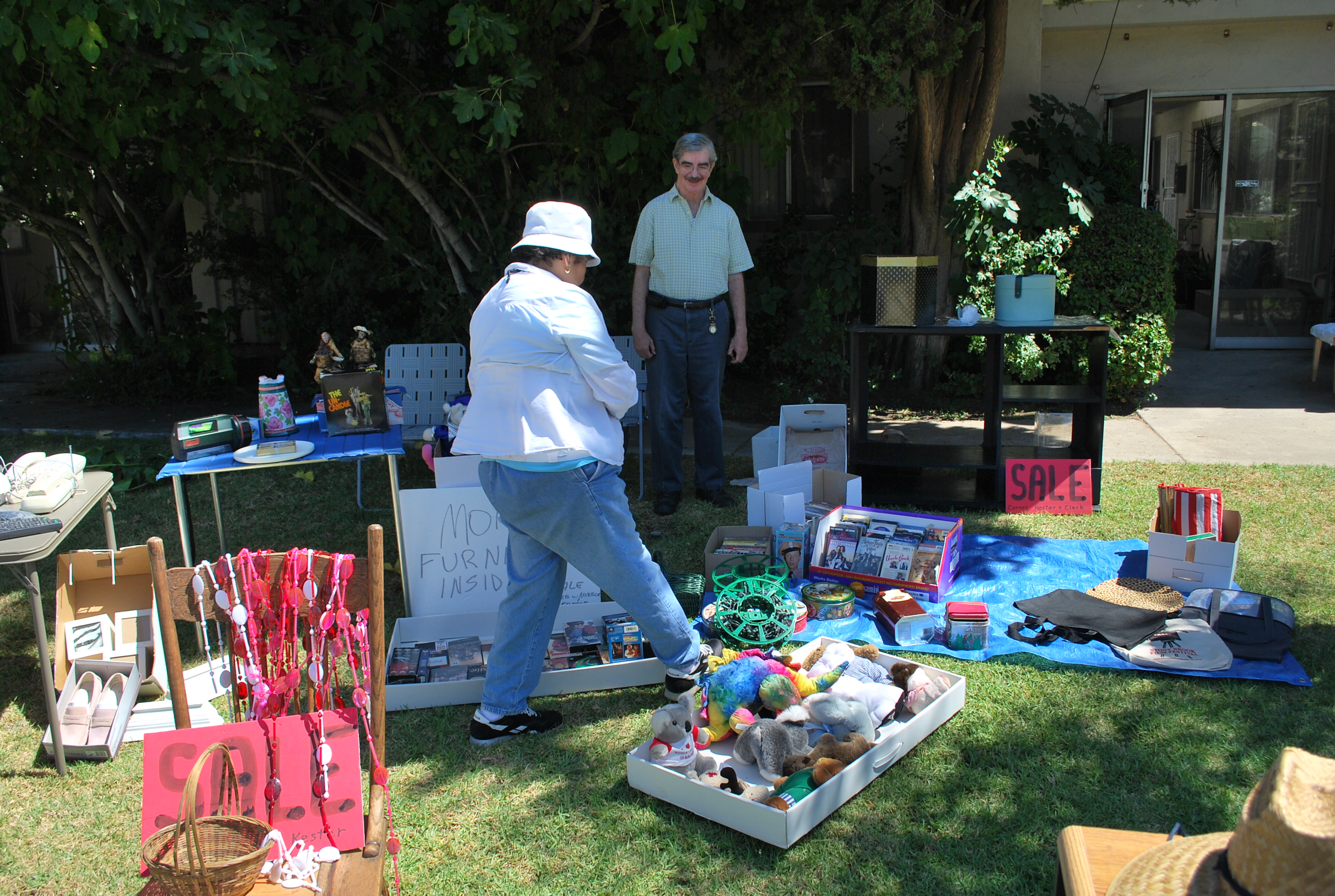
Garage Sale: Kester, n. of Magnolia. Sherman Oaks, CA.

Spread out on lawns and along the sidewalks: blankets and sheets. They are covered with old clothes, boxes of CDs, vacuum cleaners, pots, pans, glassware, chairs, hats, scarves, underwear, socks, and baby clothes.

Since the Depression laid its dollar-killing hands around the neck of Los Angeles, two years ago, junk sales have blossomed and proliferated and spread like dandelions. Jobless, insecure, fearful, angry; the people are throwing their vast array of crap onto the public sidewalks and private lawns of LA hoping to get $40 or $60.

Jack and his Mom

Outside a neat, small apartment in Sherman Oaks’ Posoville district, my friend Jack’s mom sells stuff every weekend. They live together in a three-room, vinyl-floored unit whose walls are decorated with carved crucifixes and many paintings.

White-haired, dressed in sweats, speaking in an accent that originated somewhere east of the East River, she gave me a hearty welcome. “Go to Unit #13 and see my son,” she ordered.

I walked through the gate, past the jellybean shaped swimming pool and knocked on the door.  Italian, single, straight, 45, delivery service driver; Jack answered and gave me a hug.

He was watching the game, (whatever game that was I do not know), next to a bigger lug named Caesar, a large, oversized, crotch-picking co-worker in an AC/DC t-shirt and cargo shorts whose pockets held two freshly rolled joints.

Caesar, grinning ever so proudly, told me he had walked out on his wife of 14 years last week. She lived down the street with his two kids, 10 and 14. He had just come back from Las Vegas with Nikki. “I like to eat pussy,” he explained.  His wife didn’t know where he was, which was fine with him.

Jack, though, has had some bad health problems lately. He can’t keep food down. He went to several doctors and has had a colonoscopy. He lost weight. He lost his appetite. He thinks he might be allergic to gluten.

The talk, as it does often these days, turned to “who caused the economy to crash”. I waited for the roulette wheel of scapegoats to spin and this time it landed on a surprise group.

Jack blamed “immigrants” who bought more house than they could afford and then crowded all their relatives in. These relations were all non-workers and non-citizens but they collected government benefits like disability, food stamps and unemployment.  Their housing speculation (not Wall Street or the Federal Reserve or banks), he explained, had driven the whole economy into the ground.

Jack also talked about “who owns Beverly Hills” and how he found a website that named all the names of the property owners in every house and “none of them are Americans”.

Unloved and Unneeded

There are many garage sales in Los Angeles now. They are set up anywhere by anyone. You don’t even need a garage anymore.

All along the wide, sunny, indistinguishable arteries of Kester, Balboa, Roscoe, Vanowen, Tujunga, Riverside, Burbank, Magnolia, Woodman, Moorpark, Venice, National, Sepulveda, and Pico; a city is emptying its closets and cleaning out its drawers and dumping its used, unloved and unneeded detritus; hoping to sell for pennies what was once purchased for dollars.

These are the red-flag days in California’s economy and in its social order. We Angelenos, we Americans are becoming more like our garage sales. Put out on the street to be had for next-to-nothing. Cheapened, starving, and needy. Down to our last nickel. And perhaps ready to be ignited by someone who will gain power from the powerless.

Larry Sultan: The king of colour photography – Features, Art – The Independent


Larry Sultan: The king of colour photography – Features, Art – The Independent.

Food Pantry List.


HOW TO HELP

Call food pantries for hours and other information on how to donate.

Lutheran Social Services: 6425 Tyrone Ave., Van Nuys; 818-901-9480; http://www.lsssc.org

Valley Interfaith Food Pantry: 11076 Norris Ave., Pacoima; 818-718-6460; http://www.vic-la.org

Meet Each Need with Dignity: 10641 N. San Fernando Road, Pacoima; 818-897-2443; http://www.mendpoverty.org

FISH of West Valley: 20440 Lassen St., Chatsworth. 818-882-3474.

SOVA: 16439 Vanowen St., Van Nuys. 818-988-7682; http://www.jfsla.org.

North Hollywood Interfaith Food Pantry: 4930 Colfax Ave.; 818-980-1657.

Guadalupe Community Center: 21600 Hart St., Canoga Park; 818-340-2050.

Our Redeemer Lutheran Church: 8520 Winnetka Ave., Winnetka; 818-341-3460.

West Valley Food Pantry: Prince of Peace Church, 5700 Rudnick Ave., Woodland Hills; 818-346-5554.

First Methodist Church of Reseda: 18120 Saticoy St., Reseda; 818-344-7135; http://www.fumcreseda.org.

Rescate at Canoga Park Community Church: 22103 Vanowen St.; 818-884-7587; http://www.rescatefamilycenter.org.

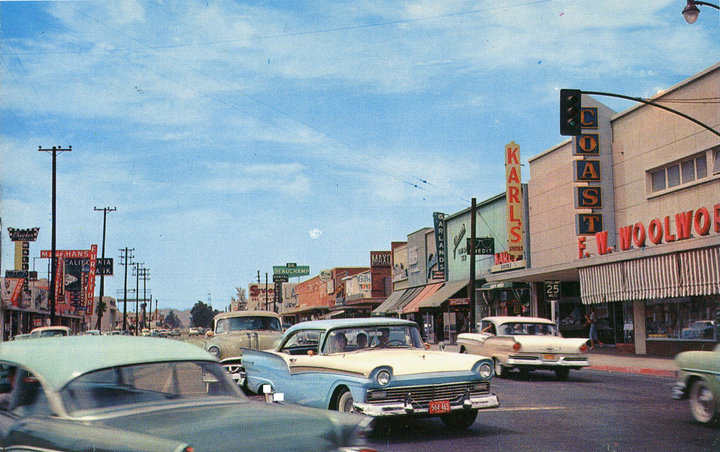
Reseda and Sherman Way/Late 1950s.


Reseda and Sherman Way/Late 1950s/ Photo Credit: Valley Relics on FB

A Remnant of Ruralism.


This slideshow requires JavaScript.

The Santa Monica Mountains cross the southern part of the Valley. They are often green, hydrated by Pacific mists, and shielded from sunlight along their northern flank.

But up in Chatsworth, one can still occasionally find a brown, rocky, and barren land where horses, ranches, hay bales, and fences predominate. Here, far from the ocean, there is hardly any fog, and the south-facing mountains bake year round in blistering sun.

Near Canoga Avenue and Chatsworth Street, there is a surviving remnant of equine ruralism. I drove here, quite accidentally, on a search for open land beyond the last cul-de-sac in Los Angeles.

In mid-morning heat, pushing 98 degrees, an old man was walking his white dog near a working horse stable. A Metrolink train passed by. In the distance were those dry, mysterious mountains.

Along Canoga, behind a row of olive trees, stood some old, tired wood-frame shacks; weather-beaten, paint-peeling, weed-covered. Only a satellite dish atop a roof gave some clue of present day life.