Crossing Ventura.


Sometime in late 2018, early 2019, I’m not sure exactly when, they created a pedestrian crosswalk, with flashing lights, across Ventura Boulevard. at Ventura Canyon Avenue.  The crossing is about a block east of Woodman and a few doors down from Yok Ramen at 13608 Ventura where I go about once a week.

This is in the heart of Sherman Oaks, where stores that paint your nails, sell used records or live birds are sprinkled along the boulevard along with massage, dry cleaners, and laser skin treatments. And Floyd’s 99 Barbershop where every customer from 18-80 is a rock star.

I’m familiar with this area and its friendly banalities.

About 20 years ago, I knew a divorced woman in her 40s, with a little girl’s voice, who spent most weekday mornings at the location where the ramen place is now. 

Back then it was a bakery and a coffee shop with big muffins and big mugs, chocolate croissants and caloric treats. She sat at a table with her journal and wrote music and poems. Today she is retirement age, married and living in rural England.  And that’s how I got to think about the time passing and the way people pass time on Ventura Boulevard. 

As Orson Welles once said, “The terrible thing about L.A. is that you sit down when you’re 25 and when you stand up you’re 62.”  

And if you spent a couple of decades eating chocolate chip muffins on Ventura Boulevard what have you got to show for it?

To keep people alive, and moving, mostly in cars, the people and “leaders” of Los Angeles have devised, through the years, the same kinds of ideas to make safer the naked and shameful stunt of walking across Ventura Boulevard.  These include longer pedestrian signals, traffic islands, and painting the street with lines or figures to indicate that humans on foot also roam in the land of cars.

We tweet in seconds about trivialities like nuclear war, impeachment or the fires in Australia but we cannot assume that six decades will correct the urban failures of Los Angeles. Photographs from the past prove my point.

On November 30, 1959, Dr. Louis Friedman, Dentist, painted his own crosswalk, with a corn broom, on the pavement at Murietta and Ventura, to protect his patients. He had unsuccessfully asked the city to do so but his requests were ignored. So he took the initiative and laid down the lines.

That same year, Carl Stezenel, 10, of North Hollywood stood at the corner of Radford and Ventura and tried to cross in the time allotted, 9 seconds. If a 10-year-old boy found that challenging, imagine the typical woman of that era in high-heeled shoes, gloves, hat and a cigarette pushing a baby buggy?

Carl Stezenel’s plight may have influenced a December 1, 1960 dedication for a new landscaped traffic island at that same location. Men in suits (a sure sign of importance) attended the event, in a district whose distinguished architecture featured auto dealerships and gas stations. 

Five years earlier, in 1955, motorists on Ventura near Dixie Canyon Avenue were warned that they were approaching a nearby school by a painting on pavement of a running boy with a ball. 

People who worked and shopped in the area did care about how it looked. Years before it was considered normal and decent to allow tens of thousands of intoxicated and mentally ill people to live on the streets with garbage filled shopping baskets, the issues of why there was no tree cover on the boulevard haunted the civic minded. 

The palm tree, with a trunk so skinny it could never crowd out a Cadillac at the curb, was the obvious solution.  

Studio City is now lined with palm trees, a species that provides no shade to sidewalks that are baked in sunshine 350 days of the year. In 1954, the first palm trees were planted as part of a beautification scheme. Fully grown, their trunks look like posts without billboards, a perfect style for this city.

The sameness of businesses in the late 1950s along Ventura Boulevard presented problems. We, who are of CVS, Starbucks and Chipotle, may understand that historical plight.

Studio City and Sherman Oaks had a competitive streak. 

To bring customers between the two districts, a special free bus was introduced on February 18, 1959. If you had a watch that needed repair, wanted to purchase panty hose, a typewriter ribbon, or a cigarette case, now you had a no fare bus to take you up and down Ventura Boulevard, opening up a world of possibilities. 

That bus must have been cancelled after 10 episodes.

Further east, at Balboa and Ventura in Encino, the traffic situation was already dire in late 1953 when work-bound suburban residents were forced into only two lanes of eastbound road, while the westbound, going into less populated Tarzana and Woodland Hills was free of congestion. The solution: three lanes in the morning, and then move the cones and make it three lanes westbound at night. 

Eventually, the current road was widened into three lanes in each direction, with an advanced staring-into-the-sun design for morning and afternoon drivers. 

High rise office buildings sprung up in the 1960s and 70s, some as high as 15 stories, but nobody in the single-family neighborhoods nearby cared because the occupants were white and well-paid. Today, a four-story tall apartment with 130 apartments, and 3 affordable units is considered social engineering and overcrowding by many in Encino.

We are now into the third decade of the 21st Century and Ventura Boulevard still lacks safe pedestrian crossings because most drivers and pedestrians are looking into their mobile devices.

Photo Credits: LAPL/ Valley Times Collection

Valley Rents Near All-Time High as Vacancies Drop.


“Vacant apartments in the Valley are scarce, rents are heading toward all-time highs, and observers expect little change for the next three years.”-LA Times 8/24/1969

Most of the new apartments will be large, luxury, high-rent operations because land is so expensive.

Landlords are choosey and many refuse to rent to tenants who have pets or children. Only 25% will allow pets or kids.

In North Hollywood, only 3.8% are vacant, in Van Nuys, 2.5% and in Northridge, 2.7%.

Ten and 12-unit buildings were once common, but now land costs and materials are pushing builders to put up 40, 60 or even 80-unit structures.

The average tenant in the San Fernando Valley, incidentally, is 27-years-old and cannot afford the high rents.

And some of the rents that are being asked are quite shocking.

Furnished and unfurnished bachelor apartments are going for $85-$95 a month ($90=$657 in 2018); one bedrooms are averaging around $115 ($115=$796.42 in 2018); and two bedrooms for $175 ($175=$1,211 in 2018).

Walt Taylor of Van Nuys, who is the new president of Valley Apartment House Owners’ Association, fears that if the trend continues only large corporations will become landlords, or even worse, the government.

Progress Report.


On a brief walk, after dropping off a package at the UPS on Van Nuys Bl. I walked west on Sylvan, south on Vesper, ending this set of photos at the new fire station on Oxnard.

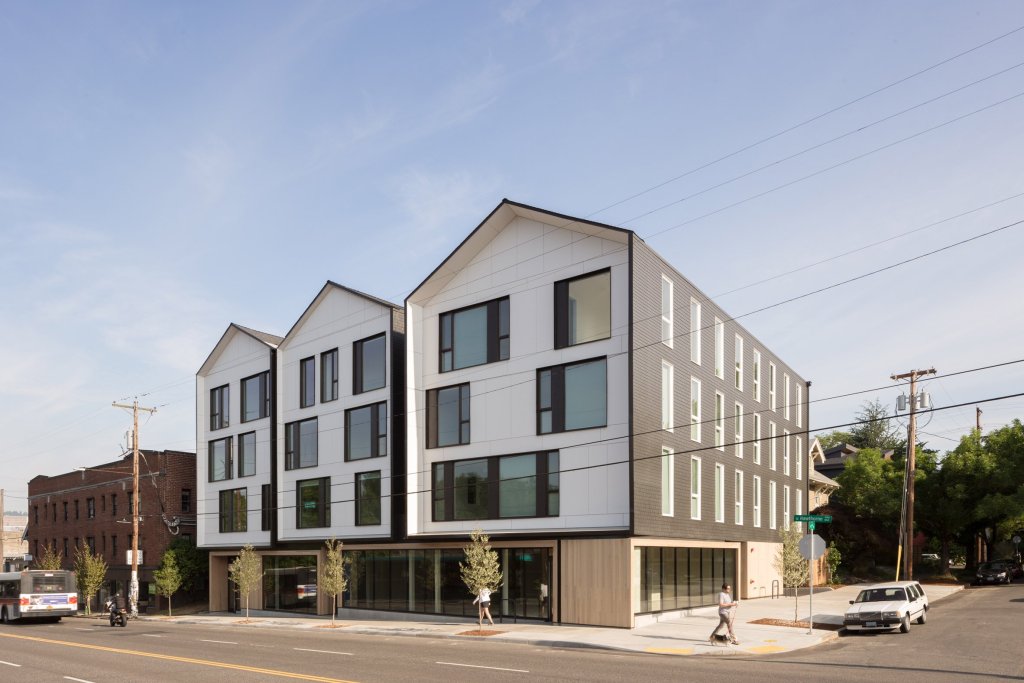
There is a small but significant amount of new apartments going up. They are pleasant additions to the neighborhood and are all in the currently popular white style, blindingly white, with dark windows.  They add some upgraded cleanliness to an area which has long been the sad kingdom of slumlords. 

On Sylvan, the former post office, built during the 1930s by the WPA, in a classical style, was later a home for Children of the Night, a non-profit created to fight childhood sexual exploitation. They have since moved out, so the sidewalk outside the gracious building is now a trash camp.

The new fire station (2019) is a great asset for the neighborhood and has significant architectural beauty that recalls the 1930s Streamline Era, and is also conversant with the first fire station on Sylvan (1939) as well as the former DWP building on Aetna and Vesper (1938) just behind the new edifice.

Just to the east of the fire station, Aetna is closed, with a high fence, between Vesper and Van Nuys Boulevard, most likely due to the trash campers who took over the area. They are banished to fly somewhere else, probably to the bird sanctuary in Woodley Park.

Councilwoman Nury Martinez has jurisdiction over this area, and her office is nearby in the Valley Municipal Building. She is now the head of the city council, and the first Latina to hold that position in city history.

We can applaud the justice of diversity, the idea that anyone from any background can ascend the ladder of politics and achieve leadership.

We cannot applaud the failures of Ms. Martinez, and her predecessor Tony Cardenas (who is now a congressman in Washington, DC) for they have had over 20 combined years of allowing Van Nuys to fall into utter disintegration, filth, homelessness and blight. 

Their ethnicity has pushed them up into the spotlight even as their academic records in elected office should be graded D- or F.

The idea that one’s identity deserves praise rather than one’s achievements is a new chapter in our American conversation. If Van Nuys should fall further into the gutter, which seems unimaginable, we will think of the paucity of Ms. Martinez’s and Mr. Cardenas’ accomplishments and recall this verse from Matthew 7:16 “Ye shall know them by their fruits.”

Rotten.

A Cleared Lot


They have almost completely cleared the 27, 762 SF lot that is 6505 Columbus.

The property once held a single family house, constructed in 1937.

One of the owners was a production manager and second unit director, Cliff Broughton, Sr.

On November 14, 1949, Mr. Broughton’s son, Cliff Jr. was piloting the 136- foot-long schooner Enchantress, along with 14 passengers, from Newport Beach, CA to Panama, and later Tahiti, when it ran aground in a sandbar off the coast of Baja California. The boat was eventually freed and everyone survived.

The senior Mr. Broughton put 6505 Columbus up for sale in 1950. Perhaps the yacht drama had distressed him.

In an LA Times classified ad from January 15, 1950, 6505 Columbus was called “Rancho Perfecto.” The one acre estate with 6 rooms, included a guest house, rumpus room, laundry house, tool house, double garage with storage closets, patio, and a lighted badminton court. There were also “plenty of shade and fruit trees.”

They were asking $22,500.

For many years 6505 was part of six other large, underdeveloped and underprivileged properties on the west side of Columbus from Hamlin to Kittridge. In a previous post this area was described accurately as I saw it.

Now they are almost done clearing the house and flattening the land where some four homes will sit between two roads, Hamlin and a TBD.

A large apartment building will be the backdrop for the next 100 years of drama at 6505 Columbus.

MacLeod Ale and Points East.


Yesterday, late afternoon, there were clouds in the sky and the temperature was notably cooler.

On Calvert Street, outside MacLeod Ale, I was waiting outside for a friend when it began to rain. A few drops fell and then it moved on.

My friend arrived and parked in one of the few spots reserved in front of the brewery. 

We had a few beers, including Cut and Dry, an Irish stout; Deal with the Devil, my favorite IPA; and The King’s Taxes, a mild warmish ale from the first days of MacLeod.

We ordered a mushroom and sage pizza. 

There were people sitting next to us with two dogs, one sitting on a lap, the other, a Rottweiler, lying on the floor.

Then we paid for our food and drink and walked down Calvert Street, east, to shoot some photos.

In what some might consider the better parts of Van Nuys the people walk or jog past you and don’t say a word. They walk their dogs past my house, they pull a wagon with triplets, they push a stroller, and nobody even looks at you or smiles.

But on this part of Calvert Street, a poor place, just steps from a large homeless encampment, the working people were outside sitting, talking, laughing, skateboarding, coming home from work and selling food from the back of a truck.  

Today’s Uber Ride.


Today’s Uber ride starred Anthony, formerly of Spanish Harlem, who picked me up at a neighbor’s house in his gray Toyota Prius on Hamlin St. for the 35-minute pool ride to Studio City.

A friendly, chatty, 40-year-old New Yorker in dreadlocks, he started off by ignoring an incoming phone call from “my best friend” who he said never returns phone calls.

But his friend, he explained, was a stand-up guy, a former addict who was spending the weekend up in Santa Barbara to help his sponsor who had fallen off the wagon, gotten back into drugs and alcohol and whose sister was illegally selling the house from under him.

We turned up Calvert Street to pick up a second rider, Ryan, a tanned, curly haired guy from Santa Clarita who worked as “an outdoor cinematographer.” On the ride down to his apartment on Valleyheart Drive he bemoaned the lack of money in his profession, but he also said his friends who travel the world and post about it on Instagram are mostly paid with products, not money.

After Ryan left, we picked up a ride at Fashion Square. This time it was a lanky, tall, black cigarette smoker, Albert, who threw out his butt before he got into the backseat of the car carrying his bag of new shoes. He was on his way down to Studio City to do some vintage shopping at Crossroads. He wore long red basketball shorts and had a dead-eyed expression on his young face. 

He said he was short on funds, but made good money as a restaurant delivery worker, as well as getting Social Security money from the government and food stamps. His ambition was to work in fashion, either in films or TV.  He wanted to buy a car, but he was also struggling to pay his $1,000 a month rent.

The driver said he made great money as an Uber driver, as much as $1500-$1800 a week, and that he could pay himself up to five times a day as funds came in. He was working to achieve success as a standup comedian. He was excited when I told him he had picked me up in front of the Workaholics House where the owner currently has monthly comedy shows in the backyard for $20 a head attended by hundreds of people. 

Finally, we got to Peet’s Coffee and inside there was a regular: Actor/Comedian Jane Lynch (Glee, Best in Show). 

I’m sure she would have loved my Uber ride.