Box Walk/Santa Monica.


For awhile now, residential modernism has been in charge in Los Angeles.

There was a period, roughly paralleling the 80s and 90s, when ersatz historical structures were the rage. Overdressed, highly embellished and gaudy.

But the stripped down box, the serious architect’s preferred style, is now the only way to build, especially on the west side of Los Angeles, where property is the most expensive, and every single ounce of concrete, glass and steel must pay homage to the gods of inconspicuous consumption.

The Box is King. Long live the Box!

On Memorial Day 2018, I walked from 5thand Pacific in Santa Monica down to Abbot Kinney, observing and photographing select buildings.

2120 4thSt. The West Winds (1959)

Whimsy from a cursive sign that provides a movie title sparkle to an otherwise dull structure.


2311 4thSt. Santa Monica (1967)

They charitably called it decorative modernism. It is a cheap way a developer dressed up his building with costume jewelry.


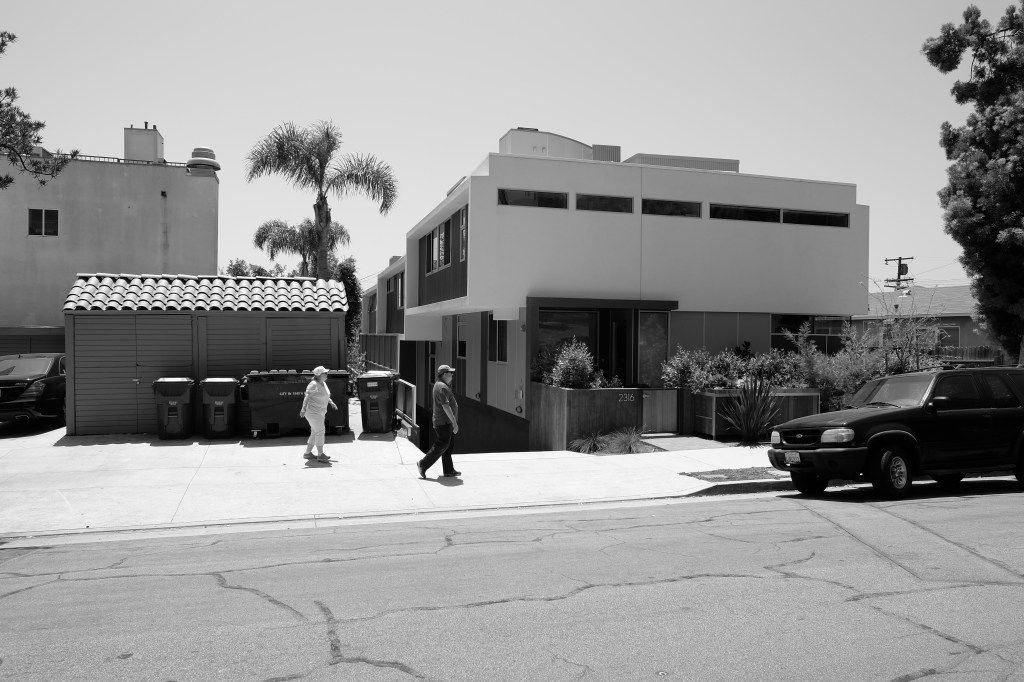
2316 3rdSt. Santa Monica (2017)

These are ultra-serious modernist condos designed by architect Robert Thibodeau. At least one unit sold for $2.6 million last year. They have all the emotionality and personality of a computer processor, but are of this moment in their sanitized, digital perfectionism, one that is scrupulously wired to accommodate residents who might command Alexa to send hot pizza and chilled Riesling by drone.


2404 2ndSt. Santa Monica (2006)

Already looking a bit dated with its ultra frozen metallic trim and smooth stucco, it compares awkwardly with its more relaxed and disheveled asphalt roofed neighbor next door.


2501 2ndSt. Santa Monica (circa 1902)

Fear not! This historic house has been under municipal evaluation/debate/conflict/litigation since at least 2010 and there are now plans to demolish only a back garage and guesthouse, and preserve the front structure. An official report by Santa Monica City said this property does not meet standards of preservation accorded to prominent architectural buildings.  A casual observer might disagree.


2520 2ndSt. Santa Monica (1900)

Imagine if Santa Monica were like Martha’s Vineyard, and little beach cottages with front porches were the norm?  2520 sits in exquisite preservation, next to a parking lot, but it is landscaped with wildflowers and drought-savvy plants. In its modesty and kindness, its gentle openness, it serves as an exception, not as the norm.


2543 2ndAve. Santa Monica (1915?)

All over Southern California, the courtyard housing of the Early 20thCentury provided modest, enveloping, nurturing neighborhoods for new arrivals to the Golden State.  These archetypes made maximum use of land, but did so with landscaping and interior gardens. Unlike today’s crime paranoid structures, this building has windows and doors around the entire perimeter, inviting and friendly.  It is under renovation, no doubt destined to be something unaffordable.


260 2ndSt. Santa Monica, CA (1989)

Now almost 30 years old,  this white, modernist, multi-family structure is best appreciated by observing it through steel security fencing and a parking lot. It has the mark of the late 1980s and early 90s in its square paned windows. Private, secretive, hidden, fortified, yet gleamingly bright and stripped down to essentials, this is what investment bankers, psychiatrists and plastic surgeons consider creative living.


320 Hampton Drive. Venice, CA (2015)

Google, Inc. is worth $600 billion and controls almost every aspect of every person’s life on the Planet Earth. It is more powerful than government, it is wealthier than 90% of all nations. Its infantile interface masks an incredibly complex and manipulative design meant to squeeze dollars out of any enterprise it wishes to.

It enslaves us by promising us ease. It erodes our individuality and uniqueness by herding us into categories assessed and rated by algorithms. It impregnates our dreams and deludes us into waking stupor.

Here is one of the buildings built by the pre-eminent monopoly of our time. It is a box: fortified, secured and undistinguished. Inside, no doubt, young employees bring dogs, tricycles, skateboards to work 18-hour-days, for 24 months, before they scooter over to another company in Silicon Beach.

In another moral riddle for our times, hundreds of homeless men and women sleep on the sidewalks just a few hundred feet away as if no money existed to rescue them from suffering.


“State of the art architectural, new residential compound, right in the heart of Venice.
One block from Gold’s gym, Abbot Kinney Blvd and two blocks to the beach. This three story gem has everything, from the rooftop patio with a jacuzzi to huge walk in showers, built in speaker syste and much more. No expense was spared on the construction of this home, it truly is one of the finest homes that Venice has to offer.
Perfect for a live work space. 2 car garage plus 2 uncovered parking spaces. Available fully furnished at $25,000.00 or unfurnished at $23,500.00
In addition to the space per public records, there is 500 sq/ft roof top patio that includes an outdoor kitchen and a hot-tub. On the second floor there is a 100 sq/ft balcony, on the main level there are also two decks/patios over 400 sq/ft that allow true indoor out door use total of over 1,000 sq/ft of outside use.
LIVE WORK ZONED”

708 Hampton Dr. Venice, CA (2017)

“Perfect for a live work space. 2-car garage plus 2 uncovered parking spaces. Available fully furnished at $25,000.00 [a month] or unfurnished at $23,500.00”

Muscular guy on balcony extra.


The Bird Scooter

All over Venice, these motorized scooters, unlocked by app, rented by hour, provide another means of transportation which speeds one along without aerobic effort.


Motor Home Home

This RV is parked at Brooks and Electric. The California Flag flies behind it, fittingly, salutingly. No housing type has grown as fast as the parked recreational vehicle.


1201 Cabrillo Ave. Venice (2008)

This home sits partly on a street and partly in an alley, both of which help solidify its sculptural presence. Dark, with variegated steel panels, and zig-zag cut outs, it is somewhat softened by vines. Lest it forget its bohemian surroundings, a reminder of drug dealers and gangs is provided by shoes hung on electrical wires nearby; as well as a tagged refuse container in the back alley.


249 Rennie Ave. Venice, CA (2013)

This is just the back guesthouse, but sparkles with a Teutonic crispness, like 1920s Bauhaus. And if this were Japan, there would be many houses just like this one, built along fastidiously maintained alleys.


420 Marine St. Santa Monica (1969)

Only 50 years ago they were knocking down quaint neighborhoods in Santa Monica and erecting cheapo, stacked, shoe-boxed units like 420 Marine St. Almost mid-century modern, this late 60s dwelling shoves cars into the back alley, and squeezes one or two under the cantilevered second floor. An overgrown pepper tree grows like a beard to obscure a homely façade.


2709 4thSt. Santa Monica (1967)

Still a rental, a recent ad offered a two-bedroom for $3,100 a month. Well-maintained from the exterior, it looks to have been upgraded with steel security gate, garage doors and energy-efficient windows. Considering its date of construction, it’s surprisingly un-ugly.


SaveSave

Stories From Our Landscape.


Deborah Geffner
Deborah Geffner


bcflyer

This writer and three others will have their short stories read aloud at the Annenberg  Community Beach House on Tuesday, August 16, 2016 at 6:30pm.

My story, “The Bright Shop”, concerns a  European refugee who designs a new life in 1960s Los Angeles only to see it crumble on the edge of the Pacific Ocean. Actor Deborah Geffner will perform it.

Tickets are free but require reservations.


Cinnamon Politics.


Cinnamon Politics

A few months ago, I walked into a Santa Monica dry spice store that my friend and I had dismissed a few years earlier.

It seemed ridiculous to us, that people, in the farm-fresh and organic era, would buy dried spices and spice blends at premium prices, and also waste money inside a store where the edibles sat in glass bottles in the burning Western window sun, becoming milder, less fragrant and more tasteless by the day.

Yet the business lived on, as culinary mediocrity often does in Los Angeles, eventually thriving in its insipid rendition of gourmet flavoring for chef lite hacks.

But then I came back into the spice store a few weeks back. I gave it another try. Maybe I was wrong.

I bought something called Northwoods Spice: salt, black pepper, paprika, thyme, rosemary and garlic, which the company describes as perfect for chicken or fish.

It cost about $13 for seven ounces. And I used it once or twice with no noticeable or discernible improvement in my food. In fact, the food had come out worse with the addition of the Northwoods Spices, giving baked chicken the flavor of something my mom might have cooked in 1975 Lincolnwood, IL served with Uncle Ben’s rice and creamed corn.

Equality’s Front Lines

Today, that company sent out an email with an entirely different agenda. They were giving away either a magnet or a cookbook called LOVE PEOPLE with any $10 purchase.

Penzeys.jpg

Further down the email, the owner and alleged author of the email, Bill, talked up his support for “people on the front lines of the continuing struggle for equality.”

Who, really, are the “people on the front lines of equality?”

To some they are students screaming to take down President Woodrow Wilson’s name at Princeton University. To others, like me, equality is often accomplished in a quiet or modulated voice: teaching, reading, praying, thinking, writing, to postulate ideas and reform minds, and argue, through logic and insight, for the reform of certain societal inequities such as equal pay for women and men.

The mob, screaming and tearing up for You-Tube, is the curse of our time. The Arab Spring, so liberating online, has burned up in the Saharan sands and splattered blood from Jerusalem to Paris to Mali. Millions protest. But not one speaks freely.

But, here in America, The Spice Man speaks freely.

He tied in the struggle for equal rights to the strange events in Ferguson, MO, where, in 2014, Darren Wilson, a police officer, shot to death Michael Brown, a black man who had just robbed a store and roughed up its owner.

A grand jury later decided not to prosecute Officer Wilson. And rioting followed after this legal decision.

So why bring this tragic event into a way of advertising your spices? The killing was an epic event, a turn of racial history, an explosion of anger, an invocation for rioting, an example of passion gone amok. To employ this police/pigmentation tale of violence to market spices reduces its enormity to triviality, and grounds it down into mere cocoa powder.

The seller of garlic powder, turmeric and thyme, whose exposure to worldwide aromatics evidently endows him with insight into all senses of the human condition, then compared police reform to Catholic priesthood reform, linking the two institutions, which have no relation or logical connection, but obsequiously praising The Catholics and The Cops for “coming a long way from protecting their own no matter what, to understanding that not everyone has what it takes to do the job.” Perhaps The Spice Man and his unessential oils belong in the latter category.

A scandal about police brutality, a scandal about child abuse, and now (to my mind) a scandal of a salt salesman using the most controversial and unsettled issues of our time to push his product.

Bill’s presumptuousness, his wise ignorance of imagining that his clientele shares his views on the proper role of police, on racial profiling, on police tactics, on law enforcement-all of it- sickened me because it used sensitive and philosophically critical issues in the service of selling spices.

In this strange marketing email, he also praised the Milwaukee police department for “an incredible forward-thinking outreach to our city’s homeless community.” In old America, before the 1980s, the police arrested people sleeping on the streets, not only because it was illegal, but also because it was unsanitary and unsafe. And gutters, park benches, alleys and dumpsters were deemed not fit for human habitation.

Strangely, there are still people, (like me) who think that there should be a law against allowing people to set up home on the sidewalk. Tolerance of it allows it to grow and become a movement of its own, normalizing the cruelty and barbarism of it, and giving a free pass to liberals to walk from their Range Rover with the handicap sticker on it, right into Studio City Lululemon on Ventura Boulevard, past the old lady who has slept on the metro bench for six months.

So now the police, as cited in Milwaukee, are expected to be the ambassadors of graciousness to the mentally ill, and to people made mentally ill by living outdoors in urban filth.

But back to The Spice Man.

He thinks he knows his customers. He thinks he knows them because sells them political opinions, set out in marketing blasts, better kept to himself.

He ought to make a better product before he jumps ahead to planetary reform.

Spices, kept out for too long, lose their potency, like old bromides.


4th of July in Years Past


From the USC Digital Archives, one finds fascinating and unusual photos of old California.

A search for “4th of July” brought up these photos and captions:

Fourth_of_July_Santa_Monica_1952

“Photographer: Gaze. Date: 1952-07-04. Reporter: Gaze. Assignement: 4th July–Santa Monica. #23-29: Navy landing craft comes ashore in Fourth of July exercises at Santa Monica. LCM No. 268 in the foreground has just landed and No. 175 has just taken off back through surf. In addition to these landing craft, visitors streamed aboard the heavy cruiser USS Toledo and the destroyer escort USS Whitehurst.”

Philippine_Independence_Day_celebration_July_4th_1951

Philippine Independence Day celebration July 4th, July 4, 1951. Elizabeth Rigor (“Miss Luzon”); Mayor Fletcher Bowron; Sartonio V. Abrera (consul of Philippines); Maria Torres (“Miss Visayan”); Aurora Garcia (“Miss Philippines”).

Special_4th_of_July_rites_at_St_Vibianas_1951-2 Special_4th_of_July_rites_at_St_Vibianas_1951

Special 4th of July rites at St. Vibianas, July 4, 1951. Processional into cathedral with Archbishop J. Francis A. McIntyre.

Fourth_of_July_advance_Ocean_Park_Beach_1952

“Photographer: Gaze. Date: 1952-07-01. Reporter: Gaze. Assignment: 4th July advance. #41: Pretty Rita Simon looks as though she were about to take off on a giant skyrocket at Ocean Park which is one way of calling attention to the annual 4th of July fireworks exhibition which will be held on the end of Ocean Park Pier on the night of July 4 in tribute this year to four warships which will anchor in the Bay. Visitors will be allowed aboard from 9 a.m. to 4 p.m. July4, 5 and 6. #42: L to R: Audrey Donahue holds her ears as Margie Brunner lights giant skyrocket and Rita Simon appears ready to take off with the explosive on the Ocean Park beach. The girls enact the scene to call attention to the annual fireworks exhibition to be held at the end of the Ocean Park Pier in tribute to 4 warships which will anchor in the Bay over the three-day holiday.”

The Nowhere City Goes Somewhere


DSCF1002

Yesterday, near downtown Santa Monica, on a strangely cloudy and drizzly summer morning, I drove west, unintentionally, into blocked roads, past barriers and bulldozers.

Men were tearing down buildings, punching holes in plate glass windows and digging trenches.

The long winding humanitarian project known as the Expo Line had made its way from central Los Angeles, sweeping through Culver City, catapulting by bridge and track into West Los Angeles and finding itself and its destination next to the Pacific.

DSCF1014


DSCF1001 copy

The empty shell of Midas, a beautiful Spanish Revival structure, lay in ruins, a stomach full of bricks and wood, its ornate ornament ready for obliteration.

50 years ago, the novelist Alison Lurie wrote a novel, “The Nowhere City” set in some places along the soon-to-be-demolished houses in the path of the Santa Monica Freeway.

Yesterday, near downtown Santa Monica, I saw the sequel to that book.

After half a century, the Nowhere City Goes Somewhere: on foot and bike and rail.

DSCF1011


Walking Through an Architectural Plan.


DSCF1807 (1) DSCF1808 (1) DSCF1813 (1) DSCF1814 (1) DSCF1818 (1)

I was in Santa Monica yesterday afternoon. I parked near Pico and Ocean to capture the waning light of day on camera.

The entire “Civic Center” area, surrounding the toxically secretive Rand Corporation, is undergoing massive redevelopment. There is a new park, a new subway line (arriving 2015), new condos and “affordable housing”, plus promised shops, restaurants and hotels.

The City of Santa Monica has a website describing the project.

“The three-acre site is an urban mix of 160 affordable rental residences and 158 luxury condominiums, 20,000 square feet of retail and restaurants, and walkable plazas and gardens. A walk street was created as a central spine through the site, providing pedestrians with a connection from Main Street to Ocean Avenue through landscaped plazas lined with retail, restaurants and outdoor dining, and public art.”

I went into the walk street yesterday and explored part of the new development.

At 6pm I was the only one.

I walked through angles and shadows past empty balconies shaded in darkness. Trapezoids and bands of glass, rectangles and vertical piers jutted out and sliced in, a silent symphony of architecture performing to an empty house. On Main Street, near a guard station, a sign ominously informed:

THIS AREA UNDER VIDEO SURVEILLANCE


A little while later, I wandered back into an old neighborhood of crummy and cute houses south of Pico, and stopped at the corner of Third at Bicknell.

DSCF1832 DSCF1848 DSCF1849

Atop the hilly street stood a strange, red-domed apartment, The Baron’s Castle. Piled above blocky stucco boxes, the exotic building of unknown origins held my eye. Its finial pointed up: leading, concluding, summarizing.

No great architect built this mess. But it felt honest, uncontrived, alive, accidental, human and organic.

With its cars parked under the first floor overhang, its ridiculously flimsy arched balconies, it was a reminder of how good bad architecture sometimes feels.

I was glad to end my walk here, staring up into spiritually redolent kitsch, irreverent and improvised. It reminded me of the people who live here, in exile, in rented costume, temporarily young, broken-hearted, dreaming, intoxicated, high, sober, scraping by, entertained; seduced by sea and sun.

How many tanned generations fucked and broke up and got together inside the many boxes under the red-tiled dome? What accidents of existence brought people here? And how fitting that they settled into a place imperfect and incomplete.

DSCF1820

The great architects who did not build The Baron’s Castle were employed on other places where perfection of form never quite ignited human passion.

Yesterday, I had walked through one perfection of form, a lavishly funded and now completed architectural plan, vetted by the government of Santa Monica, tended to by teams of architects, engineers, landscapers, designers and lawyers.

And found myself hungry.

More is less. Too much is much less.