Densmore and Stagg, N. of Saticoy.


Drive west on Saticoy St., past the 405 and turn right/north, onto Densmore Avenue. 

You are still, according to Google Maps, in Van Nuys. (all apologies to Lake Balboa, which seems to have some fourteen boundariesaround its neighborhood.)

On Densmore, near Stagg, you’ll find, as I did, a neat, monotonous, hard-working district of small companies; mostly hidden behind bricks and barred windows.

Creative Age Productions at 7628 Densmore is there. They publish beauty magazines. Nailpro, Eyelash and Dayspa are some of their best-known publications. These titles are often competing with mirrors for customer attention.

They are neighbors with: Superior Shipping Supplies, New Rule Productions, Regency Fire Protection; and Kedem Properties, 7752 Densmore, which sounds like a Kosher wine but is actually a commercial property company. 

Black Sheep Enterprises, at 15745 Stagg, manufactures theatrical and stage drapery, a specialty one cannot buy off the shelves of Target.

The Katsu-Ya Group at 15819 Stagg owns nine sushi restaurants around the Southland. They are incongruously housed in a white and brown brick Mexican style building with arched designs.

Katsu-Ya Headquarters at 15819 Stagg St.

And the American Rubber and Supply Co. at 15849 Stagg St. has been in business since 1947 and is a supplier of industrial rubber products. Your car mat, your yoga mat, and your kitchen mat, next to the kitchen sink, might have all come from here.

New Rule FX at 7751 Densmore makes special effects props and supplies for movies, TV and theater. If you need piles of fake US currency, realistic cheeseburgers in rubber, or a room full of exploding balsa wood furniture , then this is the place to shop.  Their free-floating, fantastical, imaginative fantasies are constructed behind a dismal, prisonlike façade of white cinderblocks and steel bars.

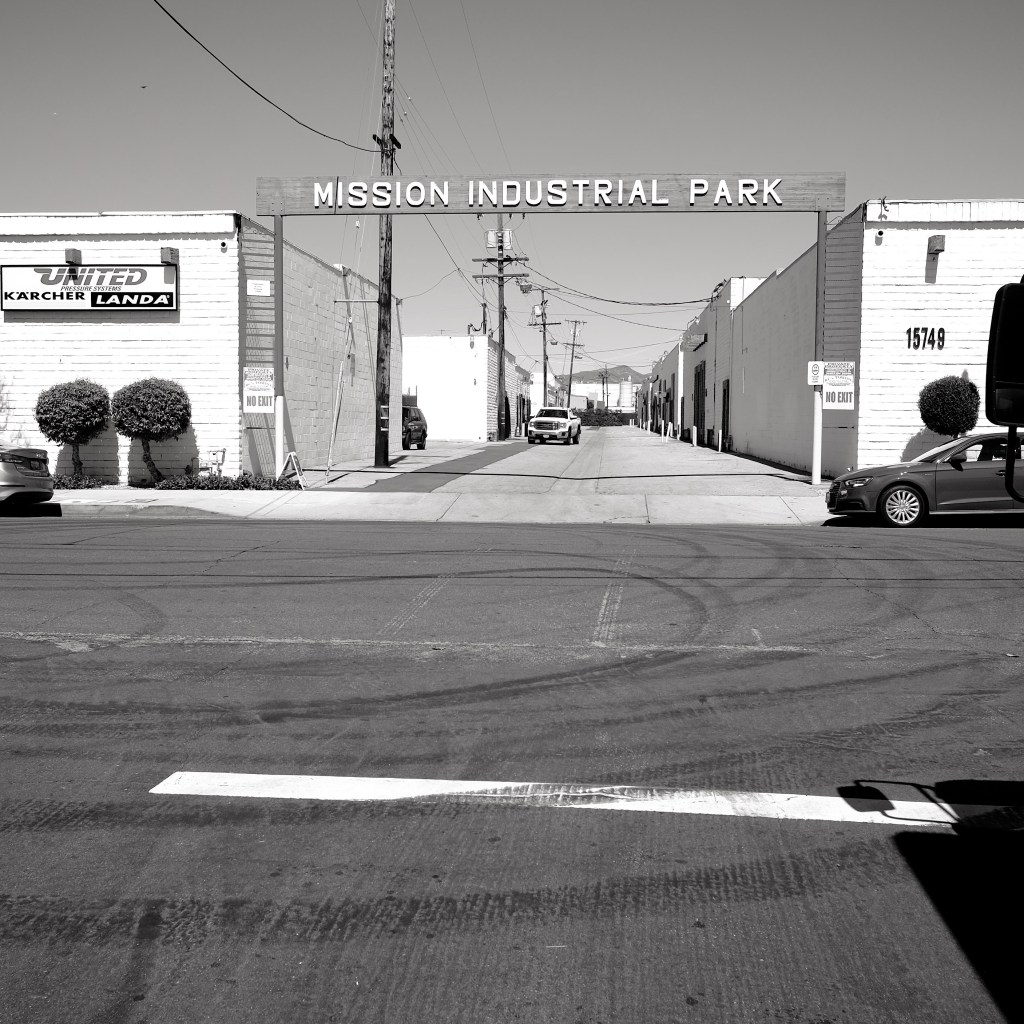
Where Stagg St. bisects Densmore Ave is Mission Industrial Park, announced by a two-posted, two-fisted, old Western kind of sign with raised letters on a wide wooden board hung 20’ high over the street.  It welcomes you to a white-walled alley of various buildings presumably under one owner who felt compelled to establish an identity for her vastly unremarkable assemblage.

Mission Industrial Park.

We went all around here, on public sidewalks, a few days ago, to shoot some photos for a mens’ fashion brand called Magill Los Angeles.  

James and Carter were the models.

Along Densmore Av. Carter (L) and James.

James was 19 and had long blonde hair and said he was born in South Los Angeles but had moved with his father to North Dakota. He was now living in New York City and visiting Hollywood to strike up a modeling career. He had the dazed and confused 70s aura from juvenile and stoned Reseda. He works at McDonalds now but may well be famous in 2029.

Carter, actor, came from North Carolina and was well-read, articulate and sensitive to both words and pollen.

James

The day was sunny, the wind was blowing, the boys were happy and we went to eat tacos later at Tacos Hell Yeah which they said was their best ever meal in LA.

Tacos Hell Yeah
7607 White Oak Ave, Reseda, CA 91335

____________________________________________________________

Those industrial compounds, like the Stagg/Densmore District, are the hidden places in the San Fernando Valley that nobody knows about. 

Tidy, productive, industrious, they are the old lifeblood of Los Angeles, where your late Uncle Bernie, with the cigar in his mouth and the bad gallbladder, set up shop after the war and bought a three bedroom, rock-roofed ranch up on Zelzah Avenue with a delightful kidney-shaped pool.

He had little patience for tears, or men who didn’t know the difference between a wrench or a pliers, having served up ice cream at Montgomery Ward until he enlisted in ’42 and saw action at Guadalcanal. He was never bored, because he was always busy, and you vowed you would never become Uncle Bernie but you’ve done quite worse, haven’t you? He had work and a family, and a company, and a paid for house and you made fun of it, but now life laughs at you.

Aside from the work that goes on inside these shops, there is nothing to do in this area for someone in search of stimulation. Densmore and Stagg and parts around here are boring, without street life. Yet men and women in these enterprises are engaged in work, absorbed in inventions, and creating products that are, in many respects, quite interesting.

Along Stagg St.

Magill: Target/N. Van Nuys
(Not near the Densmore/Stagg/ Mission Industrial District)
James on the Raymer St. Bridge, Van Nuys, CA.

Option A: What the Neighbors Think.


A light rail service yard in Washington state.

Metro is planning a light rail train down the center of Van Nuys Bl. extending from Pacoima to Van Nuys, stopping at Oxnard St. Less probable is a dedicated bus line.

Their final decision, as to what type of transport to build (bus or train) and where to service these will come in June 2018.

Four areas in Van Nuys are under consideration for eminent domain demolition and the building of a light rail maintenance yard.

These are called the “Option” areas and they are A, B, C, and D.

Options B, C, and D

B, C, and D all straddle the existing Metrolink heavy passenger rail tracks along Raymer St. near the former GM plant on the Van Nuys/Panorama City border.


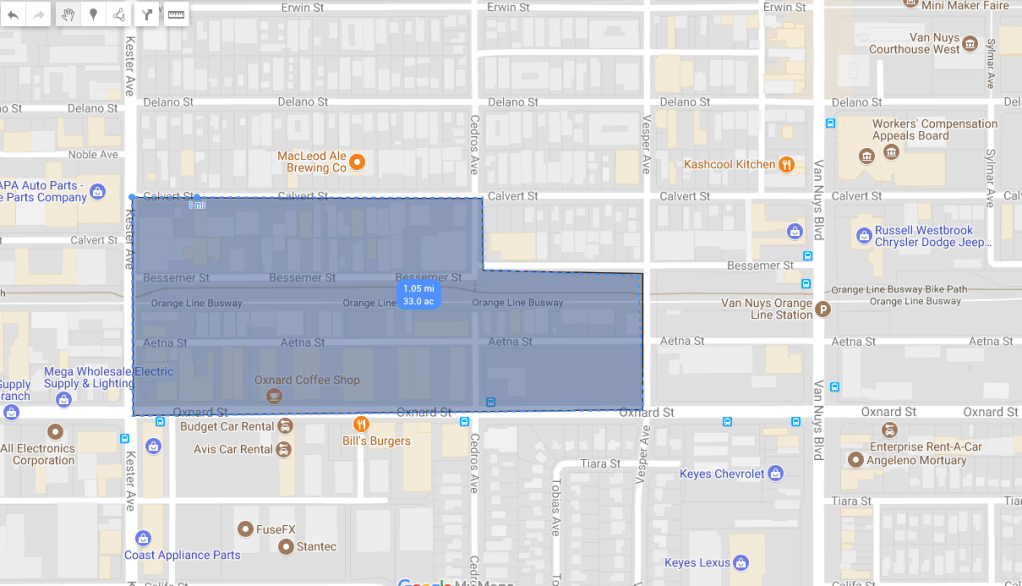
OPTION A:

Option A

Only “Option A” is located in another area: this is a 33-acre spread of light industry comprising 186 businesses, 58 structures and as many as 1,000 workers who are located NE of Oxnard and Kester along Oxnard, Aetna, Bessemer and Calvert Streets.

This blog has reported extensively, since September 2017, on the “Option A” community: a unique, productive, and innovative group of entrepreneurs who make fine decorative hardware, custom shelving; record music, weld metals, clean carpets, fashion artistic stained glass, and restore vintage Mustangs, Vespas and large yachts.

Skilled craftsman at Pashupatina

Garrett Marks, CEO, Mustangs, Etc. (est. 1967)

Peter Scholz, owner Showcase Cabinets (est. 1987)

Simon Simonian, Progressive Art Stained Glass Studio

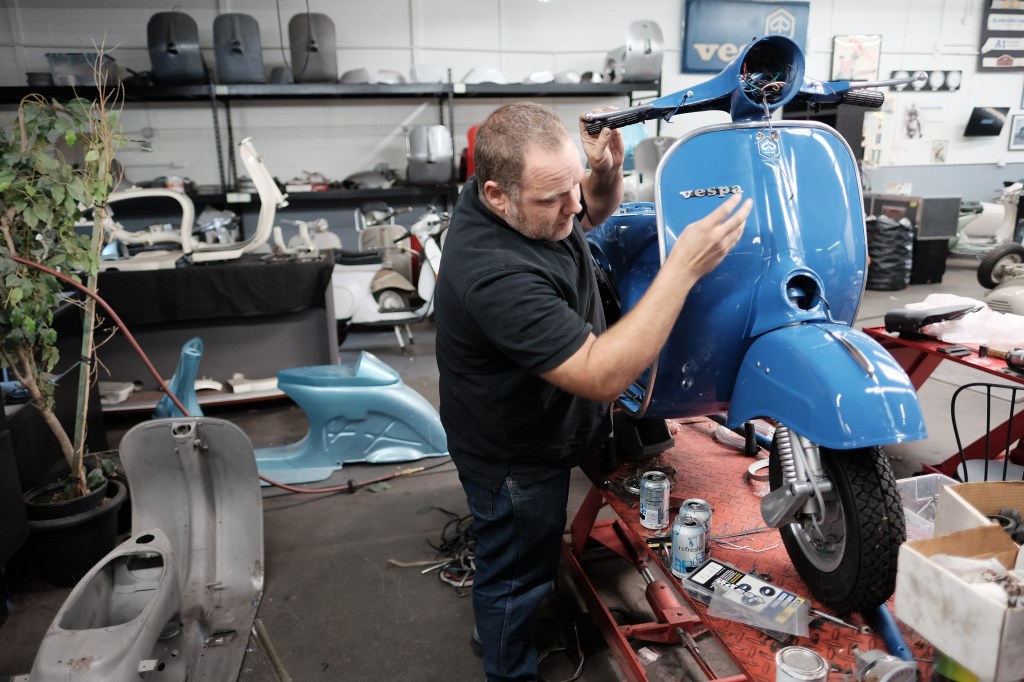
Kristian Storli, Owner: Bar Italia Vespa

Steve Muradyan of BPM Custom Marine

They employ local workers, many of whom walk to work. There are immigrants here, but there are also people who started companies 30, 40 and even 50 years ago who would be forced to move from their little supportive community and fight to rent new space competing against cash rich marijuana growers who are swallowing up space for their noxious, lethargy inducing, industrial scale weed.


I was curious what residents in the area think of “Option A” so I went online and visited Next Door.

My Next Door app page has 2,000 community members from Burbank Bl. north to Roscoe, from the 405 to Hazeline.


I posted a question asking if people opposed or supported “Option A.” Overwhelmingly, by a vote of 87% to 13 (94 total votes), they said they were against it.


Peter Scholz and employee at Showcase Cabinets


 Here are some of the comments:

“It seems like a giant repair yard would be an eye sore and would attract litter, homeless encampments and shady activities since it will have very little activity especially at night. I don’t see how that is worth uprooting all these businesses who contribute to our community and have been here for all of these years.”

“I prefer local businesses any day. Plus, with numerous new apartment buildings popping up all around the area, we have potential for more retail/cafes to move in to the buildings up for lease. However, if all of that space gets used up by ugly rail yards, then the Van Nuys economy will never thrive to its full potential. I’m sick of this city being treated as a dumping ground.”

“The downside of Option A is not only a large rail yard in main area of Van Nuys (which MTA promises would be modern and attractive) but as well, that it would take out approximately 200 small and thriving Van Nuys businesses that each employ, one, two, three, five or more employees, whereas the other two main options hold a minuscule number of businesses. Eminent domain [against] all these businesses in the heart of VN would hurt us in several ways, besides uprooting the businesses and the citizens who work there, there are limited number of commercial properties currently available close by, so many of the businesses could not relocate close by, would not be able to keep locale clientele. For many who live nearby, if new properties could be found, commutes would be added. And for all those businesses relocating outside our community, or for those that would simply be forced to fold, Van Nuys would lose a healthy business tax base. Again, the other two options provided by the city for the yard (if needed based on what the final decisions are) do not suffer from anywhere near the same extent of overall downside.”

“I own a house on Hatteras near the Option A area. And I also rent a building on Aetna which would be demolished. If this happens I will sell my house, which I just purchased two years ago and I will move out of Los Angeles. There is not a reason in the world to pick our district for demolition when so many jobs and lives are at stake. If Nury Martinez allows this she should be recalled.”

Clearly, people who live near the Option A zone are insightful and understand how important it is to preserve small business in Van Nuys. They know that an enormous, gaping hole would not revitalize Van Nuys, but further degrade it.


The community residents, as well as the businesses near Kester and Oxnard, are united in opposing the destruction of viable businesses and local jobs.

Option A: The Vespa Whisperer.


After WWII, Italy was poor, the roads were torn up by war, and the new democratically elected government was prohibited to build military hardware. Industrial revitalization was a must. So innovative militarists turned to consumer products to employ workers and restart the economy.

The Vespa (“Wasp” in Italian) grew out of this era.

It was designed and built by aerospace engineers to satisfy postwar transportation needs economically. They created a scooter, with all the mechanical parts enclosed, and a tall frontal splashguard, features which appealed to Italian men in suits and women in dresses. There was no grease to splatter on well-tailored woolens, and the versatile, small, well-engineered bike travelled well on narrow, pockmarked streets.

Piaggio & Co. introduced it and still owns and manufactures Vespa.

After its debut in 1946, it sold slowly, if solidly.

Then “Roman Holiday” (1952) starring Gregory Peck and Audrey Hepburn, filmed on location in Rome, skyrocketed the Vespa’s popularity. Suddenly 100,000 a year were selling. The popularity of films such as “La Dolce Vita” (1960) and the neo-realist Italian cinema of the 50s and 60s made all things Italian seem fast, young and glamorous. The mid 1960s Mod Subculture in Britain, dudes in Ben Sherman shirts and skinny ties and tapered trousers, furthered pushed the Vespa into pop culture.

The Mods, Britain, mid-1960s
In the US, even Sears imported Vespas and renamed them Cruiseaires. By 1981, the bike had lost popularity due to environmental laws. Yet again, in the early 2000s, Vespa restarted its American sales effort, opening its first boutique on Ventura Boulevard in Sherman Oaks, CA hoping to capitalize on our four CA freedoms: sunshine, mobility, novelty, and fun.

According to Wikipedia, there have been 34 different versions of the Vespa. Today, five series are in production: the classic manual transmission PX and the modern CVT transmission S, LX, GT, and GTS.


About 4 miles north of the Vespa retail store, at an unmarked building at 14819 Aetna St. in Van Nuys, Kristian Storli, 39 is quietly, diligently and artfully restoring Vespas, at his company, Bar Italia Classics, established 2006. According to Mr. Storli, it is the only shop of its type from here to Pennsylvania.

You pass through a gate into a courtyard packed with tools and bikes, all under some sort of repair, but then you enter a stylish, air-cooled, gray-painted, 3600 SF shop, unlike any you’ve ever been to, with vintage illustrations, glass shelves filled with awards and medals, antique framed advertising for Vespas, and a very large movie poster of Angie Dickinson atop a Vespa in “Jessica” (1962) directed by Jean Negulesco. 

Sicilian women plan to rid their village of a sexy American midwife (Angie Dickinson) by making her job obsolete.”

Angie Dickinson, 1962.

Obsolete is what haunts Mr. Storli, a stocky, blue-eyed, mechanical minded man of Norwegian descent who went to school to study musical composition, and ended up investing his life savings into his Vespa passion. He has had three shops in the last ten years: first on Calvert, then Bessemer, and now Aetna.

C, B, A….. Ominously for him there is no letter preceding A.

Each time, rents and leases ended. And this time, he fears, he may become redundant by Option A, if his shop, and 185 others are demolished by Metro Los Angeles for a 33-acre rail service yard.

Nevertheless, there is a rhythmic beat and output of bikes at the shop. Many restorations take 12-18 months and require each machine:


  • To be disassembled and inspected,
  • Stripped of old paint on engine and body parts,
  • Hardware sent out for plating,
  • Reassembling the machine to peak condition in both function and appearance.
  • Full payments are dependent upon delivery of the finished product to its owner.

It is a painstaking job, only undertaken by devotees and acolytes in the cult of Vespa, but the result, as one can see in a finished product, is the absolutely breathtaking beauty of the timeless and completely Italian product. The smooth and shiny gracefulness of a finished bike exudes sensuality and speed.

One day a few weeks back, working inside his dream factory, Mr. Storli was jolted with a bomb of an announcement: He might have to move to make way for a 33-acre demolition project bulldozing 186 businesses for a future light rail maintenance yard operated by Metro Los Angeles.

He had only moved into his third, and presumably final shop, this year, 2017. He lost over a year of income when he had to move the second time. Now he was threatened with new economic ruin, not by a downturn in business, but by an aggressive action of a government agency using Eminent Domain powers to evict lawful enterprises.

He told me that he is deflated, worried, and panicked. He has started, grudgingly, to look for other affordable space in Los Angeles. But the rental vacancy rate for industrial property is only one percent. And the competition is marijuana growers paying three times the asking rate to landlords.

To lose so many businesses is sad.

But it is doubly tragic to see a completely original and unique craftsman, Mr. Storli, thrown out of his space. It is one more step in the homogenization of Los Angeles, where shortsighted bureaucrats fail to protect unique and skillfully constructed products and services when they are operated by small businesses. But every corner store is CVS or Starbucks.

We need excellent public transport.

But grotesquely destructive and obliterating plans to build a light rail yard through viable and productive industrial tracts only harms Los Angeles -by destroying the real and the good -by promising the imaginary and the perfect.