SB 79 and Our Hood


SB 79 is a new law, authored by State Senator Scott Wiener, approved by the legislature, and recently signed by Governor Gavin Newsom, to allow the state to overrule local zoning laws and permit the construction of multi-family housing on lots which are zoned for single family housing when these properties are within a half or quarter mile of a bus or light rail stop.

In Los Angeles, the law will allow much denser and higher development along not only wide boulevards, but inside old, intact, single-family streets, “side streets” which never had apartments or multi-unit housing.


A guide to the law along with maps is here.

Tiered density: The allowable height and density for projects are determined by the quality of the transit stop and the project’s proximity to it.

Tier 1: Applies to projects near high-frequency commuter rail or heavy rail transit, like BART and LA Metro.

Tier 2: Applies to projects near light rail and bus rapid transit lines.

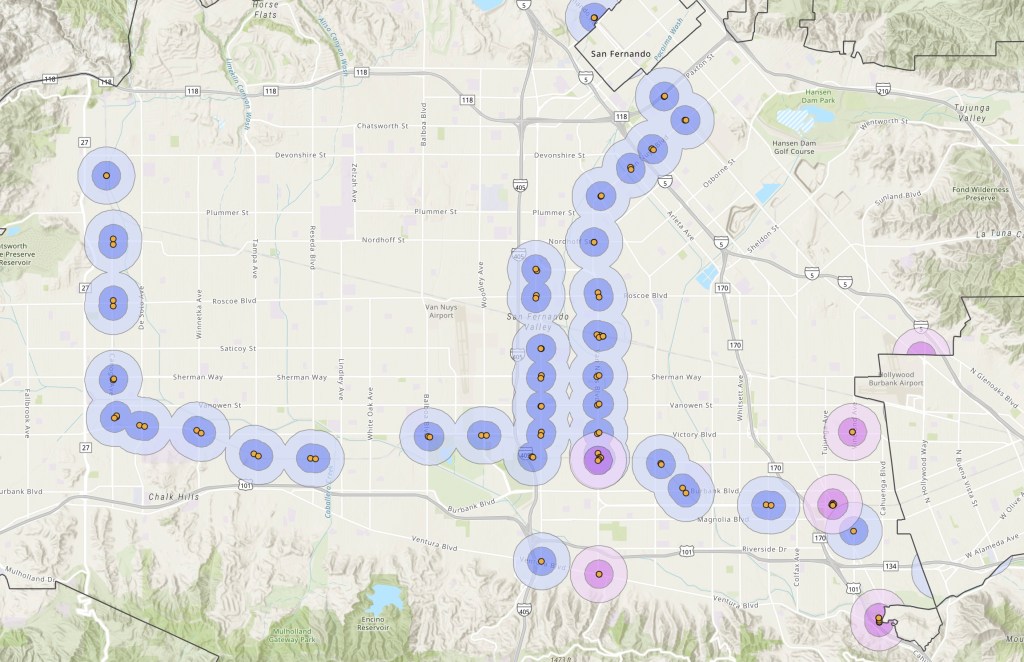
Along Sepulveda and Van Nuys Boulevard the proposed zoning map looks like purple bullet holes that radiate from transit stops. These circles are centered around the transportation stops and take no consideration into the historic or local character of any neighborhood. 

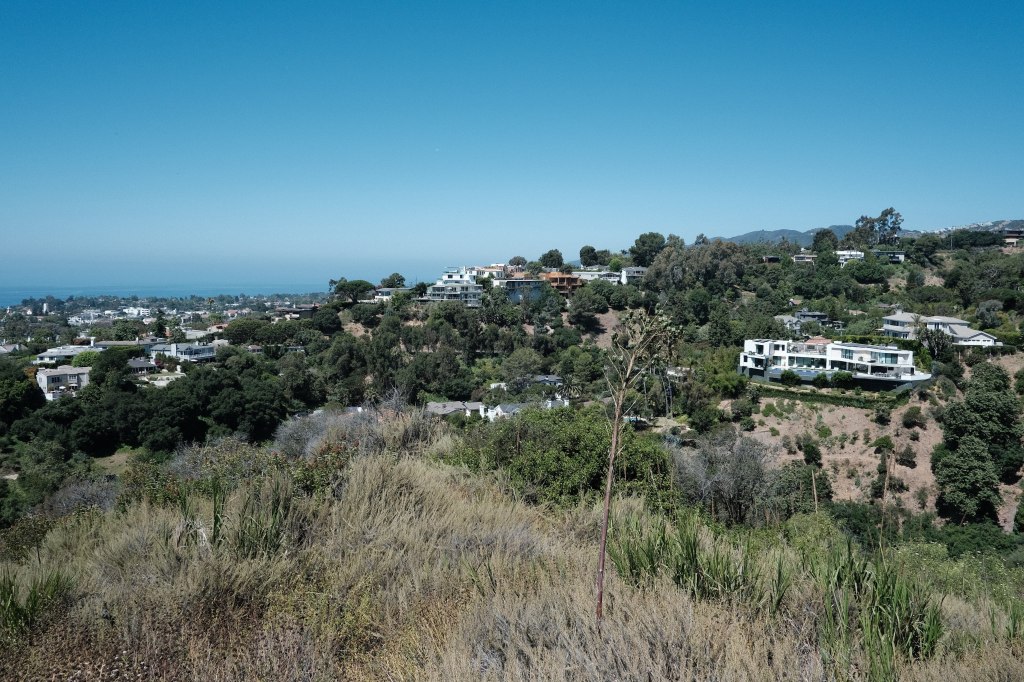
For example, I live on Hamlin Street which is a “Tier 2” zone because we are within a ¼ of Sepulveda Boulevard bus stop. My street, built on old walnut orchards, from 1936 onwards, is lined with palm trees, and then curves along with oak trees. The street has two-hour parking because of its proximity to Van Nuys High School.

If the law succeeds, my section of Hamlin Street would allow 65-foot-high buildings (six and half stories).

But the part of Hamlin Street a few hundred feet east from me would remain single family.

West of Sepulveda, south of Victory, is the beautiful and often filmed Orion Avenue with large colonial style houses planted with rose bushes and ranch fences, the location for many commercials seeking “a typical American street” that doesn’t exist anymore. With SB 79, the east side of the street could be obliterated with apartments that destroy the very beauty residents and film makers pay dearly for.


Yesterday, I had a real life encounter of what Hamlin St. and other locations nearby could become when I parked my car near 3052 West Boulevard in the Jefferson Park neighborhood of Los Angeles, east of Culver City. I was there to visit a new, multi restaurant creation, Maydan Market.

This area was given an economic boost by the Expo Line, a light rail system that connects downtown with Santa Monica. The good parts are investment, cleaner streets, the lowering of crime and the raising of the cultural and civic activities. 

The ugly parts are the disfiguring, ad hoc apartments that pop up on formerly coherent streets of 1920s bungalows. My eyes hurt looking at 3045 West Boulevard, a black and gray box suspended over a cinderblock faced garage, with a massive four story high open-air staircase on the side of the building. It looms like a monster over the street, with no respect or sensitivity to the vernacular that had existed here for 90 years.

Am I a hypocrite for decrying liberalized zoning that will change my backyard? Yes, I am. Sort of.

This blog has argued for years for the construction of new, multi-family buildings to replace unused parking lots behind abandoned shopping centers, or where there is a sea of asphalt like the Orange Line parking area along Sepulveda which was constructed for thousands of vehicles and is now empty.  I have fought for the idea of an architectural, coherent, community wide style that would incorporate history and embrace modernism but do it without destroying but enhancing the community of Van Nuys. 

And I’ve always cast a cold, unforgiving, forensic eye on the political neglect of Van Nuys by elected officials who seem to always be performing social media acts of kindness for oppressed groups while neglecting the needs of residents in this district. 

There are commercial zones galore that cry out for taller residential buildings along the wide boulevards of Van Nuys and greater Los Angeles. The one-story tall shops with parking lots in front are so defunct and useless that their very presence destroys civilized life and endangers the health of pedestrians. 

There are blighted buildings, such as this one at 7101 Sepulveda, that have been empty for years, packed with derelicts, unable to be demolished, yet crying out for replacement. As a bitter pill, the residents in the tree lined, charming, quiet streets behind must now expect multi-family housing to replace their 1940s ranchettes.

What do our elected leaders in Sacramento do with the quandary of building more housing? They embrace a fantasy of destroying single family homes and backyards. 

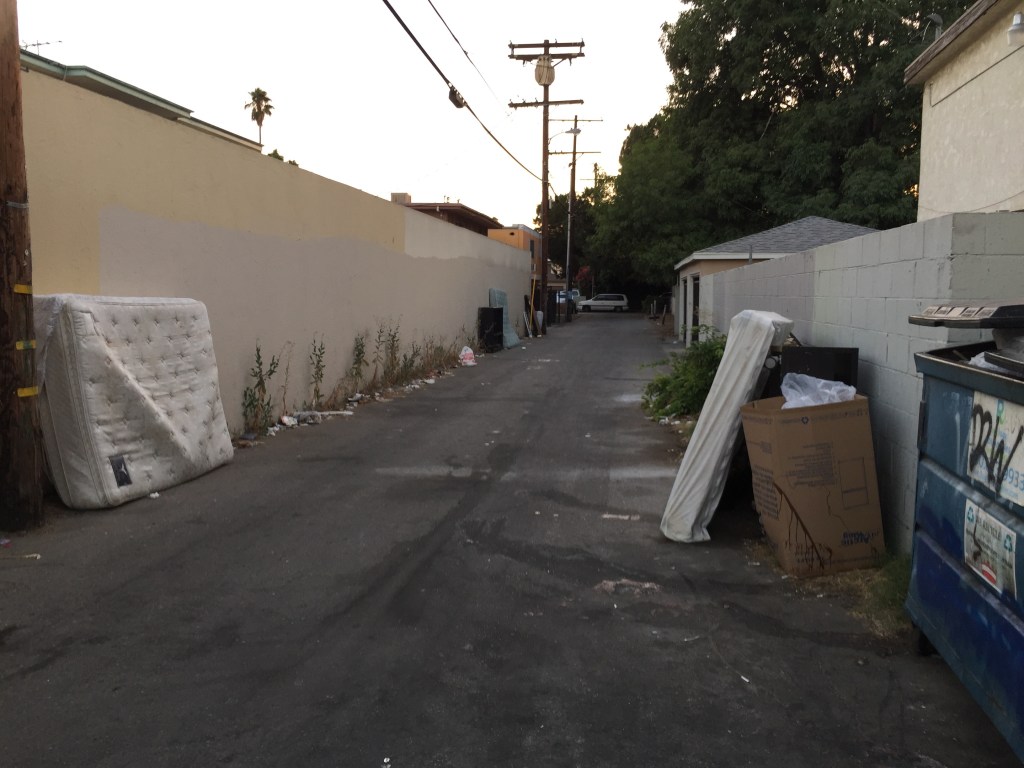
Will your neighbors and you, the elderly couple in the corner house, desire to ride buses (with homeless, drug addicts, crime?) and come home, late at night, from a bus stop on Sepulveda, and enter a new world of yet more cars, loud music, marijuana, dumped mattresses, and YouTube/TikTok/OnlyFans influencers smoking on the balcony next door? I doubt it.

Is that the paradise of tomorrow? Circles on a map, purple splotches of political malfeasance, indicating nothing but more mayhem, disorder and chaos.

I hope I’m long gone, either from life or Van Nuys, before this happens. 

The Social Disaster


In all the days since the disastrous fires destroyed vibrant and sparkling communities of people and their houses and businesses in Altadena and Pacific Palisades, flat and socially unpopular Van Nuys, miles from any combustible forests, sat silent, its empty parking lots and vacant stores along Van Nuys Boulevard mute and abandoned, its daytime as empty and lifeless as its nighttime. 

You live here and just like people anywhere yearn for the same normal things that civilized places provide: safety, cleanliness, affordability, and lawfulness. But all you get are sirens, speeding cars, helicopters at 2am, Woodley Park set ablaze monthly.

After nearly 25 years here I see nothing but decline in the environment around Van Nuys. 

The same neglected mini-mall that I complained about in 2009 is still the same trash strewn dump it always was. Its owner used to live in Bel Air. He complained about my criticism when all I asked him to do was hire a $10 an hour worker to sweep the sidewalk weekly and install a security light on the side of the building so people didn’t sleep and urinate and tag the walls. 

The stores that line Van Nuys Boulevard from Vanowen to the Oxnard are largely empty, many are built with gigantic parking lots behind them that are also empty, parking for thousands of cars that once shopped here, but those shoppers have left or died.

The Valley Municipal Building is where CD 6 Councilwoman Imelda Padilla reigns over the neglect and the ugliness. She replaced Nury Martinez who had to resign in disgrace after she was recorded by covert means saying ethnically insulting things about other Angelenos. Martinez came after Cardenas who went to Congress where he now serves.

Cardenas, Martinez, Padilla. It sounds like a nursery rhyme with its melodic Spanish surnames. It might well be a soundtrack set to an ever- present social disaster of Van Nuys with its hundreds of homeless sleeping in the plaza, along the Orange Line, or in the parking lot of the CVS on Erwin Street. 

How is it that the so-called heart of the San Fernando Valley, the place that once bustled with prosperity and good infrastructure, including light rail and neatly tended homes and businesses, has been allowed to die for so many decades? 

Victory Bl. east of Sepulveda, Van Nuys, CA 5/10/18

Is it callous to also point out that Van Nuys is less prone to fire than other areas that have boomed in recent decades? Would Van Nuys Boulevard, lined with 13-story tall Park Avenue apartment houses be a higher fire risk than thousands of wooden McMansions shoved up canyons in Bel Air, Brentwood, Malibu and the Palisades?

And when Van Nuys gets light rail, might it be possible to imagine a walkable, pleasant, less expensive part of Los Angeles where the vaunted word diversity can be used equitably as all types of inclusion would occur with young, old, well-off, not so well-off, living in nice apartments with patrolled and orderly parks and streets? 

Perhaps some of the displaced people would live in well-maintained buildings if such a thing existed in Van Nuys. 

With so much focus on rebuilding Los Angeles a good place to start an experiment in civilization would be Van Nuys. It’s the only corpse that has been screaming for rescue for decades.

December 1956: Disastrous Malibu Fire


As front liners, on foot or flying aircraft, are still fighting the worst fires in Los Angeles history, it is instructive to see that this is the inheritance of living in this region.

In late December 1956, Malibu was ablaze. Many homes were lost. The same aspects we witness today applied: heroism, narrow escapes, families in terror, and brutal conditions of fire fighting.

Though the vast majority of people who lost homes were obscure middle class people, the headlines then, as now, announced celebrities who also suffered property destruction.

Ralph Edwards, TV personality, loses $75,000 beachfront home!”

In 1956, one helicopter was in service, and after the fire, more were purchased. The militarization of fighting fires, and the use of the most advanced technology and highly trained professionals became the norm.

Here are some photos with their original captions found in the archives of the Los Angeles Public Library:

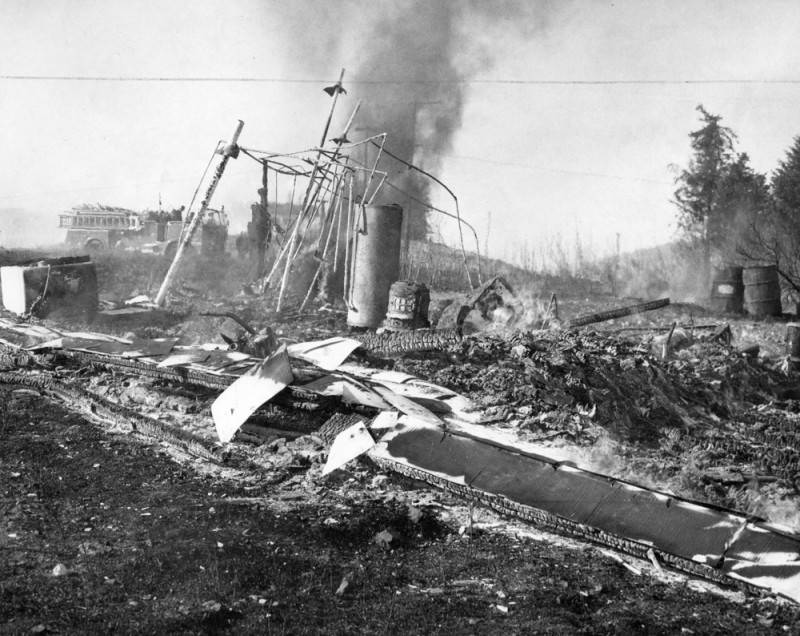
  1. Photograph dated December 26, 1956 shows debris from an unknown structure after the fast-moving mountain blaze burned through the Paradise Cove area in Malibu.
  2. “This is view of fire taken from top of Escondido Canyon looking toward ocean.  Shortly after picture was snapped, flames and smoke rolled down beach burning expensive waterside homes at Paradise Cove and Escondido Beach.  Today, flames are moving north and threaten to jump Mulholland Highway near Lake Malibu.  Army of men and mechanized equipment are massed on this highway in an effort to halt advance of flames over Santa Monica Mountains into plush lake resort area.”
  3. “Volunteer American Red Cross nurse pulls covers up over one sleeping youngster brought into Webster School which was set up as disaster station shortly after flames began threatening resort area near Malibu Beach.  Flames forced more than 1,000 persons to flee for their lives.  Evacuees with only clothes on their backs beat a path to school door to receive lodging and food for night.  Fire officials today fear that school will also be evacuated as flames loomed overhead near Malibu Canyon road.”
  4. Dennis Szigeti looks dazedly at all belongings he managed to salvage from home before it burned to ground in Latigo Canyon drive.  All six of Szigeti’s children were evacuated from home before it was consumed. Szigeti family was luckier than some which had to get out without time to save any of household belongings.”  The article partially reads, “The catastrophic fire which continued to race wildly out of control through the Malibu mountains today threatened to leap over Mulholland Highway near Malibu Lake and burn into the western end of the San Fernando Valley above Calabasas.  The fire has already jumped Mulholland Highway at Decker Canyon and advanced west into Ventura County toward the exclusive Lake Sherwood area.”
  5. “Helmeted John Durbin, 20, volunteer fireman from nearby Thousand Oaks, carries patio chair from plush $32,500 Lake Sherwood home of Mrs. Jean Robison.  Flames fueled by escaping butane gas burned all night.  Hoover home was across road and was first hit by blaze as flames moved inland from Triunfo Ranch, one-quarter mile south of Ventura boulevard near Thousand Oaks.”
  6. “Mrs. Charles Clarke, 5903 Ramirez Canyon, holds her son Billy, 1, closely as she looks up blackened canyon from Paradise Cove.  She, like hundreds of others, became refugee as brush fire inferno swallowed up more than 20,000 acres near beach area.  Her husband brought family to safety and went back to try to save home with help of firemen.”  The article partially reads, “The catastrophic fire which continued to race wildly out of control through the Malibu mountains today threatened to leap over Mulholland Highway near Malibu Lake and burn into the western end of the San Fernando Valley above Calabasas.  The fire has already jumped Mulholland Highway at Decker Canyon and advanced west into Ventura County toward the exclusive Lake Sherwood area.”

“The Malibu fire of December 27, 1956, apparently started on Backus Summit, inland from Zuma Beach. It destroyed 35 homes, killed one person, and injured thirty-three others – both firemen and civilians. Flames shot high enough to be seen from miles away, and the heat was so intense that rocks exploded, and embers and sparks showered down out of the hills across Pacific Coast Highway. Several of the homes destroyed were those of Hollywood personalities, including television’s Ralph Edwards. The Malibu fire was described as the worst Los Angeles County fire since 1938.”

  1. “Fire houses, etc. near Malibu Mountains Inn, Latigo Canyon Rd and Ocean View Drive, at head of Latigo & Ramirez Canyons.”

      2. “Groups of evacuees from S. Rambla Orieta (?) — Mr. and Mrs. Frank Hyatt, left, & Mr. & Mrs. A.W. Rebard, & family”.

      3. “Mrs. Joe Stephens Sr., right, and Red Cross nurse Mrs. Ralph Peterson, left, support Mrs. Nellie Stephens as they carry her to bed in Webster School disaster center. She and other members of family left home at 20641 Malibu Rd. as blaze came dangerously close.”

      4. December 29, 1956 reads: “Skeleton is all that remains of lakeside home belonging to Roy Hoover in Lake Sherwood fire which raced through community. More than 3,000 acres have been reported burned in this area alone. House at time of blaze was occupied by Jack Jones Jr., his wife and their three sons. They all fled to safety. Two firemen suffered injuries while fighting for lake homes.”

      5. “Reporter examines burned-out fire chief’s car”.

      Before the Luck Ran Out.


      The first job I had in Los Angeles was working at Barley Corn Entertainment, a small documentary production company in Valley Village.

      It was the summer of 1994. OJ had just not killed his ex-wife and the young waiter who was returning her sunglasses. I was living in Studio City for $400 a month, and the new job as a PA paid $450 a week.

      The woman who hired me, Lisa, was in her mid 30s, married to one of the owners, Sean. She was green eyed, tall, broad shouldered and drove a dark green Range Rover from her home in Pacific Palisades.

      She brought along a little white Pomeranian dog to the office every day, a novelty to me, being from the Middle West and the East Coast where dogs were large and stayed at home.

      Lisa was a line producer, a job she mastered in daily calm, always even tempered, even when she got cross. She commanded runs and released funds, met with producers, writers, editors, and researchers, and still had time to walk across the street to Gelsons for a cup of coffee and a large spinach salad. Her day ended at 5 or 6, and she would go down to the parking garage and drive an hour back to her enchanted life on Enchanted Way in Pacific Palisades.

      There was a Christmas party at their home in 1994. I arrived at the 1960s ranch house, built on a terraced lot, like every other house, little plots of splendor overlooking the Pacific, lots along a hilly street stacked and placed like many dinner plates on the arms of a hash house waitress. 

      We were all young and in awe at the $600,000 home with sliding glass windows that opened to a small patio that overlooked the mist and the ocean. 

      I drank a lot, and Lisa forbade me to drive home.

      I went to bed on the white sectional in the living room, and awoke under a baby blue cashmere throw with a headache. Lisa made coffee, and then Sean invited me to leave “when it was convenient.”

      Lisa and Sean, Sean and Lisa, Pacific Palisades. Range Rovers, small dogs, lovely houses that always sat in the temperature range of 58-68 degrees. 


      My co-worker, Julie, was the daughter of two negligent Marin County hippies and had gone to live with her maiden aunt in Santa Monica during high school. She adored Lisa and Sean and hoped that one day she too would live in Pacific Palisades, perhaps leveraging her BA from UCLA and weekly production check to buy a house on Enchanted Way.

      A few years later Julie met Aaron, a wealthy man who lived on Lachman Lane in the Palisades. She moved into his house, and they made plans to marry. I went to their house, sat by the pool, and talked with Julie about a reality show idea we never produced.

      Aaron wanted Julie to sign a prenuptial agreement before marriage. Julie asked her friends what they thought, and the consensus was “he doesn’t really love you.” They broke up and Aaron married someone else, a compliant wife who signed an agreement, and they may have lived happily ever after.

      Julie met a hard drinking Missouri man on a production shoot in Wisconsin, married him, had a baby girl, moved to Kansas City, got divorced after a year, and spent the next 15 years in Missouri pining for the lifestyle she lost. She and her teen daughter moved back to the aunt’s condo in Santa Monica last year.


      Kevin, circa 1995, was a producer at Barley Corn, a year older than me, married to Cori, and they lived in a house in Pacific Palisades. 

      He looked like a young Dick Nixon, was kind of a dick swinger at times, bragging about his $400,000 house bought with the wife’s parental endowment. 

      I hadn’t seen him in 28 years, but there was a reunion of Barley Corn folks last summer. I asked him about his house, his $400,000 house. 

      “It ain’t $400,000 anymore! We sold it and bought a much larger place near the village in Pacific Palisades!”


      In the 1990s I also took a comedy writing class at the home of Bill Idelson on Brooktree Lane in Rustic Canyon.

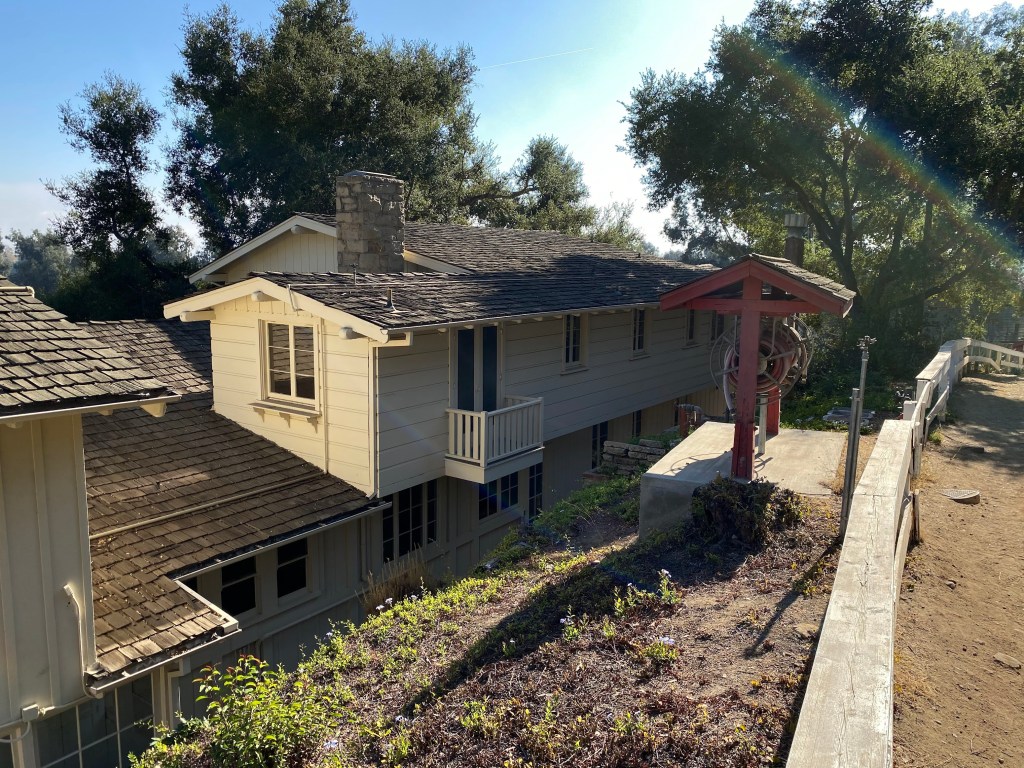
      It was a mid 1950s wood house in a redwood grove next to a creek. It was designed by Mario Corbett and photographed by Julius Shulman. (his photo below).

      Idelson, an actor, also had a successful career penning sitcoms, and he had a formula, much of which I forgot, except for his drawing of a man and a moon. “How he gets to the moon is your story!” he said.

      We would sit on the patio next to the creek, and with the sounds of water and nature, get instructed.

      Idelson had a grown son, a handsome, athletic blond guy who said he would ride the creek during rains in his raft straight down to the ocean.

      That was Pacific Palisades: the successful sitcom, the gorgeous house, the beautiful surroundings, the happy-go-lucky son who rode the rain water for fun.


      Pacific Palisades does things to people who live there and people who don’t.

      For those of us who only live there vicariously, it is sprinkled with celebrities, hiking trails, valet parking, croissants, gourmet coffees and cheeses, blond boys in collared shirts, hot yoga, scented candles, soccer matches, Will Rogers, polo ponies, Eucalyptus trees, gardeners and caterers, brand new big white houses with black windows and electric steel gates, and smooth faced women in sunglasses driving large SUVs 60 miles an hour down Sunset on their way to Lululemon. There is never smog, heat, homelessness or obesity. The maids commute two hours to clean 10,000 square foot houses that are empty because their owners live in New York City. 

      It was, until a few days ago, something you venerated and worshipped, like Harvard University (before October 7, 2023), Berkshire Hathaway, or inheriting ten acres of land atop Mulholland. If only you had that Ivy League degree, or ten $677,000 Berkshire Hathaway shares, or lived on El Medio Avenue so you could walk to the Temescal Canyon Trailhead. You might someday hit it big, marry that blonde girl, date the personal trainer stepson of that HBO celebrity with a lot of fame and money, sell that show, invent that software sold for millions to Meta, or become a partner of that law firm in Century City, if only you had one of these or that you could be the happiest person on Earth and live in Pacific Palisades.


      Since I moved to LA in 1994, there was always a sense to me that people migrated to places rather than improve the ones they lived in. They sometimes did this by changing names, from North Hollywood to Valley Village, or Valley Glen; or converting West Van Nuys into Lake Balboa.

      To this day, Los Angeles, for miles and miles, is neglected, filthy, violent. It has no nice parks, hardly any real neighborhoods to walk around. It costs a fortune to live here, to rent or buy is oppressive. People sleep in tents, or on bus benches, they rob stores, and start fires because they are so lost and miserable. 

      Seemingly not so in Pacific Palisades. Charming, safe, family friendly, delightful. Nothing catastrophic or out of control. The powers that be lived here and kept it well-tuned and well-functioning. Until January 7, 2025.

      Once in a generation weather. Except it happens around the globe every week in different horror scenes. One month it’s Lahaina, the next month it’s Greece, Spain, Western Canada.

      But Pacific Palisades? Our Pacific Palisades? Where we go for hikes, where my nephew goes to school, where my gentle, wine sipping bosses lived, where I brought my parents to Rustic Canyon so they could see “the real California?”

      We kid ourselves thinking our good luck is our own doing, that we may escape losing our health or our home. We really do live by the whims of fate.

      There is one migration that seems innocent, but it is, in a sense malignant, many people of means seeking to escape the bad air hellhole of greater Los Angeles, and it leads to Sunset at PCH where there is no more land, paradise promised at the end of the continent.

      Now it is temporarily destroyed. 

      Thank God for those who have survived. Life matters most.

      We have seen these fierce wind driven fires and their atomic destruction. 

      How one small spark can end one era and perhaps usher in another one that may be more humane and sustainable. 

      Journey to Intelligentsia


      I hate the place but I agreed to meet a friend who lives in Silver Lake down at the expensive, pretentious coffee house where there are many nice dogs and many mean people.

      It was a random Tuesday in Los Angeles. The 101 was packed with cars and trucks. But when I drove down Hollywood to Sunset, I passed less than five people walking on the streets.

      They were repairing the electrical wires on Sunset, on the year 1888 wooden poles, so I turned up Hyperion and found parking across the street from a man sleeping on the sidewalk in front of the two-million-dollar wooden bungalow.

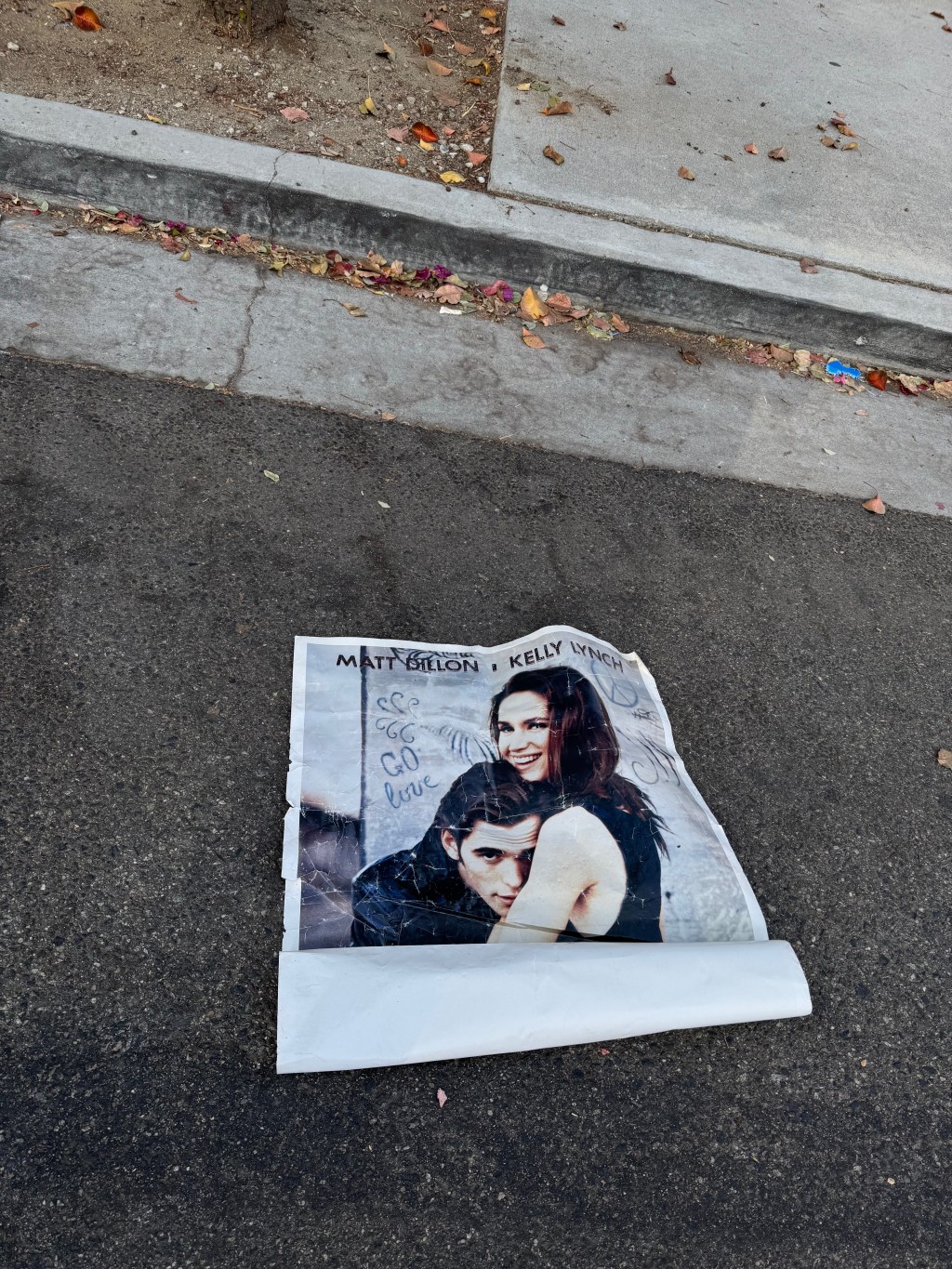
      A discarded, half rolled out movie poster from the Matt Dillion/Kelly Lynch picture, “Drugstore Cowboy” (1989) was thrown on the street. An unemployed, 60-year-old gaffer on that film probably threw it out before moving back to Naperville.

      I had to pee badly so I made a mad dash to Intelligentsia and found that the bathrooms were allegedly out of service. Quick thinking and I ran down to the other coffee place, La Colombe, which has better coffee, nicer servers and a clean, open restroom. I bought a croissant which was pretty good and walked back down to Intelligentsia to meet my friend.

      There were angry political posters taped to every pole I passed:  

      We need and demand a whole new way to live, a fundamentally different system.

      LA’s Best Restaurants Are Feeding You a Lie.

      And there was even a quotation from Black Conservative Thomas Sowell:

      “The fact that so many politicians are such shameless liars is not only a reflection on them, it is also a reflection on us.”

            Perhaps the progressive person who posted Sowell’s quote didn’t know that Sowell is an ardent opponent of racial quotas.

            Two artfully outfitted Japanese guys were taking photos of the coffee shop exterior to document their visit to this legendary place. I felt excited for them being so excited.

            I found a seat outside across from a large black French Poodle and his bearded owner in a baseball cap imprinted with the flag of a foreign country.

            A small, middle-aged man emerged carrying an espresso cup balanced on a saucer, carrying a pastry, holding a dog leash attached to a large, gray Weimaraner.

            “Do you mind dogs?” he asked as he sat down and attempted to fit his large animal between the petite table and the flat wood bench.

            I was still waiting for my friend as more dogs arrived. It was an excellent seat for dog watching, looking at their fur colors, admiring their leashes, listening to their barking. The whole patio was dogs, tied up to the table legs, emptied of their owners who were inside ordering drinks.

            Finally, my friend arrived. He is about 50, a short Filipino graphic designer who carried Age of Revolutions: Progress and Backlash from 1600 to the Present by Fareed Zakaria. 

            He told me he had a crazy dream about losing expensive camera equipment. It inspired me to tell him about a camera store in St. Moritz I had recently seen that kept hundreds of thousands of dollars of electronics in their store window overnight without fear of theft.

            We got our coffees and new seats and sat on the outdoor patio where no loud humans could be heard, only the occasional bark from one of 12 dogs.

            Suddenly, a foul faced young woman holding a saucer of water for her rust bulldog threw the water bowl liquid on the patio inches from where we were sitting. She might have walked to the numerous plant containers and politely dumped her dog water there, but since this was Los Angeles, not Switzerland, consideration for others was highly unlikely. 

            We talked more about travel, politics, international affairs, apartments, real estate, and everything that might have involved Donald Trump, but his name was never mentioned. My friend asked if I wanted to walk down Sunset, perhaps to a park, to sit and talk, so we left Intelligentsia, the dog motel with coffee drinks.

            “Are you still hungry?” he asked. I assumed he was going to buy me a sandwich.

            We walked into Bravo Toast, a place with gourmet toasts. He ordered one with thin slices of bananas and a power drink. He paid for his sandwich and drink and got a number.

            “Hey, should I order something Ross?” I asked.

            “Oh, I’m sorry Andrew. Go ahead,” he said.

            But since this was Los Angeles, not Switzerland, consideration for others was highly unlikely.

            I got one with ricotta cheese for $12.50, plus $1.50 tip, my treat, for me.

            We were conversing, quietly, enjoying our food and ruminating about life, ideas, dreams.

            Then the noise began. 

            Two skinny, female presenting things somewhere north of 20 with many piercings and 18-inch waists sat down nearby. As they screamed and laughed not even the fire engines with sirens speeding down Sunset could be heard. I briefly considered asking them to talk softer, but since this was Los Angeles, not Switzerland, consideration for others was highly unlikely.

            We left Bravo Toast and said good-bye on Sunset.      

      “Next time I’ll come up to Van Nuys and you can show me around,” Ross said. 

      Young Asia.


      Image

      They were young when we boarded Singapore Airlines at LAX, bound for Tokyo. 22 men and women, flight attendants, smooth skinned, well mannered, and slim, women with hair pulled back wearing Sarong Kebaya. Graceful, smiling, polite, they maneuvered in and out of the aisles, pushing carts, pouring tea.

      The flight left on time and touched down in Tokyo as silently and softly as a Kleenex falling on a pillow.

      The airports were dazzling, slick, architectural and inviting: Tokyo Narita, Singapore Changi, and KLIA.  Customs officials in every nation were polite, well-spoken, welcoming. Everything they are not in Los Angeles.

      The skyscrapers were young, newly built, tall, dropped into every corner of Kuala Lumpur: Icon Mount Kiara, Charigali Tower, 60 floors tall, St. Regis Hotel, 80 stories tall, Menara Tradewinds, Warisan Merdeka (118 Floors Tall!), KL Tower (Menara Kuala Lumpur) 1,381 feet tall, Ilham Baru Tower (62 floors).  They were clearing out jungles, paving over valleys, erecting vast suburban housing and vertical towers in Cyberjaya, Shah Alam, Bangsar, Petaling Jaya. Soon, a high-speed train will connect Singapore, KL and Bangkok.

      The land was young, landfill on the west side of Melaka, thousands of acres of new commercial buildings lined up like soldiers in a future army of retail, uninhabited infants.  Old classical mansions that once stood on the shore were abandoned and empty, their contents stolen, their memories wiped clean.

      The KL malls were new, full of shoppers, hordes of black haired boys and girls in bright scarves and long dresses, eyes glued in their smart phones, moving through vast air-conditioned, bright spaces. The Pavilion! KLCC Suria! Star Hill Gallery!

      The Malaysian highways were new, and along the new landscaped lanes, billboards shouted advertising with smiling faces, multi-cultural Malay and Chinese faces beaming in Samsung, Jasmine Rice, Panasonic, Thai Airways, Telekom Malaysia, Air Asia, Hyundai.

      The Malaysian born bride was young, effervescent, intelligent, ambitious, and well connected. She owned a condo, a house (under remodel) worked for a bank and travelled to Singapore, Bali, Jakarta, Hong Kong, Shanghai, Seoul, and Melbourne. She had a lot of friends, a lot of family, a lot of generosity and much love around her. She was the future, for just this moment, of a region where education and money are exploding exponentially.

      And the trains in Tokyo, the intersections of Shibuya, Shimokitazawa, Ginza, Shinjuku, they were young, overwhelmingly so, populated with hundreds of thousands of post 1985 human beings pouring off the modern perfectly run trains, into stores and shops and cafes, hurrying everywhere, acquiring purses, shoes, makeup, perfume, suits, electronics.

      Inside the endless shops of Tokyo Station, the bowing and the smiling, the serving and the selling, a furious, unabated, exhausting and exhilarating controlled carnival of commerce, this was Japan.

      And everywhere, in every corner, the spirit, the energy, the optimism, the faith in tomorrow and the future, a region poised to take over the world, relentless in its work, socialized to harmonize, grouped en masse into money-making and modernism, this was young Asia.

      I went here on holiday, for three weeks, to attend a wedding in Kuala Lumpur, to vacation in Phuket, Thailand and stop off in Tokyo for four days.

      I came back to Los Angeles in culture shock. For what I saw back there made the Golden State seem dyspeptic, backward, self-congratulatory– without merit.  Our new international airport had dirty windows; the customs people were fat and shouted angrily at passport holders. The bus was late and the driver made jokes (“This bus isn’t going to Van Nuys. Long Beach! Just kidding!”) that delayed our trip.

      And the news was that the government was shut down. I thought of that on the 405 bus ride home, having just seen, 10 hours earlier, postal workers at work at Tokyo Station, on Sunday afternoon.

      America is no longer young, in outlook or output, and I wonder if we even have any dreams left in our national imagination.