Today’s Uber Ride.


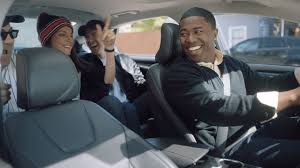
Today’s Uber ride starred Anthony, formerly of Spanish Harlem, who picked me up at a neighbor’s house in his gray Toyota Prius on Hamlin St. for the 35-minute pool ride to Studio City.

A friendly, chatty, 40-year-old New Yorker in dreadlocks, he started off by ignoring an incoming phone call from “my best friend” who he said never returns phone calls.

But his friend, he explained, was a stand-up guy, a former addict who was spending the weekend up in Santa Barbara to help his sponsor who had fallen off the wagon, gotten back into drugs and alcohol and whose sister was illegally selling the house from under him.

We turned up Calvert Street to pick up a second rider, Ryan, a tanned, curly haired guy from Santa Clarita who worked as “an outdoor cinematographer.” On the ride down to his apartment on Valleyheart Drive he bemoaned the lack of money in his profession, but he also said his friends who travel the world and post about it on Instagram are mostly paid with products, not money.

After Ryan left, we picked up a ride at Fashion Square. This time it was a lanky, tall, black cigarette smoker, Albert, who threw out his butt before he got into the backseat of the car carrying his bag of new shoes. He was on his way down to Studio City to do some vintage shopping at Crossroads. He wore long red basketball shorts and had a dead-eyed expression on his young face. 

He said he was short on funds, but made good money as a restaurant delivery worker, as well as getting Social Security money from the government and food stamps. His ambition was to work in fashion, either in films or TV.  He wanted to buy a car, but he was also struggling to pay his $1,000 a month rent.

The driver said he made great money as an Uber driver, as much as $1500-$1800 a week, and that he could pay himself up to five times a day as funds came in. He was working to achieve success as a standup comedian. He was excited when I told him he had picked me up in front of the Workaholics House where the owner currently has monthly comedy shows in the backyard for $20 a head attended by hundreds of people. 

Finally, we got to Peet’s Coffee and inside there was a regular: Actor/Comedian Jane Lynch (Glee, Best in Show). 

I’m sure she would have loved my Uber ride.

The Janitors’ Light Rail.


nury-martinez-dn
Nury Martinez, 2012. (Hans Gutknecht/Staff Photographer)

“If you’re a housekeeper, janitor or dish washer, you need to get to work every day on time,” she said. “Buses don’t move as many people and as quickly as the light rail. That’s why we’re excited about the project that would serve people who are transit dependent.”[1]

“As a mom, I can tell you it’s terrifying to sometimes think of having to get on the Red Line. I won’t for that very reason,” she said. “I don’t have to see the data collection to know that if I feel unsafe to ride the train with my kid, that I’m just simply not going to use it.”[2]

-Councilwoman Nury Martinez


Why are these two quotes important?

What does it matter what Councilwoman Nury Martinez of LA’s City Council District #6, representing Arleta, Panorama City, Lake Balboa, and Van Nuys thinks about public transportation, light rail, who rides it and who needs it?

It matters, I think, because it shows a way of describing non-car travel as something used by people who are the lesser people of the City of Angels: maids, janitors, dishwashers and perhaps even criminals.

Can agents at William Morris, that actor who stars on that sitcom, Hancock Park attorneys, the conductor of the LA Philharmonic, and Dodger Clayton Kershaw also ride trains? I wish they all did!

Strange that a political culture that panders to PC should grossly stereotype transit riders.

The prospect that Van Nuys, long languishing, is under her jittery guidance, and limited vision, is not especially comforting.  A public official who denigrates public transportation is not doing the people’s business very well.

For in her remarks she shows a remarkably retrogressive and depressing view of public transportation as something which is sometimes terrifying, unsuitable for mothers with children, and only made for unskilled workers commuting to low paying jobs in the NE Valley.

There has been, for a long time, an idea that if you had enough money in Los Angeles you would surely travel by car. And today, we have the spectacle of 24/7 traffic produced by a culture conditioned to expect that every journey must begin and end in a car.

Even as plans for expansion of light rail go on all over Los Angeles, there is an equally strong pushback against it.

  • Uber and Lyft are making it possible to take short distance trips by dialing up a ride on your phone.
  • Amazon is delivering everything from chewing gum to sofas with fleets of trucks that are also clogging our streets.
  • Parents who rightly shudder at their children attending a low rated local school chauffeur their kids 25 miles away to “better schools.”
  • Housing is now a luxury commodity but every law that seeks to expand it runs into the “where will they park?” crowd who wants to stop new apartments, new granny flats, new retail stores and multi-family dwellings near trains.

And instead of public officials offering imaginative, innovative and futuristic ideas, we have a throwback to the car culture that is unsustainable.

Los Angeles! This is 2018! This is not 1975, 1965 or 1945!

Light rail and subways are not dangerous. They are not only for criminals. They are not only for the woman who scrubs your floor. Properly policed, intelligently managed, excellently maintained, they can be pleasant, quick and enjoyable.

They are the way we ALL will get around Los Angeles when gridlock by private vehicle renders this city dysfunctional.


[1] https://www.dailynews.com/2018/06/03/heres-van-nuys-through-the-eyes-of-mr-van-nuys/

[2] http://www.latimes.com/local/lanow/la-me-ln-martinez-metro-sexual-harassment-20180124-story.html

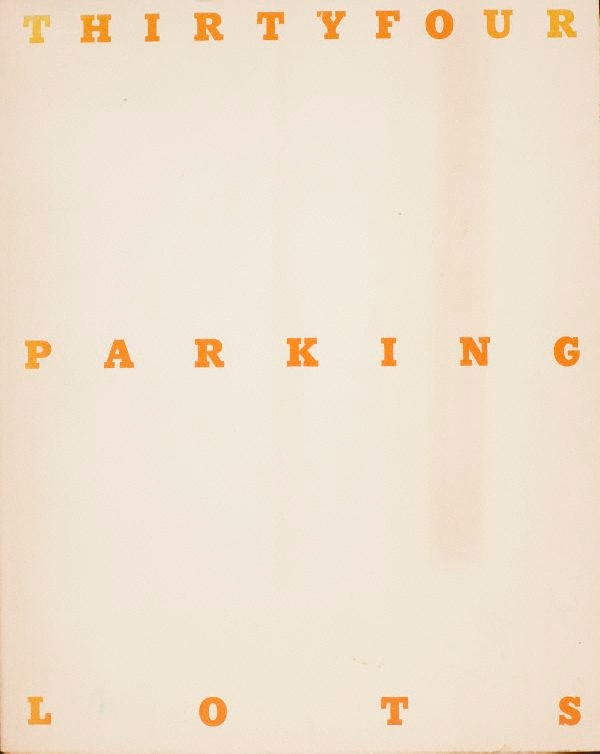
Thirty-Four Parking Lots in Los Angeles (1967)


Thirty-Four Parking Lots in Los Angeles (1967)

I previously wrote about this topic in 2014, but bring it up again as Los Angeles, and the State of California, are now in a furious debate about housing, cars, homelessness and how best to build.

All B&W photographs below are by Ed Ruscha. 


Ed Ruscha’s “Thirty-Four Parking Lots in Los Angeles” was published 51 years ago.

The artist, born in Nebraska in 1937, came to this city in 1956 to study at the Chouinard Art Institute. He also had an apprenticeship in typesetting.

Graduating in 1960, only 23 years old, he started working at an advertising agency doing graphic design. Influenced by the works of Jasper Johns, Robert Rauschenberg, Andy Warhol and Roy Lichtenstein, Ruscha was featured in a 1962 survey called “New Painting of Common Objects.”

That year he published “Twentysix gasoline stations” and later “Every Building on the Sunset Strip.” (1966)

He was the first, or perhaps the most notable artist, to create a deadpan, earnest, unesthetic photography of built Los Angeles. He looked, without pretense, at the sprawling, cheap, roadside city of billboards, car washes, instant apartments and filling stations and wrapped up his black and white photographs into little, smart, best-sellers.

Ruscha was talented and knew how to sell things, always a winning combination in the city of angles. (intentional)

The 1960s was a dirty flood of bitter reckoning that hit America and threw cold water on its made-up, powdered face.

Assassinations, sexual relations, racial issues, drugs, protests, music, environmental desecration, Vietnam: the entire decade blew up a contented self-image.

A nation, which thought itself a beacon of light onto the world, was forced to reconsider its own grotesque violence and misunderstand it.

Confronting Los Angeles, Ruscha presented a homely city with a picture book full of raw honesty.

State Board of Equalization 14601 Sherman Way, Van Nuys, CA.

May Co. 6150 Laurel Cyn NH

Inside “Thirty Four Parking Lots in Los Angeles” are some aerial shots of ordinary Van Nuys, North Hollywood and LA in 1967, with those enormous oceans of parking lots floating boat-like buildings.

Up in an airplane, looking down, Ruscha captured lines and boxes transposed upon the land, asphalt which looked, on its surface, much like the curtain-walled office buildings of that era.

Goodyear Tires 6630 Laurel Cyn NH

Good Year Tires at 6610 Laurel Canyon in North Hollywood occupies only a dot atop a long “I” shaped land-mass of parking.

Dodger Stadium

Dodger Stadium is buried deep within the hot skins of asphalt, a vaginal shaped structure where men played ball.

7101 Sepulveda, Van Nuys, CA.

And 7101 Sepulveda, a now abandoned office tower near Sherman Way, has trailers and motels on its perimeter, as well as plenty of free parking. Today, this area often hosts large encampments of homeless people, so the peripatetic ways of Van Nuys have historical precedent it seems.

Eileen Feather Salon 14425 Sherman Way, Van Nuys, CA.

14425 Sherman Way was called the “Eileen Feather Salon” and has but one long building fronting Sherman Way with parking in back.

Today, that corner is a cacophony of grossness and visual pollution including donuts and Denny’s. Signs are everywhere. And the weary eye becomes nostalgic for the simple joy of a lone building and its parking lot set down on arid land in the once less populated San Fernando Valley.


7128 Van Nuys Bl. 8/5/14

We are now engaged in a great civic debate about housing, and public transportation, and some voices hope (mine included) that denser buildings along bus and train lines will help alleviate high rents and homelessness.

Yet we never quite escape the trap set by the automobile: where to drive it, where to park it, how to best accommodate its needs.

Every single debate about new buildings always begins and ends with parking. Tens of thousands sleep on the street, families cannot afford rents or mortgages, developers are hamstrung providing parking for everyone and their guests, and Los Angeles dies a little each day from auto related illnesses.

Every time we think we are biking or busing more, something sinister comes onto the scene, and we now have 100,000 Ubers and Lyfts clogging the roads, and making our lives more hellish even as we praise their conveniences.

We plan a light rail down Van Nuys Boulevard and the auto dealers like Keyes stop it at Oxnard. They still run things. They destroy the city, and they are congratulated and worshipped for it. Thousands of their new cars are stored at outdoor transit adjacent parking lots built by Metro with taxpayer funds. Ironic.

Every time we imagine we are free of the car, we are forced back into it to chauffeur little white kids to school in better neighborhoods, to commute to $10 an hour jobs, to spend three hours every day in our vehicle so we might live in a house that consumes 50% of our income. Madness.

Ed Ruscha’s simple aerial photographs of parking lots are still a fact-based statement of what this city is. And how we are all swallowed into it.

Goodyear Tires 6630 Laurel Cyn NH