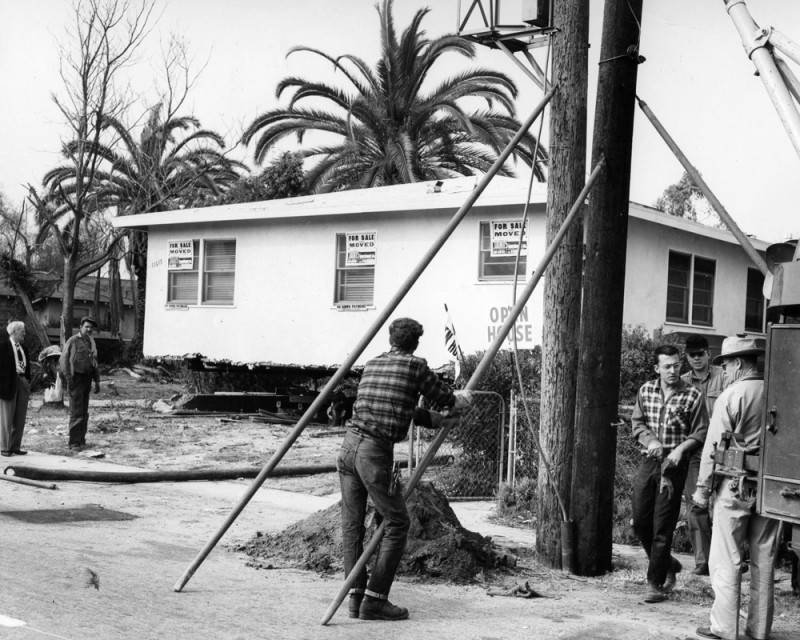
Clearing Away Parks and Houses for the Hollywood Freeway.


In the 1950s and early 60s, the expansion of the Ventura and Hollywood Freeways was accomplished by massive bulldozing of parks and houses.

North Hollywood, never rich in parkland, suffered the loss of some 20 acres of parkland to accommodate the construction of the 170 which today slices through and forms a new border between more affluent “Valley Village” and less wealthy North Hollywood.

It was cheaper to take parks than pay private property owners to seize land for the highways. Yet there were also many thousands of buildings moved or destroyed when California embarked on its mad program to make us completely dependent on motor vehicles.

Today we live in a reality that we think is normal but was paved and paid for by our elected ancestors. Car chases, global oil with wars and climate change, air pollution, shopping centers that took away orange groves, every five-minute traffic reports, the self-defeating obsession with oil prices, the decline of walking and the promotion of obesity are all linked in some way to the freeway system.

Our fervor to ride our cars to the Starbucks and drop our kids off at school, empowers Saudi Arabia, Russia, Iran. 

Our question for every apartment building and every house built in California: where will they park? Nothing architectural or aesthetic, nothing about the urgency of housing, only one thing on everyone’s minds:

Where will they park? Where will they park? Where will they park? Where will they park?

If by some miracle there was a proposal to build Rockefeller Center in the middle of a parking lot in Van Nuys behind rows of empty storefronts, there would still be only one question: where will they park?

We would rather live in environmental degradation than rethink our freeway and road addictions.

But in the 1950s every destructive program was considered an improvement.

Photo credits: LAPL/Valley Times.


The Van Nuys Experimental District (VNED)


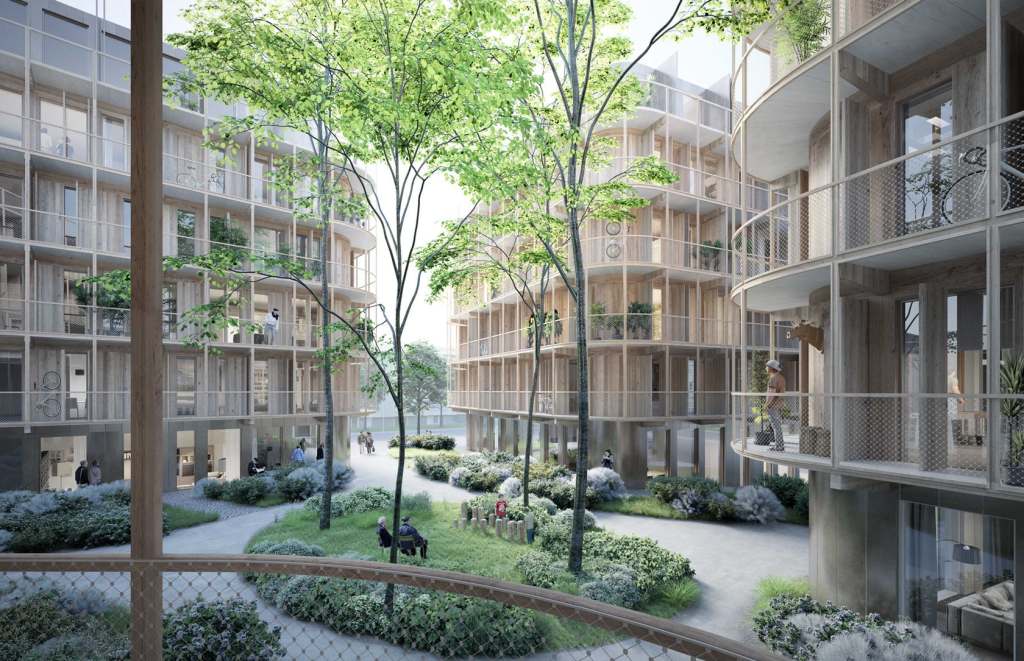
kjellandersjoberg_salabacke_view-courtyard.jpg

kjellandersjoberg_salabacke_view-inner-courtyard.jpg

kjellandersjoberg_salabacke_view-inner-courtyard.jpg

Sketch by kjellandersjoberg_salabacke_view-inner-courtyard.jpg

perspektive_aussen_totale_006.jpg

kjellandersjoberg_salabacke_glade-view.jpg

payette_rbenson.jpg

Given that the largest amount of new housing built in Van Nuys consists of tents on sidewalks, the idea of taking a portion of this district, say from Oxnard to VanOwen along Van Nuys Boulevard, and re-christening it as “The Van Nuys Experimental District” (VNED) is an idea whose time has come.

Along with light rail, bike roads and alternate modes of transport beyond private automobiles, the VNED would allow architects great freedom to build modern, inventive and attractive buildings providing apartments for a city starving for it.

If these buildings could be tax deferred for developers for 25 years, maybe the high costs of construction could be partially ameliorated.

Professional complainers, who begin and end every discussion with “where will they park?” should instead ask, “where will we live?” Amateur economists, who hate new housing because “it’s too expensive” should ask if limiting housing will reduce its price.


The photographs on this page are taken from a website called Architizer.

The photographs below were taken by me on Victory near Sepulveda on the south side of the “99 Ranch Market” shopping center.

Victory Bl. east of Sepulveda, Van Nuys, CA 5/10/18

Victory Bl. east of Sepulveda, Van Nuys, CA 5/10/18


SaveSave

SaveSave

SaveSave

SaveSave

Populating Van Nuys with Fine Architecture


VNB: 1952, photo by Alan Weeks.

DWP Collection

Van Nuys (b. 1911) began as a town, centered around a main street, connected to Los Angeles by streetcar and rail.

It built its fire station, library, city hall,  police station, and its churches, schools, shops and post office steps apart. On foot, a person could buy a suit, take out a library book, mail a letter, and walk to school.

Come to think of it they still can. But it was all there in downtown Van Nuys.

Today you might stand outside the LAPD Van Nuys Station and smoke a joint, drink a can of beer,  pee against a wall and nobody would raise an eyebrow.

The librarian, the cop, the priest, the attorney, they would walk past you and shrug their shoulders and mutter, “What can I do?”

We are so tolerant these days. Everything degrading is welcomed, while everything worthwhile is rare, expensive  or extinct.

Posture Contest, Van Nuys, 1958. Impossible to imagine these days with all the cell phone spines.

Surrounded by orange and walnut groves, the growing town nonetheless managed to provide safe, civilized and opportune situations for its newly arrived residents with affordable housing, subsidized by low interest government backed loans after WWII.

And plentiful, well-paying jobs. Imagine that!

Van Nuys, circa 1938.


Widening of Victory Boulevard: 1954.

Van Nuys Blvd. at Friar (circa 1950). Notice diagonal parking and streetcar wiring.

Van Nuys Bl. 2013

Somehow it was lost after 1945. The enormous shopping centers robbed Van Nuys of its clientele. The street widenings turned boulevards into raceways and the village feel was destroyed. Factories closed, banks shrunk, stores fled, and crime settled here to afflict, rob, disable and kill.

Why does Van Nuys flounder, while all around it other cities like Burbank, Glendale, Pasadena, and sections of Los Angeles, like North Hollywood, Studio City, Mid-City and Highland Park flourish?

Delano St. July 2017

Delano St. July 2017


Raymer St. March 2017


A journalist from Curbed LA called me yesterday. He is writing an article about Van Nuys and wanted to talk.

I mentioned many things that I wish were changed here, from road diets to better housing, from cleaner streets to more law enforcement for illegal dumping.

But I also told him that so much of our political leadership is devoted to working on problems like prostitution, rather than building a coalition of architects, designers, investors, and planners who could build up Van Nuys and make it, once again, a coherent, safe, stimulating, and pleasant place to live and work.

I know what’s bad here. But what about making it good? Where are our dreams? Why can’t we be as artistic as our studios, as wild in our imaginations as our writers, directors, cinematographers, animators, and designers?

Why isn’t the whole energy of creative Los Angeles devoted to overcoming our civic afflictions?


Near Cedros and Delano.

Van Nuys Bl. Nov. 2016


The deadest and more depressing areas of Van Nuys are closest to the Orange Line, which is also a good thing. Because this is where Van Nuys should work to build new, experimental, and innovative housing and commercial buildings.

Van Nuys Bl. Oct 2016 A dead place for street life.

The Empty Post Office/ Van Nuys Bl. Oct. 2016

Dystopian Van Nuys Oct. 2016. No people, no chairs, no trees. Just concrete.

Homeless on Aetna St. Feb. 2016


From Kester to Hazeltine, north of Oxnard, the “Civic Center” district contains an empty post office, vacated stores, underutilized buildings, and dystopian spaces of concrete, homelessness, garbage, and withering neglect.

The pedestrian mall on Erwin, south of the Valley Municipal Building and surrounded by the Superior Court, the library and police station, is a civic disgrace.

Ironically, all the law enforcement, all the government agencies, all the power that resides in Van Nuys….. presides over the ruins of it.


Meanwhile up in Portland, OR.

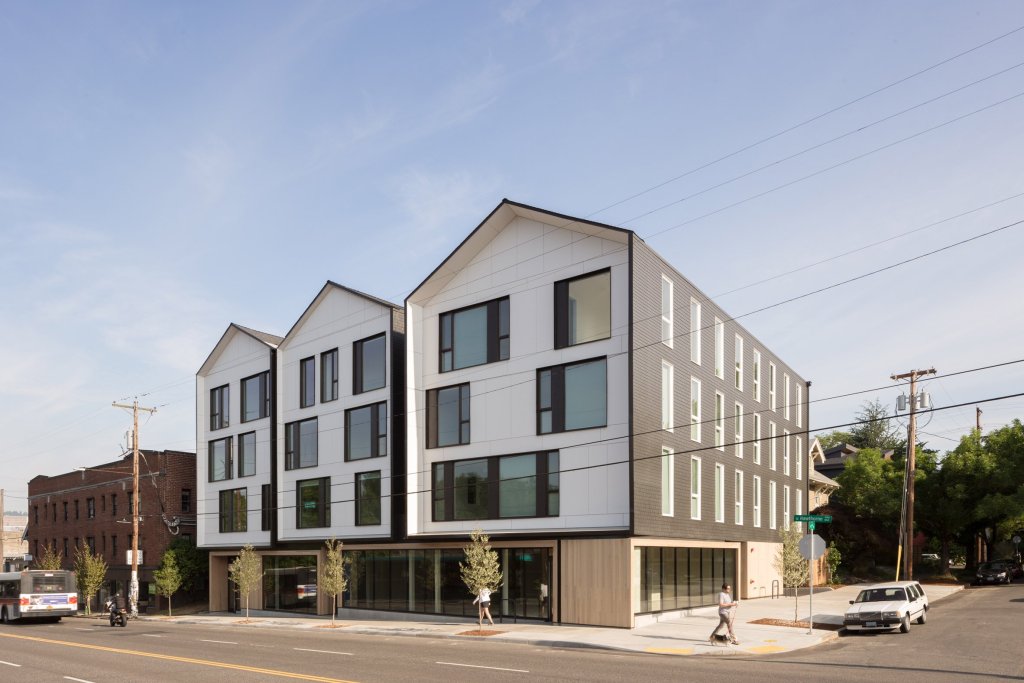
Holst Architecture, Portland, OR (Dezeen)

Works Progress Architecture, Portland, OR (Dezeen)

Works Architecture, Portland, OR (Dezeen)

Fujiwaramuro Architects, Kobe, Japan (Dezeen)

Van Nuys Alley near Delano and VNB

On Dezeen, there are posts about new, infill buildings in Portland, OR and Japan where the general level of architecture and design far outpaces Van Nuys. These are sophisticated, modern, but humble structures with ideas for living.

Look at these and imagine how, perhaps 25 new ones, could transform Van Nuys.

In the midst of our wasteland, we need to go back to working to demanding the best for Van Nuys, rather than accepting squalor and mediocrity.


Return to Van Nuys Savings and Loan


Ph: Maynard Parker
Ph: Maynard Parker

In an earlier post, I wrote about the old Van Nuys Savings and Loan, at 6569 Van Nuys Boulevard.

It was built in 1955 and designed by architect Culver Heaton with murals by noted artist Millard Sheets.

Modernity and innovation were expressed in its zig-zag roof, screened metal panels and wide, airy interior, a place of efficient banking and progressive faith in the future of Van Nuys which was booming in housing, retail, industry and education.

This was a place for people to save and earn 4 1/2% annual interest, guaranteed. This was an institution whose name was spoken of with pride. And who worked within the community to loan money and helped invest in productive enterprises.

Ph: Maynard Parker
Ph: Maynard Parker

Ph: Maynard Parker
Ph: Maynard Parker

Nobody in 1955 could have imagined what Van Nuys has now become.

La Tapachulteca is a Guatemalan grocery store that currently occupies the old bank building. I came here and photographed the exterior just as photographer Maynard Parker once did.

Yesterday, May 20, 2016, on the same day the brand new Expo Rail line opened to connect downtown to Santa Monica, a  homeless woman slept here in a pigeon pooped, urine sprinkled, dirty entrance where unwashed windows and grime completed a scene of degradation and filth.

La Tapachulteca La Tapachulteca Homeless Front La Tapachulteca

Door La Tapachulteca


Los Angeles is building its future in public transport by emulating the past.

Streetcars once ran up and down Van Nuys Boulevard. Service stopped in 1952. The boulevard was widened to accommodate more cars, and vast parking lots were built behind Van Nuys Boulevard, while walls of blankness went up on the street because all activity was now behind. The street went dead.

Van_Nuys_ca1940 Van_Nuys_Blvd_ca1946DSCF2607

And now only cars promenade along the boulevard, or rather speed past without stopping.

The store, like the bank before it, is scheduled to close down.

In its place, a new mixed-use residential/commercial building will be erected. The bank building, once an architectural jewel, will be bulldozed and dumped and carted away.

Perhaps a community needs to hit rock bottom to again climb up into prosperity.

If one building’s decline is emblematic of a whole area’s fall, can a new structure represent a new beginning for an entire area?

Time will tell…


Future Gardens of Van Nuys?


One of the continuing themes of this blog is to look at what we are and imagine what we might be.

I think about that as I walk around Van Nuys, a misbegotten and deformed district.

But also an oddly lucky place where land is abundant and cheaper, yet frequently and usually, neglected and wasted.

DSCF0093

At 14550 Sylvan St., between Van Nuys Blvd. and Vesper, there is now an empty courtyard surrounded by buildings on three sides. They once fixed cars here. This is a street full of fine old buildings, including the former Van Nuys Library (now a law office) and the former post office. There are also small stores: a tailor, a barber, a school, and a storefront church.

This is where a garden belongs.  Buildings are small scale and human, within walking distance of every important building in downtown Van Nuys.

I took photos (with permission) from England. The  ‘London Permaculture’ Flickr page shows urban gardens transforming bleak and hostile spaces into fertile and green growing areas.

Brown brick, beer guzzling, working-class England can be drab, but these gardens are a morale booster for their users.

4875262608_37ee8bed18_o 4875232792_63e85a5525_o


DSCF0090
Sylvan near Van Nuys Bl.

Our alleys, behind Van Nuys Boulevard, can be fixed up with cafes, bars, trees, plants and lights. Eating, drinking and socializing can replace public urination, rats, tagging and trash.

DSCF0042
14526 Victory near VNB

At 14526 Victory Boulevard, the NCJW (National Council of Jewish Women) has a donation center which again, is a North facing forecourt that would also do nicely as an outdoor beer garden, pocket herb garden, etc.

4875185840_23295da3e0_o

Friar St.
Friar St.

At Friar and Van Nuys Boulevard there is a large parking lot, which is across the street from another large parking structure, in an area with too much parking. Why does Van Nuys, in this ramshackle location, with its empty storefronts and dead buildings, need 2,000 parking spaces?

There are wasted opportunities of land and development all over Van Nuys.

We live in an environment built for the lowest common denominator of mediocrity and exploitation.

DSCF0009
West of Van Nuys Blvd. near Hamlin St.

Who can marshall the resources to bring money and planning into Van Nuys?

4875151558_205265f2d0_o

War Costs Money. Our Money.


Where were all these geniuses when the US first invaded Iraq, and later Afghanistan? All these wars and all the spending overseas, not to mention weapons expended on such wonderful allies as Pakistan, is directly visible in the deplorable condition of American infrastructure.

Here in Southern California we have a substandard school system, bursting water pipes, pot-holed pavement, bankrupt police and fire departments, cutbacks in every type of poverty aid; cities who are laying off park, sanitation, and medical personnel; and a public transport system which would be fine in a city of 4,000 people.

And we don’t have glorious public parks, efficient and clean streets; underground electrical, or well-patrolled and safe neighborhoods.

If you take a Google Street View of any street in Denmark, Finland, France, Sweden, Germany or Italy and compare it to many sections of Los Angles, you will have a real life story of how our nation is literally decaying and dying and how our leaders continue to pour money into useless and self-defeating war that is bankrupting us financially and morally.

Go to Google Street view and compare bombed out Dresden, Germany in 2011 to the victorious San Fernando Valley or Detroit, Michigan and see how the US treats its own.