SB 79 and Our Hood


SB 79 is a new law, authored by State Senator Scott Wiener, approved by the legislature, and recently signed by Governor Gavin Newsom, to allow the state to overrule local zoning laws and permit the construction of multi-family housing on lots which are zoned for single family housing when these properties are within a half or quarter mile of a bus or light rail stop.

In Los Angeles, the law will allow much denser and higher development along not only wide boulevards, but inside old, intact, single-family streets, “side streets” which never had apartments or multi-unit housing.


A guide to the law along with maps is here.

Tiered density: The allowable height and density for projects are determined by the quality of the transit stop and the project’s proximity to it.

Tier 1: Applies to projects near high-frequency commuter rail or heavy rail transit, like BART and LA Metro.

Tier 2: Applies to projects near light rail and bus rapid transit lines.

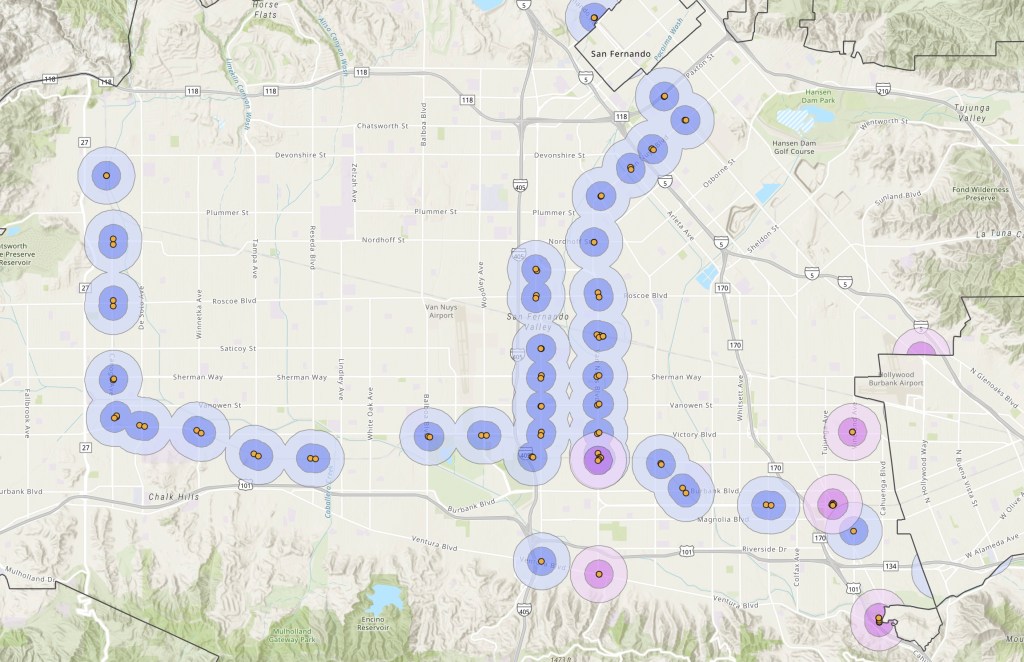
Along Sepulveda and Van Nuys Boulevard the proposed zoning map looks like purple bullet holes that radiate from transit stops. These circles are centered around the transportation stops and take no consideration into the historic or local character of any neighborhood. 

For example, I live on Hamlin Street which is a “Tier 2” zone because we are within a ¼ of Sepulveda Boulevard bus stop. My street, built on old walnut orchards, from 1936 onwards, is lined with palm trees, and then curves along with oak trees. The street has two-hour parking because of its proximity to Van Nuys High School.

If the law succeeds, my section of Hamlin Street would allow 65-foot-high buildings (six and half stories).

But the part of Hamlin Street a few hundred feet east from me would remain single family.

West of Sepulveda, south of Victory, is the beautiful and often filmed Orion Avenue with large colonial style houses planted with rose bushes and ranch fences, the location for many commercials seeking “a typical American street” that doesn’t exist anymore. With SB 79, the east side of the street could be obliterated with apartments that destroy the very beauty residents and film makers pay dearly for.


Yesterday, I had a real life encounter of what Hamlin St. and other locations nearby could become when I parked my car near 3052 West Boulevard in the Jefferson Park neighborhood of Los Angeles, east of Culver City. I was there to visit a new, multi restaurant creation, Maydan Market.

This area was given an economic boost by the Expo Line, a light rail system that connects downtown with Santa Monica. The good parts are investment, cleaner streets, the lowering of crime and the raising of the cultural and civic activities. 

The ugly parts are the disfiguring, ad hoc apartments that pop up on formerly coherent streets of 1920s bungalows. My eyes hurt looking at 3045 West Boulevard, a black and gray box suspended over a cinderblock faced garage, with a massive four story high open-air staircase on the side of the building. It looms like a monster over the street, with no respect or sensitivity to the vernacular that had existed here for 90 years.

Am I a hypocrite for decrying liberalized zoning that will change my backyard? Yes, I am. Sort of.

This blog has argued for years for the construction of new, multi-family buildings to replace unused parking lots behind abandoned shopping centers, or where there is a sea of asphalt like the Orange Line parking area along Sepulveda which was constructed for thousands of vehicles and is now empty.  I have fought for the idea of an architectural, coherent, community wide style that would incorporate history and embrace modernism but do it without destroying but enhancing the community of Van Nuys. 

And I’ve always cast a cold, unforgiving, forensic eye on the political neglect of Van Nuys by elected officials who seem to always be performing social media acts of kindness for oppressed groups while neglecting the needs of residents in this district. 

There are commercial zones galore that cry out for taller residential buildings along the wide boulevards of Van Nuys and greater Los Angeles. The one-story tall shops with parking lots in front are so defunct and useless that their very presence destroys civilized life and endangers the health of pedestrians. 

There are blighted buildings, such as this one at 7101 Sepulveda, that have been empty for years, packed with derelicts, unable to be demolished, yet crying out for replacement. As a bitter pill, the residents in the tree lined, charming, quiet streets behind must now expect multi-family housing to replace their 1940s ranchettes.

What do our elected leaders in Sacramento do with the quandary of building more housing? They embrace a fantasy of destroying single family homes and backyards. 

Will your neighbors and you, the elderly couple in the corner house, desire to ride buses (with homeless, drug addicts, crime?) and come home, late at night, from a bus stop on Sepulveda, and enter a new world of yet more cars, loud music, marijuana, dumped mattresses, and YouTube/TikTok/OnlyFans influencers smoking on the balcony next door? I doubt it.

Is that the paradise of tomorrow? Circles on a map, purple splotches of political malfeasance, indicating nothing but more mayhem, disorder and chaos.

I hope I’m long gone, either from life or Van Nuys, before this happens. 

The Perfect House


In early 1993, I was visiting Larry and Kay, who lived in a beautiful home in Woodland Hills, south of Ventura, of course. They were around the corner from the last large orange grove in the San Fernando Valley.

They were Hollywood people, who had moved out to the SFV, in the late 1960s, from Michigan. 

The husband was a TV producer who had success on ABC in the 1970s. The wife played tennis with “Happy Days” star Marion Ross. They had three children. I was friends with their middle daughter Beth, who I had gone to college with.

Their house was up on a hill, atop a long driveway, in a bed of ivy and surrounded by mature trees. There was a large, life-sized cow in front, so you were assured this was a place of wit and irony.

The expansive, beamed, rustically casual interior with a wall of patio facing French doors was paved with polished bricks. A two-story tall front hall, with plants growing up to the ceiling along an open riser staircase, extended back into an amorphous pool that was surrounded by terraced, green hillside and more vintage signs from old roadside advertising.

That year I was considering moving from New York City to Los Angeles. And then, the next year, I did. 

The husband was a gregarious, self-confident, big Midwesterner who liked practical jokes, loved making television, and loved Los Angeles. He would have made a good poster child for the LA Chamber of Commerce: family man, in a spectacular house, having fun earning a living in entertainment.

During one conversation Larry said he liked LA because when you drove to the airport “you never had to go through a bad neighborhood.”

Kay said she loved LA because she loved her house, “It’s paradise here in my home and garden,” she said.

I thought then, 26 years ago, how odd and how normal these remarks were, how characteristic of Los Angeles, and a certain kind of person these impressions of life here were. For who would argue, especially in 1993, that a nice home was not the entire object of life and the culmination of Los Angeles dream? 

Who cared if there was nowhere to walk, if “Main Street” was a 15-mile-long wreckage of parking lots, junk food, car washes, shopping centers and ugliness; and your downtown was a vacated, forgotten and despised urban renewal zone, strangled by bad air and wide freeways, where lost people wandered aimlessly?

And you never knew your neighbors’ names, and you only saw them from behind your tinted, electric windows.

If you bought a nice ranch house south of Ventura Blvd. you were really set. The city and its attributes or lack thereof were of no importance. The sun always shined on your pool and your garden.


I have lived in this city more years than other city, and still I wonder what I am doing here.

Like Larry and Kay I have a nice house, perhaps not on the scale of their house, but it’s a good, clean, comfortable house, and I like it.

But beyond this house, a few houses down, here in Van Nuys, one encounters a city where 58,000 people live on the streets, and traffic, billboards, mini-malls, illegal dumping, air pollution, and crime are profuse. 

A great house would be a great if it were in a great city that took great care of its environment. 

But our city lets people camp out along the freeway, and defecate in the take-out line next to Wendy’s. It cannot stop it when drivers cut off in traffic kill each other and it cannot predict if a madman with a gun will shoot to death some random man at the Orange Line bus in Lake Balboa.

The Perfect House could never exist in a city where 90% of the people who can, drive their children to schools in other school districts, because the local schools are inferior, because the nearby, walkable schools are populated by less advantaged kids. What fine city sends its’ kids far away to go to schools in other places?

In our city, desperate for housing, people with homes protest housing for homeless seniors. It reminds me of a man with epilepsy, and an autistic boy, who protested a memory care facility for Alzheimer’s patients near his home in NJ. 

The Perfect House would not exist in a city with scattered, garbage-filled carts on sidewalks. And a bus bench shelter was not for bus riders, but a bed for a man without a bedroom.

Los Angeles promotes self-destruction of self and city as public policy. It allows vagrancy, dumping and human defecation into local rivers that empty into the ocean.  And its leaders ask you to understand and accept the degradation of a city as the natural order of business.

Straws are banned, smoking is banned, but tens of thousands of trash campers can set up their tents anywhere in Los Angeles.

How are we not calling this an emergency?


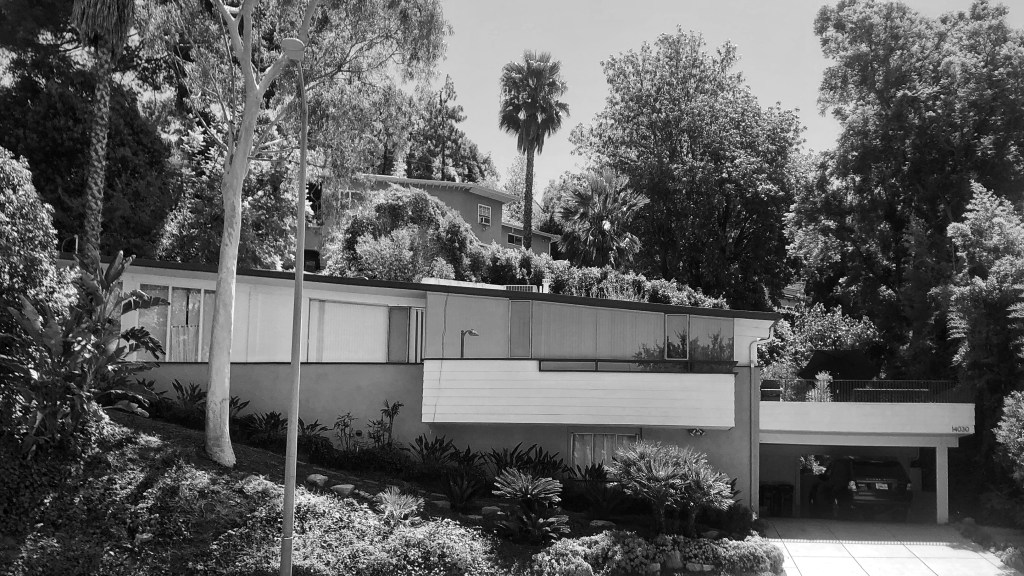
In the photo above is a version of The Perfect House at 14030 Valley Vista, Sherman Oaks, CA by Gal Harpaz, photographer.

The architect was born in Ferrara, Italy, a Jew who escaped when Mussolini came to power. Edgardo Contini, (1914-90) who was a founder of Gruen Associates and a planner in many projects in this city including the Pacific Design Center, the Fox Hills Mall as well as President of the Urban Innovations Group, the practicing arm of the UCLA Graduate School of Architecture and Urban Planning. He worked with Architect Charles Moore and participated in the Grand Avenue proposal for California Plaza on Bunker Hill.[2]

And during his lifetime in Los Angeles, Mr. Contini seemed to think that this city was in need of urban preservation, reuse of older buildings rather than outward sprawl. He wanted to end our wasteful, continual destruction of historical structures and our voracious consumption of wild lands and agricultural fields beyond the city.

He saw Los Angeles as more than the ideal house. He imagined a city where the health and well being of all was the optimal.  

What would he think of Studio City today where $3 million dollar houses are constructed steps away from people sleeping on mattresses along the LA River? Or of Van Nuys Boulevard with its’ boarded up businesses, homeless encampments, and dismal condition?

In 1972, he wrote, “We should place the emphasis on recycling, no further withdrawl from our resources of open land would be required/ and we will not leave urban litter behind.”

Are we better off today than we were in 1972? Or are we still, like Mayor Garcetti, just talking a virtue game and living in a cesspool? 

Where are all the big plans for humane and just architecture to heal all the atrocities of modern Los Angeles? Can we just survive and continue to build a city of flat-topped McMansions, backyard garage add-ons and $3500 a month apartments?

Is any large city in America as dirty as Los Angeles? Is any booming and billionaire saturated city in Europe? One looks to India to imagine our dystopian future.

The Perfect House is beyond most of our reach, but the better city should not be.


[2]Obituaries: Edgardo Contini, Architect, Urban Planner; by Leon Whiteson; LA Times, May 1, 1990.

Plowing Asphalt into Green Spaces.


This slideshow requires JavaScript.

click bottom center of photo to STOP.

Two big parcels of land on Van Nuys Blvd., encompassing at least three acres, have come into being now, due to the demolition of the Keyes Mercedes building at Chandler and the emptying of Rydell Chevrolet on the NW corner of Burbank.

To see these lots cleared is to appreciate the enormity of space they once occupied, and offers urban dreamers the chance to imagine how these land areas could be utilized for greener businesses.

According to my friend Dick Carter, a restaurant real estate broker, parking is always a problem. The Keyes and Rydell lots offer possibilities for integrating parking, dining and agriculture.

An organic diner or restaurant could grow herbs, citrus, vegetables, and sustainable plants on these lands, products grown locally and freshly right here in Van Nuys. People would sit outside, in gardens, under trees, and dine on foods grown on Van Nuys Blvd!

Government tax breaks, modifications in zoning, and enlightened planners could transform our environment, our neighborhood and our health.

And Steve Weiss at Capital (818-905-2400) is leasing the Rydell space.