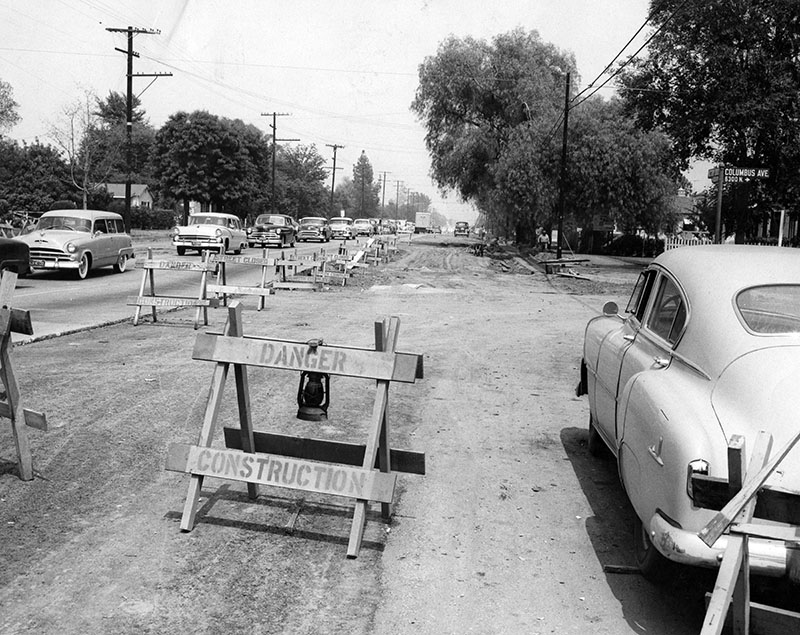
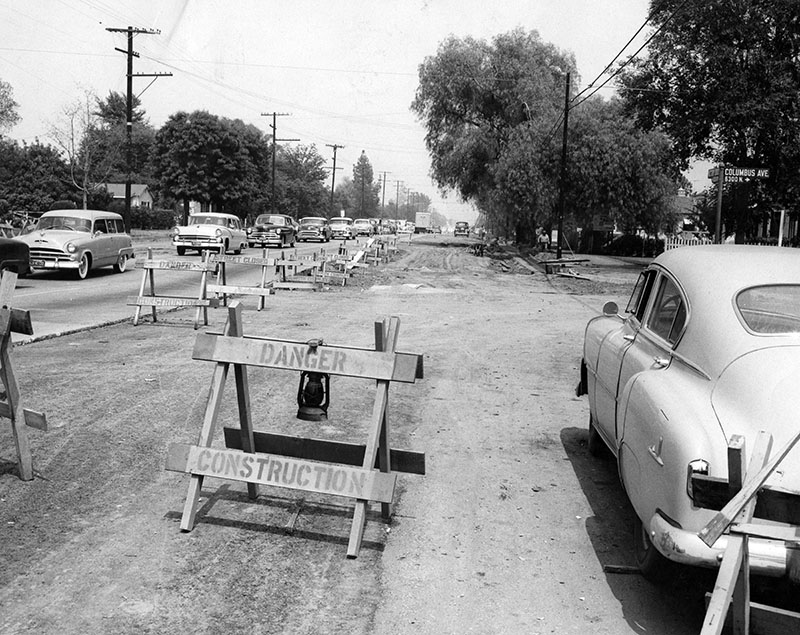
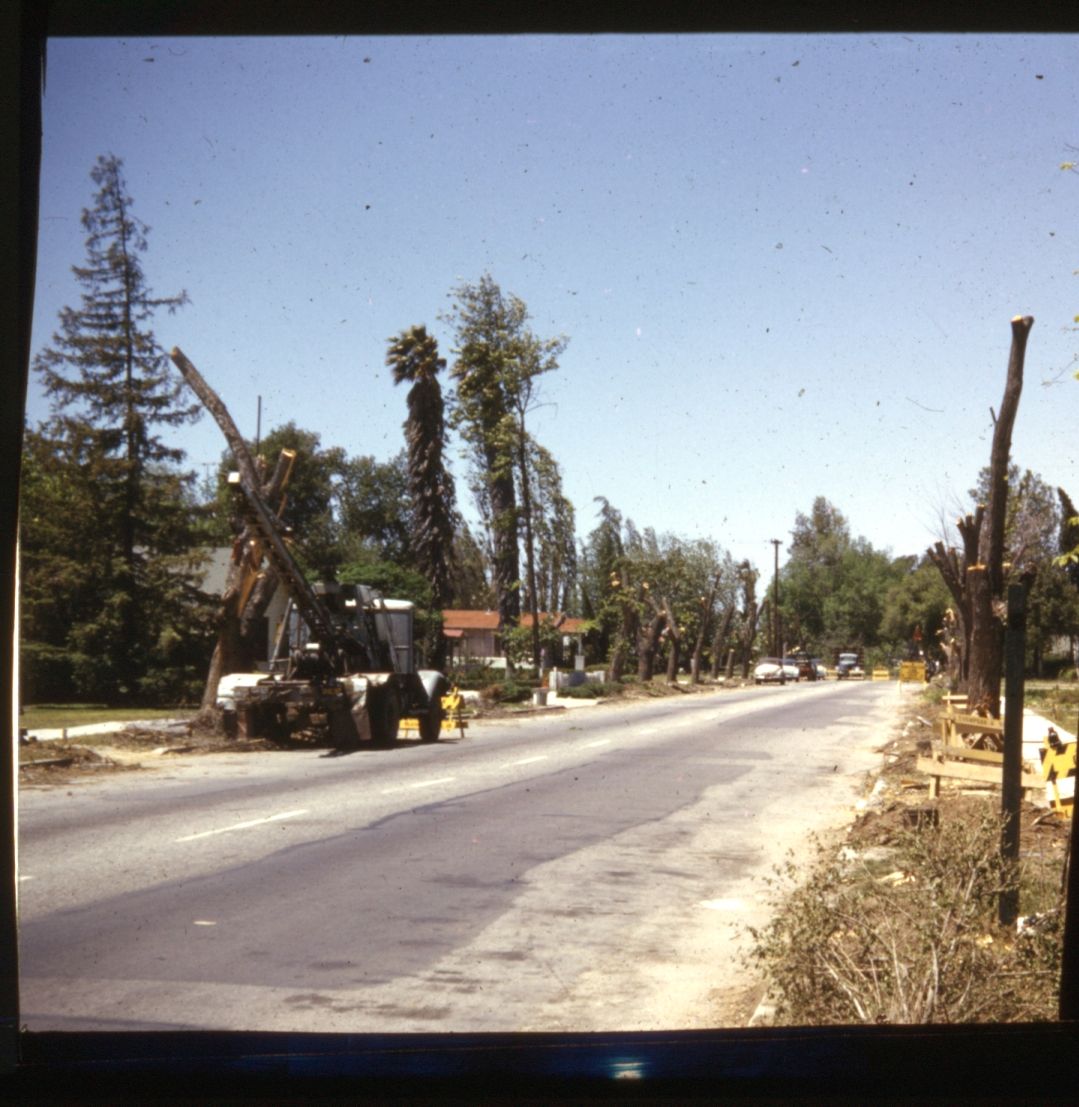
LAPL: Widening of Victory Bl. at Columbus Ave. 1955.
In 1955, pepper tree lined Victory Blvd. was widened to six lanes, three in each direction. The trees were chopped down, and soon multi-story, dingbat apartments replaced houses and garden apartments along most of the street.
It was done in the name of progress. In that era, almost all public works were thought to be “progressive” or in the best interest of the people. In a few years, the 405/San Diego Freeway would cut through Van Nuys, not far from this photograph, and the area would become the car-centered, sprawling place it is today.
The Greatest Generation, those men and women who settled here after WWII, fervently believed that Los Angeles was the city of the future because it was mobile. The biggest parking lots, the most freeways, the widest boulevards, the least of amount of public transportation, those were the goals.
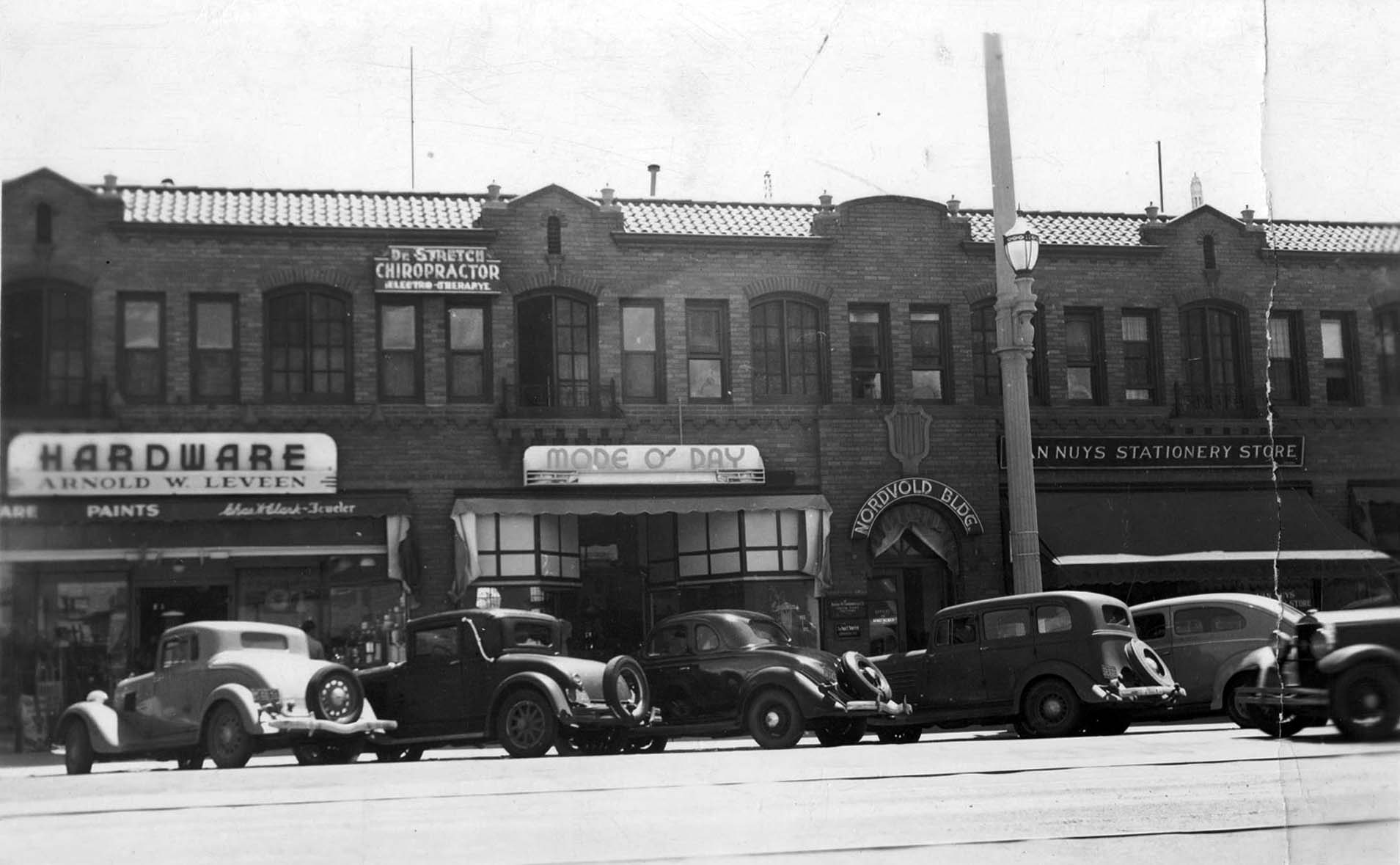
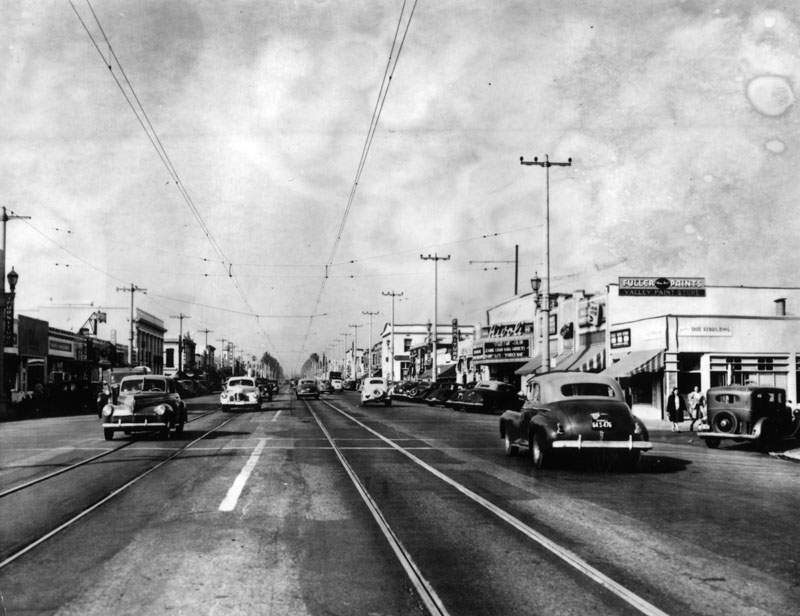
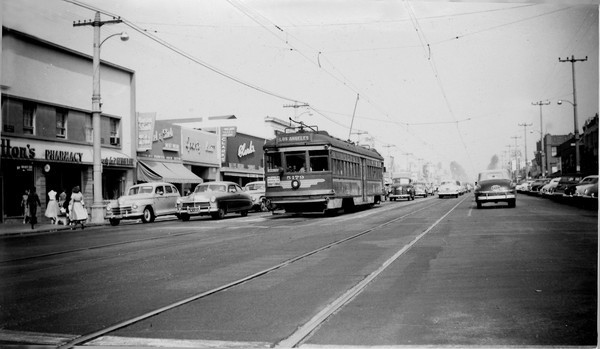
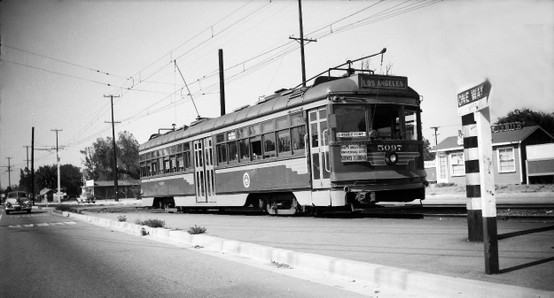
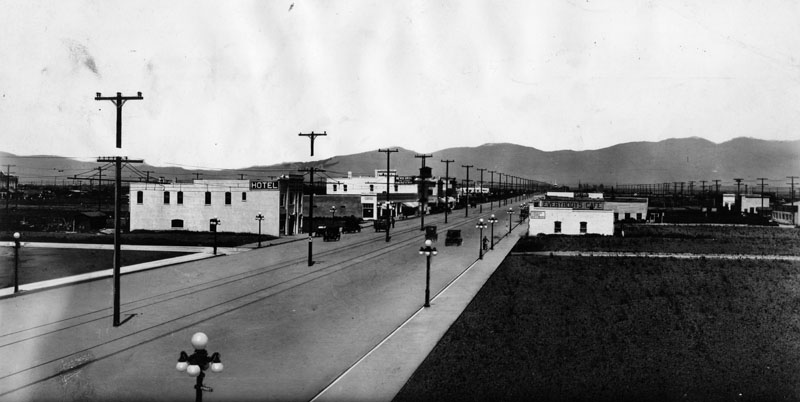
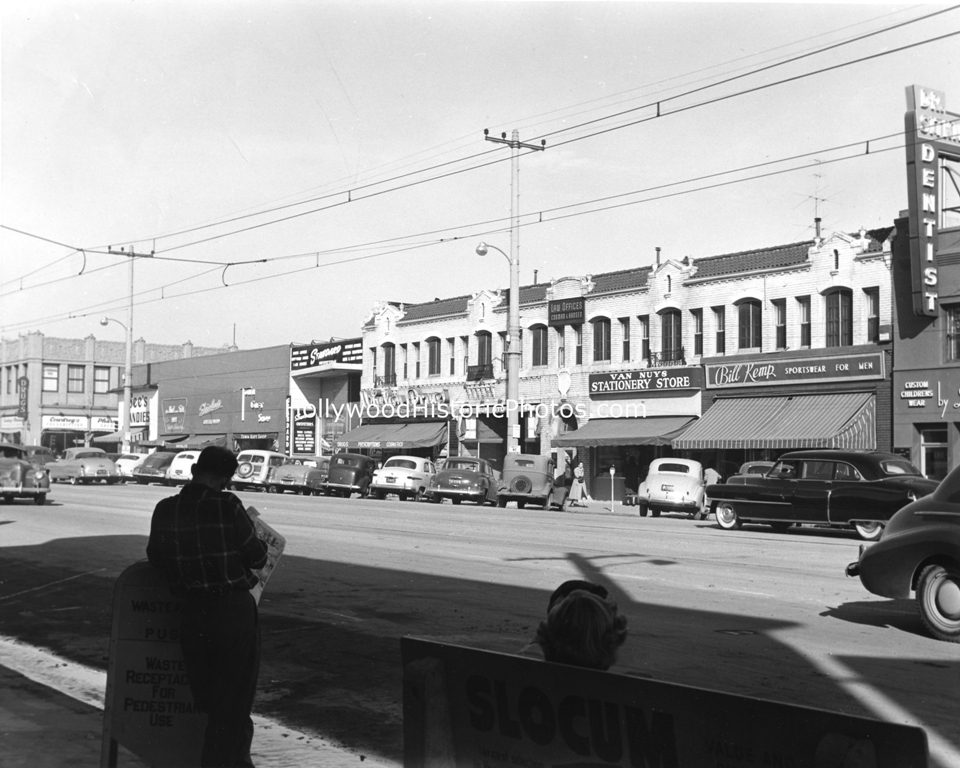
In 1955, the widening of Van Nuys Blvd was also underway. The streetcar tracks were ripped up and diagonal parking banished. The new street would also be six lanes of traffic. But the old Van Nuys, seen below, seems to have been a nice place to work, shop and hang out in. Why was it so necessary to destroy it?
Some have commented that this blog focuses on dystopian ideas about Van Nuys, presenting the community as something dysfunctional and lost. But there is another purpose to Here in Van Nuys.
The philosophy behind it is to explore the past and use it as a guide for where we should, and should not go. Our concepts of bettering the community will hopefully lead us into a more walkable, civil, clean, cultured and dynamic one.
That is my fervent hope.
Widening of Victory Boulevard: 1955. (Courtesy Phillip DePauk)
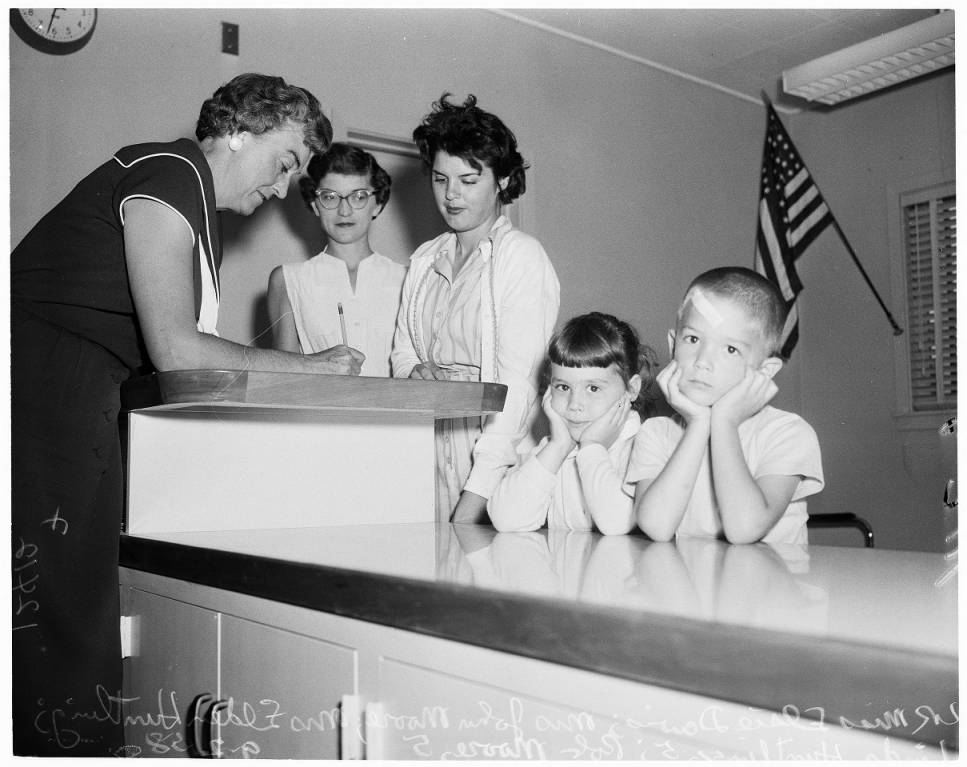
On September 2, 1958, Miss Elsie Davis, Principal, Kittridge St. Elementary School in Van Nuys, CA registers children at her school.
Linda Huntling and Bob Moore, 5 years old, stand glumly as their mothers oversee the process.
59 years ago, there were children with names like Linda and Bob, as old fashioned sounding now as Bertha, Alvira, Sylvester and Abraham were to 1959 ears.
Van Nuys (b. 1911) began as a town, centered around a main street, connected to Los Angeles by streetcar and rail.
It built its fire station, library, city hall, police station, and its churches, schools, shops and post office steps apart. On foot, a person could buy a suit, take out a library book, mail a letter, and walk to school.
Come to think of it they still can. But it was all there in downtown Van Nuys.
Today you might stand outside the LAPD Van Nuys Station and smoke a joint, drink a can of beer, pee against a wall and nobody would raise an eyebrow.
The librarian, the cop, the priest, the attorney, they would walk past you and shrug their shoulders and mutter, “What can I do?”
We are so tolerant these days. Everything degrading is welcomed, while everything worthwhile is rare, expensive or extinct.
Posture Contest, Van Nuys, 1958. Impossible to imagine these days with all the cell phone spines.
Surrounded by orange and walnut groves, the growing town nonetheless managed to provide safe, civilized and opportune situations for its newly arrived residents with affordable housing, subsidized by low interest government backed loans after WWII.
And plentiful, well-paying jobs. Imagine that!
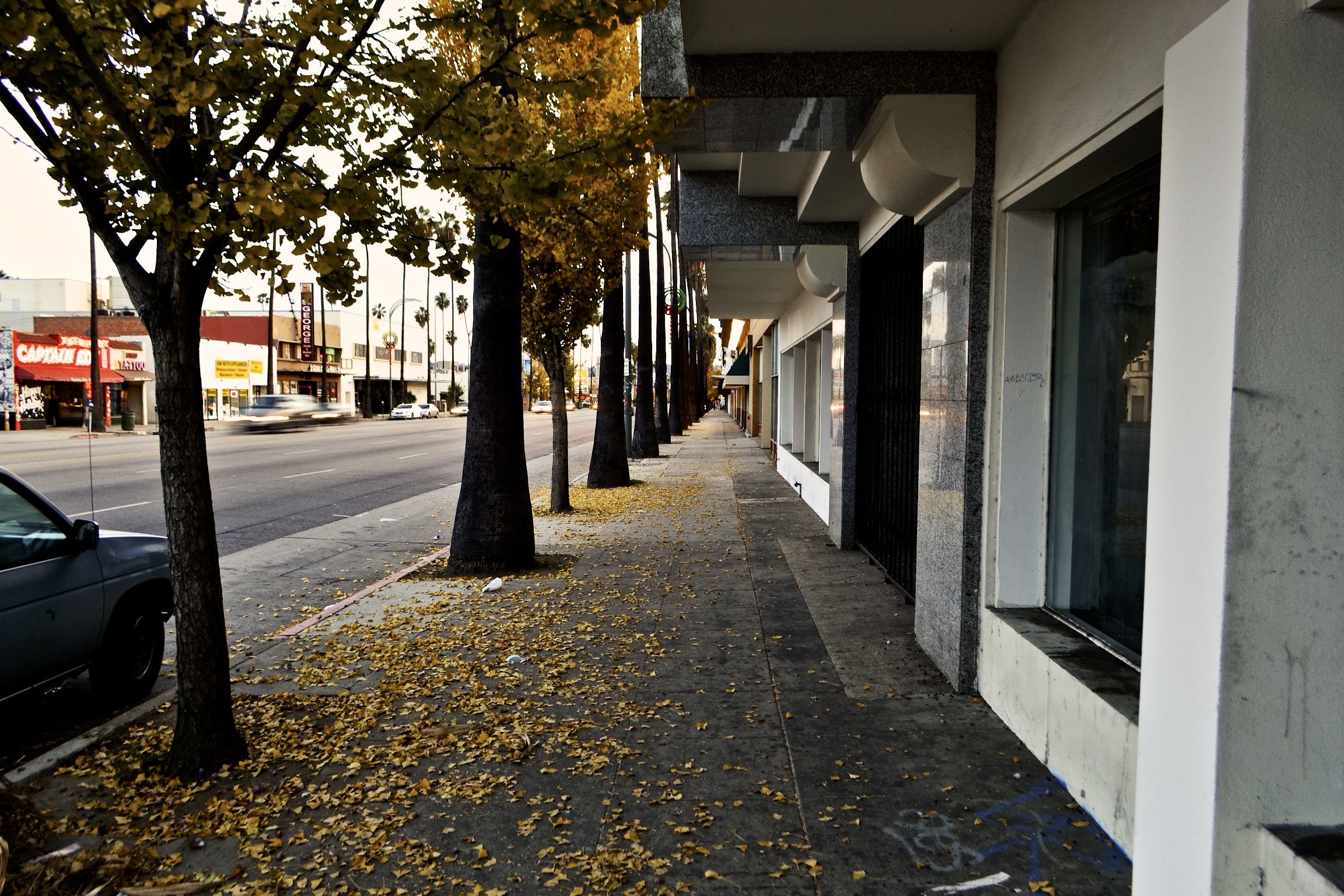
Van Nuys, circa 1938.Widening of Victory Boulevard: 1954.Van Nuys Blvd. at Friar (circa 1950). Notice diagonal parking and streetcar wiring.Van Nuys Bl. 2013
Somehow it was lost after 1945. The enormous shopping centers robbed Van Nuys of its clientele. The street widenings turned boulevards into raceways and the village feel was destroyed. Factories closed, banks shrunk, stores fled, and crime settled here to afflict, rob, disable and kill.
Why does Van Nuys flounder, while all around it other cities like Burbank, Glendale, Pasadena, and sections of Los Angeles, like North Hollywood, Studio City, Mid-City and Highland Park flourish?
Delano St. July 2017Delano St. July 2017
Raymer St. March 2017
A journalist from Curbed LA called me yesterday. He is writing an article about Van Nuys and wanted to talk.
I mentioned many things that I wish were changed here, from road diets to better housing, from cleaner streets to more law enforcement for illegal dumping.
But I also told him that so much of our political leadership is devoted to working on problems like prostitution, rather than building a coalition of architects, designers, investors, and planners who could build up Van Nuys and make it, once again, a coherent, safe, stimulating, and pleasant place to live and work.
I know what’s bad here. But what about making it good? Where are our dreams? Why can’t we be as artistic as our studios, as wild in our imaginations as our writers, directors, cinematographers, animators, and designers?
Why isn’t the whole energy of creative Los Angeles devoted to overcoming our civic afflictions?
Near Cedros and Delano.
Van Nuys Bl. Nov. 2016
The deadest and more depressing areas of Van Nuys are closest to the Orange Line, which is also a good thing. Because this is where Van Nuys should work to build new, experimental, and innovative housing and commercial buildings.
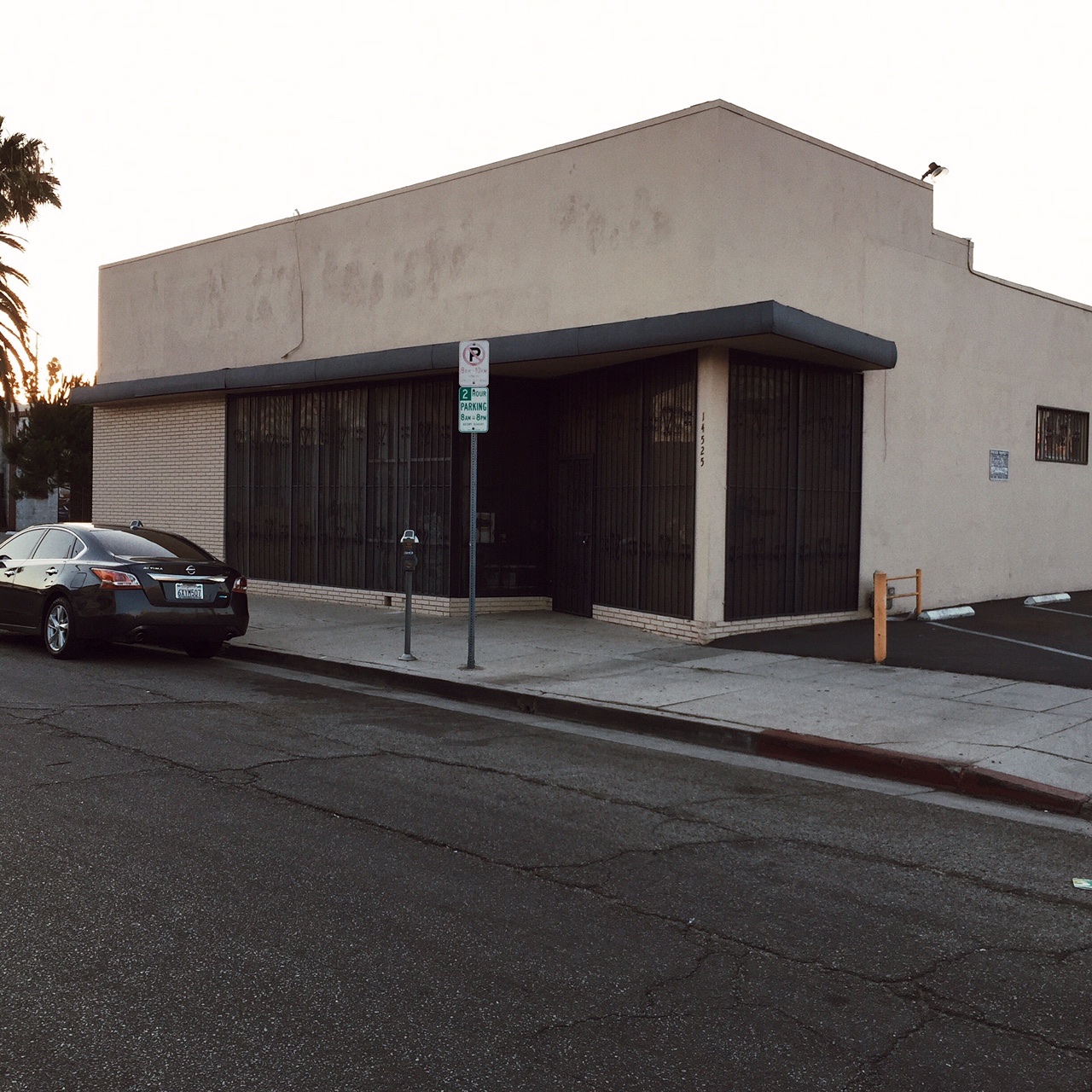
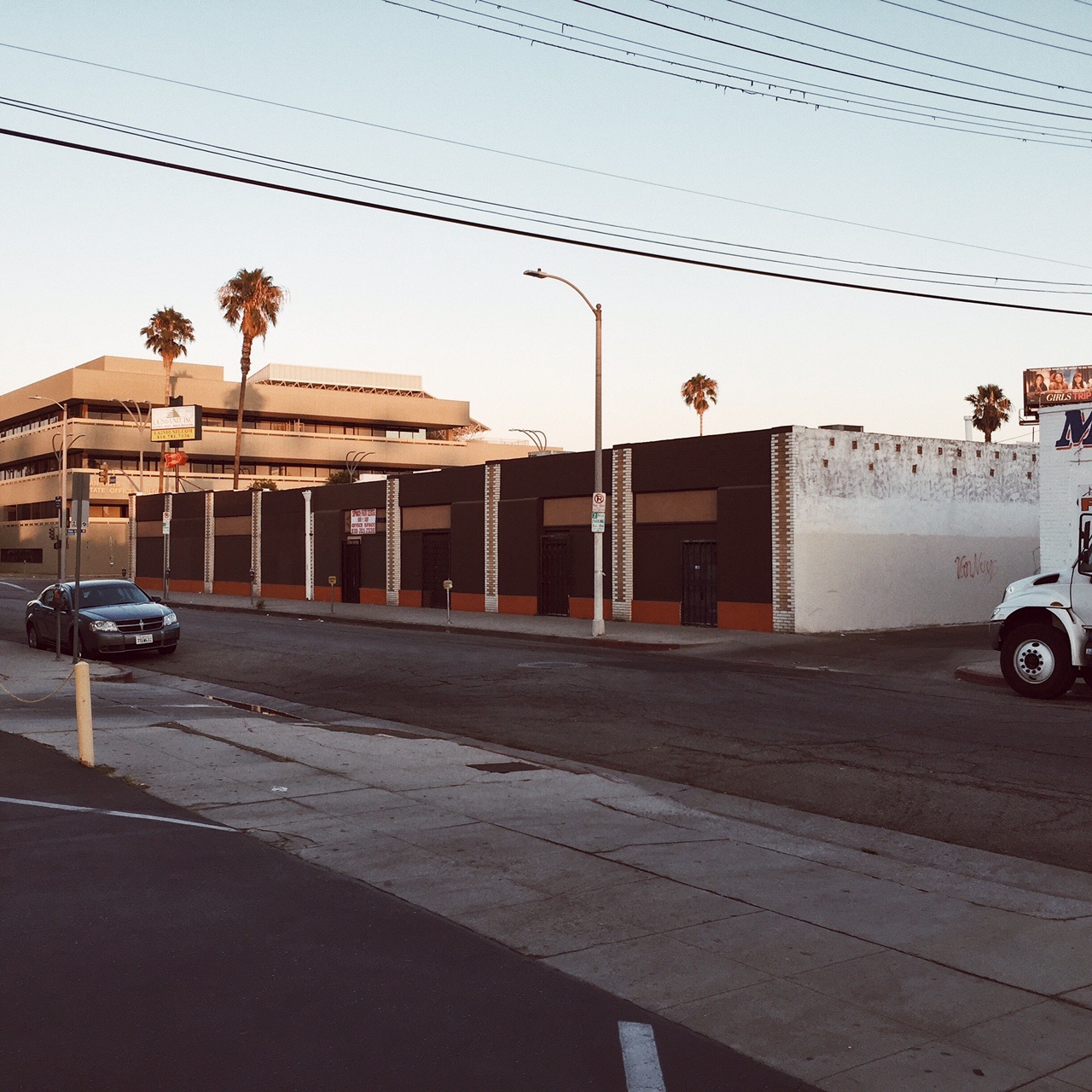
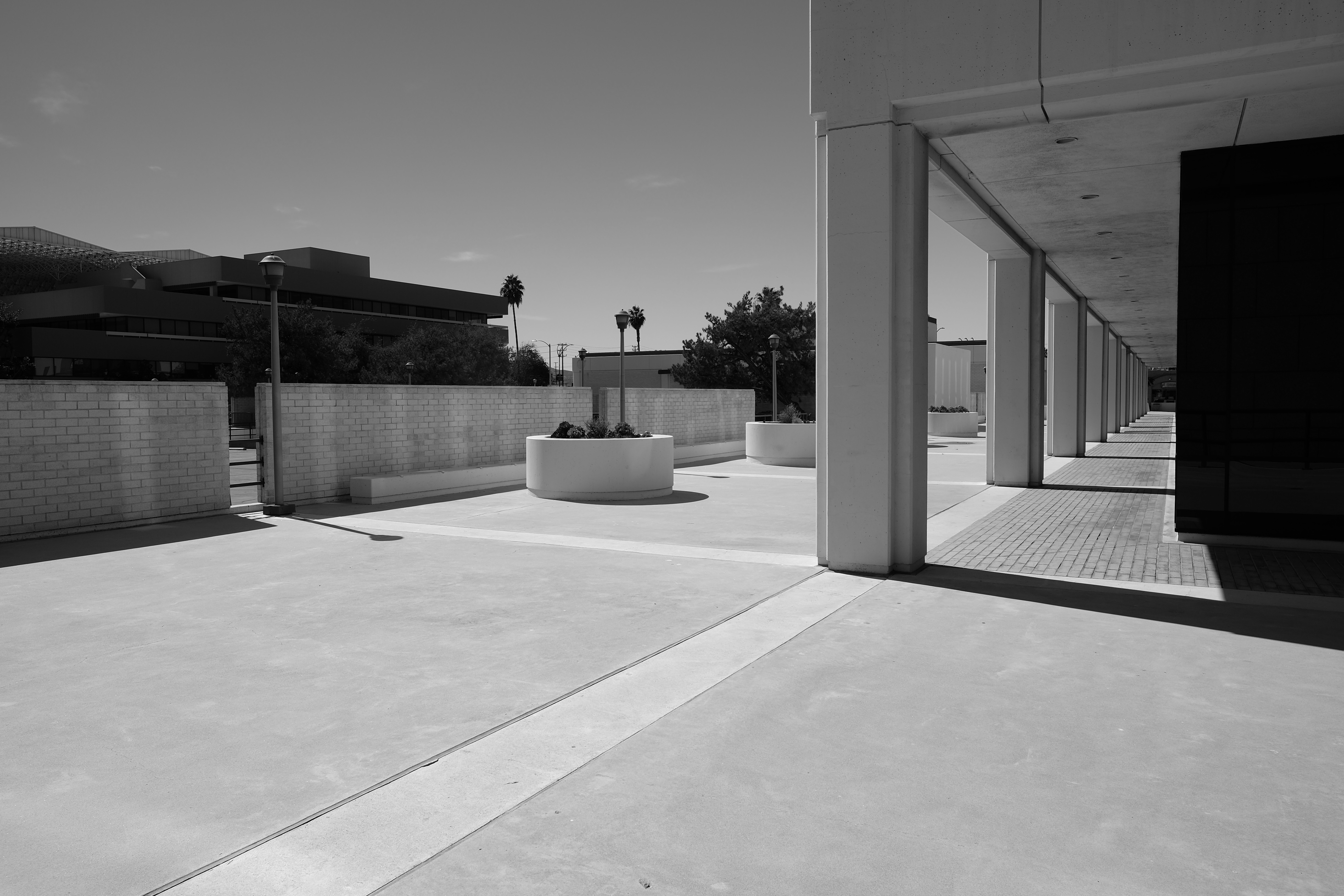
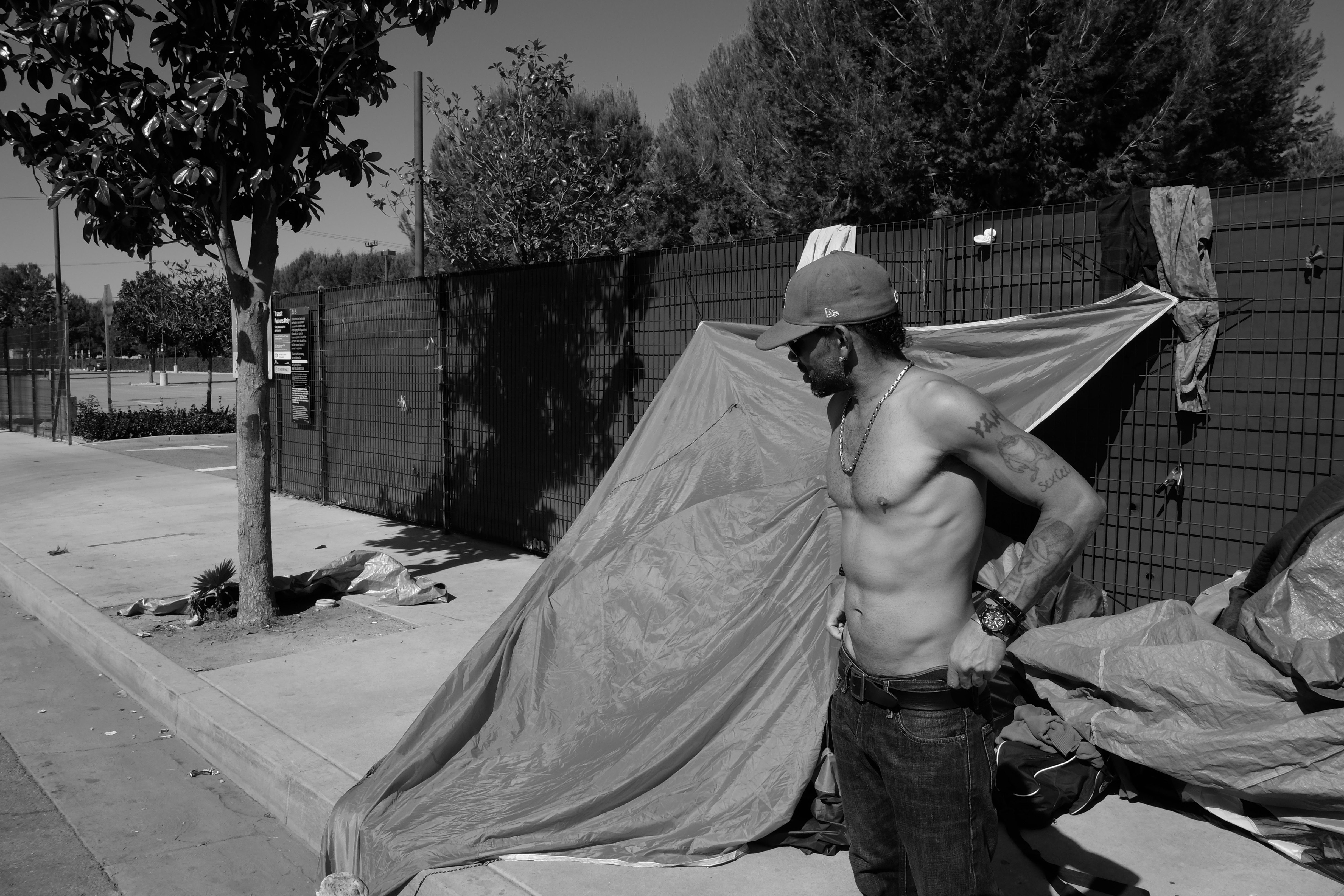
Van Nuys Bl. Oct 2016 A dead place for street life.The Empty Post Office/ Van Nuys Bl. Oct. 2016Dystopian Van Nuys Oct. 2016. No people, no chairs, no trees. Just concrete.Homeless on Aetna St. Feb. 2016
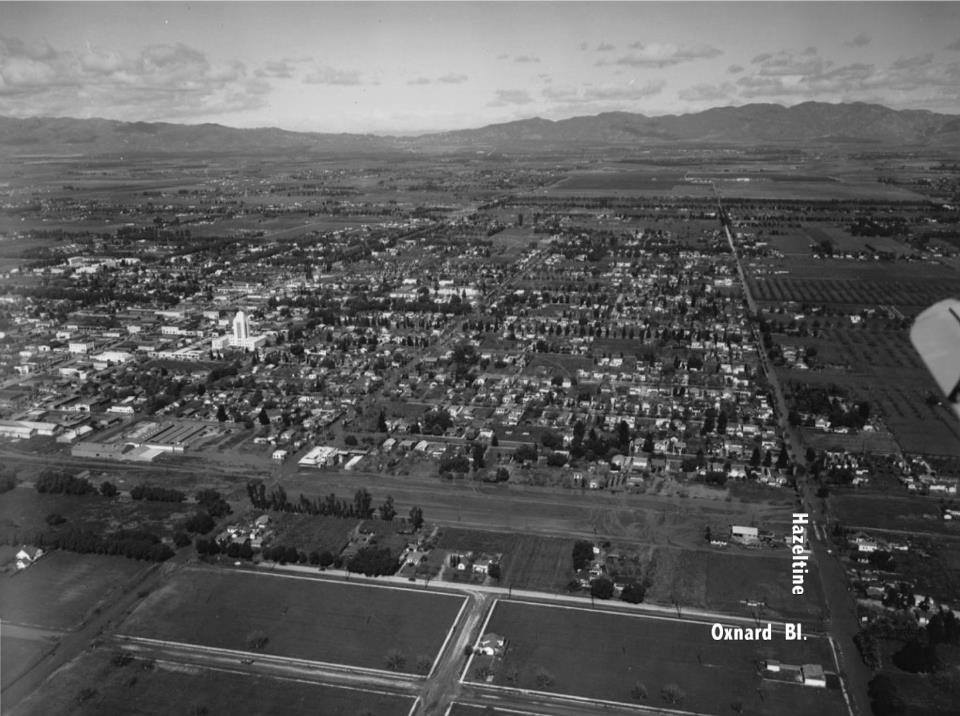
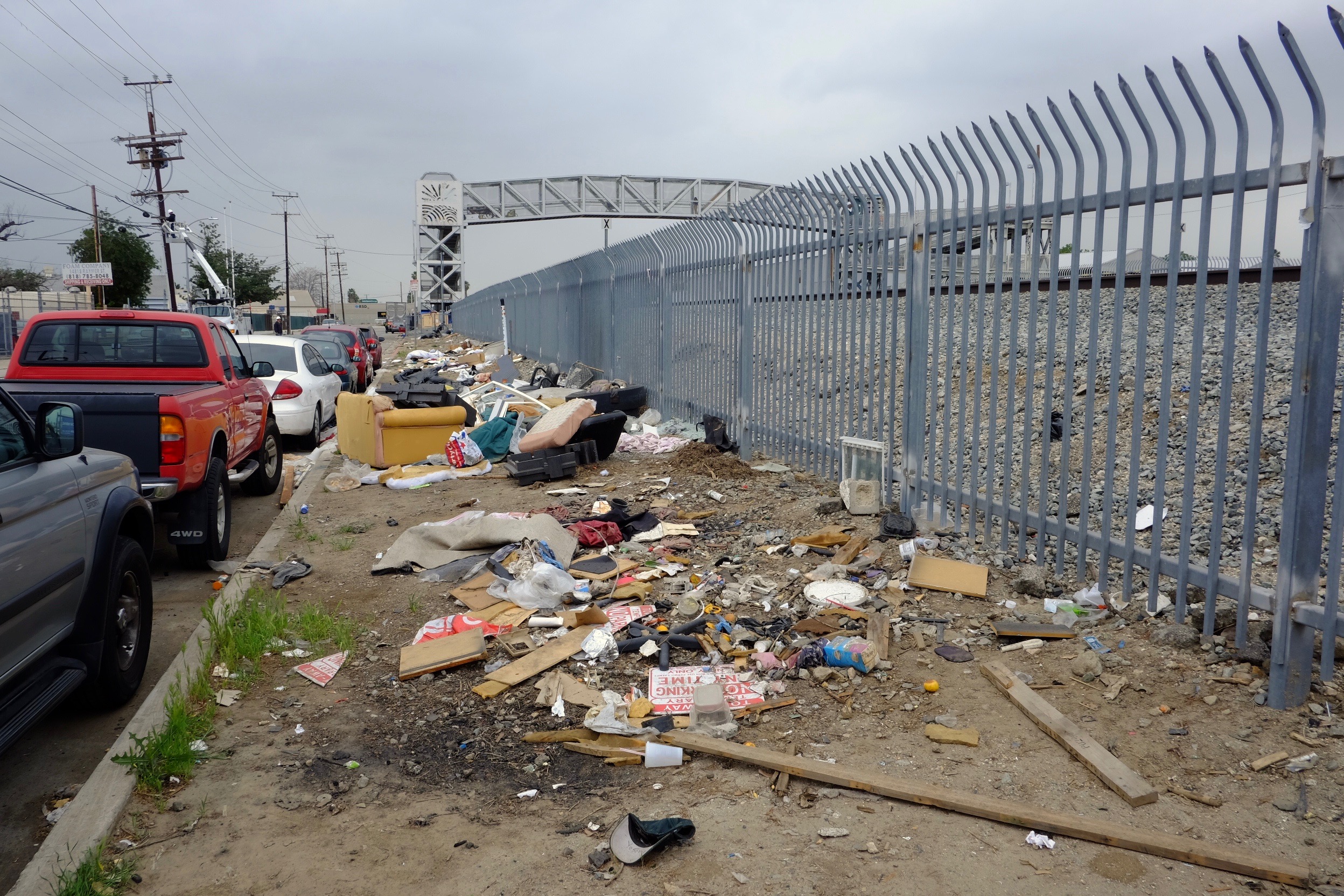
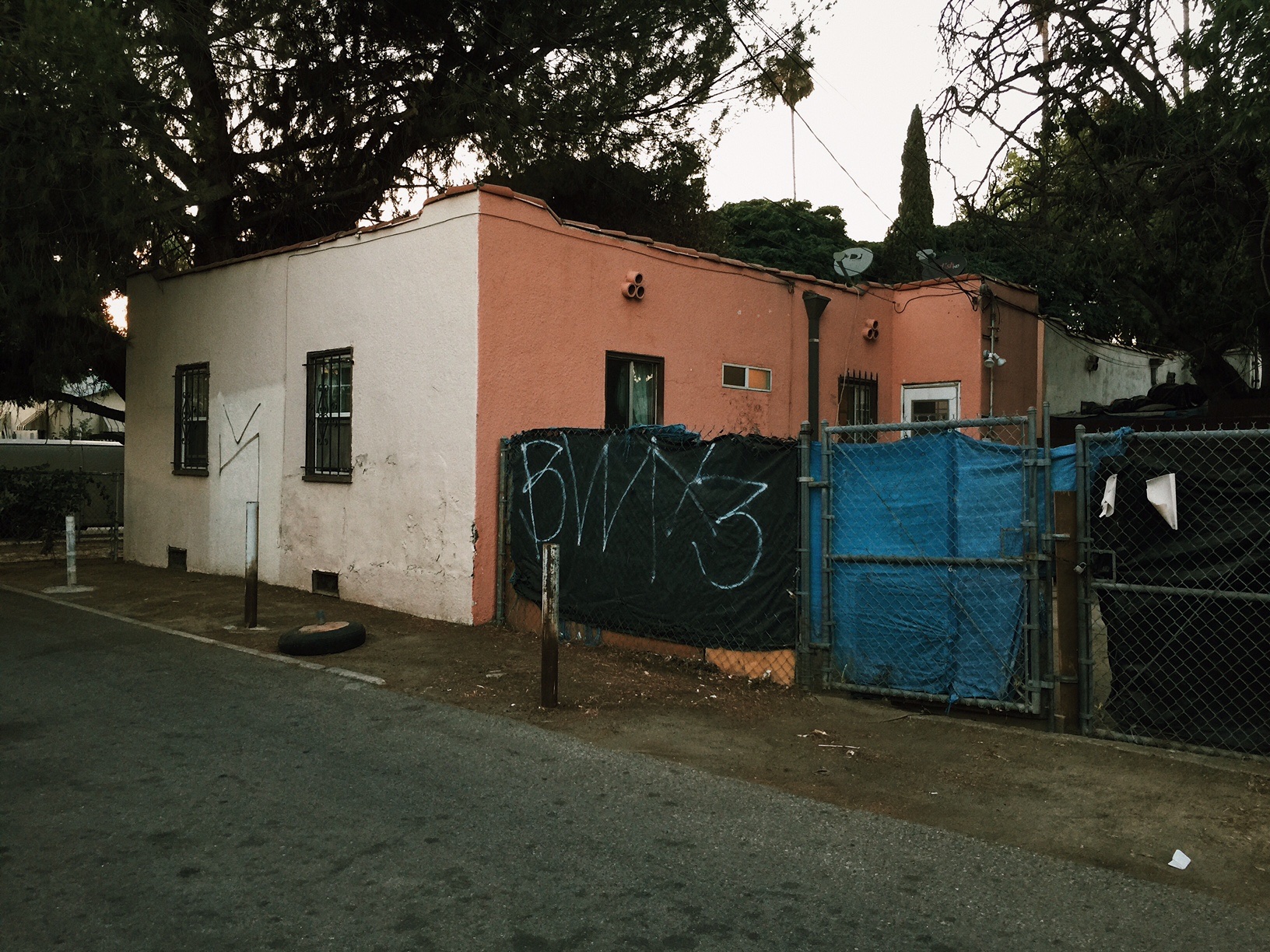
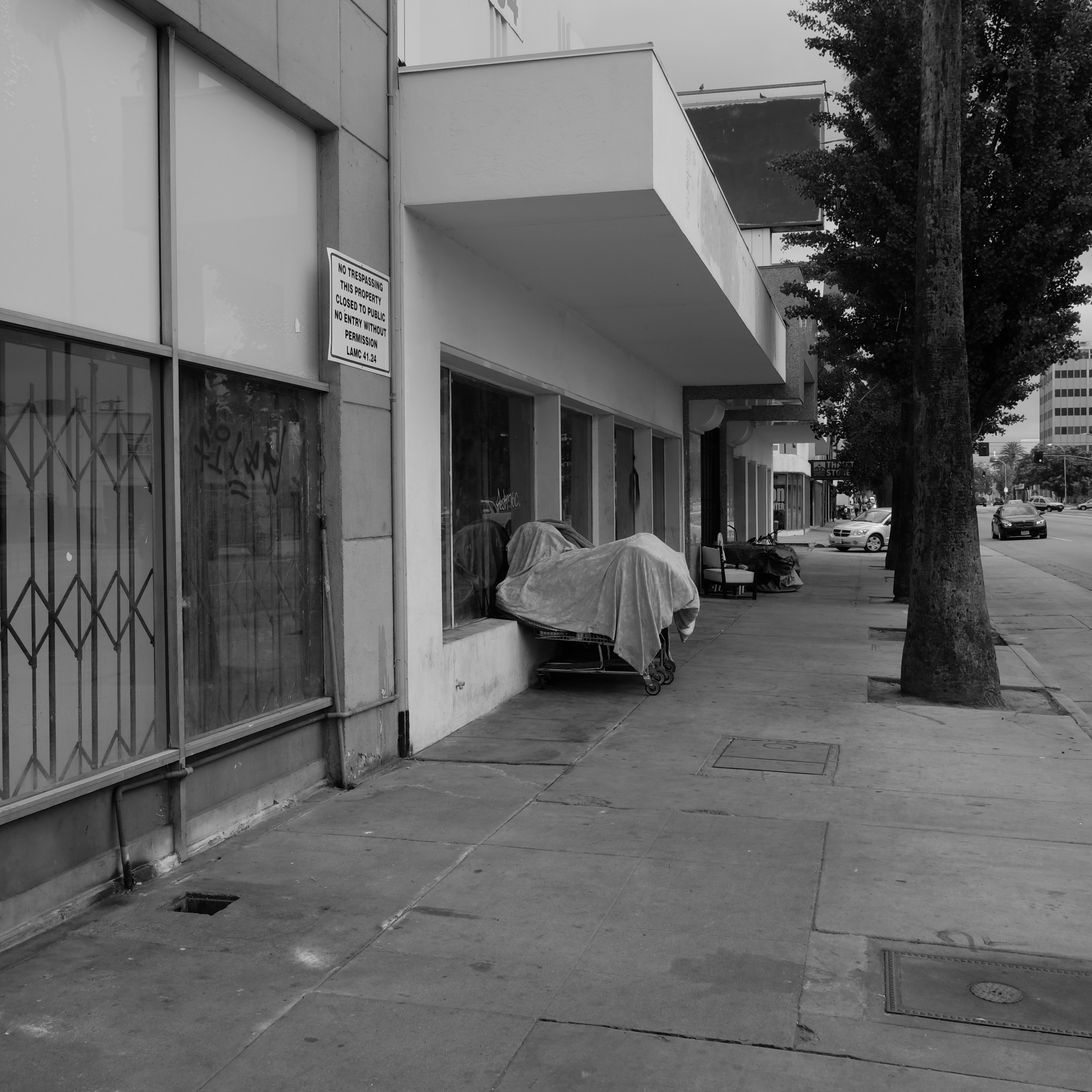
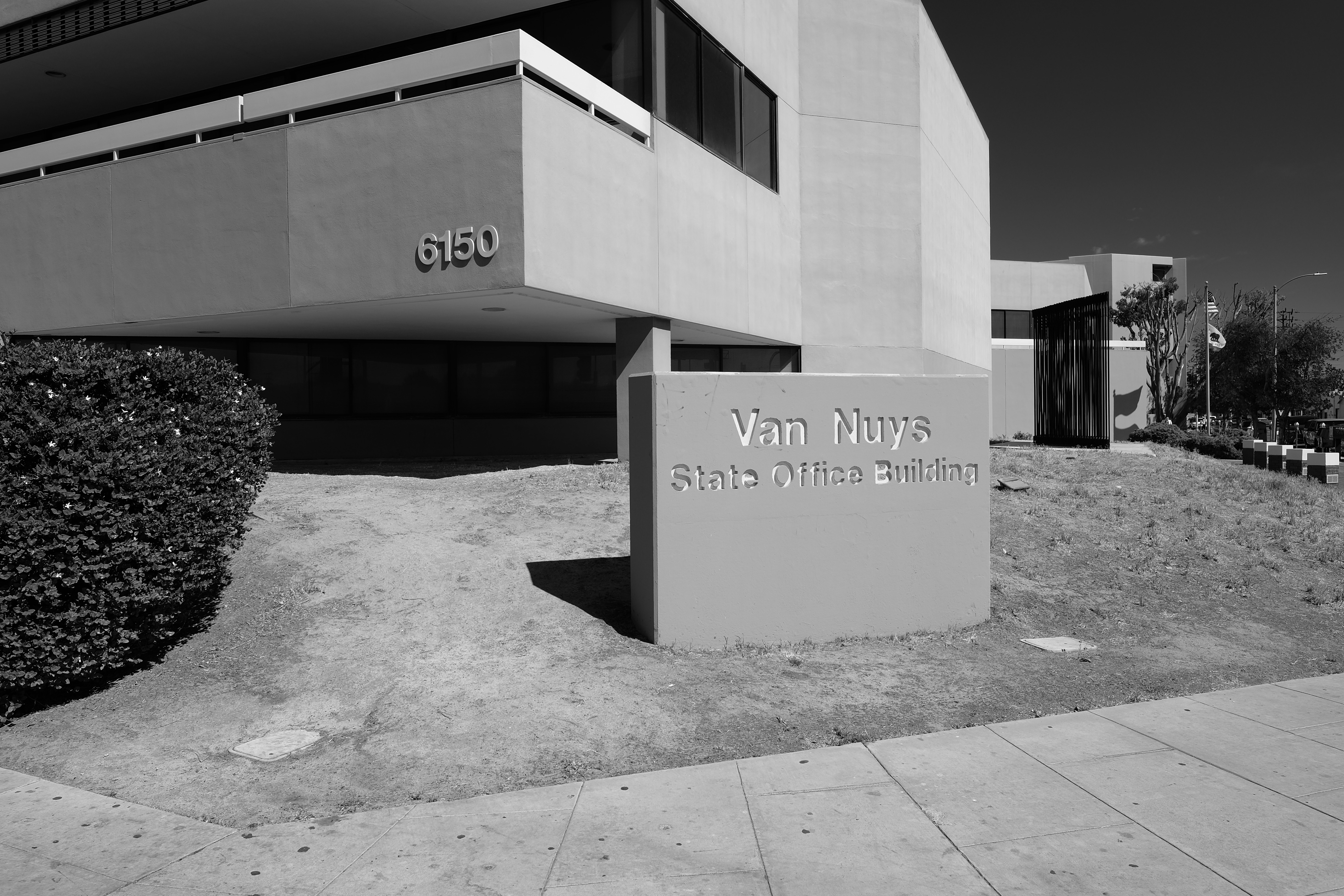
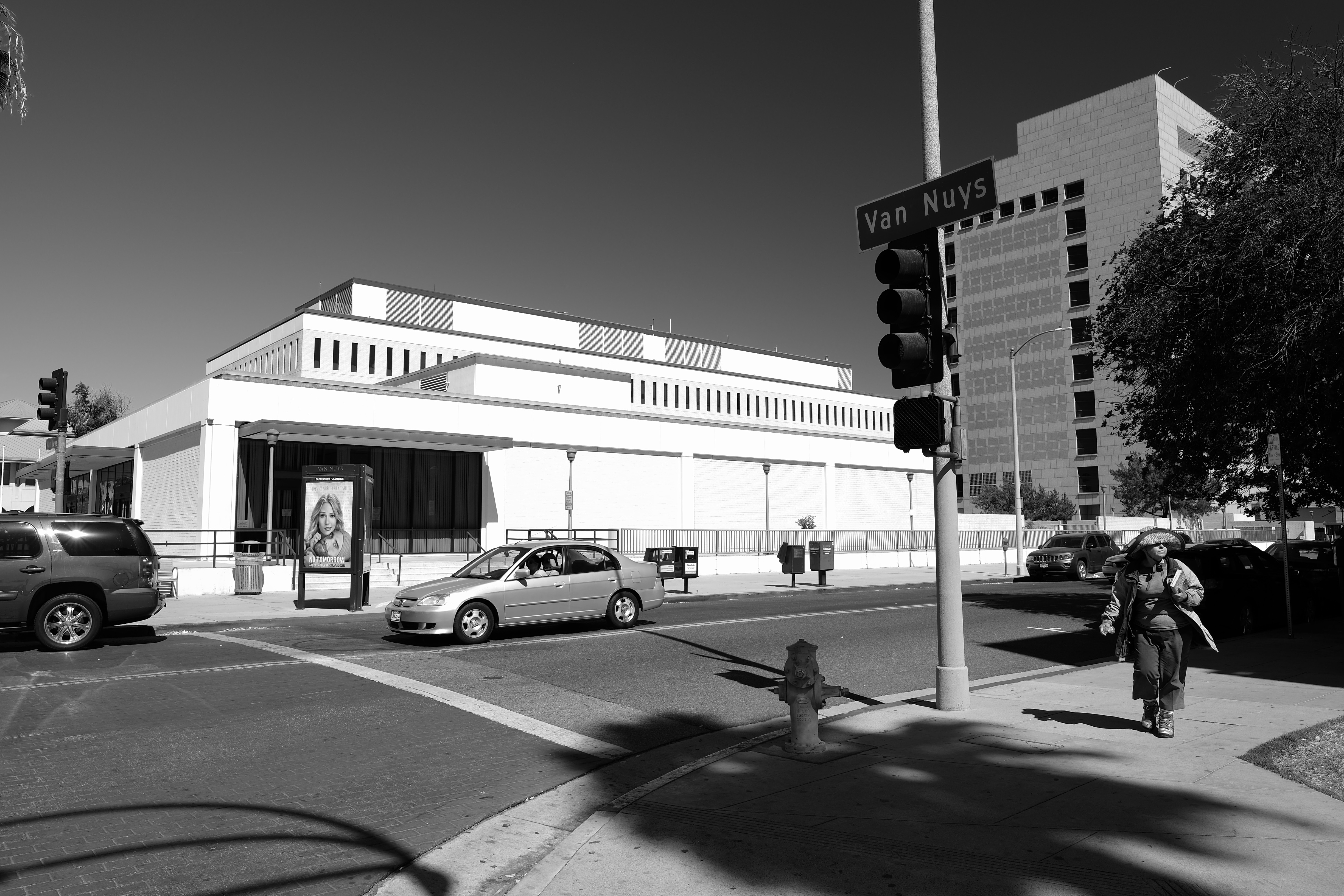
From Kester to Hazeltine, north of Oxnard, the “Civic Center” district contains an empty post office, vacated stores, underutilized buildings, and dystopian spaces of concrete, homelessness, garbage, and withering neglect.
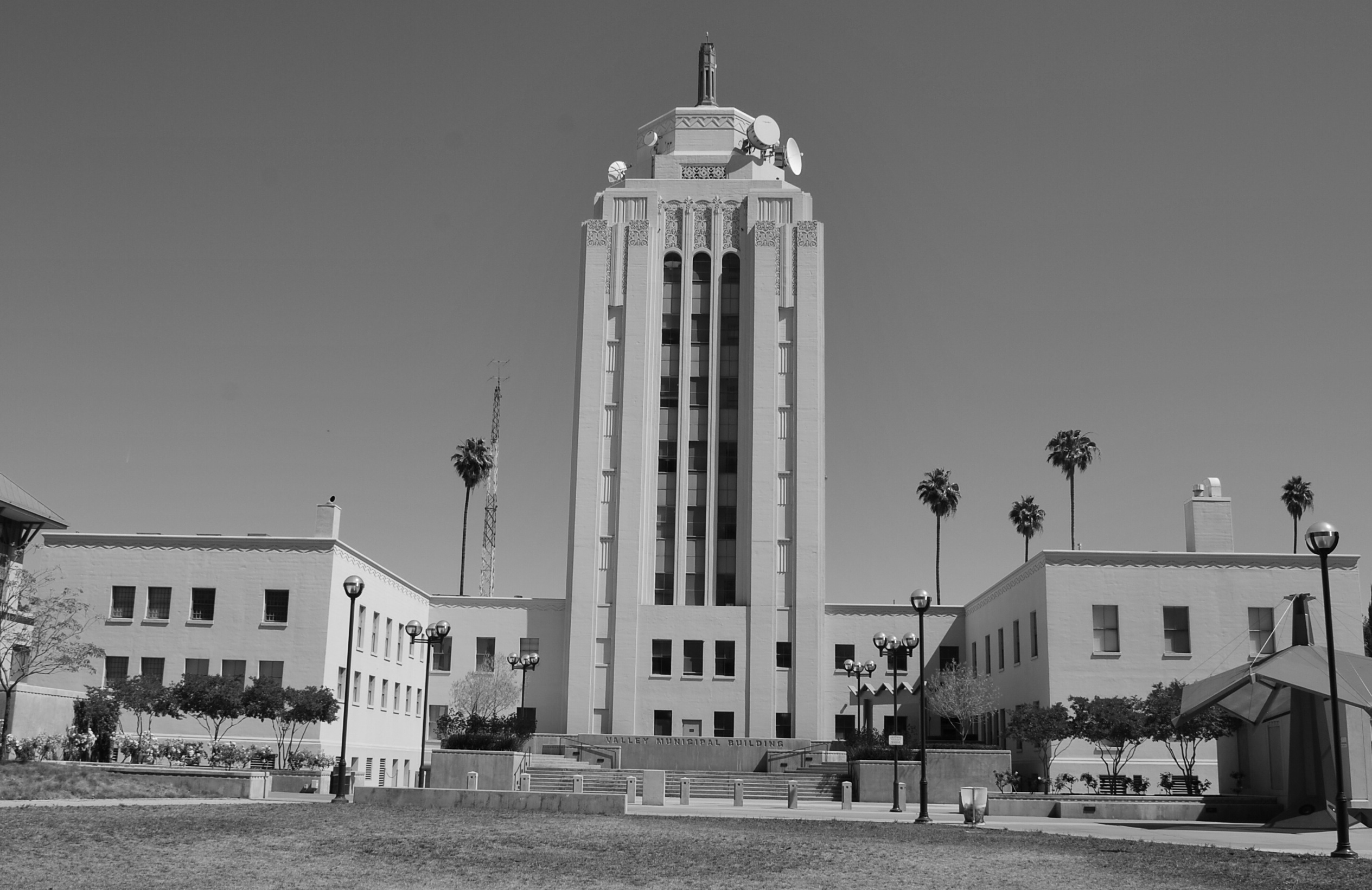
The pedestrian mall on Erwin, south of the Valley Municipal Building and surrounded by the Superior Court, the library and police station, is a civic disgrace.
Ironically, all the law enforcement, all the government agencies, all the power that resides in Van Nuys….. presides over the ruins of it.
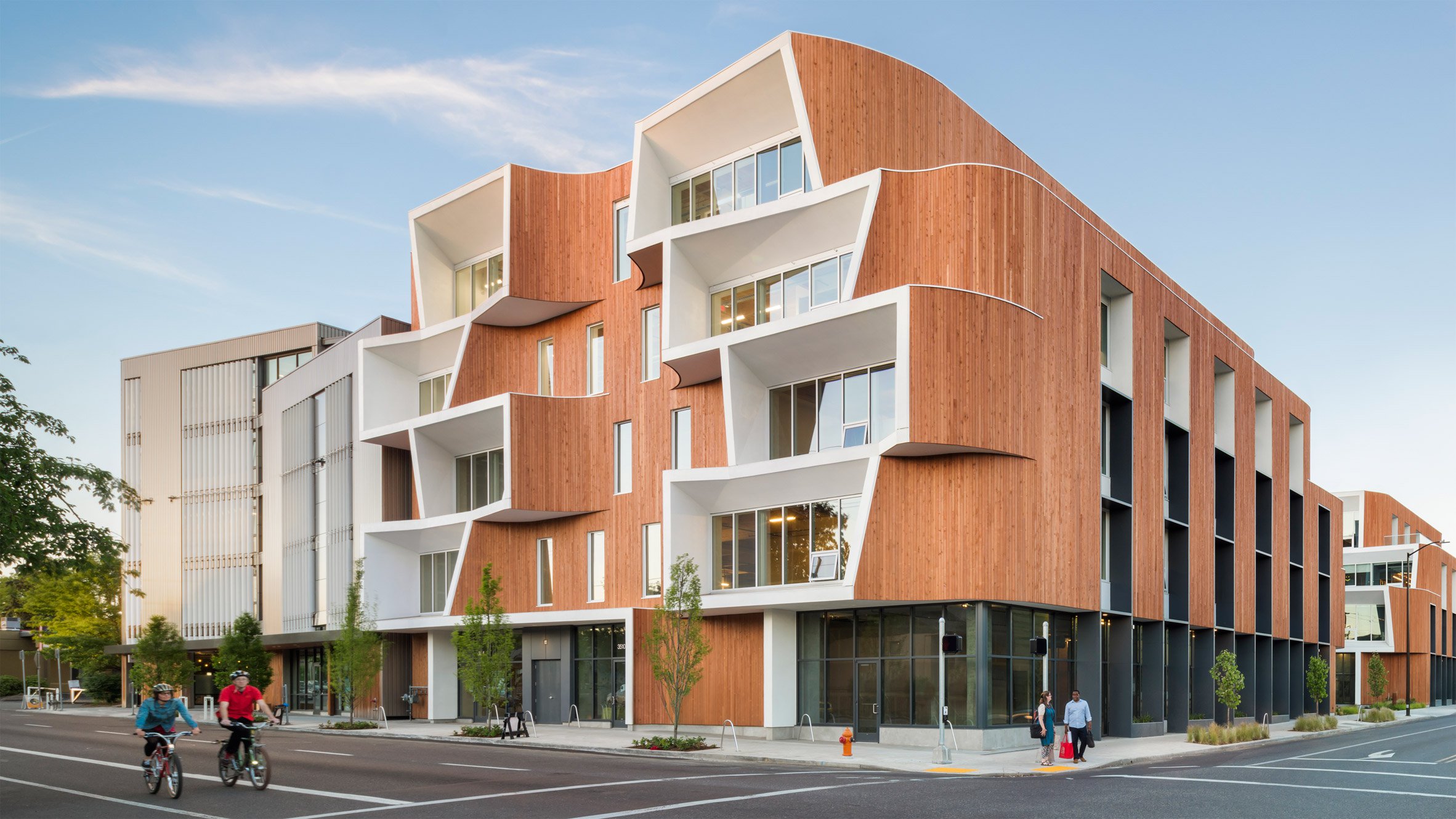
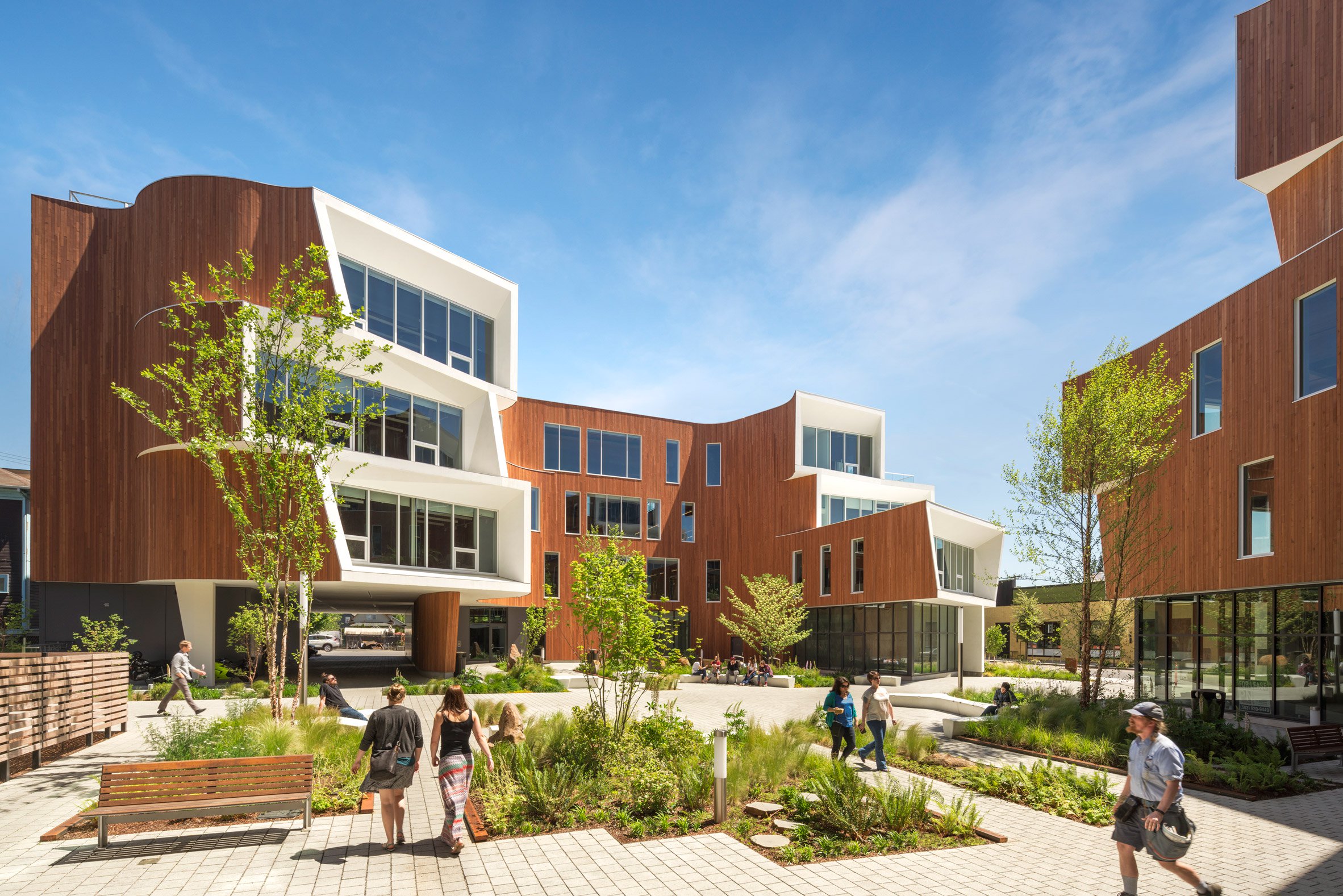
Meanwhile up in Portland, OR.
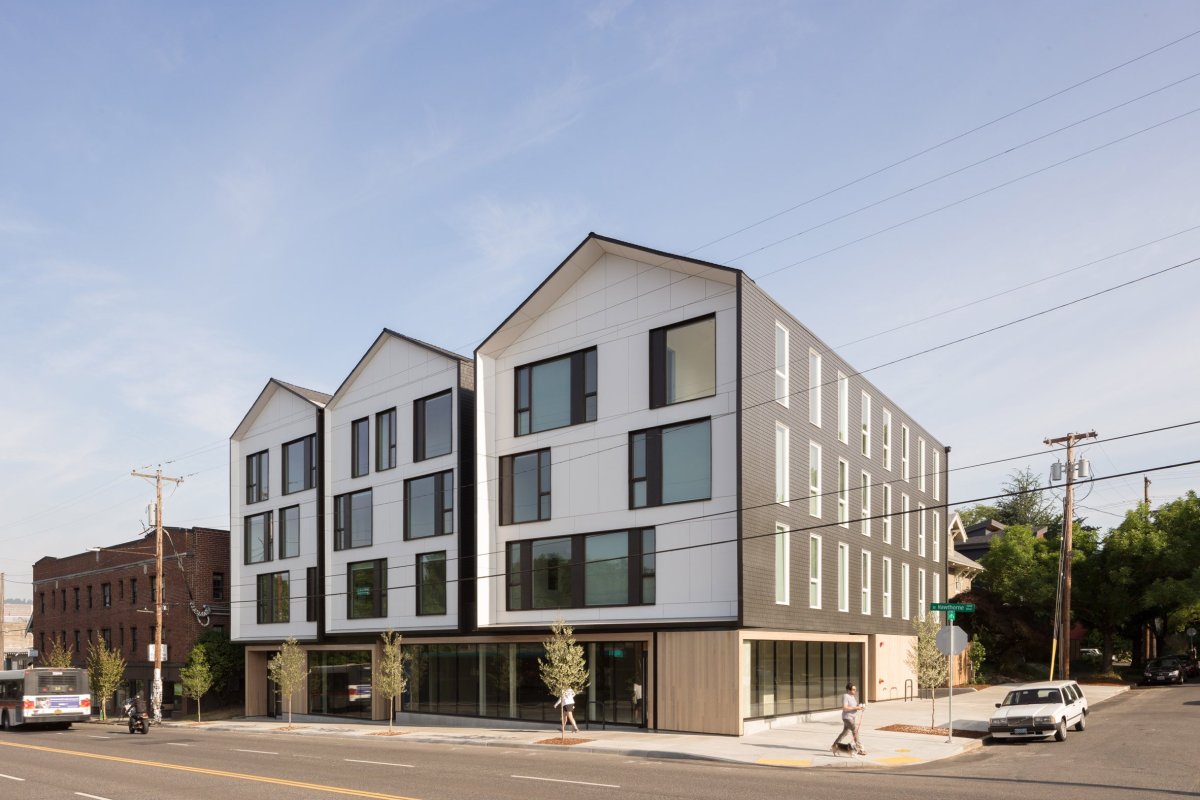
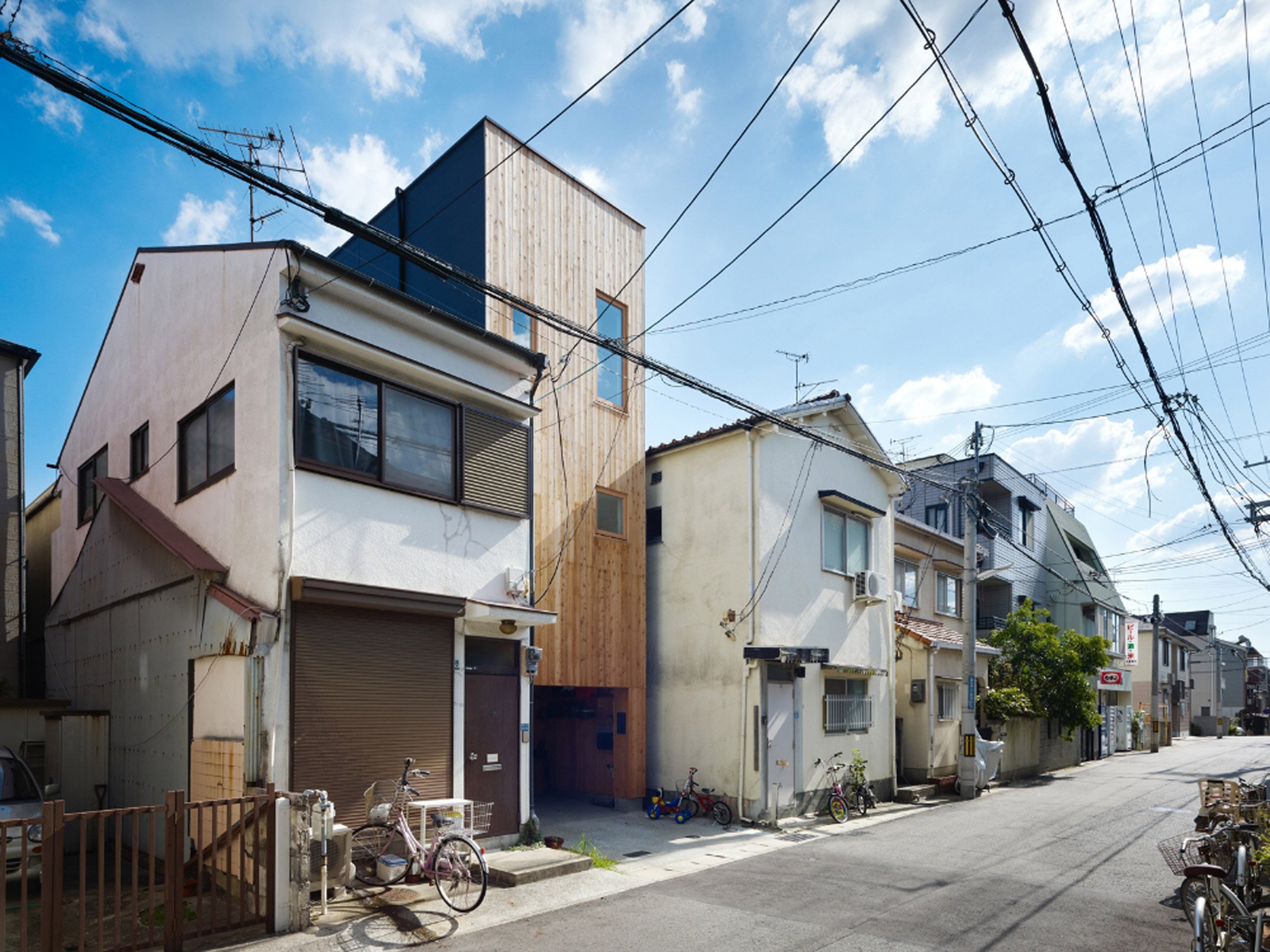
Holst Architecture, Portland, OR (Dezeen)Works Progress Architecture, Portland, OR (Dezeen)Works Architecture, Portland, OR (Dezeen)Fujiwaramuro Architects, Kobe, Japan (Dezeen)Van Nuys Alley near Delano and VNB
On Dezeen, there are posts about new, infill buildings in Portland, OR and Japan where the general level of architecture and design far outpaces Van Nuys. These are sophisticated, modern, but humble structures with ideas for living.
Look at these and imagine how, perhaps 25 new ones, could transform Van Nuys.
In the midst of our wasteland, we need to go back to working to demanding the best for Van Nuys, rather than accepting squalor and mediocrity.
Photo by George Brich, Valley Times./ LAPL/Public Domain
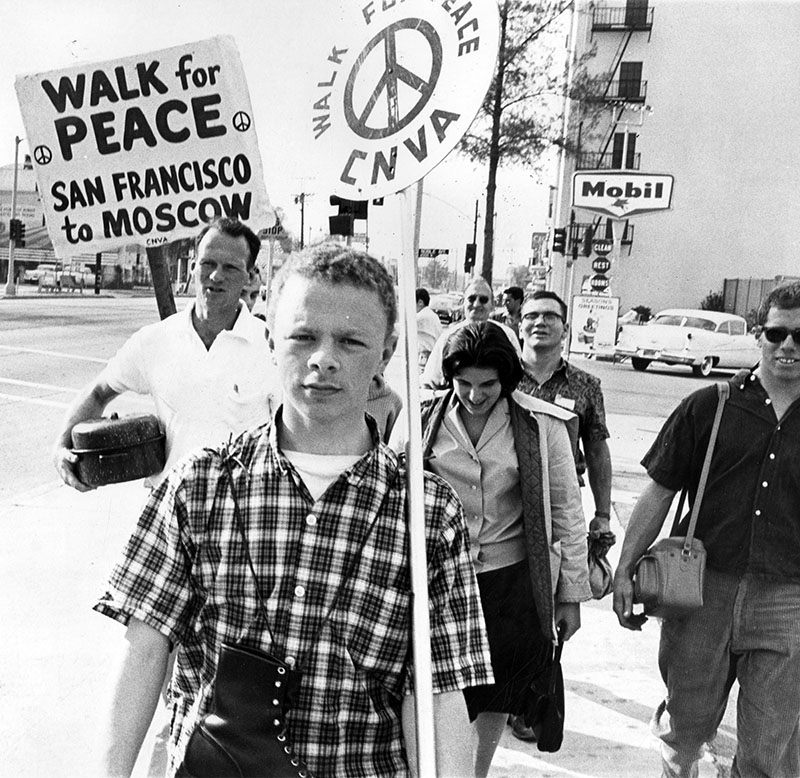
At the height of the Cold War, a brave and liberal minded group of progressive people marched through Los Angeles and eventually ended up in Moscow where they worked to defuse tensions between the US and the Soviet Union.
Los Angeles at that time was a conservative, anti-communist city whose main industry, Hollywood, was just emerging from the blacklist and any association with Russia was tantamount to career suicide.
The Committee for Non-Violent Action (CNVA) was an American anti-war group, created in 1957. Its purpose : resist the US government‘s testing of nuclear weapons. It used non-violence to oppose atomic military tools.
The group was often attacked as pacifist and for its welcoming of African-Americans into the fold.
Photograph article dated December 22, 1960 partially reads, “Eight foot–sore peace walkers marched through the Valley Wednesday on the 11-month tour that will take them from San Francisco to Moscow, Russia. The placard-bearing marchers, who represent the Committee for Nonviolent Action, stopped Wednesday night at Highland avenue and Hollywood boulevard in Hollywood. They will remain in the Los Angeles area until Christmas day when they will resume their march toward Tucson, Ariz. In addition to having their board and room paid for by the committee, which is composed of 60 Americans, the hikers have seven administrators and advance publicity men making the tour with them.” Bruce McIntyre, 20, leads the peace walking team along Ventura Blvd. near Noble Ave.
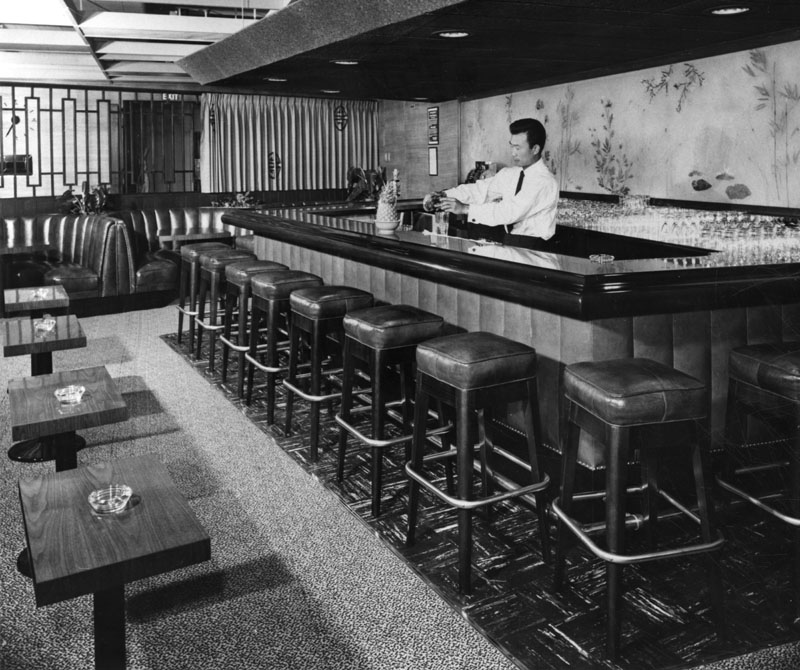
Philip Ahn’s Moongate Restaurant, located at 8632 Van Nuys B(Credit: LAPL)
50 or more years ago people (of means) ate out perhaps once a week.
In Van Nuys, up until the late 1960s, the dining scene reflected the overwhelmingly white make-up of the region. The vast immigration from Central and South America, Africa and Asia that has made present day Los Angeles so varied and so heterogeneous and brought us Malaysian, Taiwanese, Laotian, Mongolian, Thai, Filipino, Vietnamese, Guatemalan, Russian, Indian, Burmese, Persian, and Ethiopian did not exist half a century ago.
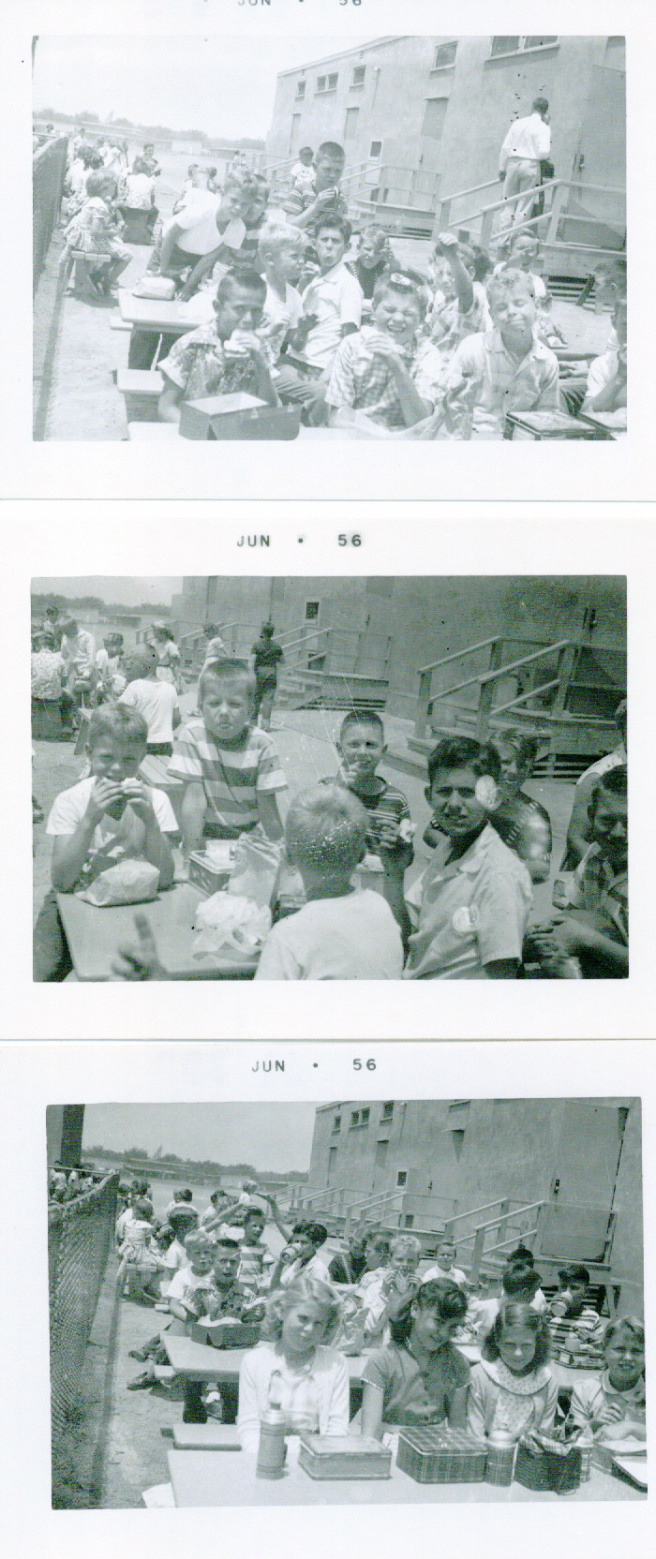
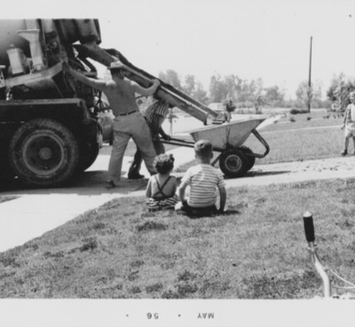
Valerio St. School Van Nuys, CA June 1956 (Tom Cluster)
What was on the menus back then offered a variety of “German”, “Italian” and “Chinese” cuisines that had as much authenticity as a studio back lot.
Which is not to deride the food. It was offered to customers graciously, copiously and somewhat formally, as people would not dare enter a restaurant without being dressed up, with men in suits and ties, and women in dresses, skirts and high-heels.
(Credit: LAPL)
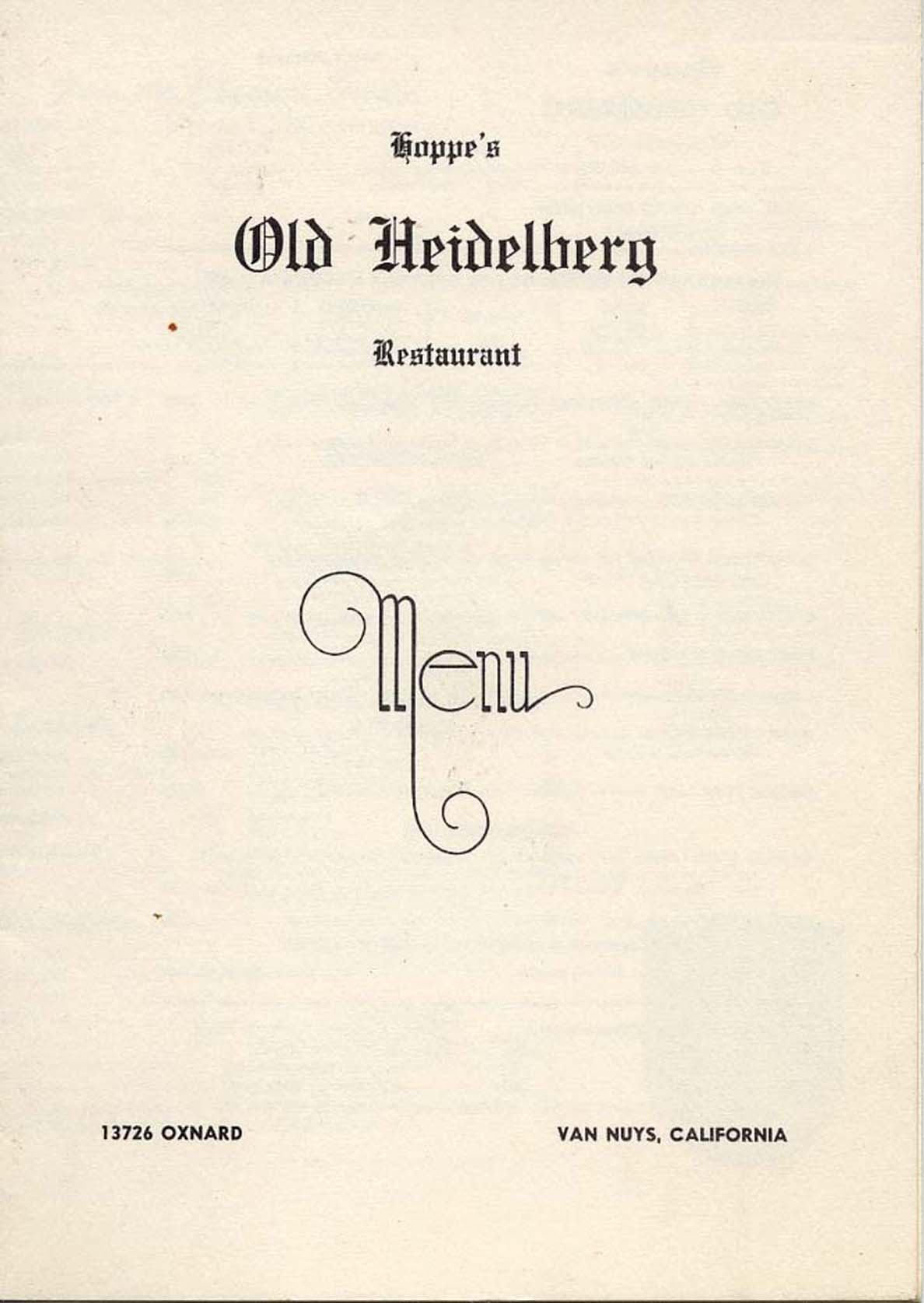
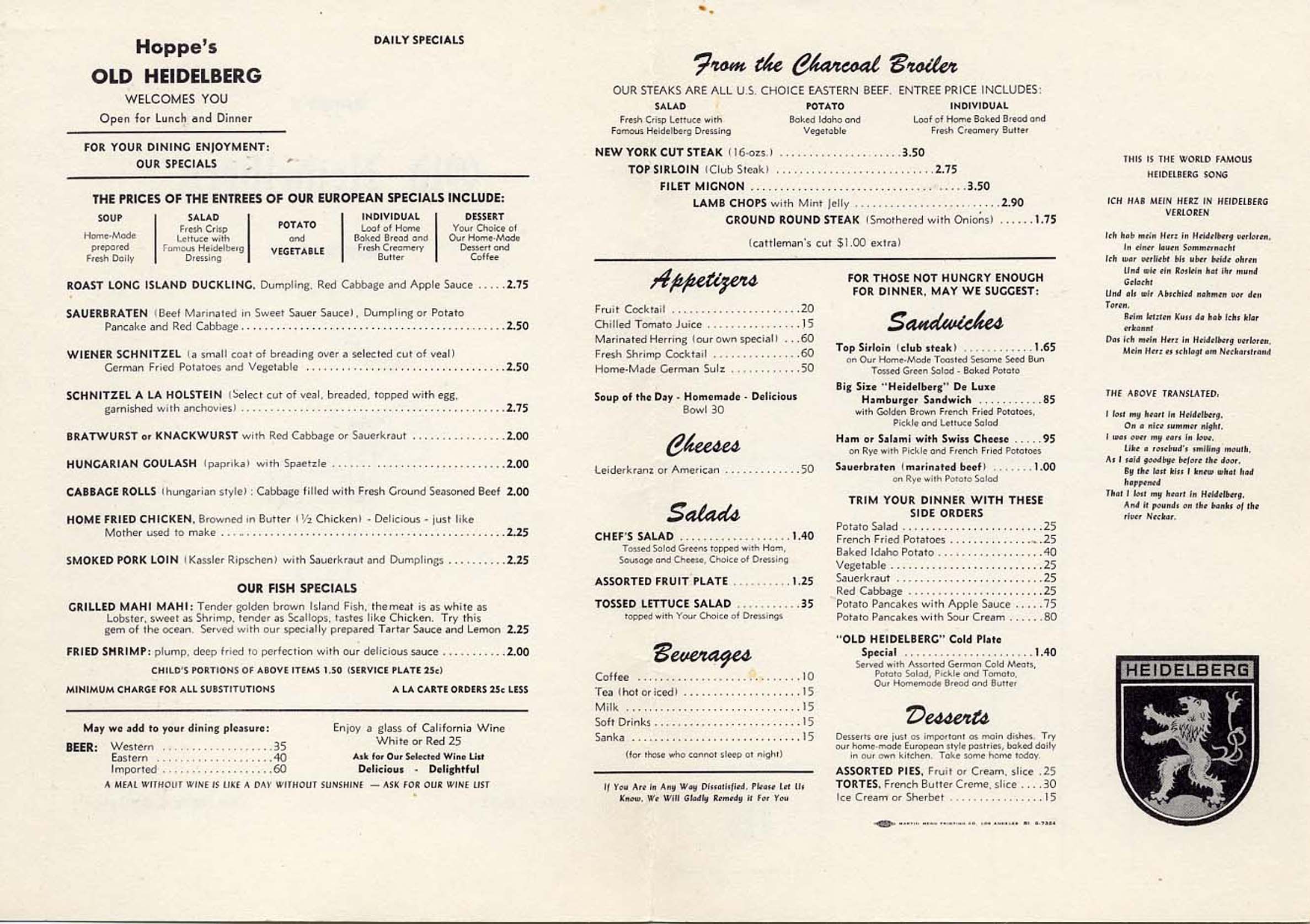
At Hoppe’s Old Heidelberg, 13726 Oxnard, men and women who fought in WWII, 15 years earlier, would dine guiltlessly on Schnitzel A La Holstein for $2.75 and enjoy an imported German beer for sixty cents.
Entrees came (free of charge) with soup, salad, potato and vegetable, fresh bread and butter and a dessert. Light eaters might order fruit cocktail for 20 cents and a glass of tomato juice for 15 cents.
(Credit:Museum of the SFV)
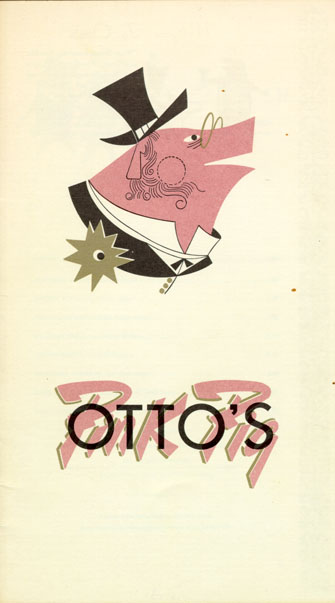
Otto’s Pink Pig at 4954 Van Nuys Bl. offered many fine seafood dishes, some of which are seemingly extinct in Los Angeles dining, such as frog legs, mountain trout, abalone steak, filet of sole, and Crab Mornay. All the aforementioned were also offered under $5.
Otto’s had a huge beef menu offering 19 choices. There was a 16 Oz. Culotte Steak, Sirloin Steak, NY Stripper Steak, Porter House Steak, Filet Mignon, Ribeye, Steak Au Poivre, Steak Alla Pizzaiola, Grenadine of Beef Bordelaise, Beef Steak Surprise, Dinner Steak, Steak and Green Peppers, Tournedos of Beef Au Sherry, Tournedos of Beef Morderne, Beef in Brochette, Steak and Eggs “King Size”, Steak and Eggs “Princess Size”, Steak Sandwich, Megowan Steak Sandwich De Luxe. And there were three roasts as well!
(Credit: LAPL)
(Credit: LAPL)(Credit: LAPL)
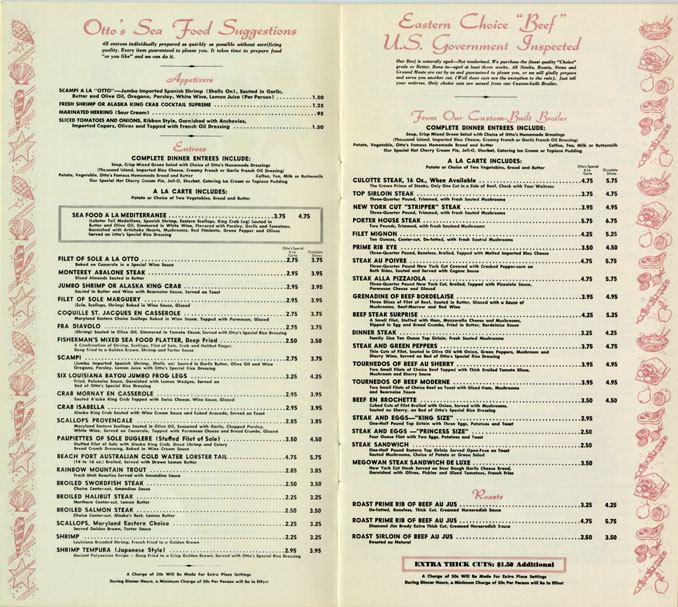
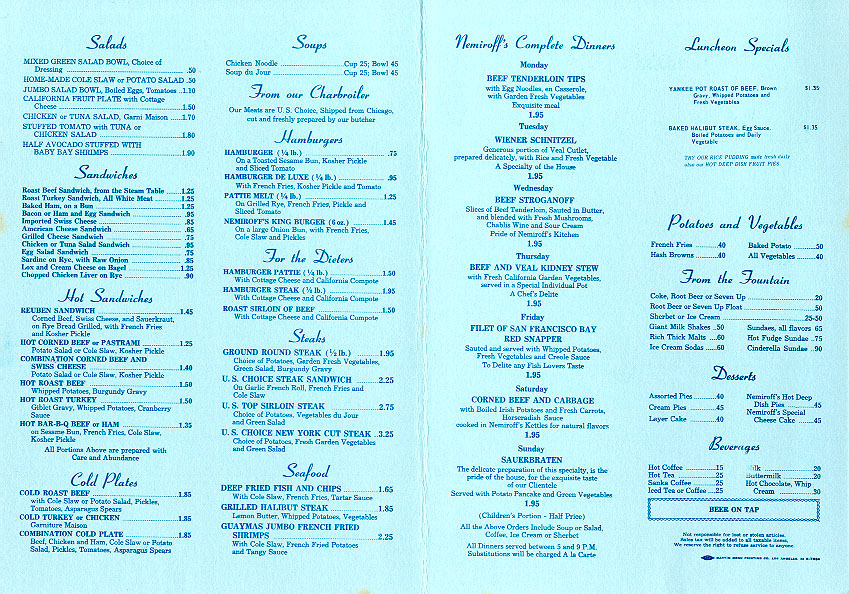
At 6801 Van Nuys Blvd. at Van Nuys and Vanowen (think of that lovely location today) stood Nemiroff’s with its blue menu and regal crest.
It seems to have been a Jewish style deli much like Jerry’s, without kosher offerings, but selling such sandwiches as Lox and Cream Cheese on Bagel for $1.25 and Chopped Chicken Liver on Rye for 90 cents.
Every day of the week offered a special, such as Monday’s Beef Tenderloin Tips with Egg Noodles and Garden Fresh Vegetables, described as an “exquisite meal” for $1.95 or Friday’s Filet of San Francisco Bay Red Snapper for observant Catholics. Indeed, Nemiroff’s seems to have delved into many styles with its German Sauerbraten ($1.95) and Irish Corned Beef and Cabbage with boiled potatoes and fresh carrots, horseradish sauce cooked in “Nemiroff’s Kettles for natural flavors” and it also cost $1.95.
There were many more restaurants, too numerous to mention, but places, spoken of today, regarded fondly, chiefly because where you ate when you were young is sacred, and every drop of cottage cheese and chocolate pudding, canned peaches and fish sticks, transports you back to a time when the world possessed freshness, vigor, and possibility.
And all the dreams you had were still in the future, waiting to be fulfilled, and a dream job, a dream car, a dream girl, a dream boy, a dream house, existed not only in the imagination, but for many, across this region, in reality.
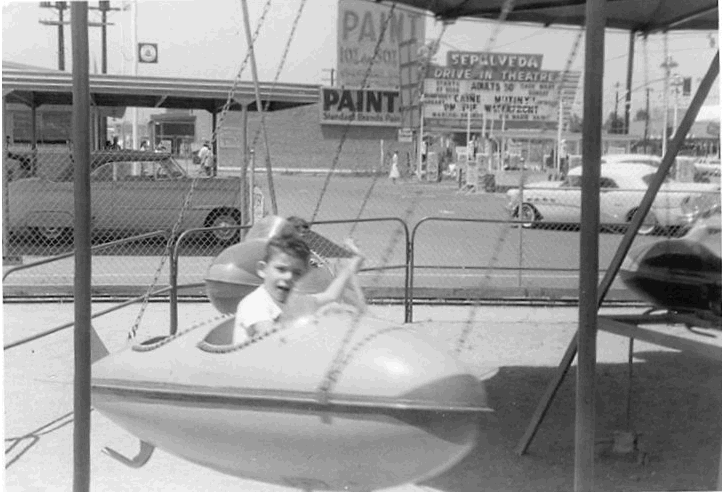
May 1956/ View south down Columbus towards Vanowen/Bassett (Tom Cluster)Sepulveda Drive-In Theatre, Van Nuys, CA circa 1954
Four days after the national cataclysm, uneasy inside, tentative, mourning for my nation and its political immolation, I took advantage of a partially overcast Saturday morning and walked on those quiet, well-kept streets north of Valley Presbyterian Hospital.
Tom Cluster’s emails had introduced me to the area, and I wanted to see for myself what it looked like.
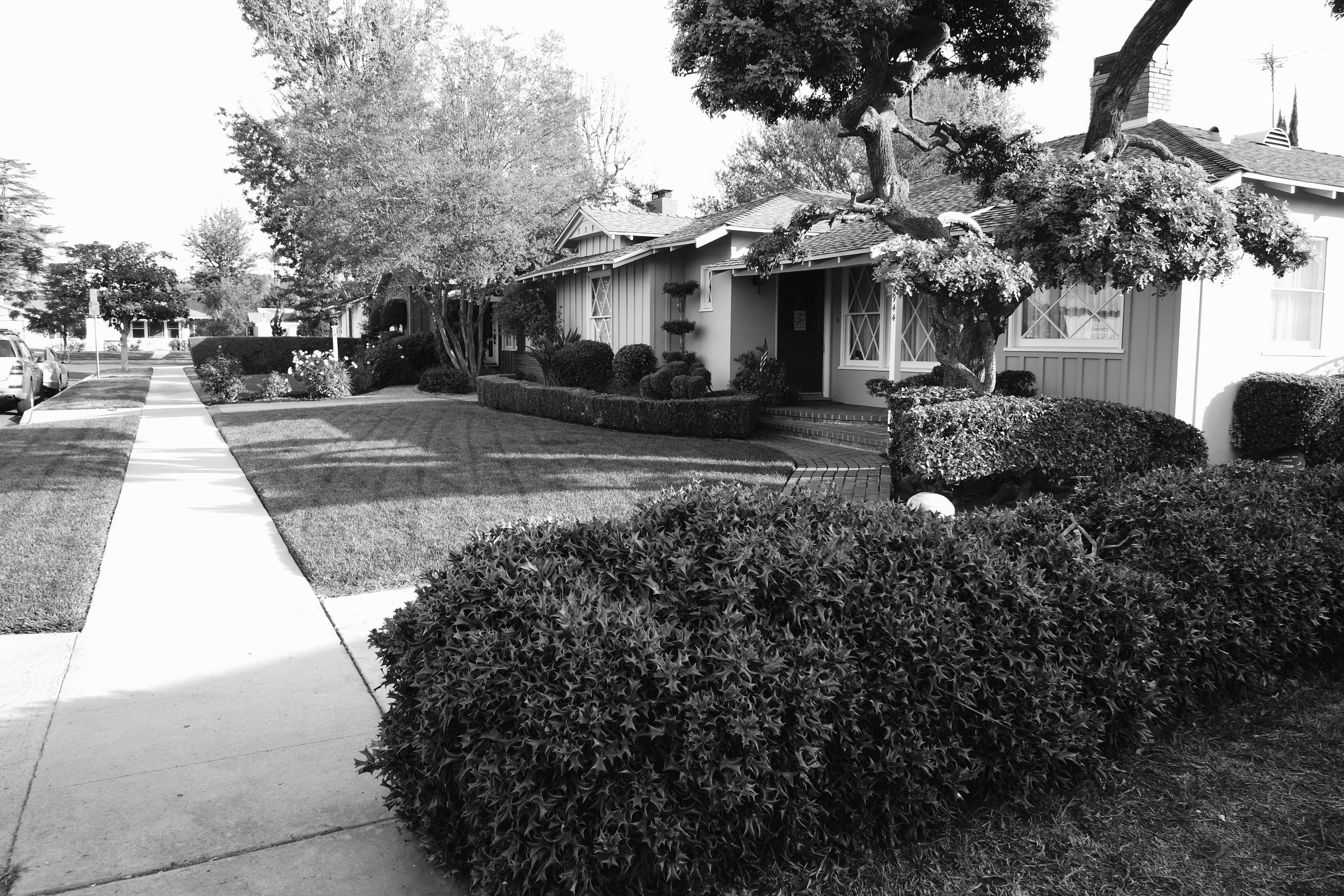
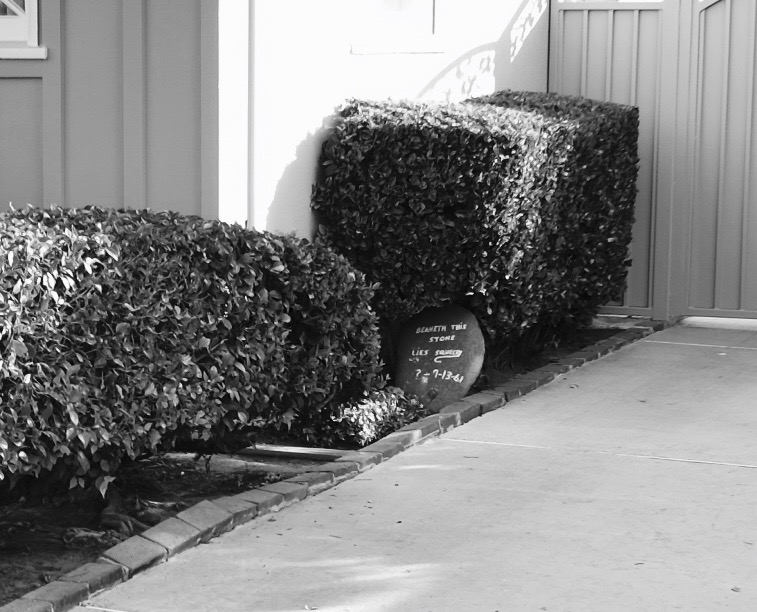
On Columbus Avenue, where Tom had grown up, the street was still lined with trees, with neatly kept houses, and well-paved sidewalks. In front of his childhood home at 6944, where he lived from 1955-62, a gravestone next to the driveway read: “Beneath the Stone Lies Squeaky 7/13/61.”
I assumed a pet, but have not asked Tom yet. But I am sure he will fill in the mystery.
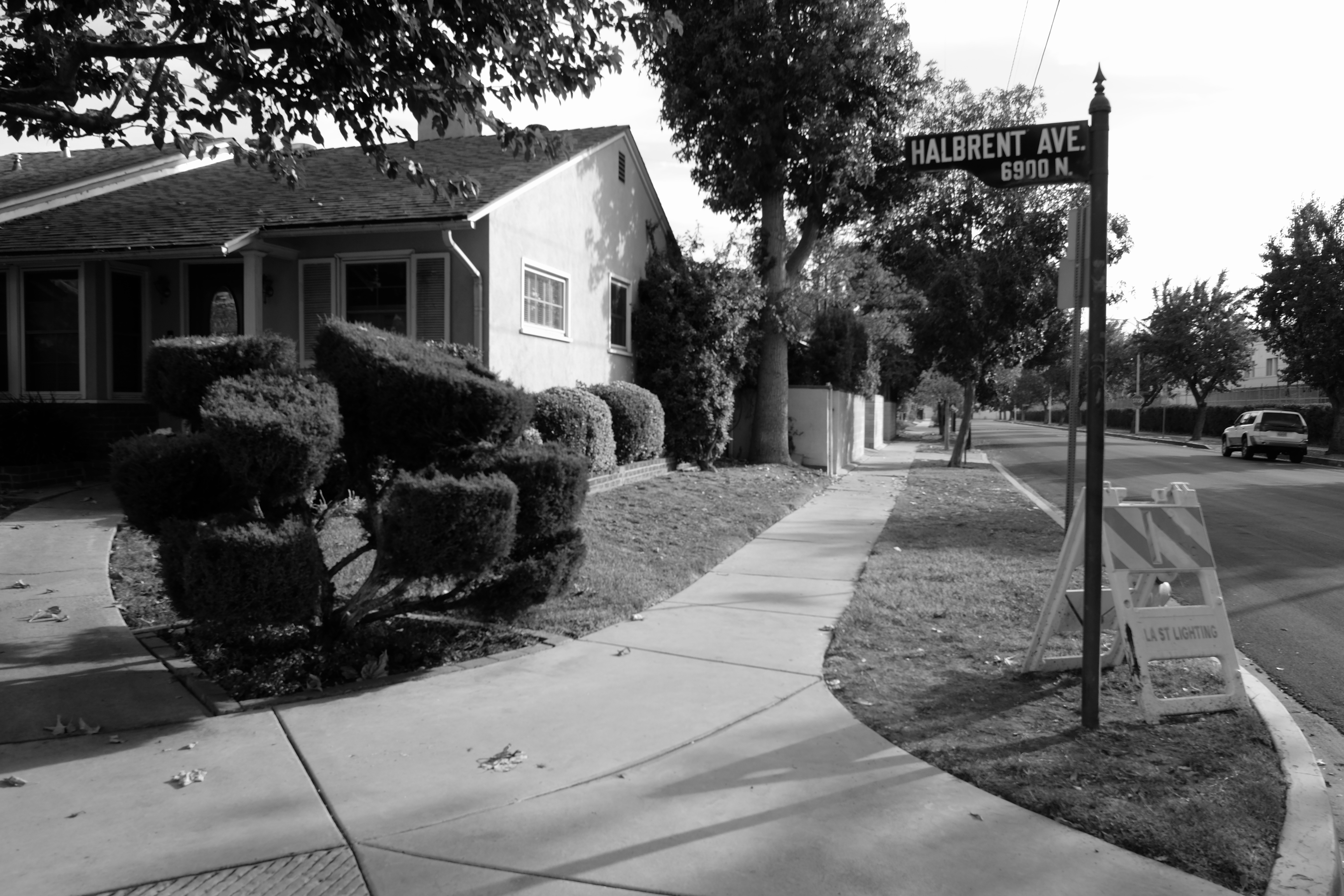
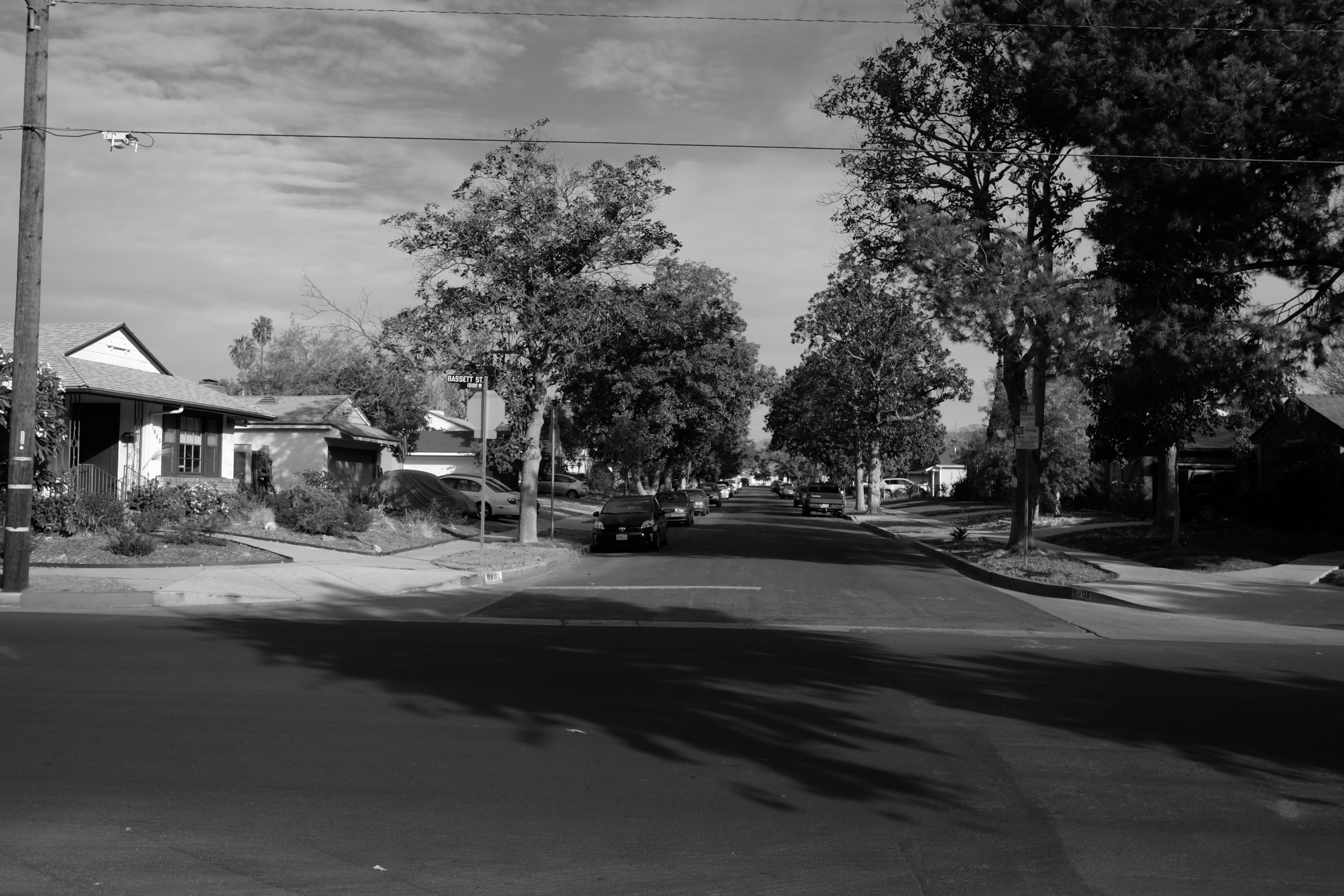
If you walked just three streets, Halbrent, Columbus and Burnet, you might be forgiven for believing that virtuous, middle-class, hard-working, Ozzie and Harriet Van Nuys was still the norm.
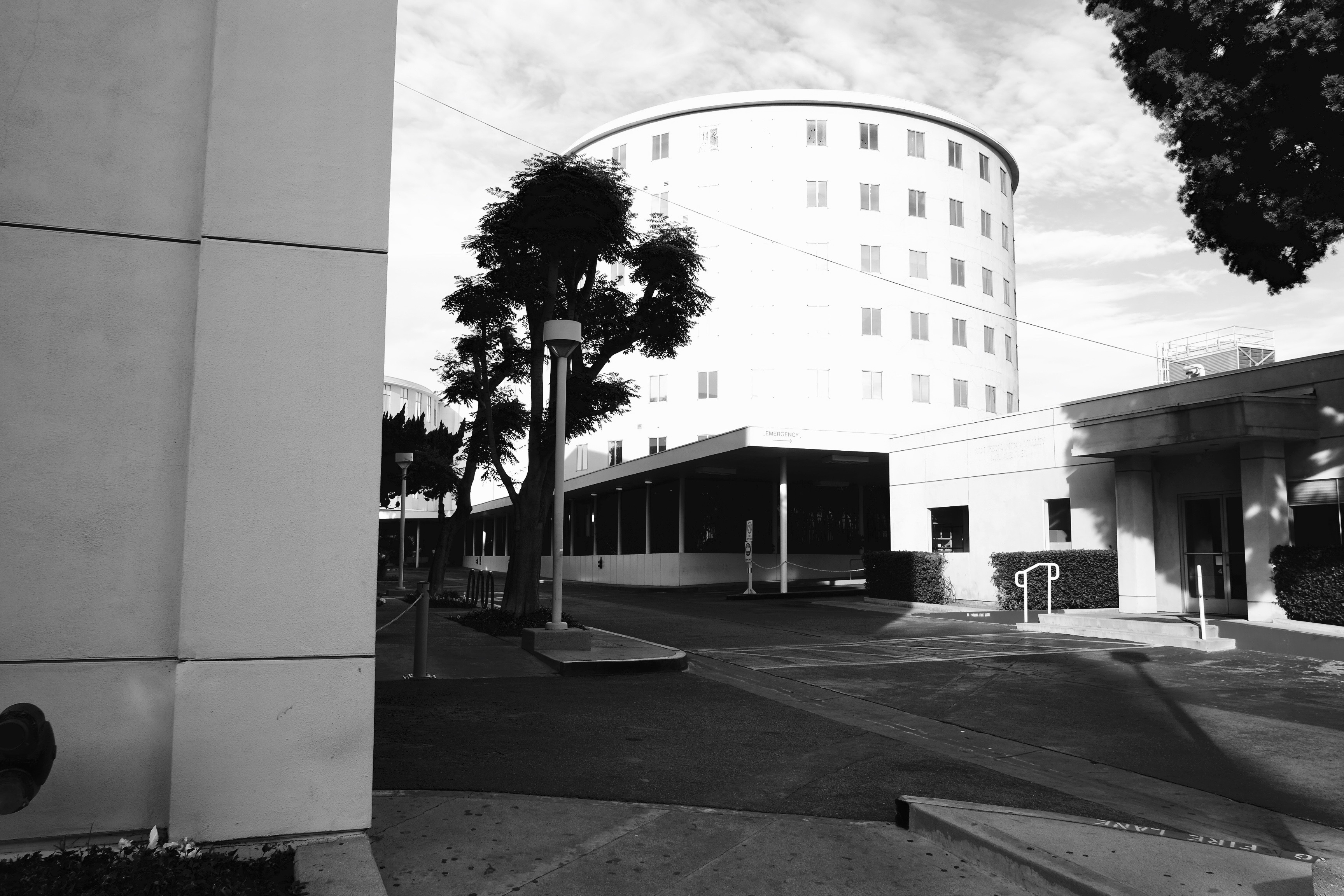
There is hardly any trash, the curbs are swept, the lawns are cut, and it seems that the hospital itself is as sanitized on the exterior as the interior. There is a calm, a self-assurance, an illusory orderliness conveying control. The buildings, dating back to 1958, drum shaped towers, share the grounds with more recent concrete ones; but unlike Cedars or UCLA, there is no affluence in the architecture, no preening for impressiveness or garish technological materials. This is a plain Protestant place, stripped down and frugal.
At Valley Presbyterian, there is also a long driveway leading from Noble, west, into the main entrance of the medical facility. The edge is lined with raised, planted beds under a 1950s modern, illuminated overhang. Welcoming and efficient, it conveys a public language of progressive health care and community.
The Edsels and the Oldsmobiles and the Pontiacs wait patiently at the entrance as the medical staff bring out wheelchairs. Dad, always calm, lights a cigarette and turns on the radio to hear how Don Drysdale is doing. Mom, in labor, is brought into the hospital by nurses as Dad goes to park the car and walk back into the hospital to wait, in the maternity area, for his wife to give birth to their third child.
Volunteer girls in red lipstick and white uniforms hold trays of apple juice in Dixie cups. They walk the floor and offer refreshments.
Dad took the afternoon off work but will be at the GM plant in the morning. His wife will spend a week in the hospital and they will pay their $560.00 bill in $15.55 monthly installments over the next three years.
For a few blocks, a section of Van Nuys, its homes and hospitals, is still preserved in a formaldehyde of memory and architecture, a Twilight Zone where hospitals were up-to-date and affordable, great schools were within walking distance, jobs were plentiful, work was secure, streets were safe, and houses reasonably priced.
Beyond these streets, the real, harsh, angry, misery of another Van Nuys in another America plays out.
And we Californians, we Angelenos, are caught in a vise of fear, hoping for the best, fearing the worst, and seeing the day of demagoguery descend over Washington and the world.
In preserved pockets, like the one north of Vanowen, some cower and hide from a restless surge of irrationality in search of scapegoats, chasing myths down dark alleys of the mind. The state, if it comes to it, may join the vigilante in enforcing the law. Or the law, if it is just, may return us to a semblance of sanity.
The best and the worst, the past and the future, it is all here in Van Nuys.












 Here in Van Nuys
You must be logged in to post a comment.