Navigating Public Space in Marina Del Rey.


In the 1960s, the swamps of south Venice became a multi-million dollar building project that culminated in what we now call Marina Del Rey.

Pleasure boats, yacht clubs, nautical facilities, circular high rises with balconies overlooking the harbor, landscaped roadways with palm trees, office buildings, pharmacies, tennis courts, a hospital, a fire station, a library; and many restaurants overlooking the yachts, sailboats and motor boats.

A district devoted to tanning, drinking, carousing, love making, and living the good life amongst airline pilots, stewardesses, restaurant workers, aspiring actors, and retirees. The 1960s dream of accessible pleasure for anyone white with a convertible.

They even built the 90 Freeway to get people in fast, before the boat left the dock. Imagine the high quality of life 60 years ago, when a new freeway was affordable and considered the highest and best use of land.

From its inception, Marina Del Rey feigned a public purpose while raking in the dollars fencing off the best parts for private use of yacht clubs and apartment dwellers. Docks are locked up and there are many barriers to prevent the use of the harbor for the general public unless you are there to purchase a dinner and drinks on a boat, bar or restaurant.

Over the years, there have been community projects to create usable public space, such as Yvonne B. Burke Park on the north side of Admiralty Way which has athletic equipment, bike roads and jogging paths. That park too has recently been incarcerated when Bay View Management built a cinder block wall that closed a public access point behind a Ralph’s store on Lincoln Boulevard. 

God forbid a pedestrian in a park might access a supermarket on foot.

Other luxury apartments, understandably fearful of crime, vagrancy and violence, have illegally built obstructions along their land to prevent the park from becoming a way to enter their properties.

Every few hundred feet, the green parks become parking lots. An athlete running, riding a bike or rolling skating will eventually stop at a busy road where vehicles speed by at 60 miles an hour. And other cars and trucks will be entering the parking lots or exiting, creating additional hazards for the non-driver.

The big, popular restaurants, anchored in seas of asphalt, offering seafood, steak, alcohol, valet parking, and private parties to corporate diners and red nosed, melanomatous men in Tommy Bahama, have all gone out of business. Café Del Rey and Tony Ps with their crumbling, dated, Brady Bunch style restaurants are empty. The cigarettes, cigars, Aramis and lounge singers gone with the wind.

The great pandemic meltdown which has stolen our lives, taken our movie theaters, pillaged our department stores, and defecated upon our civic dignity, has now obliterated the big dining establishments of Marina Del Rey.

These popular places, that seemed immune to time, forever serving enormous plates of grilled lobster, prime rib, baked potatoes, cheesecake, ice cream sundaes and voluminous cocktails are now dead. Silent as Hiroshima after the bomb, these outposts of high on the hog, intoxicated living were ailing, out of fashion, and are now exiled from our spartan, self-consciously healthy era.


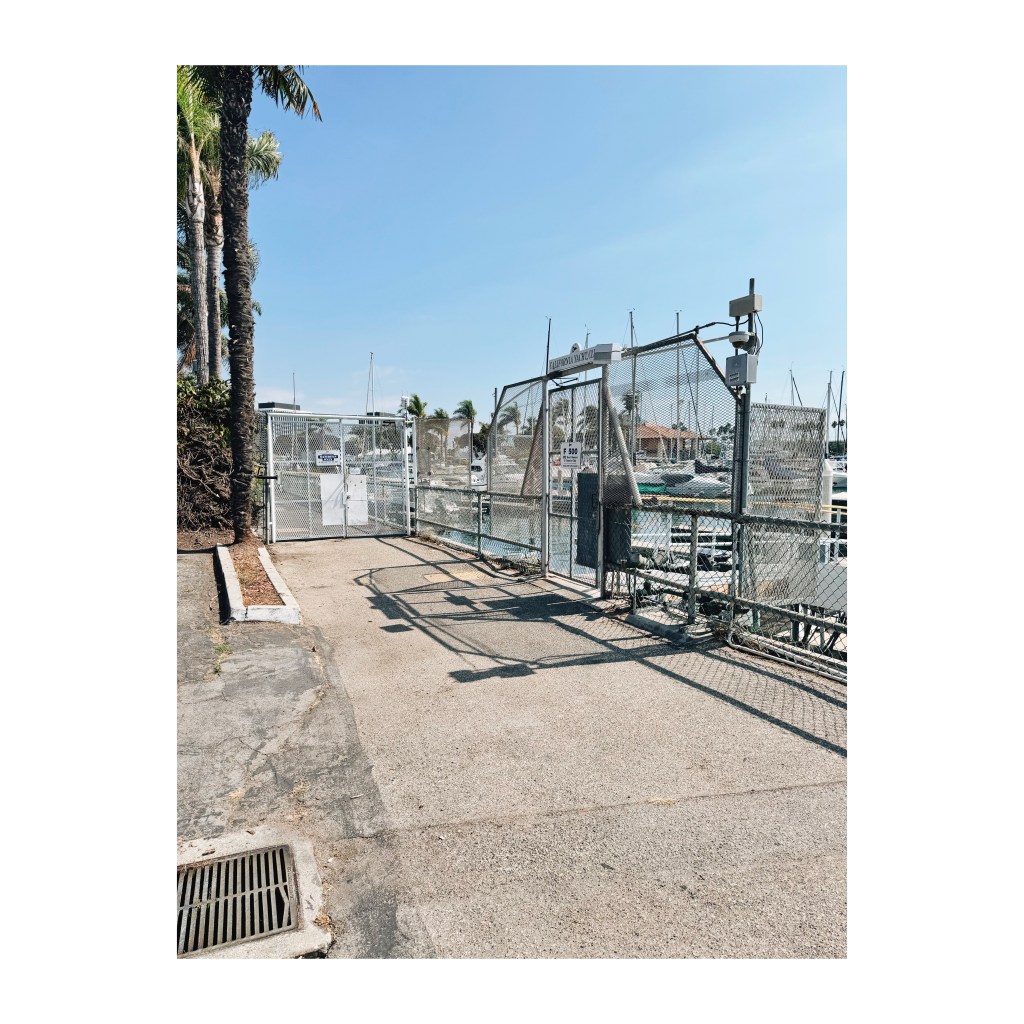
For a pedestrian who is trying to stroll one mile of the harbor west from Bali Way to Palawan Way, with the boats in view along the south walkway, there are several private obstructions that make it impossible to complete the walk.

I speak from experience as my friend Danny and I did the walk today.

The California Yacht Club locks up the walkway with their own use of the property. 

One is forced to detour to Admiralty Way with the unused parking lots of the long-gone restaurants on one side, and the near-death experience of speeding cars on the other.

To reenter the harbor walkway, you find the Los Angeles County Fire Department Station #110 (4433 Admiralty Way) and walk behind the building to rejoin the path along the water to once again enjoy the public recreational qualities that are supposedly there for everyone to enjoy, not just yacht members.

The Marina City Club encompasses three early 1970s high rises which are entered securely by several guarded driveways on Admiralty Way. This complex has swimming pools, tennis courts, a convenience store, but is threatened by similar structural defects that brought down the Surfside, Florida condominium in 2021, killing 98 persons.

For now, residents who own property there pay high HOA fees, and even those who bought in cheaply face repairs that will surely cost collectively in the hundreds of millions of dollars to make these three, 55-year-old buildings safer in a location where tsunamis and earthquakes are always visiting unexpectedly.  

Concluding the walk today, we went north along a dirt path on the west side of the Oxford Basin “Wildlife Refuge” which connected to Washington Boulevard.

As we passed a vagrant man sprawled on wall, shopping cart and garbage nearby, my friend Danny shouted, “Get going, walk faster.”

Danny had spotted a handgun in the vagrant’s hand.  

Just another reminder, if any is needed, that nobody should assume that this is a safe area, regardless of how much homes sell for. The demoralizing and unsanitary aspects of Los Angeles are all around, because we live in perhaps the dirtiest metropolis in the United States, one that believes public trash camping is a civil right and mental illness is only a danger after it kills.

How this city will present during the 2028 Olympics is something Orwell would have pondered.

Box Walk/Santa Monica.


For awhile now, residential modernism has been in charge in Los Angeles.

There was a period, roughly paralleling the 80s and 90s, when ersatz historical structures were the rage. Overdressed, highly embellished and gaudy.

But the stripped down box, the serious architect’s preferred style, is now the only way to build, especially on the west side of Los Angeles, where property is the most expensive, and every single ounce of concrete, glass and steel must pay homage to the gods of inconspicuous consumption.

The Box is King. Long live the Box!

On Memorial Day 2018, I walked from 5thand Pacific in Santa Monica down to Abbot Kinney, observing and photographing select buildings.

2120 4thSt. The West Winds (1959)

Whimsy from a cursive sign that provides a movie title sparkle to an otherwise dull structure.


2311 4thSt. Santa Monica (1967)

They charitably called it decorative modernism. It is a cheap way a developer dressed up his building with costume jewelry.


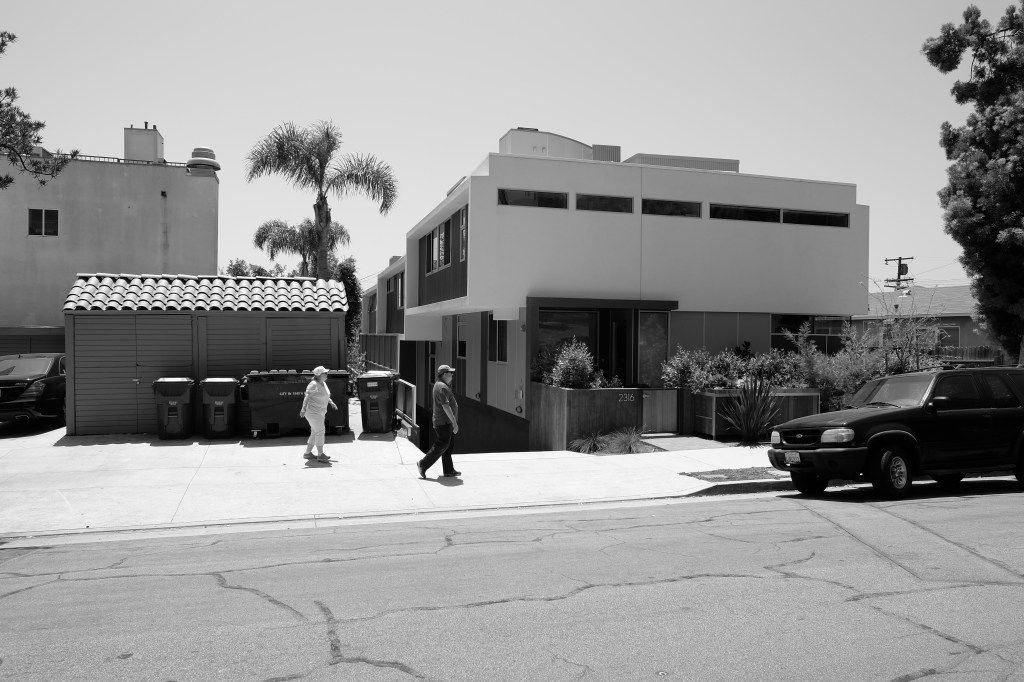
2316 3rdSt. Santa Monica (2017)

These are ultra-serious modernist condos designed by architect Robert Thibodeau. At least one unit sold for $2.6 million last year. They have all the emotionality and personality of a computer processor, but are of this moment in their sanitized, digital perfectionism, one that is scrupulously wired to accommodate residents who might command Alexa to send hot pizza and chilled Riesling by drone.


2404 2ndSt. Santa Monica (2006)

Already looking a bit dated with its ultra frozen metallic trim and smooth stucco, it compares awkwardly with its more relaxed and disheveled asphalt roofed neighbor next door.


2501 2ndSt. Santa Monica (circa 1902)

Fear not! This historic house has been under municipal evaluation/debate/conflict/litigation since at least 2010 and there are now plans to demolish only a back garage and guesthouse, and preserve the front structure. An official report by Santa Monica City said this property does not meet standards of preservation accorded to prominent architectural buildings.  A casual observer might disagree.


2520 2ndSt. Santa Monica (1900)

Imagine if Santa Monica were like Martha’s Vineyard, and little beach cottages with front porches were the norm?  2520 sits in exquisite preservation, next to a parking lot, but it is landscaped with wildflowers and drought-savvy plants. In its modesty and kindness, its gentle openness, it serves as an exception, not as the norm.


2543 2ndAve. Santa Monica (1915?)

All over Southern California, the courtyard housing of the Early 20thCentury provided modest, enveloping, nurturing neighborhoods for new arrivals to the Golden State.  These archetypes made maximum use of land, but did so with landscaping and interior gardens. Unlike today’s crime paranoid structures, this building has windows and doors around the entire perimeter, inviting and friendly.  It is under renovation, no doubt destined to be something unaffordable.


260 2ndSt. Santa Monica, CA (1989)

Now almost 30 years old,  this white, modernist, multi-family structure is best appreciated by observing it through steel security fencing and a parking lot. It has the mark of the late 1980s and early 90s in its square paned windows. Private, secretive, hidden, fortified, yet gleamingly bright and stripped down to essentials, this is what investment bankers, psychiatrists and plastic surgeons consider creative living.


320 Hampton Drive. Venice, CA (2015)

Google, Inc. is worth $600 billion and controls almost every aspect of every person’s life on the Planet Earth. It is more powerful than government, it is wealthier than 90% of all nations. Its infantile interface masks an incredibly complex and manipulative design meant to squeeze dollars out of any enterprise it wishes to.

It enslaves us by promising us ease. It erodes our individuality and uniqueness by herding us into categories assessed and rated by algorithms. It impregnates our dreams and deludes us into waking stupor.

Here is one of the buildings built by the pre-eminent monopoly of our time. It is a box: fortified, secured and undistinguished. Inside, no doubt, young employees bring dogs, tricycles, skateboards to work 18-hour-days, for 24 months, before they scooter over to another company in Silicon Beach.

In another moral riddle for our times, hundreds of homeless men and women sleep on the sidewalks just a few hundred feet away as if no money existed to rescue them from suffering.


“State of the art architectural, new residential compound, right in the heart of Venice.
One block from Gold’s gym, Abbot Kinney Blvd and two blocks to the beach. This three story gem has everything, from the rooftop patio with a jacuzzi to huge walk in showers, built in speaker syste and much more. No expense was spared on the construction of this home, it truly is one of the finest homes that Venice has to offer.
Perfect for a live work space. 2 car garage plus 2 uncovered parking spaces. Available fully furnished at $25,000.00 or unfurnished at $23,500.00
In addition to the space per public records, there is 500 sq/ft roof top patio that includes an outdoor kitchen and a hot-tub. On the second floor there is a 100 sq/ft balcony, on the main level there are also two decks/patios over 400 sq/ft that allow true indoor out door use total of over 1,000 sq/ft of outside use.
LIVE WORK ZONED”

708 Hampton Dr. Venice, CA (2017)

“Perfect for a live work space. 2-car garage plus 2 uncovered parking spaces. Available fully furnished at $25,000.00 [a month] or unfurnished at $23,500.00”

Muscular guy on balcony extra.


The Bird Scooter

All over Venice, these motorized scooters, unlocked by app, rented by hour, provide another means of transportation which speeds one along without aerobic effort.


Motor Home Home

This RV is parked at Brooks and Electric. The California Flag flies behind it, fittingly, salutingly. No housing type has grown as fast as the parked recreational vehicle.


1201 Cabrillo Ave. Venice (2008)

This home sits partly on a street and partly in an alley, both of which help solidify its sculptural presence. Dark, with variegated steel panels, and zig-zag cut outs, it is somewhat softened by vines. Lest it forget its bohemian surroundings, a reminder of drug dealers and gangs is provided by shoes hung on electrical wires nearby; as well as a tagged refuse container in the back alley.


249 Rennie Ave. Venice, CA (2013)

This is just the back guesthouse, but sparkles with a Teutonic crispness, like 1920s Bauhaus. And if this were Japan, there would be many houses just like this one, built along fastidiously maintained alleys.


420 Marine St. Santa Monica (1969)

Only 50 years ago they were knocking down quaint neighborhoods in Santa Monica and erecting cheapo, stacked, shoe-boxed units like 420 Marine St. Almost mid-century modern, this late 60s dwelling shoves cars into the back alley, and squeezes one or two under the cantilevered second floor. An overgrown pepper tree grows like a beard to obscure a homely façade.


2709 4thSt. Santa Monica (1967)

Still a rental, a recent ad offered a two-bedroom for $3,100 a month. Well-maintained from the exterior, it looks to have been upgraded with steel security gate, garage doors and energy-efficient windows. Considering its date of construction, it’s surprisingly un-ugly.


SaveSave

CicLAvia Event: Sunday, April 6th 9am-5pm


screenshot_302

This Sunday, April 6th, from 9am-5pm, Wilshire Boulevard, from Downtown LA to Fairfax, all six miles, will be free of automobiles and entirely owned by pedestrians and bicyclists.

The event was created by CicLAvia, an organization promoting healthier and humane alternatives to the dystopia of LA’s car enslavement. 100,000 people are expected to attend this free event which can be walked or biked along any starting point.

Public transportation is the best way to get there.

Those traveling near this area by car are warned that traffic will be nightmarish.

The Quiet Hour.


DSC_7919

DSC_7931

DSC_7918

DSC_7914

Crescent Heights at Selma

Passing through Sunset, near Crescent Heights, early in the evening, I abandoned the idea of crawling over Laurel Canyon to get back into the Valley.

Instead, I stopped and parked, a block east, and walked with Nikon up into the dark, winding, empty lush streets, meandering and mesmerizing roads, where historic houses hide people and lives behind storybook cottages, thatched roofs, and ornate doors.

This city is full of pain and struggle and disappointment.

But as long as the eyes can see, the legs can walk, the lungs can breathe, the scented and bewitching segments of Los Angeles are placed within reach; silent and mordant, mysterious and seductive, within grasp for gapers and wanderers, dreamers and photographers.

Unsafe Intersection: Columbus and Victory.


Victory and Columbus: Unlit

Gilmore and Columbus: Lit.

The corner of Columbus and Victory, on the north side of Victory, is one which has a constant stream of both traffic and pedestrians. But at night, the unlit intersection is a dangerous place, where cars turning north onto Columbus often narrowly miss nighttime bicyclists and people walking in the dark.

A few years ago, I contacted the City of LA about this, and was told, ridiculously, that a petition would need to be signed by area residents to request a street lamp at the busy corner. Yet, just north on Columbus, at Gilmore, Roya, Hamlin, Haynes, Kittridge and Vanowen, all are magically illuminated.

Many people walk at night in this area. And to keep them in the dark is to invite death or injury.

Pedestrian Friendly LA?


Century-City-Condo, originally uploaded by Here in Van Nuys.

From Project for Public Spaces:

“L.A. County has begun to rewrite the “DNA” of its streets with a new Model Streets Manual that will set guidelines to support improved safety, livability and active transportation options.

This effort was supported through a grant from the Los Angeles County Department of Public Health, through its RENEW initiative. RENEW stands for “Renewing Environments for Nutrition, Exercise and Wellness.” It’s inspiring to see a health-focused organization embrace a leadership role in Placemaking by broadening the scope of its concern to include planning for the built environment.

There is a growing understanding that streets configured to support an active lifestyle can lead to positive community health outcomes.

As Streetsblog reports, team lead Ryan Snyder of Ryan Snyder Associates has said the manual is like “the DNA of our streets, and it defines everything from where to place bike lanes to how wide a roundabout should be.”