SB 79 and Our Hood


SB 79 is a new law, authored by State Senator Scott Wiener, approved by the legislature, and recently signed by Governor Gavin Newsom, to allow the state to overrule local zoning laws and permit the construction of multi-family housing on lots which are zoned for single family housing when these properties are within a half or quarter mile of a bus or light rail stop.

In Los Angeles, the law will allow much denser and higher development along not only wide boulevards, but inside old, intact, single-family streets, “side streets” which never had apartments or multi-unit housing.


A guide to the law along with maps is here.

Tiered density: The allowable height and density for projects are determined by the quality of the transit stop and the project’s proximity to it.

Tier 1: Applies to projects near high-frequency commuter rail or heavy rail transit, like BART and LA Metro.

Tier 2: Applies to projects near light rail and bus rapid transit lines.

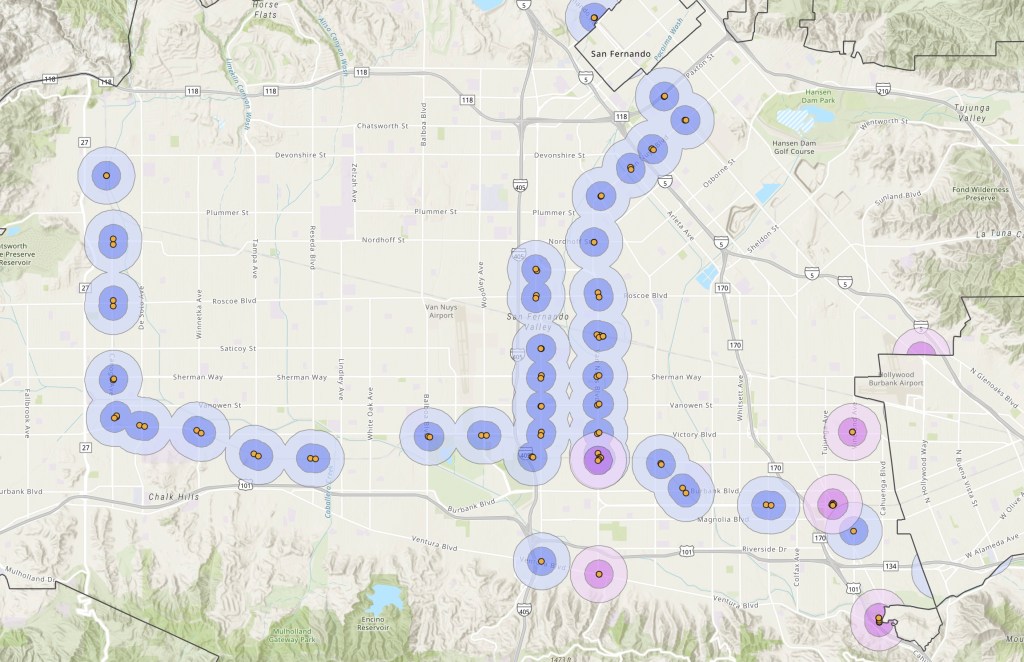
Along Sepulveda and Van Nuys Boulevard the proposed zoning map looks like purple bullet holes that radiate from transit stops. These circles are centered around the transportation stops and take no consideration into the historic or local character of any neighborhood. 

For example, I live on Hamlin Street which is a “Tier 2” zone because we are within a ¼ of Sepulveda Boulevard bus stop. My street, built on old walnut orchards, from 1936 onwards, is lined with palm trees, and then curves along with oak trees. The street has two-hour parking because of its proximity to Van Nuys High School.

If the law succeeds, my section of Hamlin Street would allow 65-foot-high buildings (six and half stories).

But the part of Hamlin Street a few hundred feet east from me would remain single family.

West of Sepulveda, south of Victory, is the beautiful and often filmed Orion Avenue with large colonial style houses planted with rose bushes and ranch fences, the location for many commercials seeking “a typical American street” that doesn’t exist anymore. With SB 79, the east side of the street could be obliterated with apartments that destroy the very beauty residents and film makers pay dearly for.


Yesterday, I had a real life encounter of what Hamlin St. and other locations nearby could become when I parked my car near 3052 West Boulevard in the Jefferson Park neighborhood of Los Angeles, east of Culver City. I was there to visit a new, multi restaurant creation, Maydan Market.

This area was given an economic boost by the Expo Line, a light rail system that connects downtown with Santa Monica. The good parts are investment, cleaner streets, the lowering of crime and the raising of the cultural and civic activities. 

The ugly parts are the disfiguring, ad hoc apartments that pop up on formerly coherent streets of 1920s bungalows. My eyes hurt looking at 3045 West Boulevard, a black and gray box suspended over a cinderblock faced garage, with a massive four story high open-air staircase on the side of the building. It looms like a monster over the street, with no respect or sensitivity to the vernacular that had existed here for 90 years.

Am I a hypocrite for decrying liberalized zoning that will change my backyard? Yes, I am. Sort of.

This blog has argued for years for the construction of new, multi-family buildings to replace unused parking lots behind abandoned shopping centers, or where there is a sea of asphalt like the Orange Line parking area along Sepulveda which was constructed for thousands of vehicles and is now empty.  I have fought for the idea of an architectural, coherent, community wide style that would incorporate history and embrace modernism but do it without destroying but enhancing the community of Van Nuys. 

And I’ve always cast a cold, unforgiving, forensic eye on the political neglect of Van Nuys by elected officials who seem to always be performing social media acts of kindness for oppressed groups while neglecting the needs of residents in this district. 

There are commercial zones galore that cry out for taller residential buildings along the wide boulevards of Van Nuys and greater Los Angeles. The one-story tall shops with parking lots in front are so defunct and useless that their very presence destroys civilized life and endangers the health of pedestrians. 

There are blighted buildings, such as this one at 7101 Sepulveda, that have been empty for years, packed with derelicts, unable to be demolished, yet crying out for replacement. As a bitter pill, the residents in the tree lined, charming, quiet streets behind must now expect multi-family housing to replace their 1940s ranchettes.

What do our elected leaders in Sacramento do with the quandary of building more housing? They embrace a fantasy of destroying single family homes and backyards. 

Will your neighbors and you, the elderly couple in the corner house, desire to ride buses (with homeless, drug addicts, crime?) and come home, late at night, from a bus stop on Sepulveda, and enter a new world of yet more cars, loud music, marijuana, dumped mattresses, and YouTube/TikTok/OnlyFans influencers smoking on the balcony next door? I doubt it.

Is that the paradise of tomorrow? Circles on a map, purple splotches of political malfeasance, indicating nothing but more mayhem, disorder and chaos.

I hope I’m long gone, either from life or Van Nuys, before this happens. 

Squandered Opportunities


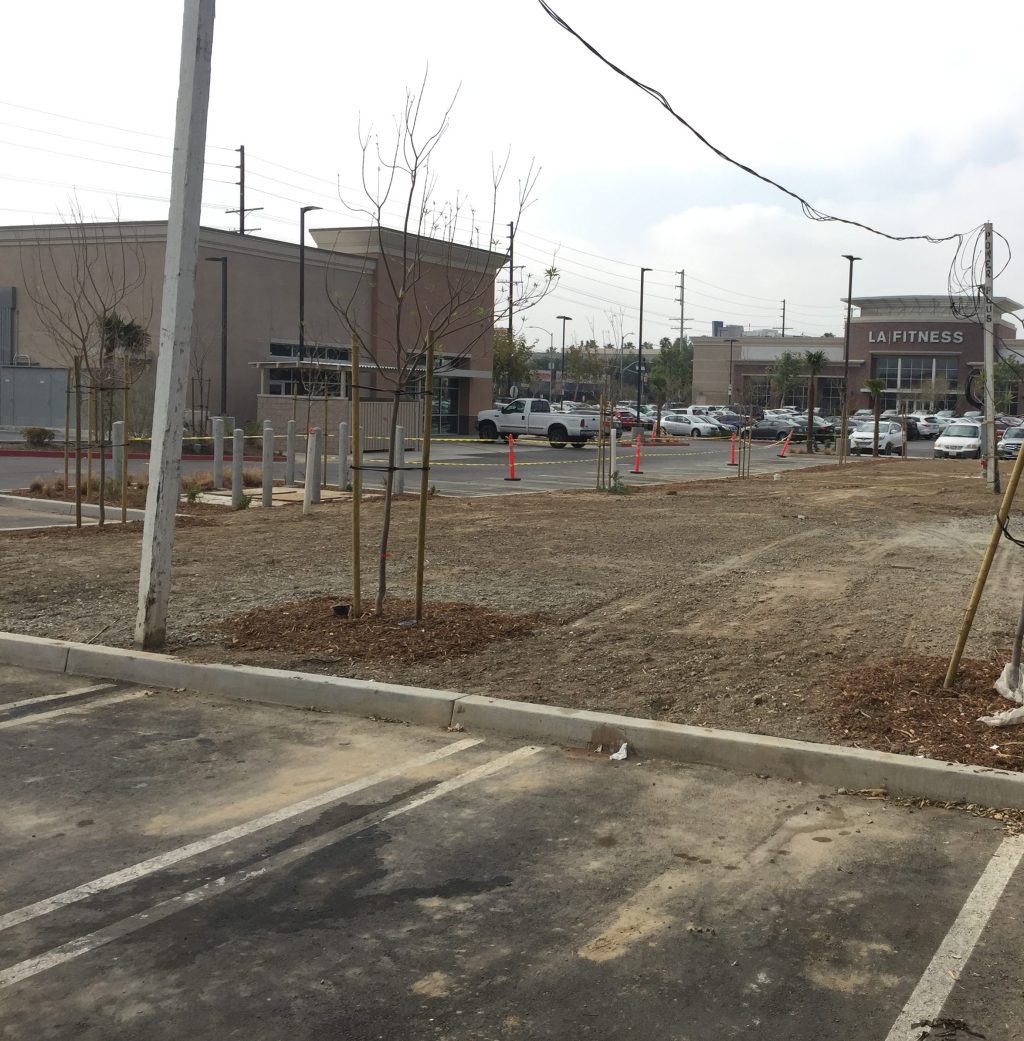
Nearing completion, now, is a one-story mini-mall on the north end of the LA Fitness parking lot near Sepulveda and Erwin.

Pleasantly innocuous, in a beige/brown way, the mall (with circa 1999 cornice) is being landscaped, pretty extensively, all around, with various trees and shrubs to decorate the sea of asphalt.

Zoned commercial,  this is also next door to a Wendy’s, also recently naturalized, with new water saving plants and a modernistic, horizontally striped renovation. Customers who feast on industrial meat, sugary soda, and frozen French Fries, all trucked in from Iowa, will do so surrounded by native California succulents.

This is all bordering the Metro Orange Line Parking Lot, 50% of which is occupied as a storage center for not-yet-sold new Keyes Automobiles. This scientifically zoned area is irrationally sited along an efficient, pleasant bus line that runs on schedule and connects Van Nuys to Hollywood and Downtown Los Angeles.

Left over in the new mini-mall layout is a rectangular island of land that, in my imagination, I envision as a small apartment building or even a white, wooden Colonial house, a residential arrangement that provides living space for people who can walk next door to the gym, stop for milk at CVS, ride their bikes on the bike path, and most importantly, are there to populate, energize and humanize a sea of parking spaces.

I picked “Colonial” to lovingly pander to the nearby residents of privileged, filmed upon Orion Ave. hoping they might not object to an 18th Century House with a garden in front, housing a nice coffee place or a fort-monthly locale for filming Target and Walmart commercials.

Why not build something on this open spot like these below:

But, for now, the neat, empty rectangle of land is unoccupied with forms either natural or man-made.

This waste of land, and the time-wasting, perpetual, irritating and circular question, “Where will they park?” dominates the beginning and end of any discussion of new apartments, housing or commercial building in Los Angeles.

If there is no room for 1,000 New Hummers in that New 200 Unit Apartment…then I say, to hell with it, let people sleep on the street in tents!

What exists, when it’s built, is a battleground of short-tempered drivers circling parking lots, looking for parking, even when there are 2,000 or 3,000 spaces provided for their temporary storage!

So the opportunity for a new, innovative, and imaginative kind of development, one that integrates the commercial and the residential, is again squandered.

Why?

What have we got to lose?

We are already losing.

SaveSave

One Story Town


One Story Town is Sepulveda Bl., from Oxnard St. north to Victory Bl.

It is 2,569 feet long, almost a half a mile. It encompasses the Orange Line Metro Busway, LA Fitness, Costco, Wendy’s, Chef’s Table, The Barn, CVS, Dunn Edwards, Bellagio Car Wash, Wells Fargo Bank, Enterprise, Jiffy Lube and other small businesses selling used cars, folding doors, RV rentals, Chinese food, hair cutting, and ceramic tile.

The Southern Pacific freight trains once ran through the present day Orange Line, and they fashioned the district into a lumber- oriented, light industrial area. Such behemoths as Builder’s Emporium were located here, and the stretch of Oxnard that borders the old rail line has retained an industrial use.


The zoning designations for almost all the parcels along Sepulveda are commercial. They prohibit residential within walking distance of the Orange Line, and they prohibit it even though buses run up and down Sepulveda!

A beautifully maintained bus stop perfectly sited for long waits in 110 degree heat.

Available online for public research, is the Los Angeles’ ZIMAS, a website run by the Department of City Planning. Here one can select a parcel, for example, 6206 Sepulveda Blvd., where The Barn furniture store is located, and see that it occupies two parcels totaling 44,250 SF. It is not, according to ZIMAS, in a transit-oriented area, nor is it designated as a pedestrian oriented one, nor is it part of a community redevelopment one.

Someday the owners of The Barn, which has sold, since 1945, brown stained furniture in heavy wood to seemingly nobody, may choose to sell their business. And here there is enormous potential to develop a first-class residential and commercial building just steps from the Orange Line.

Residents of Halbrent St. just east of The Barn and other businesses, are on the ass-end of parking lots, illegally parked homeless RVs, and are subject to the use of their street as a speedway for cars entering and exiting Costco. Maybe, just for once, Halbrent St. might see a better development on its west side.

Every single one of the businesses, up and down Sepulveda, between Oxnard and Victory, is located, by observation, in a transit- oriented area. Yet ZIMAS states they are not.

Perhaps that will change as Los Angeles reviews its zoning, and permits taller, denser, more walkable development within a 5-minute walk from public transit.

At dusk, with the early October sun hitting the one-story buildings, there is a homely, lowbrow, neat banality to the structures along this stretch.

This is not the worst of Van Nuys. It is generally tidy. But nobody living nearby, some residing in million-dollar homes, would come here to mingle, to socialize, to sit and drink coffee, eat cake, shop or walk with their kids after dark.

Studio City has Tujunga Village.

Tujunga Village, Studio City, CA. Photo by John Sequiera.

And we, in Van Nuys, have, this:

The One Story Town: what is it and what could it be? Might this district, one day, contain vibrant restaurants, outdoor cafes, beer gardens, garden apartments, parks, trees, flowers, fountains? Why not?

In planning for 2027, 2037, 2047 and beyond why would we keep the preferences of car-oriented, suburban dreaming, 1975 Van Nuys, in place? Why are thousands of parking spaces at the Orange Line Busway used to store cars for Keyes Van Nuys? Is this the best we can do?

Could not a group of architects, developers, urban planners, government leaders and vocal citizens devise a Sepulveda Plan to transform this wasted opportunity into something better, or even ennobling?

Where is our vision? And why are we so starved for it when we live inside Los Angeles, the greatest factory of imagination, illusion and improvisation the world has ever seen?


The Plaintive Call.


A few weeks ago, around 7:30 at night, I received a phone call from an upset stranger.

“Paul Dunbar” said he was a neighbor. A woman had given him my number. And told him Andrew, at “Here in Van Nuys”, might be helpful.

Mr. Dunbar explained that he lived with his wife and two children in a home he has owned for the past 16 years. His 1950s ranch has three bedrooms, and a large den facing a backyard pool. It is a classic old Valley house. But it is now under assault.


DSCF0880
Dunbar Family Pool.
DSCF0870
Just Beyond the Fence Behind the Dunbars.
DSCF0868
A backyard paradise which will have an audience in the next few months.
DSCF0866
A single famly house now developed as a multi-family rental property.
A few months earlier, the house behind the Dunbar’s was sold and purchased by an LLC. That entity was now constructing two houses, intended for rental use, on an 8,099 sf lot, zoned R1 (single family).

The back house, entirely new, will rise up two stories and contain a two-car garage below, and living spaces upstairs. The renters will enjoy an outdoor balcony whose view will be the Dunbar pool below and the back of the Dunbar House where all activities, indoor and outdoor, will be under the scrutiny of strangers.

A backhoe had dug up all the vegetation, and had deforested the backyard. A naked slat wood fence was all that stood between the neighboring houses. Rising up, like Godzilla over Tokyo, was a new 22.5-foot high house with many windows.

The egregious backyard neighbor’s two houses will be rented out. The renters (whomever they are) will live, and look down, across the entire width and breadth of the formerly private property. At night, the Dunbar Family drama will be a stage show for prying eyes.

Exhaustively, and in detail, Paul Dunbar kept records of the various letters, emails and phone calls he made to many city agencies and offices: Councilwoman Nury Martinez, District 6; Assembly member Adrin Nazarian; LA’s Department of Building and Safety; City Inspectors,the City Attorney’s Office. Senior Lead Officer Erika Kirk, LAPD, even intervened, with no results.

The upshot of the situation is that a speculator can buy a home on a single-family lot and put two houses on one lot with a “variance”.

All the neighbors in the area are aghast. They know anybody can now come in and demolish. And then construct two new, rentable houses on old, one-family 8,000 SF lots. A bad precedent has been set.

IMG_0667
Construction for the new multi-family development on a single-family lot.
The New Homes of the LLC Family.
“What is the point of investing your life savings and a large portion of your monthly paycheck into a single family neighborhood? The city decides they will change it with no explanation/warning. And NO representation to voice your feedback, unless you spend more money and time for an attorney to fight what is already a done deal?” Mr. Dunbar asked.

A few hours later in the afternoon, the first story of the new guesthouse rises over the Dunbar fence.
The first story of the eventual two-story house rises above the Dunbar fence.
DSCF0888
Privacy Under Assault.


Van Nuys, in the aftermath of the recession, has regained most of its pre-2007 property values. But the average house in our neighborhood might be worth $550,000. If a home sells for $500,000 and needs $150,000 worth of work to remodel it, there is little incentive to flip it if the ceiling is only $700,000.

Therefore, the only way to make property profitable in Van Nuys is to carve up the pieces and put some income producing business on it.

Some speculators are trying the LLC route. Others are engaged in various nefarious scams.

There are now businesses that are buying up houses around the area and using single-family houses as sober living halfway houses. The owners bill insurance companies thousands of dollars for each resident, and then cram six or seven un-related adults into a house. The operators can earn $20,000 or $30,000 a month paid for by health insurance, subsidized by Obama Care.

My cousin, who sometimes works in these “sobriety” houses, says they are a profitable business and he knows of people who bought up multiple $1,500,000 houses in Beverlywood and set them up as post-addiction estates. Van Nuys, with lower cost housing, is in the sights of unscrupulous people bilking medical insurance to finance these arrangements.

Other properties that are zoned for single-family houses are now being redeveloped as denser housing to encourage more intensive use of large parcels of land. Allegedly creating a more walkable city, the new “small-lot” zoning will pour additional cars onto the street day and night.

The LLC situation means that individuals are not the new homeowners. Companies owning many houses will buy up distressed properties and rent them out, and they will also find ways around the zoning laws to carve up lots and cram in homes.

Poor Van Nuys.

Even when properties are rehabilitated they are simultaneously degraded.

Who is in charge of zoning? And who is in charge of handing out permits? Why and how is it allowed that an LLC can throw up two houses on one lot in the midst of our single-family home neighborhood?

Why are we always fighting new forces intent on destroying Van Nuys?

Why are people in power deaf to their constituency?