The Nowhere City Goes Somewhere


DSCF1002

Yesterday, near downtown Santa Monica, on a strangely cloudy and drizzly summer morning, I drove west, unintentionally, into blocked roads, past barriers and bulldozers.

Men were tearing down buildings, punching holes in plate glass windows and digging trenches.

The long winding humanitarian project known as the Expo Line had made its way from central Los Angeles, sweeping through Culver City, catapulting by bridge and track into West Los Angeles and finding itself and its destination next to the Pacific.

DSCF1014


DSCF1001 copy

The empty shell of Midas, a beautiful Spanish Revival structure, lay in ruins, a stomach full of bricks and wood, its ornate ornament ready for obliteration.

50 years ago, the novelist Alison Lurie wrote a novel, “The Nowhere City” set in some places along the soon-to-be-demolished houses in the path of the Santa Monica Freeway.

Yesterday, near downtown Santa Monica, I saw the sequel to that book.

After half a century, the Nowhere City Goes Somewhere: on foot and bike and rail.

DSCF1011


CicLAvia Event: Sunday, April 6th 9am-5pm


screenshot_302

This Sunday, April 6th, from 9am-5pm, Wilshire Boulevard, from Downtown LA to Fairfax, all six miles, will be free of automobiles and entirely owned by pedestrians and bicyclists.

The event was created by CicLAvia, an organization promoting healthier and humane alternatives to the dystopia of LA’s car enslavement. 100,000 people are expected to attend this free event which can be walked or biked along any starting point.

Public transportation is the best way to get there.

Those traveling near this area by car are warned that traffic will be nightmarish.

Waiting for the Bus on Sepulveda


Bus Stop Crebelley, Vaud, Switzerland © 2013 Gerald Verdon
Bus Stop
Crebelley, Vaud, Switzerland
© 2013 Gerald Verdon

Later this year, friends and family from Zurich, Switzerland will visit here in Van Nuys. In that lovely nation public transport is dignified, clean, cheap and abundant. (see photo above)

The visitors will see Los Angeles with Swiss eyes, a city where trash sits on Sepulveda in both human and inhuman formations. Only Disneyland and Magic Mountain will come close to presenting an ideal city. That’s our American dream.

But for the bus riders who must wait in the sun, without protection, for 30 or 45 or 60 minutes, before a bus arrives, for these people trudging up to work at low paying jobs putting bagels into bags, or unloading boxes, imagine how their day starts before work?

Imagine they must sit here at the beginning and sometimes the end of their day. And think of what this says about Los Angeles, that our bus system is so neglected that people are treated no better than garbage.

What do Mayor Garcetti and Councilwoman Nury Martinez plan to do about this?

734 Bus at Sepulveda and Busway, Van Nuys, CA.  By Andy Hurvitz
734 Bus at Sepulveda and Busway, Van Nuys, CA. By Andy Hurvitz

IMG_2713

IMG_2714

Keyes Van Nuys Rents METRO Busway Parking Lot.


DSC_3232

DSC_3233

DSC_3235

DSC_3238

screenshot_279

The publicly financed METRO has found a new way to earn some cash.

They are renting out about one-third of the Orange Line Busway parking lot to Keyes, Keyes, Keyes, Keyes in Van Nuys.

The lot, at Erwin near Sepulveda, was built, in the LA way, for bus riders to park their cars while they ride their bus and bike.

Someone very wise and very powerful at METRO must have concluded that most bus riders don’t own automobiles. So why not earn some bucks renting an enormous expanse of asphalt, planted with many hundreds of trees that lies fallow and unused?

The lovely neighborhood which abuts this lot to the north has been justifiably paranoid about proposed development plans which have included hundreds of town homes, office buildings, and potential additional retail stores. Hemmed in by the 405 Freeway, nightly helicopters, noxious fumes, prostitutes, trash, illegals and pimps on Sepulveda; oil storage tanks, psychics and speeding psychotics, the homeowners in these rose-covered cottages can do little about their immediate environment but rent out their properties to movie companies.

Perhaps a very large car park, rented out on public land to private industry, is a good thing. Nobody makes noise. Parked cars are silent and quite neighborly.

So for now the publicly paid for land is being used in that most characteristically Angeleno way, as a home for cars.

Baking in the Sun, Waiting For the Bus.


Riders at METRO RAPID LINE 734 in Van Nuys.

Despite upgrades and vast physical improvements in buses, trains and modes of public transport in Los Angeles, there are still glaring and inhumane gaps in the Metro System that seem to be devised to torture and humiliate the people who ride them.

One of them is this garbage-filled, plastic bench waiting area at Metro’s Rapid Line #734 stop in Van Nuys near Oxnard and Sepulveda. It is a direct connection for riders who come from across the street off the Orange Line and intend to travel north on Sepulveda. Sometimes as many as 30 people stand here and wait, baking in the noxious Valley heat, next to a bench that can accommodate only three.

Out in the sun, out in the rain, riders stand; without overhead shelter or trees, in front of the oil soaked parking lot of Pet Boys, where cars inside service areas are treated better than humans standing outside.

To add insult to injury, most of the riders are dressed in all black, a hue which absorbs the most sunlight.

The Art of Road Building.


DSC_5764

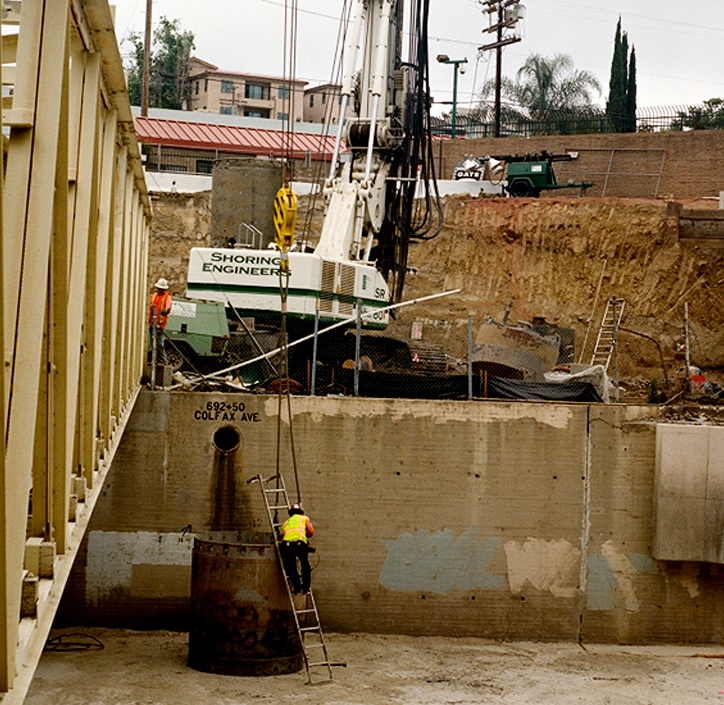
The 10-mile long, $1 billion dollar widening of the San Diego Freeway is a monumental feat of engineering: demolition and reconstruction of bridges and roads, 27 on/off ramps, 13 underpasses and 18 miles of retaining and sound walls.

When the rebuilding stops, new car pool lanes will open.

Before that time, we, who travel or live in the Sepulveda Pass, go amidst temporary art installations. The partially built is perhaps more compelling than the finished product.

1
6a
1a

These functional components of road building are ingenious engineering and unaware artistry; choreographed, measured and precisely drawn elements of structure alive in rhythm, movement and shape.

2

Along the west side of Sepulveda at Wilshire (above and below), skeletal underpinnings, in wood and steel, for future on/off ramps, evoking the lean, linear infancy of modernism, form following function.

High pillars of steel hold up horizontal spans along Sepulveda, near the Veterans Cemetery and the Federal Building. Perhaps unintentional, the in-progress road suggests that this flat open expanse requires something triumphant and civic to pass through to salute government workers and honored soldiers.

3a

4

Wood slats nearby evoke the organic asymmetry of Japan, while frail wood railings conjure up jungle bridges.

5

Near Montana, a tall hillside is clamped into place by ten-story tall concrete ziggurat criss-crossed by steel bars and round bolts onto which plates of facing will hang.

Near Getty Looking N

Here are dancing and unfurling materials, performing in shadow and sun, ribbons of road next to green mountains, tall walls of tapered concrete holding back tons of earth.

61b near Getty

Serrated vertical lined concrete walls, go low and march along in rectangular pattern near the Getty. Parts of drain pipes sit alongside. A crane stands on the west side of the freeway near the Getty.

7

Near Mountaingate, the 405, seen from below along Sepulveda, sweeps up behind a tall wall, a freeway heard but not seen.

Valley

DSC_5766

At Mulholland, the pass opens up to the Valley.

The mountains seem higher, the vistas taller and wider.

New steel spans are stacked under the old road, ready to perform their next feat of support to carry up a new bridge.

It is a penultimate, high altitude moment of reconstruction: intelligent, courageous and invigorating.

Soaks

And up in Sherman Oaks, near Valley Vista, the sunny and self-satisfied homes of prosperity are caked in dust, caught in the bottom-end of the widening. The congestion is worse, the noise more constant, the torn-up streets taken over by bulldozers, trucks, fencing, excavation, speeding drivers, demolition and reconstruction.

DSC_5790

DSC_5794

DSC_5796

A heroic human endeavor whose energies are producing, in our backyard, a fast changing and fascinating spectacle of clashing forms, tactile tons of man-made materials, anonymous art along the 405, silently begging us, as Los Angeles often does, to open our eyes and drop our assumptions.

DSC_5723

DSC_5695

DSC_5781