On March 30, 2007 there was a fire burning in Griffith Park.
And I was walking in Studio City when a red-haired woman drove up and parked on Ventura Bl. in an odd little purple car, a Nash Rambler. Her license plate read “Kissmet.” I’m sure she is someone, or was someone, quite beloved, judging by her car and plate.
March 30, 2007
November 9, 2019
Yesterday, 13.7 years later, there was another fire burning above Warner Brothers Studio near Barham. And the same atomic plume of smoke went up in the sky and theatrically filled up the space between the rows of palm trees along Ventura Boulevard.
There was no Nash Rambler in yesterday’s photograph, and by comparison, in content and style, the new image is quite unexciting and unremarkable.
When fire threatens Los Angeles, the first thing we think of is our loved ones, and then our homes, and lastly our cars.
Members of Santa Monica College Women’s Row-A-Way Club, Santa Monica, 1935
House with tiled roof, garden, and gated wall, Palm Springs, [1930s or 1940s?]
California Bank, Brentwood office, Brentwood, [1957]
Prefabricated steel home, [1930s?]
UCLA’s Adelbert Bartlett Collection has superb, hi-resolution images from the work of a commercial photographer who lived from 1887-1966 and worked in Southern California in the 1920s through the 1960s.
It was a time when this state was considered the pinnacle of glory, a place where aviators, sportsmen, golfers, movie stars, and athletes played and worked in brilliant sunshine under smog-free skies; swimming, water skiing, boating and hiking through deserts, mountains and parks.
El Kantara, house with onion dome, horseshoe arches, and tiled roof, Palm Springs, [1930s or 1940s?]
Santa Monica shoreline, Santa Monica, 1934
Santa Monica College Women’s Row-A-Way Club, Santa Monica, 1935
Bungalow court, The Town House and Bungalows, Palm Springs, 1936
Coastal view from hill towards house under construction in the Rancho Malibu la Costa development, Malibu, circa 1927
El Kantara, house with onion dome, horseshoe arches, and tiled roof, Palm Springs, [1930s or 1940s?]
As we endure cataclysmic natural disasters and allow unnatural disasters, such as homelessness, to overtake our state, we have to look back to how the Golden State operated when economic conditions were truly bleak.
We have brought ourselves, by our own powers, to a time and place of our own creation, and our California is a product of our human strengths and weaknesses, a society which can go up or down, in a natural environment which is now turning deadly as it is heated up by carbon.
Way before people understood that our planet might perish by our own hand and not God’s, California took stock of its good fortune and erected a real place out of fantasy.
How did such phenomenal architecture, science, sports and innovation happen here in the early and mid 20th Century? What can we do to restore the optimism and leadership that once made California the envy of the entire world?
Can we bring back the pristine, polished, glimmering, spotless world that once existed?
Woman and girl on dirt road, Santa Monica, 1928
Spanish-style house, Santa Monica, 1928
Mullen Bluett building, Wilshire Boulevard and Ridgeley Drive, Los Angeles, 1949
Group on dock and on Sikorsky S38-A
Ann Pruden and Mary Conners in outdoor area with palm trees, Palm Springs, 1940
El Kantara, house with onion dome, horseshoe arches, and tiled roof, Palm Springs, [1930s or 1940s?]
They have almost completely cleared the 27, 762 SF lot that is 6505 Columbus.
The property once held a single family house, constructed in 1937.
One of the owners was a production manager and second unit director, Cliff Broughton, Sr.
On November 14, 1949, Mr. Broughton’s son, Cliff Jr. was piloting the 136- foot-long schooner Enchantress, along with 14 passengers, from Newport Beach, CA to Panama, and later Tahiti, when it ran aground in a sandbar off the coast of Baja California. The boat was eventually freed and everyone survived.
The senior Mr. Broughton put 6505 Columbus up for sale in 1950. Perhaps the yacht drama had distressed him.
In an LA Times classified ad from January 15, 1950, 6505 Columbus was called “Rancho Perfecto.” The one acre estate with 6 rooms, included a guest house, rumpus room, laundry house, tool house, double garage with storage closets, patio, and a lighted badminton court. There were also “plenty of shade and fruit trees.”
They were asking $22,500.
For many years 6505 was part of six other large, underdeveloped and underprivileged properties on the west side of Columbus from Hamlin to Kittridge. In a previous post this area was described accurately as I saw it.
Now they are almost done clearing the house and flattening the land where some four homes will sit between two roads, Hamlin and a TBD.
A large apartment building will be the backdrop for the next 100 years of drama at 6505 Columbus.
On the west side of Columbus Avenue, between Hamlin and Kittridge, are some six contiguous properties that were subdivided in the 1930s and, until this year, remained largely undeveloped beyond their original single-family homes.
Their combined total square land footage is 156,035 SF with the properties ranging in size from 19,931 SF to 27,783 SF.
The backs of all these properties face the rapidly redeveloping Sepulveda Boulevard corridor with its new white apartment towers looming overhead into the old ranches.
THE 1994 FENCE OWNED BY BILLIONAIRE ANGELA CHEN SABELLA OF KAR FUNG CO.
In all the years I’ve lived here (since 2000) Columbus Avenue was a blight, a ragged and torn sleeve on the arm of neatly pressed neighborhood. No sewers, no sidewalks, and helicopters that flew overhead weekly.
There was the drug house, the abandoned house, the house that stored 100 inoperable vehicles in back. There was the foreclosed house, and the house that put up a paved parking lot in its backyard.
There was the vagrant who moved into an empty house and put a moat of 50 trash filled shopping baskets around the property to keep out intruders. There was a completely empty property whose owner was happy to hang on because his taxes were $400 a year and his house with broken windows was worth $500,000+.
There was another property with a mad dog that sometimes went out and menaced other dogs and people and was kept by undocumented immigrants who ran a nursery and installed artificial grass . That is still going on.
All of these semi-criminal and wholly-criminal activities were reported to law enforcement, and eventually some of them found their way into the court system, but correction, penalty and punishment are often wrist slaps or take many years to enforce.
It’s 2019 and even Van Nuys deserves to have what Studio City got in 2013, and West Hollywood in 2009.
Mr. Boaz Miodovsky of Ketter Construction is putting up four modern garages with attached houses along 6537. They will have their own private road, Solomon Lane.
And Mr. Nick Shoshan of Innovation Design and Construction bought 6505 and is demolishing the single-family home there, dating to 1936, and erecting four houses. They once kept horses here, another neighbor grew walnuts, there were backyard pools, lemon, orange and lime trees. Now this parcel will have four houses and two streets and look west into the back of a seven-story apartment building.
6505 is next to the dead-end street where Hamlin once cut through to Sepulveda before it was walled off, in 1994, and the public way sold to the Kar Fung Company which owns the 99 Ranch Market “Signature Plaza” shopping mall.
Hamlin St. Beyond the Fence. Owned by Kar Fung Co. Ltd.
Preposterously, 6505 will have to build its own private street because Hamlin Street is no longer available as a public way. It is owned and supposedly maintained by Kar Fung, though they have allowed it to denigrate into a tagged, trashed and overgrown weed lot out of utter neglect and indifference.
The new houses at 6505 will be bookended by two streets, one in their front yards, and one in the backyards. The owner, Kar Fung Company, for reasons only known to God herself, has never wanted to sell their section of Hamlin Street to anyone.
Incidentally, Kar Fung Company is run by Angela Chen Sabella, who is the daughter of “Chen Din-hwa (simplified Chinese: 陈廷骅; traditional Chinese: 陳廷驊; pinyin: Chén Tínghuá; 1923 – 17 June 2012). He was a Hong Kong industrial tycoon, billionaire and philanthropist. He was known as the “King of Cotton Yarn” in Hong Kong.[2]”. When he died he had a fortune of over $2.6 billion dollars. Which may explain why money to paint the shopping center or repair the 1994 cyclone fence on Columbus is quite impossible to come by.
In Van Nuys, the vast majority lives close to ruination, but absentee slumlords who live in Bel Air, Beverly Hills and Hong Kong squeeze out money from a community starving for investment and civic decency. What could $50 million from Kar Fung could do to alleviate the homeless blight in Van Nuys?
To imagine what could be done with proper architectural designs over the totality of Columbus Avenue with its 156,035 SF is to entertain dreams of parks, of gardens, of towering oak trees, fountains and benches surrounded by nice homes. The way they might have built in South Pasadena in 1910.
But instead, it will go the low-brow, ugly way, the only path that ever gets paved in Van Nuys, with cheapish houses along asphalt driveways, stuck along Columbus Avenue like a pocket comb. These boxes will be so compressed, and so tightly sited, that there will be no room for shade trees. And overlooking every private property will be hundreds of prying eyes from new apartment dwellers.
Parking for cars will be provided in the two car garages in each home, but if you have lived in Los Angeles long enough you know that 90% of all cars are never parked in garages. On my street, me and my partner are the only residents who use their garage for auto storage. It will transpire that each new home will have four drivers, and a garage full of belongings, and guess where the vehicles will sleep every night?
If this were a well-run city of neatness, law, order, and regulations (which it is not) then new housing would be a great blessing. But as it drops around here I know the future.
The new residents will probably include renters, perhaps four or five unrelated adults sharing a home, paying $1500 each so that the owner can pay off their $5,000 a month mortgage on their $900,000 house. And these private lanes will have gated entrances, understandably, because it takes two hours for LAPD to respond to anything other than murder.
I don’t have all the answers, I’m merely describing reality as I see it in front of me.
We desperately need new housing in Los Angeles, but does it all have to come forth like this? Aesthetically dismal, organizationally atrocious, environmentally destructive.
A friend of mine who lives in Lincoln Heights is, was, and will always be a progressive minded guy who grew up in Santa Monica, the son of a Muslim from India and an Irish-American mom.
He used to be the proprietor of a bike shop, and he also ran for public office until he was hounded out by the mobs on Twitter for a ten-year-old remark found on a virtual message board. He is married with a young daughter and supports himself in construction. His hobbies are his passions: the environment, biking, clean air, living healthy and simply by thinking of ways to get around this city by non-car means.
These days he is as appalled at Los Angeles, as I am .
He sent me this photo of a “solar powered” trash can which is emblazoned with the name of its donor, a politician. Apparently the receptacle is wifi connected and cost (my friend claims) $30,000.
He wrote that it is maintained via one-time special funds and some money from a Lincoln Heights Business Improvement District district maintenance money. The BID is a special property tax authority that extracts money from property owners for security, sanitation, district marketing, events, etc.
The can cannot be dumped by the arm of a trash truck. It requires a special technician to come out and empty it because it is really an electronic device. It is so special that the top of it is covered in solar panels which some thoughtful dumpers covered with their own discarded electric waste products.
And yesterday, speaking of waste, my friend saw a man urinate all over the can in broad daylight.
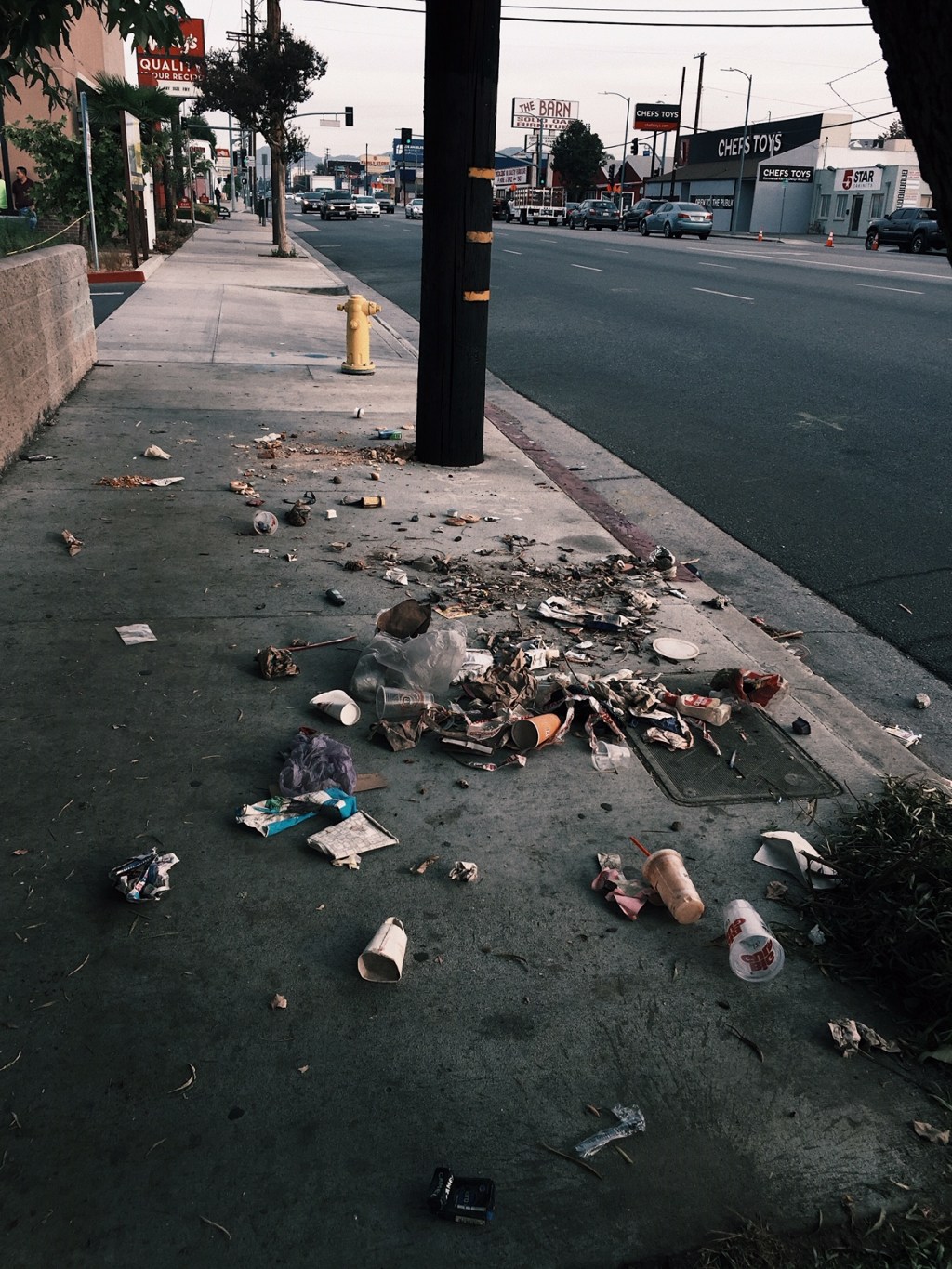
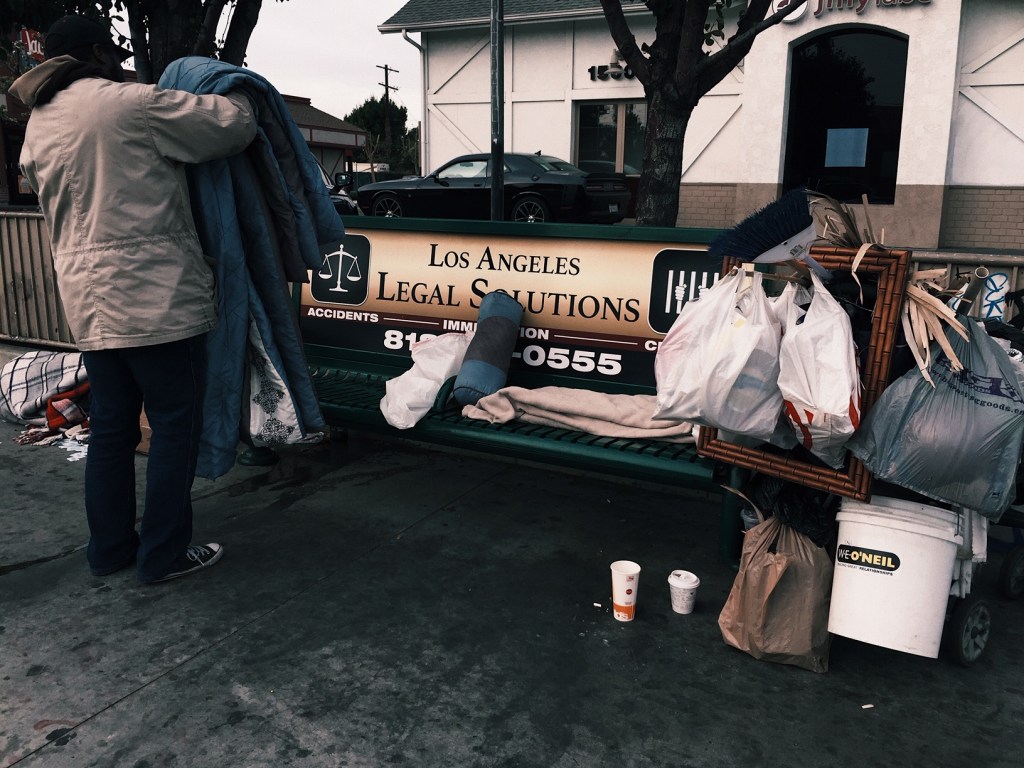
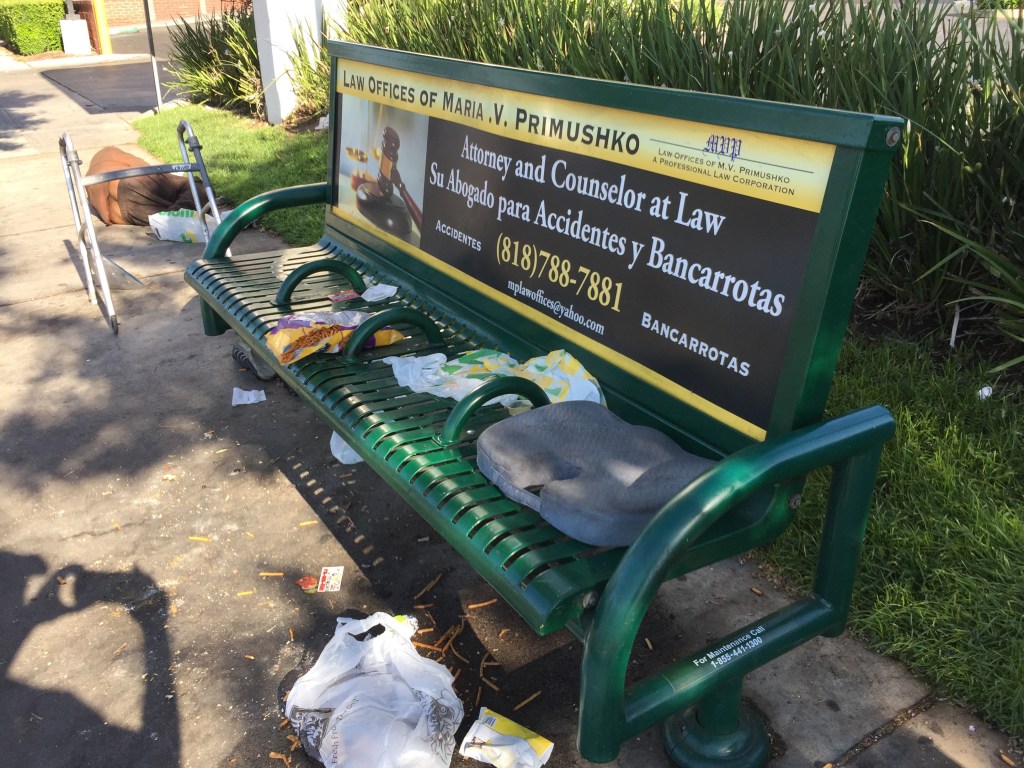
There was a time, long ago, when Los Angeles fined property owners who didn’t sweep their curbs or sidewalks. They did not allow trash camping on the street, or every bus bench to become a halfway house. They enforced the law, not by chip and app, but by a cop on the beat. It seemed to have worked, because you cannot see anything but clean Angeleno streets on any old episode of Dragnet or Mannix.
But we live in advanced times, so advanced that people live in garbage on the sidewalk, but we have a robotic trash can emitting signals when it overflows.
Yesterday, late afternoon, there were clouds in the sky and the temperature was notably cooler.
On Calvert Street, outside MacLeod Ale, I was waiting outside for a friend when it began to rain. A few drops fell and then it moved on.
My friend arrived and parked in one of the few spots reserved in front of the brewery.
We had a few beers, including Cut and Dry, an Irish stout; Deal with the Devil, my favorite IPA; and The King’s Taxes, a mild warmish ale from the first days of MacLeod.
We ordered a mushroom and sage pizza.
There were people sitting next to us with two dogs, one sitting on a lap, the other, a Rottweiler, lying on the floor.
Then we paid for our food and drink and walked down Calvert Street, east, to shoot some photos.
In what some might consider the better parts of Van Nuys the people walk or jog past you and don’t say a word. They walk their dogs past my house, they pull a wagon with triplets, they push a stroller, and nobody even looks at you or smiles.
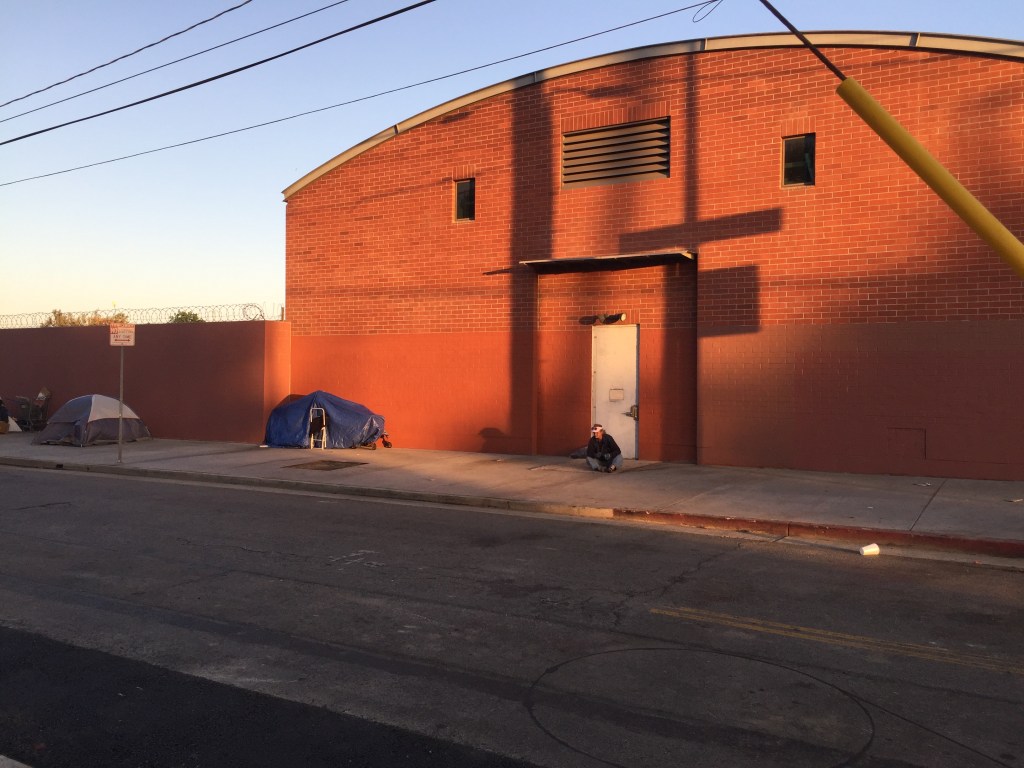
But on this part of Calvert Street, a poor place, just steps from a large homeless encampment, the working people were outside sitting, talking, laughing, skateboarding, coming home from work and selling food from the back of a truck.
You must be logged in to post a comment.