Greedy Developers: Los Angeles in the 1920s.


dw-1926-611-19-5819-x2
Completely out-of-scale building towers over one story house next door.
dw-1926-611-19-5809-x2
In a neighborhood of single family homes, a greedy developer built this apartment populated by people who selfishly can afford to live here.
dw-1930-03-17-14510-x2
A true monstrosity, more appropriate for Manhattan than Los Angeles.
dw-1926-611-19-5808-x2
A towering colossus of land exploitation without any surface parking lots.
dw-1926-611-19-5806-xl
Disguising something as European does not hide that this enormous building is completely out of scale with the little houses only a block away.
dw-1926-611-19-5804-xl
Neighborhood Council should sue to take down this enormous theater whose builder put it right on the street without any parking lot. Sign is too bright and too big and disturbing to spotted frogs who live in the park across the street.

All photos from the Whittington Gallery at USC Digital Archives.

Letter from an Old, Practicing Architect in Los Angeles


12602 Moorpark St. Studio City, CA. 91604

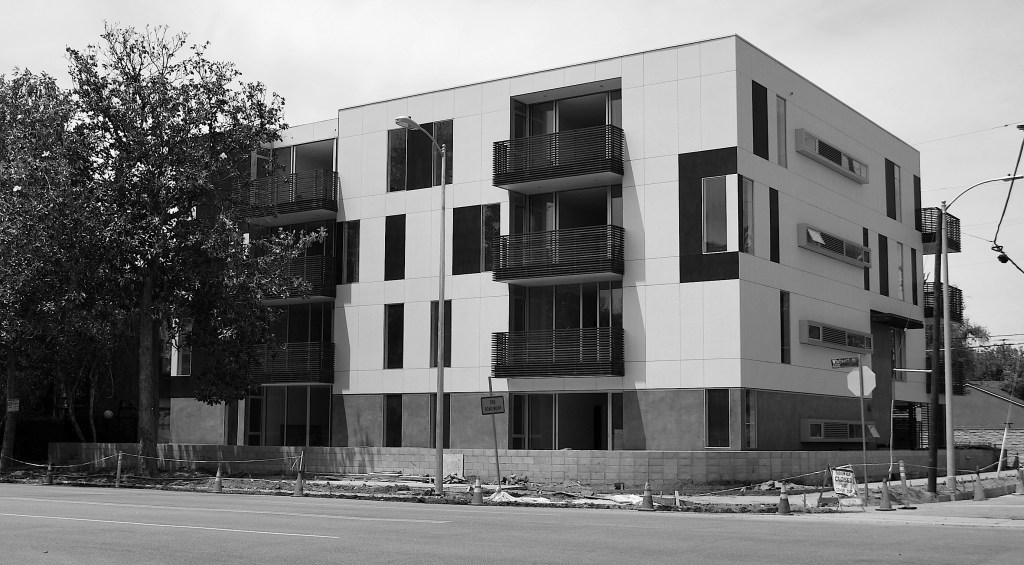
Driving down Moorpark St. in Studio City last week, I passed a notably austere and well-designed apartment under construction. I stopped and walked around and shot some photos of the building which had precise lines, solid forms and possessed an architectural sensibility of the 1930s.

I later looked up the architect online and wrote him an email. To my surprise, he responded in detail. Even more surprisingly, he is a man who has been practicing architecture for over 50 years.

Here is what he had to say about the state of planning and architecture in Los Angeles, especially as it relates to the San Fernando Valley.

I have not disclosed his name to protect his privacy.


Dear Andrew:

Thank you for the complimentary words regarding my apartment project. They are truly appreciated. I looked at your excellent blog.

Your involvement in trying to better the quality of life in Los Angeles is noble. I suspect, however that you are constantly faced with the frustration and anger of dealing with a Los Angeles bureaucracy that has become stifling and counterproductive.

The planning department has been a dismal failure as long as I can remember and has continually failed to address the real and important problems that have faced our city.

Old Montgomery Ward. Panorama City, CA.

I am sure you know the recent history of the Valley better than I do. I came to Los Angeles as a child in 1948, just after WW2 ended and lived in West LA.

A trip to the Valley was a bit of an adventure. Mostly open space. And it was hard to find a restaurant or much of anything. I did not realize then what we were soon going to lose. Tough-minded, enthusiastic, returning soldiers were coming to LA during this period wanting only to work and raise families in peace.

I was fortunate to have a few of these men as instructors at the U.S.C. School of Architecture. The Valley provided an abundance of cheap land on which to develop housing. And with the coming of these returning soldiers, a major Valley building boom began. Housing tracts and apartments were built as quickly and cheaply as possible. It was an exciting event to see a searchlight in the sky and drive towards it to find what new business opening it heralded.

Macy's, North Hollywood, CA.
Macy’s, North Hollywood, CA.

All of this was happening with virtually no master planning. One bland community rolled into another. As I drive the Valley today, I find it kind of fun to try to identify the architectural styles, if you can call them that, of each of the building booms in the 60 plus years since the end of the War. Thank God for the mature landscaping that is making the Valley environment somewhat more pleasant. I find myself, grudgingly, seeing a kind of quirky nostalgic beauty in whole thing. But enough rambling. No easy answers.

15300 Valerio St. Van Nuys, CA 91405

The specific problem you face in trying to elevate the quality of Architecture in LA is a tough one. It entails getting greedy bottom line developers to take an interest in the environments that they are building. They only ‘design’ that these developers relate to is that which they feel is necessary to rent or sale their product. This design is too often provided by their spouses or a friend with “good taste.”

A developer buddy of mine once exclaimed with the excitement of discovery that he had figured out how to build a modern building. It is simple he said – no details, white paint and a flat roof. He unfortunately built a number of large apartments in the Valley with his newly discovered understanding of modern architecture.

The developers must be taught that they have a moral responsibility to the community to provide good environment. Good luck on this one. Developers must also be taught that over time a well-designed building will make them more money.

Archwood St. near Van Nuys Blvd. Van Nuys, CA 91405

The bureaucracy must be scaled down and restricted on the number of code provisions and roles that they can enact without public input and approval.

I have acted as an Architect, owner builder, and small time residential developer in LA for over a half a century. In the early 1960s, both the California State Board of Architectural Examiners and the A.I.A. for being an “Architect-Developer” chastised me.

There was a conflict of interest they said, not understanding the value of having the Architect as the developer as to opposed to a bottom line businessman. I chuckled when some years latter I ran across an ad for a course called the ‘Architect as a Developer’ sponsored by the A.I.A.

Studio City, CA.
Studio City, CA.

Yours is not an easy road to travel, but please keep it up.

If things are ever going to get better, and I am a pessimistic about this happening, it will take a rising up of the community, under leadership like yourself, to demand the changes you that you are seeking. Thank you for your efforts and good luck.

Van Nuys Bl. 2016
Van Nuys Bl. 2016

Crest Apartments


DSCF0752DSCF0753DSCF0754

One of the best buildings in Los Angeles has opened in one of the least likely locations.

Crest Apartments, 13604 Sherman Way, is a $20 million dollar, 45,000 s.f.,  64-unit apartment for the Skid Row Housing Trust. It is east of Woodman Av.

It provides special needs support for the chronically homeless as well as veterans. Social services and a federally supported health clinic are part of the complex.

Architect Michal Maltzan designed a five story tall, tautly elegant building. Rising subtly from its garish surroundings of motels, billboards, discarded furniture, speeding cars and urban decay, Crest Apartments is a crisp, all-white façade with no signage and no ornamentation.

DSCF0757

Mr. Malzan has experience designing many lauded buildings, including another homeless project near downtown, New Carver Apartments, which has received many awards.

There is irony in the fact that an exquisite, understated and artful building will now house a marginalized group of people.

The Crest Project is but a drop in the bucket of solutions to the appalling and obscene homelessness afflicting our city.

In a better nation, morality, money, architecture and the public good would join hands to build a more humane and aesthetic city. But reality favors bluster, bravado and bragging.

Some of the ugliest housing in Van Nuys and greater Los Angeles is still going up for those who feign affluence and success.

DSCF0738

The Last Days of The Ridge Motel.


DSCF2375

The Ridge Motel, at 6719 Sepulveda Blvd in Van Nuys, between Archwood and Lemay, recently closed down. Like the nearby Voyager (now demolished) it also enjoyed a debauched and degraded reputation of drugs and prostitution and illegal activities of every sort.

A long list of violations compiled by LA City inspectors is available online.

Just for nostalgia sake, I went past The Ridge one recent early evening and photographed the exterior of the abandoned building.

The style of the building, built in 1963, is somewhere between mid-century modern and Swiss Chalet in an open California courtyard. At its prime, the affordably priced motel was ideal for families. While kids swam in the pool, Dad could walk next door and buy a bottle of Scotch and a pack of cigarettes at Red Valentine’s Liquor Store where Boost Mobile is today.

Dinner at Hody’s at Victory and Sepulveda might cap off the day of excitement.

Courtesy: The Museum of the San Fernando Valley.

Here are the last days of The Ridge:

DSCF2378 DSCF2381 DSCF2383 DSCF2385 Lodge Motel

A new owner plans to erect a 3-4 story tall rental apartment complex in the modern style. There will be some affordable units but 85% will be market rate. GA Engineering obtained permission from the boss and sent me renderings of the new project that will replace the repellent Ridge.

Sepulveda Plan and Elevations-01 Sepulveda Plan and Elevations-02


Dreaming of Exile


DSCF2360Even if you have given up on LA, cursed its tackiness, screamed at its traffic, revolted from its inanities, choked on its air and dreamed of exile from its toxicities, you might be seduced on Sunday afternoon, as I was yesterday, by a place hidden away that seems like a small town in the Poconos.

I accompanied a friend on an errand. She manages properties, and was cleaning up after renters at a small house on a street called Lake Shore Avenue.

East of Glendale Blvd, south of the 2, west of Elysian Park, it sits snuggly into a hill that blocks the setting sun. Shady, built with little bungalows, it bisects, at Effie, an institution: Gateways Hospital and Community Mental Health Center.

A mid-century sign sits at the entrance to the facility.

Egregious, garishly lettered in big vertical typeface, it announces, creepily, its authoritative medicinal mission (rehabilitation, research, hospital) as if they were triple feature films from the 50s like “I Want to Live”, “The Creature from the Black Lagoon” and “The Blob.”


DSCF2348

DSCF2354

DSCF2351

We parked on Effie and looked ahead at a wide dirt path climbing up a steep hill where nets were laid down to trap water and debris that may pour down here fiercely.

My friend went to work on her property, and I climbed up the trail.

Around me were dried, parched grasses, the remnants of homeless blankets and bags of clothes, and, at the top of the hill, a stucco shack of a house, with a pitted asphalt driveway, and a wooden deck. It was guarded by ziggurat cinder block walls and reinforced steel window bars.

The dilapidated home was a find, unusual in its state of disrepair. For we live in a city of brutally competitive property investment, where every top elevation has been captured by someone richer. This mountain hideaway lacked the hidden cameras, the expensive cars, the pool, and the pretense to architecture. An eccentric hermit might inhabit it.

Moby if he had no money might live here.

Its views stretched out to Silverlake, downtown, and tall radio towers across the way. Yet it was an uneasy isolation. It felt dangerous, not reassuring.

Bucolic and rustic in Los Angeles never exists in purity.

Helicopters and sirens in the distance, the threat of fire, the presence of people without homes, the surprise of events that might end our life erupting from the deepest earth, or from a violent intrusion through an open window. These are the sights, sounds and conjurations of the imagination haunting happy moments.

That is how that house and hill felt.


DSCF2361

Back down on Lake Shore Avenue I walked past institutional houses, illuminated by industrial floodlights, set along the street, behind gates. Two older men were on the stoop of one place, smoking. They nodded to me and I waved back.

Outside the property of Gateways, dominating the bright part of the hill on Lake Shore Avenue, was a tall, two-toned, red and white brick house looming over a row of old garages. Homely, graceless, squinting in the sun, it refuted the lovely myth that everything historic is charming. The white “sanitary” bricks, glossy and washable, were often used in the 1920s on building facades for bakeries and cleaners.

A small signifier of community well-being, a landscaped traffic circle, ended my walk up Lake Shore.

That idea that a street could come together in a circle, unified by architecture, common purpose, cafes and conversation, there was something of that here, but I saw no other pedestrians. The only movement was daylight in retreat, shadows moving over the street.

After walking around, I came back to my friend’s property and went inside. We stacked dishes in the dishwasher, carried out bags of food from the refrigerator, and a basket of dirty towels. She turned on the alarm and locked the door. We got in the car and left to return to the real city beyond.


Van Nuys Savings and Loan.


1 3 54b.jpg
LA Times 1 3 54
1 3 55.jpg
LA Times 1 3 55

In 1954, architect Culver Heaton’s design for the Van Nuys Savings and Loan, with interior murals by artist Millard Sheets, rose at 6569 N. Van Nuys Bl.

Along with other financial institutions such as Jefferson Savings, Lincoln Savings, Great Western Bank and Bank of America, they served the local community of hard-working people who opened accounts that paid 3% or 4 1/2% interest and where polite tellers, dressed in pearls and high heels, addressed customers by their last (never their first) name.

photCL_MLP_0551_003

photCL_MLP_0551_008 photCL_MLP_0551_007 photCL_MLP_0551_006

Photographer Maynard Parker shot these images of the bank exterior and interiors. They bespeak a dignified and progressive institution whose architecture was as up-to-date as its vision of a prosperous, safe Van Nuys. A sign on the outside of the building reads “The Home of Security” leaving no doubt to depositors about the solidity of the S&L.

photCL_MLP_0551_005 photCL_MLP_0551_004

Mr. Sheets was a prodigious artist whose work can be seen all over Southern California, most notably on the exteriors of many of those white, marble clad, Home Savings of America buildings that resemble mausoleums.

Architect Culver Heaton designed many Mid 20th Century churches in Southern California in a style of expressionistic eccentricity long departed from our stripped-down imagination. His Chapel of the Jesus Ethic in Glendale (1965) is almost campy in form with its prayerful red roof, rising like hands, above a turquoise reflecting pool and a statue of Jesus on water fashioned by Herb Goldman.

Photo by Michael Locke

In the 1980s, there was a national scandal and shakeout in the savings and loan industry and many closed down. The de-industrialization of Van Nuys, and its decline as a manufacturing and commercial center, coincided with a tremendous increase in immigration from Central America.

Today, a Guatemalan market, La Tapachulteca, occupies the old bank property.

2014/ Image by Andy Hurvitz

But last year, in a hopeful sign of better times, Boaz Miodovsky of Ketter Construction, who is the new owner, plans on demolishing the old bank which has now been degraded from its original condition. His company will design and erect a multi-story apartment house with ground floor retail. The front, on VNB, will be five stories tall and taper down to three stories in back.These illustrations, which he sent to me, are preliminary and will be further refined to include landscaping and additional detail.

View 0 View 0_3

Nostalgist and Van Nuys Neighborhood Council member John Hendry, who grew up and still lives in Van Nuys, alerted me to the impending demolition and asked me to research the origins of the historic structure. Quirino De La Cuesta, another VNNC member, stepped in and purchased these images from the Huntington Library.

And Mr. Miodovsky, in a nod to the old murals, will have new artwork painted within the new structure. It will be created by local artists and reflect the continuing development of Van Nuys which hit its bottom and is now climbing out parcel by parcel.