Populating Van Nuys with Fine Architecture


VNB: 1952, photo by Alan Weeks.
DWP Collection

Van Nuys (b. 1911) began as a town, centered around a main street, connected to Los Angeles by streetcar and rail.

It built its fire station, library, city hall,  police station, and its churches, schools, shops and post office steps apart. On foot, a person could buy a suit, take out a library book, mail a letter, and walk to school.

Come to think of it they still can. But it was all there in downtown Van Nuys.

Today you might stand outside the LAPD Van Nuys Station and smoke a joint, drink a can of beer,  pee against a wall and nobody would raise an eyebrow.

The librarian, the cop, the priest, the attorney, they would walk past you and shrug their shoulders and mutter, “What can I do?”

We are so tolerant these days. Everything degrading is welcomed, while everything worthwhile is rare, expensive  or extinct.

Posture Contest, Van Nuys, 1958. Impossible to imagine these days with all the cell phone spines.

Surrounded by orange and walnut groves, the growing town nonetheless managed to provide safe, civilized and opportune situations for its newly arrived residents with affordable housing, subsidized by low interest government backed loans after WWII.

And plentiful, well-paying jobs. Imagine that!

Van Nuys, circa 1938.

Widening of Victory Boulevard: 1954.
Van Nuys Blvd. at Friar (circa 1950). Notice diagonal parking and streetcar wiring.
Van Nuys Bl. 2013

Somehow it was lost after 1945. The enormous shopping centers robbed Van Nuys of its clientele. The street widenings turned boulevards into raceways and the village feel was destroyed. Factories closed, banks shrunk, stores fled, and crime settled here to afflict, rob, disable and kill.

Why does Van Nuys flounder, while all around it other cities like Burbank, Glendale, Pasadena, and sections of Los Angeles, like North Hollywood, Studio City, Mid-City and Highland Park flourish?

Delano St. July 2017


Raymer St. March 2017

A journalist from Curbed LA called me yesterday. He is writing an article about Van Nuys and wanted to talk.

I mentioned many things that I wish were changed here, from road diets to better housing, from cleaner streets to more law enforcement for illegal dumping.

But I also told him that so much of our political leadership is devoted to working on problems like prostitution, rather than building a coalition of architects, designers, investors, and planners who could build up Van Nuys and make it, once again, a coherent, safe, stimulating, and pleasant place to live and work.

I know what’s bad here. But what about making it good? Where are our dreams? Why can’t we be as artistic as our studios, as wild in our imaginations as our writers, directors, cinematographers, animators, and designers?

Why isn’t the whole energy of creative Los Angeles devoted to overcoming our civic afflictions?


Near Cedros and Delano.

Van Nuys Bl. Nov. 2016


The deadest and more depressing areas of Van Nuys are closest to the Orange Line, which is also a good thing. Because this is where Van Nuys should work to build new, experimental, and innovative housing and commercial buildings.

Van Nuys Bl. Oct 2016 A dead place for street life.
The Empty Post Office/ Van Nuys Bl. Oct. 2016
Dystopian Van Nuys Oct. 2016. No people, no chairs, no trees. Just concrete.
Homeless on Aetna St. Feb. 2016


From Kester to Hazeltine, north of Oxnard, the “Civic Center” district contains an empty post office, vacated stores, underutilized buildings, and dystopian spaces of concrete, homelessness, garbage, and withering neglect.

The pedestrian mall on Erwin, south of the Valley Municipal Building and surrounded by the Superior Court, the library and police station, is a civic disgrace.

Ironically, all the law enforcement, all the government agencies, all the power that resides in Van Nuys….. presides over the ruins of it.


Meanwhile up in Portland, OR.

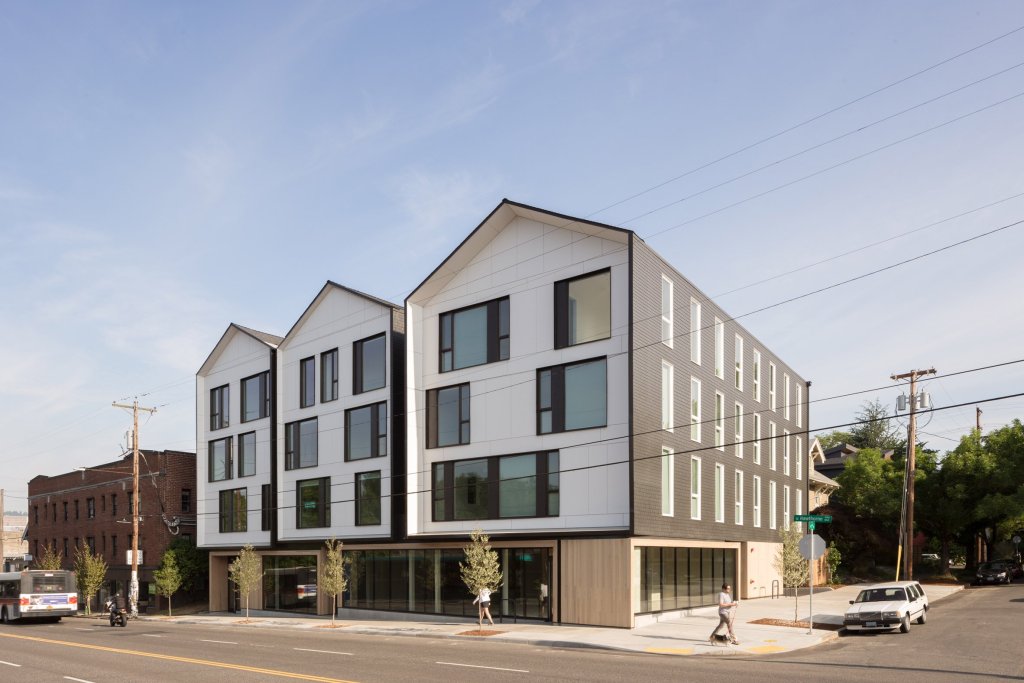
Holst Architecture, Portland, OR (Dezeen)
Works Progress Architecture, Portland, OR (Dezeen)
Works Architecture, Portland, OR (Dezeen)
Fujiwaramuro Architects, Kobe, Japan (Dezeen)
Van Nuys Alley near Delano and VNB

On Dezeen, there are posts about new, infill buildings in Portland, OR and Japan where the general level of architecture and design far outpaces Van Nuys. These are sophisticated, modern, but humble structures with ideas for living.

Look at these and imagine how, perhaps 25 new ones, could transform Van Nuys.

In the midst of our wasteland, we need to go back to working to demanding the best for Van Nuys, rather than accepting squalor and mediocrity.


Before it Changes…….


Curbed LA recently published a photo essay by Kwasi Boyd-Bouldin, “An Ode to the Valley Before it Changes” featuring images of grass growing through concrete and defunct gas stations in parts of the San Fernando Valley. It’s a type of setting I have long adored and sought out.

Photo by Kwasi Boyd-Bouldin.

Mr. Boyd-Bouldin writes, “The Valley neighborhoods I encounter still vibrate with an authenticity that I took for granted in the past and that have all but disappeared from the rest of the city I love. I am doubtful the Valley will always look this way as the pace of redevelopment picks up around it.”


Here are some my photographs of Van Nuys, taken with a different eye and intent.

14640-victory
14640 Victory Bl.

Should one yearn for authenticity and places that have not changed or improved in 50 years, a person might travel down Victory Boulevard between Kester and Hazeltine, where the buildings are 1950s shops and 1960s office buildings converted to vacancy, pot shop, and bail bonds. The Coalition to Preserve LA would no doubt approve of the frozen in 1966 retardation of Van Nuys where “greedy developers” have not come in and built anything on the scale of The Grove. Here preservation, in the form of economic impoverishment has worked wonders.

van-nuys-branch-library

Should one desire a great example of failed urban planning from the 1960s, one might walk amongst the sleeping homeless gathered in front of the police station, next to the library, behind the Valley Municipal Building, on that mall of nothingness surrounded by the Superior Court and the small statues sitting in pools of pee.

Van Nuys is full of the real, the urban, the forgotten, the abandoned, the neglected and the ugly. We have blocks and blocks of empty buildings, empty parking lots, and shuttered retail stores awaiting tenants, investment, customers, renters and buyers.

14547 Gilmore
14547 Gilmore-why not a beer garden or a garden?

There are no parking problems along Van Nuys Boulevard because nobody shops here. There are plenty of parking spaces in big asphalt spaces on Gilmore west of the “downtown” where Matthews Shoe Repair shut down, and other buildings, with tens of thousands of square feet of space, awaiting the next boom.

Matthews Shoe Repair-CLOSED

This is Van Nuys. I’ve been writing and photographing it for over ten years. I show it as it is. Or I try to.

Van Nuys, CA 90401 Built: 1929 Owners: Shraga Agam, Shulamit Agam
Van Nuys, CA 90401-a slum property owned by a wealthy Encino businessman.
Built: 1929
Owners: Shraga Agam, Shulamit Agam
Van Nuys, CA
Van Nuys, CA-why not a cool burger spot? Why not?

And I welcome change, provided it’s done with some architectural integrity and it’s not just the result of shlock hucksters and con-men throwing up the next slum.

But I would live with change, I’d welcome it, if it made my neighborhood safer, more prosperous and livelier.


Van Nuys Savings and Loan.


1 3 54b.jpg
LA Times 1 3 54
1 3 55.jpg
LA Times 1 3 55

In 1954, architect Culver Heaton’s design for the Van Nuys Savings and Loan, with interior murals by artist Millard Sheets, rose at 6569 N. Van Nuys Bl.

Along with other financial institutions such as Jefferson Savings, Lincoln Savings, Great Western Bank and Bank of America, they served the local community of hard-working people who opened accounts that paid 3% or 4 1/2% interest and where polite tellers, dressed in pearls and high heels, addressed customers by their last (never their first) name.

photCL_MLP_0551_003

photCL_MLP_0551_008 photCL_MLP_0551_007 photCL_MLP_0551_006

Photographer Maynard Parker shot these images of the bank exterior and interiors. They bespeak a dignified and progressive institution whose architecture was as up-to-date as its vision of a prosperous, safe Van Nuys. A sign on the outside of the building reads “The Home of Security” leaving no doubt to depositors about the solidity of the S&L.

photCL_MLP_0551_005 photCL_MLP_0551_004

Mr. Sheets was a prodigious artist whose work can be seen all over Southern California, most notably on the exteriors of many of those white, marble clad, Home Savings of America buildings that resemble mausoleums.

Architect Culver Heaton designed many Mid 20th Century churches in Southern California in a style of expressionistic eccentricity long departed from our stripped-down imagination. His Chapel of the Jesus Ethic in Glendale (1965) is almost campy in form with its prayerful red roof, rising like hands, above a turquoise reflecting pool and a statue of Jesus on water fashioned by Herb Goldman.

Photo by Michael Locke

In the 1980s, there was a national scandal and shakeout in the savings and loan industry and many closed down. The de-industrialization of Van Nuys, and its decline as a manufacturing and commercial center, coincided with a tremendous increase in immigration from Central America.

Today, a Guatemalan market, La Tapachulteca, occupies the old bank property.

2014/ Image by Andy Hurvitz

But last year, in a hopeful sign of better times, Boaz Miodovsky of Ketter Construction, who is the new owner, plans on demolishing the old bank which has now been degraded from its original condition. His company will design and erect a multi-story apartment house with ground floor retail. The front, on VNB, will be five stories tall and taper down to three stories in back.These illustrations, which he sent to me, are preliminary and will be further refined to include landscaping and additional detail.

View 0 View 0_3

Nostalgist and Van Nuys Neighborhood Council member John Hendry, who grew up and still lives in Van Nuys, alerted me to the impending demolition and asked me to research the origins of the historic structure. Quirino De La Cuesta, another VNNC member, stepped in and purchased these images from the Huntington Library.

And Mr. Miodovsky, in a nod to the old murals, will have new artwork painted within the new structure. It will be created by local artists and reflect the continuing development of Van Nuys which hit its bottom and is now climbing out parcel by parcel.


Gilmore St. Between Kester and Tyrone


DSCF0021 DSCF0023 DSCF0030 DSCF0037 DSCF0040 DSCF0042

I walked along Gilmore this morning, a varied street one block north of Victory, and found old bungalows, church gardens, crappy apartments and neatly tended ones; along with a shoe repair shop, new Chinese food and a Mid-Century pharmacy.

Gilmore is an old street. A sidewalk was paved in 1929, but the road goes back further than that.

It was part of old Van Nuys, near town, school and church.

In the obliterating 1950s-70s, many old houses were torn down and replaced with rentable apartments, way before the revived fashion for “Mission.” If Gilmore had been preserved as only homes, it might look like today like a neighborhood of Pasadena.


DSCF0060 DSCF0064 DSCF0067 DSCF0074 DSCF0075

Guns, gangs, crime.

One might understand a small shopkeeper viewing the aforementioned with fear or suspicion.

A Photographer?

Yes it is the photographer, with a camera slung around his neck, who gets the nasty stares and the unwanted questions.

At the colorful Kovacs Pharmacy, a pharmacist came out, confronted me and wanted to know why I was shooting photos.

She asked for my card. I had none. I told her I was a photographer.

She went back inside.

Does one need to have an answer for taking a photo? Would you ever dream of walking up to a stranger- talking on the phone- and asking who they were calling? Would you walk up to a driver stopped at a light and ask, “Why are you driving?”


DSCF0077

DSCF0082 DSCF0084

At 14417, next door to Kovacs, time stands still as faded light illuminates a garage set way back in the yard, the kind of house and garden that once dotted this street.

At Sylmar Avenue, the Van Nuys Elementary School is still handsome and historic, roofed in red tiles and painted in warm tan.

The infamous spray marker of the Barrio Van Nuys (BVN) marks a fence outside of a bungalow court across from the school.

DSCF0093 DSCF0095 DSCF0098 DSCF0099 DSCF0101

The Central Lutheran Church, whose white and red brick façade on Victory at Tyrone seems sad and neglected, has a surprisingly vigorous and lush group of edible gardens spreading over at least a half acre or more of land. Very well-tended and green, the vegetables and plants propagate magnificently in fertile soil alongside wooden stakes and raised beds. It looks like a future bumper crop. Its gentle greenery stands in stark contrast to next door car repair and vacant parking lots.

When people talk about the revival of Van Nuys, of making the community better, they might start by visiting a street like Gilmore. Narrow and walkable, tree-shaded and neighborly, it has a variety of both individuals and institutions who are already contributing positive change to this district. They are feeding the homeless, educating the children, planting organic gardens and making Van Nuys come to life in the most unexpected and surprising places.