SB 79 and Our Hood


SB 79 is a new law, authored by State Senator Scott Wiener, approved by the legislature, and recently signed by Governor Gavin Newsom, to allow the state to overrule local zoning laws and permit the construction of multi-family housing on lots which are zoned for single family housing when these properties are within a half or quarter mile of a bus or light rail stop.

In Los Angeles, the law will allow much denser and higher development along not only wide boulevards, but inside old, intact, single-family streets, “side streets” which never had apartments or multi-unit housing.


A guide to the law along with maps is here.

Tiered density: The allowable height and density for projects are determined by the quality of the transit stop and the project’s proximity to it.

Tier 1: Applies to projects near high-frequency commuter rail or heavy rail transit, like BART and LA Metro.

Tier 2: Applies to projects near light rail and bus rapid transit lines.

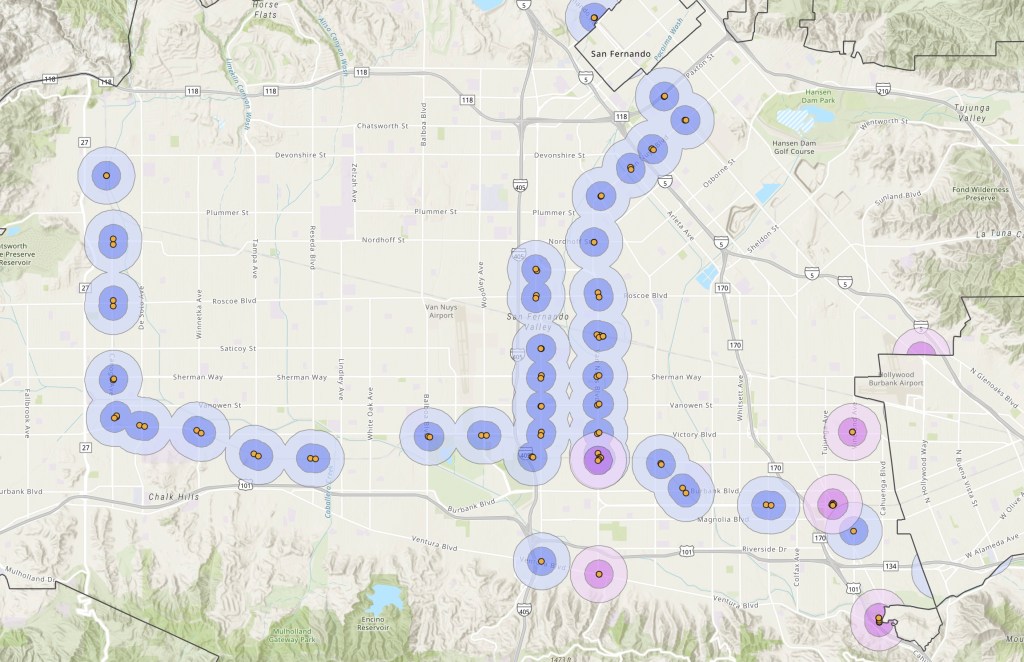
Along Sepulveda and Van Nuys Boulevard the proposed zoning map looks like purple bullet holes that radiate from transit stops. These circles are centered around the transportation stops and take no consideration into the historic or local character of any neighborhood. 

For example, I live on Hamlin Street which is a “Tier 2” zone because we are within a ¼ of Sepulveda Boulevard bus stop. My street, built on old walnut orchards, from 1936 onwards, is lined with palm trees, and then curves along with oak trees. The street has two-hour parking because of its proximity to Van Nuys High School.

If the law succeeds, my section of Hamlin Street would allow 65-foot-high buildings (six and half stories).

But the part of Hamlin Street a few hundred feet east from me would remain single family.

West of Sepulveda, south of Victory, is the beautiful and often filmed Orion Avenue with large colonial style houses planted with rose bushes and ranch fences, the location for many commercials seeking “a typical American street” that doesn’t exist anymore. With SB 79, the east side of the street could be obliterated with apartments that destroy the very beauty residents and film makers pay dearly for.


Yesterday, I had a real life encounter of what Hamlin St. and other locations nearby could become when I parked my car near 3052 West Boulevard in the Jefferson Park neighborhood of Los Angeles, east of Culver City. I was there to visit a new, multi restaurant creation, Maydan Market.

This area was given an economic boost by the Expo Line, a light rail system that connects downtown with Santa Monica. The good parts are investment, cleaner streets, the lowering of crime and the raising of the cultural and civic activities. 

The ugly parts are the disfiguring, ad hoc apartments that pop up on formerly coherent streets of 1920s bungalows. My eyes hurt looking at 3045 West Boulevard, a black and gray box suspended over a cinderblock faced garage, with a massive four story high open-air staircase on the side of the building. It looms like a monster over the street, with no respect or sensitivity to the vernacular that had existed here for 90 years.

Am I a hypocrite for decrying liberalized zoning that will change my backyard? Yes, I am. Sort of.

This blog has argued for years for the construction of new, multi-family buildings to replace unused parking lots behind abandoned shopping centers, or where there is a sea of asphalt like the Orange Line parking area along Sepulveda which was constructed for thousands of vehicles and is now empty.  I have fought for the idea of an architectural, coherent, community wide style that would incorporate history and embrace modernism but do it without destroying but enhancing the community of Van Nuys. 

And I’ve always cast a cold, unforgiving, forensic eye on the political neglect of Van Nuys by elected officials who seem to always be performing social media acts of kindness for oppressed groups while neglecting the needs of residents in this district. 

There are commercial zones galore that cry out for taller residential buildings along the wide boulevards of Van Nuys and greater Los Angeles. The one-story tall shops with parking lots in front are so defunct and useless that their very presence destroys civilized life and endangers the health of pedestrians. 

There are blighted buildings, such as this one at 7101 Sepulveda, that have been empty for years, packed with derelicts, unable to be demolished, yet crying out for replacement. As a bitter pill, the residents in the tree lined, charming, quiet streets behind must now expect multi-family housing to replace their 1940s ranchettes.

What do our elected leaders in Sacramento do with the quandary of building more housing? They embrace a fantasy of destroying single family homes and backyards. 

Will your neighbors and you, the elderly couple in the corner house, desire to ride buses (with homeless, drug addicts, crime?) and come home, late at night, from a bus stop on Sepulveda, and enter a new world of yet more cars, loud music, marijuana, dumped mattresses, and YouTube/TikTok/OnlyFans influencers smoking on the balcony next door? I doubt it.

Is that the paradise of tomorrow? Circles on a map, purple splotches of political malfeasance, indicating nothing but more mayhem, disorder and chaos.

I hope I’m long gone, either from life or Van Nuys, before this happens. 

All the Great Plans…


Yesterday afternoon, we were gathered at MacLeod Ale to celebrate Quirino’s birthday. We sat along a wooden table in the back, near the bags of hops. People were playing darts. The front door was closed, the air conditioning was on, we ate BBQ tri-tip beef (marinated in MacLeod). And we were discussing Van Nuys over warm and cold beer.

A young guy named Daniel sat across from me. He had worked under Former Councilman (Congressman!) Tony Cardenas and is now in the city planning department. Andreas asked him if he thought Van Nuys might be the new Highland Park.

“Not now, maybe not ever,” Daniel said.

15900528579_abeca9a14b_o
“Highland Park Market” Photo by Lance Leong / Flickr

Daniel was versed, in the somnambulistic and arcane zoning laws of Los Angeles, the kind that mandate how much parking is needed and what height a building can be, if additional units of housing can go up if some rents come down. And how many feet away from a school is permissible for a liquor store? And who can put up a 1200 sf granny flat in their backyard (the answer is you).

His generalized, and probably correct assertion is that Highland Park has an active and engaged group of residents and Van Nuys does not. The same is true of more affluent and contentious areas like Studio City or Woodland Hills. In those places, where planters and trees now line the boulevards, bike lanes are carved out, and revitalized shops, apartments, housing are going in. Much of the credit goes to the people who live there.

Van Nuys complains. But it never unites to fight for its betterment. Much easier to bicker on the Next Door app.

ucla_freeway_construction
Construction of the Santa Monica Freeway 1961. (USC)

Also at our table was white-haired, impassioned, articulate Howard who is on the VNNC. He is smart, accomplished, a lifelong resident of Los Angeles who grew up near Venice and Fairfax and watched the demolition of housing during the construction of the Santa Monica Freeway in the early 1960s. At that time, thousands of old houses, many architecturally notable, were bulldozed.

Howard recalled the dirt berm that extended for fifteen miles after the houses came down. “At night you could hear the rats, there were millions of them, and they ran and scurried and made noise.”

The Santa Monica Freeway was part of the big plan for Los Angeles. As was the Van Nuys Civic Center, Dodger Stadium, Bunker Hill, and the Federal Building in Westwood. In all these cases the results were less than stellar. Walkable, vibrant, historic, human scaled places were obliterated. And what remains today are acres of baked asphalt and mute modernism.

DSCF0031

Howard said that the planned redevelopment of Van Nuys Boulevard, to make it a transit hub, to put a light rail down the center, to install bike lanes, to increase the allowable height of apartments, all of these progressive ideas, pushed by everyone from New Urbanists to developers and transit advocates, would be a “disaster for Van Nuys.” Many small businesses would close and the area would turn into something worse than even the hellish condition it currently is in.

So simultaneously, he decried the automobile oriented era of the Santa Monica Freeway and mimicked the impending one of density and pedestrian oriented development.

“The test of a first-rate intelligence is the ability to hold two opposed ideas in mind at the same time and still retain the ability to function.”- F. Scott Fitzgerald

And yet his views do make sense if you consider that every time big ideas come to Los Angeles, they are somehow, like a good-looking wannabe actor/model from the hinterlands, deflated and defeated by this city.

DSCF0014


Renderings by Gensler Courtesy of Psomas

The daily assassination of youthful idealism is the oldest tradition in our city.

In the built environment there is also something here that abhors a unifying concept of planning and harmony. If a building can be built to stick out and look freaky and out-of-place it is deserving of praise.

In architecture, as in politics and entertainment, the bigger the carnival and the louder the wreck, the more applause, the more profits. That’s what we are aiming to create.

When we do get together under some banner like Mayor Villaraigosa’s “Million Trees” or Mayor Garcetti’s “Great Streets” the gods start to laugh at us. We are best at half-hearted, half-completed projects.

And perhaps that negative is a good thing. One must give Los Angeles credit, not only for attempting to build massive public works, but for making sure that once the great works go up, small indignities, like homeless encampments along the Orange Line Bike Path, will sober up dreamers and urban fantasists.

All the Great Plans are like those coffee-house conferences with laptops, planning to produce and cast and finance something, someday….


la-1463068477-snap-photo
The Agence Ter plan. (Pershing Square Renew)

la-1463064134-snap-photo

On the drawing board now is a new park in Pershing Square.

Two years ago, I went with a group of photographers to shoot the city on a Sunday afternoon and was told I could not put my camera on a tripod. This was in the same park where mattresses were laid out and people sprawled down stairs drunk and asleep.

A public park where public photography is regulated by private security.

What you should be able to do in public you cannot, and what you should NOT do, is allowable.


And then there is MacLeod Ale, a private venture, started by two people over 50, using family money and retirement funds to make great beer.

That one small incubator of beer seems to produce more ideas for the betterment of Van Nuys than any political slogan coming out of City Hall.

Throw out all the great plans for Van Nuys.

Start small, dream big, pursue your own venture. Maybe that is the key to change.