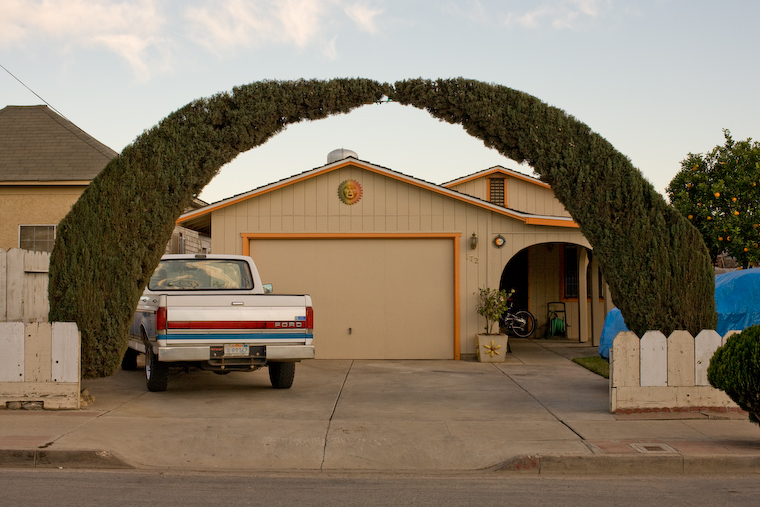
Boulevard of Blankness.


DSCF0082 DSCF0080 DSCF0078 DSCF0036

According to City Data, the area of Van Nuys bounded by Roscoe Boulevard on the North, Woodman Avenue on the East,Burbank Boulevard to the South, and the 405 on the West, an area of 7.2 square miles, contains some 100,000 people at a population density of 13,271 per square mile. The LA Times claims 110,000 lived here as of 2008.

Heart of this district is a blank-walled canyon of bleakness, Van Nuys Boulevard. It was once a thriving commercial street, full of fine looking Mid-Century Modern banks, small stores, and family run businesses where the windows were washed and the sidewalks swept daily.

In the 1950s through the 1980s it was a cruising area, taken over by young people and cool cars.

And now it is a dump.


It seems that this blog, for over 8 years, has reported ad nauseum on this wasteland of shuttered shops, littered parking lots, and vast expanses of asphalt surrounded by decay.

And yet, two blocks from Van Nuys Boulevard, there are some lovely and historic streets, well maintained houses, people and their properties who are trying to keep neatness and bourgeois respectability evident in their front yards.

The bottom line is the bottom line. There is not a plan, nor a large scale investment, nor a vision for Van Nuys Boulevard. There are piecemeal and weak proposals put forth by well-meaning people to make it “bicycle friendly” or “pedestrian friendly”. But who the hell wants to spend time in the 100-degree heat, soaking up the smell of urine in doorways, stepping over dog shit, as the smoke of illegal food vendors blows over the parked cars and idle trucks who have flunked their smog inspections?

The current environment is a hellish place, one whose continuing demoralizing existence blights the whole community of Van Nuys.

One hundred thousand people who live here deserve better.

DSCF0031 DSCF0028 DSCF0027 DSCF0020


The Holdouts.


Not far from my house in Van Nuys, there is an unimproved street without gutters or sewers, where the blacktop was probably laid down 80 years ago, past large parcels where grew walnuts, oranges and figs.

On Columbus Avenue, there are perhaps five properties of 20-30,000 square feet each. Most of the houses are rented, ramshackle places with overgrown weeds, dry grasses, cyclone fences, trucks parked on the meridian, and slanted roof cottages housing lawful people and unindicted felons who hide behind tall lumber and cinder block and eek out a living as gardeners, actors, piano tuners and truckers.

Up until the last wave of prosperity crashed into itself, speculators had bought up some of these places, intending to tear them down and stack together stucco developments.

Some of these places, which nobody can sell, might be worth $300,000. But a few years ago they were asking $700,000 and now the owners are defaulting and trying to unload their gambles.

I rode my bike last week and passed a man who I see once a year at my neighbor’s Christmas party and he invited me into his compound where I met dozens of cats, picked figs off the trees, and walked into a Depression Era scene that might have come out of Bonnie and Clyde.

While we talked, another man, a younger man, carrying a Canon DSLR, walked up the very long driveway, and joined us. He was a location scout interested in photographing the place.

There is a lot of filming in our area. A show called “Workaholics” is shooting here now, on a street where many people are jobless but where some young post-collegiate comedians posted a Youtube video and sold a show to Comedy Central.

One might drive past the Workaholics House and see a horse and carriage, or a rowboat tacked up on the roof, and on other occasions I may have seen an elephant hosing down a car, and some old lady with a broom chasing straw hatted kids on skateboards.

Every other week, dozens of trucks and hundreds of crew- members come here, and film a fiction about life in Van Nuys, using our real world as a cheap and ironic backdrop for the callow humorlessness of modern hip Hollywood.

My idea of funny is still “The Dick Van Dyke Show” or “All in the Family” just as my idea of a film is “The Best Years of Our Lives” and my favorite singer is Frank Sinatra and I don’t think any house built after 1945 is attractive.

So I live in the past and I run from the present and wander through this city with a camera and a laptop computer. And hope that someone will anoint me with gold dust.

And escapism, and the ability to dream and imagine, and produce and prosper, that is only for a lucky few in Van Nuys.

The rest are holdouts, living in rented places, or hanging onto places they own but will never own and may lose before they die.

Renaldi Does Clifton’s.


Photo by Richard Renaldi

Photo by Richard Renaldi

Photographer Richard Renaldi does LA’s Clifton’s Cafeteria.


Liz Kuball: California Vernacular


California: strange, off-kilter and right before our eyes.
As photographed by Liz Kuball.

This slideshow requires JavaScript.

William Reagh: Los Angeles 1950’s-80’s.


William Reagh
William Reagh
William Reagh
William Reagh

110[2]

William Reagh
William Reagh

The blog American Suburb X has some great photographs of Los Angeles, shot by photographer William Reagh. Other images of Reagh’s, along with notes, can be found at the California State Library.

The photographs show a city undergoing vast demolition and reconstruction, especially in downtown LA. This was the era of urban renewal and grandiose high-rise projects. Odd movie-set type houses, strange juxtapositions of paper thin stucco cottages and exotic trees, empty moonscapes, sad fluorescent-lit cafeterias, plywood faced storefronts, decaying neighborhoods…this is what it looked like in LA, 40 years ago.
A documentary frankness on film.