Seeking to escape the haze and home confinement, we went where we used to go on Sunday in normal times: Santa Monica.
We parked on one of the wide, flat streets north of Montana, away from crowds. And we walked in masks that we imagined shielded us from dangers visible and invisible.
At Adelaide and 4th, where a palm lined grass island ends at a cliff and now blockaded stairs, someone had written “No Vaccine” on a wall.
This year everything is No: no work, no travel, no movies, no dining out, no socializing, no school, no hugs, no kisses, no bars, no strangers, no baby visits, no old people, and, of course, no vaccine.
Before the pandemic there were many runners here, and they would run up and down the stairs, but the virus put an end to that, and now the bad air ensures it.
This part of Santa Monica is grand, with large houses, of every style and decade from the past 100 years, but everything, under the grayish, smoky skies seemed tired, out of breath, defeated; like the city and the state and the nation.
There were Porsches parked in driveways, and Mercedes speeding past, but there seemed no respite from thoughts of ruin and gloom. Who will save us? Will we burn down? Will we be safe when fascism takes over? Or will the lawless sack the mansions and the stores while hated cops stand by and watch? Will a smart leader emerge? Or shall we suffer under Q-Anon and the conspiratorial voices on Next Door?
Who shall live and who shall die and who shall find the most followers on Instagram?
Only the Shadow Knows.
Along Ocean Avenue at Georgina there is a restoration of a grand mansion, with construction illustrations of the elegant plans, and other photographs of historic and happier Santa Monica. Why there’s Mr. Pepper Gomez, Muscle Beach Contest Winner, 1950.
On Georgina there are yard signs, some of them angry. “Elect a clown, expect a circus” says one placed inside a long olive tree lined forecourt of a gated house.
Sometime from the 1940s through the 80s, this area was not so rich. There were large houses, but they weren’t expensive, so developers came in and tore down some of the historic ones and put up cheap apartments.
A 1971 apartment at 129 Marguerita is emblazoned with a strange sign: 129 Career. A door or two off Ocean Avenue, the 2-story building is remarkably plain and homely, with a side alley of individual garage doors, stucco wall and steel windows. Balconies are big and full of plastic furniture. The good life was once available at bargain prices.
And at 147 Adelaide (built 1926) there is a mysterious, long, downsloping, concrete driveway that leads into an old, wood door garage with a five-panel utility door next to it. Two spotlights were on at Noon, and in the distance, haze covered the canyon and the hills and the houses.
On March 30, 2007 there was a fire burning in Griffith Park.
And I was walking in Studio City when a red-haired woman drove up and parked on Ventura Bl. in an odd little purple car, a Nash Rambler. Her license plate read “Kissmet.” I’m sure she is someone, or was someone, quite beloved, judging by her car and plate.
March 30, 2007
November 9, 2019
Yesterday, 13.7 years later, there was another fire burning above Warner Brothers Studio near Barham. And the same atomic plume of smoke went up in the sky and theatrically filled up the space between the rows of palm trees along Ventura Boulevard.
There was no Nash Rambler in yesterday’s photograph, and by comparison, in content and style, the new image is quite unexciting and unremarkable.
When fire threatens Los Angeles, the first thing we think of is our loved ones, and then our homes, and lastly our cars.
“The remains of burnt down homes and vechicles resulting from the Woolsey Fire are seen on Busch Drive in Malibu, California on November 13, 2018. – At least 44 deaths have been reported so far from the late-season wildfires and with hundreds of people unaccounted for the toll is likely to rise, as thousands of weary firefighters waged a pitched battle against the deadliest infernos in California’s history. (Photo by Frederic J. BROWN / AFP) (Photo credit should read FREDERIC J. BROWN/AFP/Getty Images)”
“The fire was roaring down the canyon. We had already stocked the car with our papers, our family photos. Carla was so good, so organized, getting the kids into the car. And it was 3:30AM and we were ready to get the hell out in our 2018 Range Rover. The smoke was thick, of course. Then over the hill we saw flames. Carlos, Esmerelda and Arturo ran up to the car. Carla begged them to leave, mandatory evacuation, but they said they were staying. They would take garden hoses and buckets and fight the fire. So they did. They saved our house. The garage, where they lived, burned, but the main house, thank God, is still standing.”
Jason, The Hollywood Advisor, was sitting on a deck overlooking the ocean, talking to me, weeks after the deadly and horrific fire that consumed Malibu. We were alone, drinking wine. He wore strange little sunglasses shaped like Forever Stamps, rectangular and beady; he wore them even after the sun dropped below the horizon. I guessed to hide his tired, sad eyes.
Carla and the kids, Samantha, 13 and Igor, 11 were in Montserrat waiting out the reconstruction, and Jason was staying in Malibu, at a $6,000 a week AIRBNB, to attend to the repair of his semi-destroyed rustic cabin, worth millions.
The fire was only the latest setback in his life.
He had spoken of lost projects, stolen ideas, friends who betrayed him, opportunities that evaporated quickly like afternoon rains in the summer desert.
“I had the original script that belonged to Steve McQueen in The Towering Inferno. I bought it at auction when I was 18 years old in 1989. It was $400. And it burned too. God I loved that. It was Steve McQueen’s!” he said.
That incinerated script was merely a metaphor for other charred, ruined and once-adored life attachments.
The latest outrage was a friend of 20 years, Dean Meagrer[1], a big deal in the film world, a director and producer who had partnered with Jason, but then went behind Jason’s back to sell the film project to another company, and then denied he had done so.
“People suck. Carla had nursed him through his relationships. She even sat up all night with Claire Foy talking her out of breaking up with him, and so basically Carla saved their relationship. And of course, Claire will star in their film, so everything was saved, jobs and love and money. And now he just lies to me and betrays me. So fucking unbelievable,” Jason said.
He talked, seemingly with insight, about the world of fakery and insincerity that he once thought he belonged in, lorded over. He never took the circle of lost friends as a sign that perhaps none of these people had ever truly been true friends, but merely transactional relationships that were formed to bring goods and services to Jason and Carla and their kids.
“Best Friends” was how Carla once described Lois and Johann who owned White Now, an ultra expensive tooth whitening process which the owners provided free to Jason, Carla and the kids, a $4,000 value. Every few months, the family got free whitened teeth, brighter and whiter than Dunn-Edwards Precious Pearls, a very white paint.
Arnaldo and Noma, two Beverly Hills landscape architects, became the new best friends for a while, and designed, gratis, a sloping scheme of native plants, water-saving trees, artfully placed rocks and an herb garden. Noma was a set designer in her previous life, and Arnaldo was a Urauguayan film director, so that landscaping couple assumed a free outdoor makeover would lead to other entertainment opportunities, but that, of course, fell out.
And undocumented Guatemalans Carlos, Esmerelda and Arturo moved in, free, into the back garage, near the creek, and were allowed to stay, in return for light household chores like brush clearance, carpentry, painting, and cooking. That family lived like old plantation workers, grateful for a roof over their heads and enough food to eat, and they earned it by unofficially joining firefighters and risking their lives to fight the massive wildfire last month.
Always Carla spoke of her conquests, her connections, her exploits, as a mother might speak of her children, with care and concern. There was a callousness to the bartering where Jason and Carla used their positions to promise results which never materialized. “We helped a refugee family and our home was a sanctuary.” A scrim of kindness masked the manipulations.
But Jason was unaware.
His self-pity was the major event that preoccupied him last week. He imagined that he had gained sad wisdom into the human condition, seeing in his own lost dreams a truly gripping tale of impoverishment, wandering and dazed, a defeated winner walking along Pacific Coast Highway in a smoked, soaked James PerseT-Shirt.
I had not the courage to call him out, to point out his lies, his denials, his false sense of friendship and how temporal and shaky all of his foundations were. At the heart of his life, he had constructed a tale, a story, a narrative of sacrifice, truth, unselfishness and caring.
4/29/1960: Harry Brandt, 53 (with cigar) stands in the ruins of his gutted Living Room in Van Nuys where his wife Charline, 46, died after a cigarette ignited a house fire. (Photo courtesy of Valley Times Collection at LAPL)
The sky was exceptionally sublime last night with distant plumes of smoke climbing up into the clouds. The air was smoky and humid. The city seemed exhausted, ready to take a cold shower, drink ice water, and crawl into a bed without a blanket in an air-conditioned room.
But firefighters were racing to multiple scenes, battling on foot, assisted by water dropping copters. There would be little sleep for the defenders of life and property.
Near 12653 Osborne St, Pacoima, CA 90012
The 2017 La Tuna Canyon Fire in the Verdugo Mountains, a punishing event, looked tame from a distance in Pacoima along San Fernando Road. Closer up, panic and urgency: horses, dogs, cats and people evacuated. Others chose to stay home, hose down their roofs and wait it out.
In Sunland, still along San Fernando Road, one could glimpse the hot flames shooting up in the crevices between the jagged hills, orange fire against the dark blue sky.
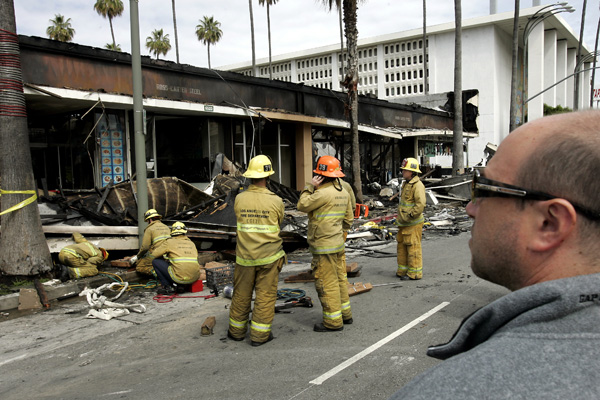
The enormous Valentine’s Day conflagration that consumed the former home of prostitutes and drugs called the Voyager Motel brought out hundreds of firefighters.
And hundreds of spectators, photographers, cars and neighbors who eagerly and gleefully watched smoke and flames from safe vantage points near the fire site at Sepulveda and Hamlin Streets.
Children were hoisted atop parental shoulders, laughing bicycles circled streets, black clad XXL’s in their Sunday best waddled to box seats near the flames.
Voyager Fire
It was the greatest entertainment in our area since an elephant stood on a driveway and hosed a car on an episode of Workaholics.
We had been driving from downtown, and on the 101 near Laurel Canyon could see a funnel cloud of dark smoke, somewhere in the NW distance, and then heard on the radio, an announcement, that there was an enormous blaze happening right near our home.
When we drove up Hamlin, the strong winds were blowing the acrid fumes south, away from our street, as if God herself had intervened to produce something dangerous and exciting within hundreds of feet from our house, without endangering any of us.
Voyager Fire
The life risks were undertaken by 170 firefighters who spent almost three hours dousing the fire, killing it by drowning it until its fearsomeness and ferociousness fled.
For years, the Voyager Motel was a constant blight on the area. Nothing could end that local monster whose clientele paid by the hour, and whose rooms and reputation stained and demoralized everything around it. The sex and drug trade flourished. Nightly sirens and helicopters and cops buzzed the fleabag whorehouse. And then, last year, the motel was shut down, or went out of business.
One problem ended in Van Nuys, as 666 other criminal activities flourished.
Yesterday, Satan returned to finish his business at the Voyager Motel, his personal university in Van Nuys, and did it in his usual surprise way.
VNCC Member Penny Meyer (L) pays an official visit to the fire scene.
You must be logged in to post a comment.