History Online


15139 Hamlin.jpg

In the public record, and available online, are millions of building records, in The Department of Building and Safety, encompassing a large part of the history of the city of Los Angeles.

I discovered this great trove of fascinating information during a recent employment incarceration at a Sherman Oaks realty agency.

When we received a listing, we went online and pulled up permit records related to a particular property. This was part of my duties, along with stuffing plastic fingers and plastic spiders into hundreds of orange and black Halloween bags destined to hang on doorways south of Ventura Boulevard.


My neighbor’s home at 15139 Hamlin went on sale yesterday.

I pulled up a 1933 building permit for the property.

These records are available for anyone to view. And are not confidential, private or top-secret. They are part of the public record of building safety in our city.

15139 Hamlin was built by Fred J. Hanks who lived down the street at 15015 Hamlin (since demolished). Mr. Hanks estimated the total construction cost of the home at $2,000.

Incidentally, I plugged $2,000 into the US Inflation Calculator and found that amount to equate to $36,606.92 in 2015 dollars.

Mr. Hanks built a two-bedroom house with one bathroom and a kitchen, living room and dining room on a 50’ x 137’ lot with garage for about thirty-six thousand 2015 dollars.

The current values for housing properties in Los Angeles are truly insane. They are fed by a frenzy of speculation and collusion by appraisers, property owners, banks and realtors and seem to reflect no sane relation to either income or reality.

Van Nuys, between Kester and Sepulveda, above Victory, is stuck in a strange rut. The houses here are expensive enough (over $500,000) but are mostly unaffordable for new home buyers. But there are few that sell for over $650,000 so developers have no interest in purchasing old or dilapidated houses, pouring $100,000 into them, only to find that their $600,000 investment cannot sell for over that amount.

As a result our area has quite a number of empty houses, and others that sit on large parcels of land that could be developed for more housing. People sleep on benches, and on the street, or spend $3000 a month for renting an apartment and they all could be owning a house if only the economics of our times permitted.

Perhaps someone sensitive and aesthetic, with modern tastes and an artistic eye will purchase 15139 Hamlin. Or, as seems more likely these days, the house will be obliterated by concrete driveways, 30 cheap exterior lantern lights sitting on stucco walls or iron gates, vinyl windows and Roman columns, and five Hummers parked in front with four on the street.

People once had little money but could build cheaply and practically and pleasantly. Now they have little money, but they build as if they have millions, and the result is a vandalizing of our communities producing pimped-up houses that will again go vacant and unsold when the next downturn hits.

They knew something in that Great Depression year of 1933 we need to learn all over again.


306 W. Valencia Ave. Burbank, CA, 1979


screenshot_422.jpgDSCF0049

Last week, I ventured along Victory Boulevard in Burbank.

And I came across a one-story stucco building at 306 W. Valencia Ave. built in 1940, with round porthole windows and horizontally striped overhangs.

I posted photos of the structure on this blog which Dwayne Baldridge saw.

Mr. Baldridge was connected to 306 W. Valencia Ave. and had spent time there in the late 1970s and early 1980s.

He sent me photos some of that era which I am posting below.

Untitled-Scanned-1245
“My new (now ex) wife leaning against our 1970 Mustang in front of our apartment looking east, just a couple of days after our wedding, taken 7/2/81”


"My Mother, Father, younger Brother, Maternal Grandfather and Grandmother at a simple party to celebrate my Grandparents Anniversary taken in late 1979."
“My Mother, Father, younger Brother, Maternal Grandfather and Grandmother at a simple party to celebrate my Grandparents Anniversary taken in late 1979.”
Untitled-Scanned-288
“Me with my girlfriend on our first official date around June 1979”

Alma Imogene Payne Waters (1922 – 2014) at 14336 Gilmore St., 1952


screenshot_414DSCF0084 DSCF0083

Don Waters (b. 1954), who grew up in Van Nuys and now lives in Missouri, has been a longtime reader of this blog.

After seeing my recent photos of Gilmore Street, he recognized one particular bungalow court at 14336.

His parents, Donald (1929-2007) and Alma (1922-2014) had lived there in the early 1950s.

A 2007 obituary provides some family biography.

Don, very considerately, sent me a 1952 photograph of his mother, standing in the courtyard of the complex.

It must have been a quite pleasant neighborhood to live in: schools, government offices, stores, and churches, within walking distance.

In 1952, the San Fernando Valley was on the precipice of speeding into the future full throttle.

And now, in 2015, we look back and wonder what went so very wrong.

Nobody wears skirts in Van Nuys anymore.

116Imo@VNapts

Van Nuys Boulevard in Three Eras.


Van Nuys Blvd. Opening 1911. (DWP)

Van Nuys Boulevard was made in 1910, open for traffic and business in 1911.

It was the heart of the San Fernando Valley, and apparently a quite pleasant and neighborly place to shop.

Van Nuys Blvd. Early 1950s

Cars were parked at a diagonal (like Glendale’s Brand Blvd. today) which effectively and passively narrowed the wideness of the street. It was a more pedestrian friendly boulevard.

Van Nuys circa 1960
Van Nuys circa 1960

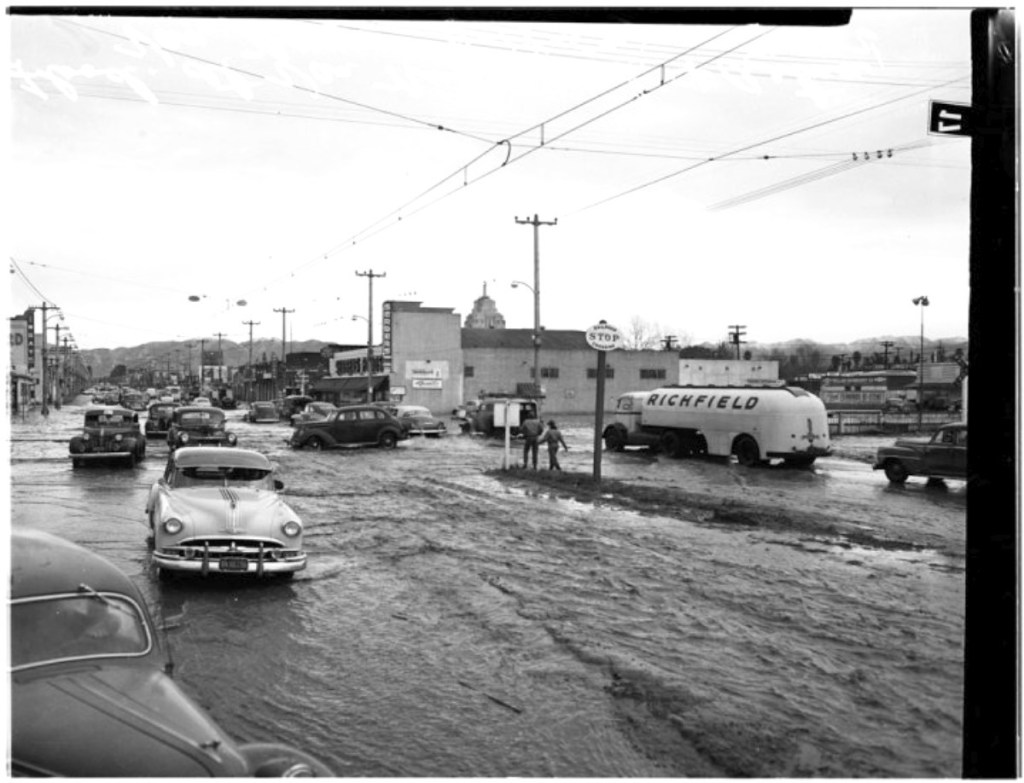
But in 1954 Victory and Van Nuys Boulevard were widened. The high intensity lights came later, but the effect was to turn the street into a type of freeway, perfect for cruising, but inhospitable to much else.

Van Nuys at Friar, facing north, September 2014.

The 2014 view is what we see today, a wide street stripped of appeal, whose stores are either vacant or taken up with low rent bail bonds, and cheap crap.

Wide streets are not where people walk and shop. They want trees to shade them. They want to cross the street without walking across six lanes of speeding cars. Studio City, Sherman Oaks, Encino and Tarzana, all the wealthier parts of the San Fernando Valley, have all grasped this basic fact of life and have planted trees and landscaped medians to humanize their business districts.

What accounts for the neglect other than a lingering racism and an inability to formulate a plan financed by government and developers? If a sea of blond-haired people started coming here, would Mayor Garcetti and Councilwoman Nury Martinez suddenly spring into action? Why is Van Nuys different than Highland Park, Encino, North Hollywood or Burbank? Are we somewhere on Mars?

The postcards are (once again) courtesy of Valley Relics. The 2014 photo is taken from Google Street views.


Rancho Pequeño and Other Places….


Rancho Pequeno Back

Rancho Pequeno

Kester Street, for those who don’t know her, is a narrow road halfway between Van Nuys  and Sepulveda Boulevards, paralleling both.

Before WWII, it was on the fringe, out on the wide land, beyond settled Van Nuys.

Rancho Pequeño at 7050 Kester (near Vose) was significant enough to have its own postcard.


These are postcards scanned from the collection amassed by Tommy Gelinas at Valley Relics.

They provide pictorial fantasy, mined from fact, of the places and events and people who once lived in the San Fernando Valley.


Malaya:Van Nuys Back Malaya:Van Nuys

A 1931 postcard shows two men in Malaya (Malaysia) procuring exotic birds for shipment back to Bird Wonderland, Inc. in Van Nuys.

It was located at 15640 Ventura Boulevard, Van Nuys, CA, a location that today is known as Encino.

80 years ago, the name Van Nuys was used all the way from Beverly Glen south of Ventura up to Roscoe west past the present day 405. There was no shame in the name.

Our Ventura Boulevard has an interesting article on Bird Wonderland, which also had exotic animals, including, Jackie the Lion who allegedly inspired the roaring one seen in every MGM movie.


Take It Easy Take it Easy Back

No motel on Sepulveda today enjoys an entirely good name. Much of them, especially those north of Victory, are havens for prostitution.

But back when the area was a main highway into the San Fernando Valley, before the freeway, it hosted many family owned motels.

Take it E-Z Motel at 5764 Sepulveda was owned by Mr. and Mrs. GB Parrott.

The motel is still there, at Hatteras, across from Target, and is planned for tear down next year with a new replacement.

The postcard shows two people sitting in chairs on the side of the building, facing the western sun.


Gene Autry Front Gene Autry Back

Dorothy visited Hollywood and sent a postcard of Gene Autry’s home in Toluca Lake on August 5, 1947.

Writing to The Chalfants of Waynesboro, PA, she reports, “Saw two radio shows today, Queen for a Day and Heart’s Desire. Both good fun.”

Things may change in Southern California. But people still text and email the folks back home to tell them how they came in contact with celebrities and how wonderful the weather is.


“This is the club where Bing Crosby belongs….”


Picking Olives Front

Some of the enormous, picturesque, and historic postcard collection amassed by Tommy Gelinas and his Valley Relics has passed through my hands.

The San Fernando Valley, only 100 years ago a largely agricultural area, dotted with newly established towns, became the fastest growing part of the United States in the 15 years after WWII.

Postcards from visitors who passed through here; visited olive groves, rode streetcars through vast planted lands, absorbed all the sunshine, boosterism and hucksterism of that time; radiate in words and pictures.

Lankershim VN Front Lankershim VN Back

Around 1910, Pacific Electric advertised a 101-mile-long, one-day trolley trip for one dollar. “The Scenic Trolley Trip” visited 10 beaches and 8 cities.

“Paralleling the mountains from Los Angeles to the ocean, then 36 miles along the Seashore. Parlor Car; Reserved Seats, Competent Guides. FREE ATTRACTION-Admission to largest Aquarium on Pacific Coast; Ride on the LA Thomspon Scenic Railway at Venice; Admission to Camera Obscura, Santa Monica.”

It sounds thrilling.

And imagine, men in suits and women in long dresses riding all day in wool coats, felt and feather hats, with many layers of undergarments, not even an ankle exposed.

Tower Motor Front

Thirty or so years later, the Tower Motor Hotel at 10980 Ventura Blvd in Studio City was smartly streamlined with gas pumps in front, steam heat and air-cooled rooms.

Lakeside Front Lakeside Back

Bing Crosby, who lived in Toluca Lake, was the most successful singer of the 1930s. A postcard sent from a fan who visited Lakeside Golf Club near Mr. Crosby’s home wrote: “I’ve seen him playing two mornings this week.”

IMG_0028

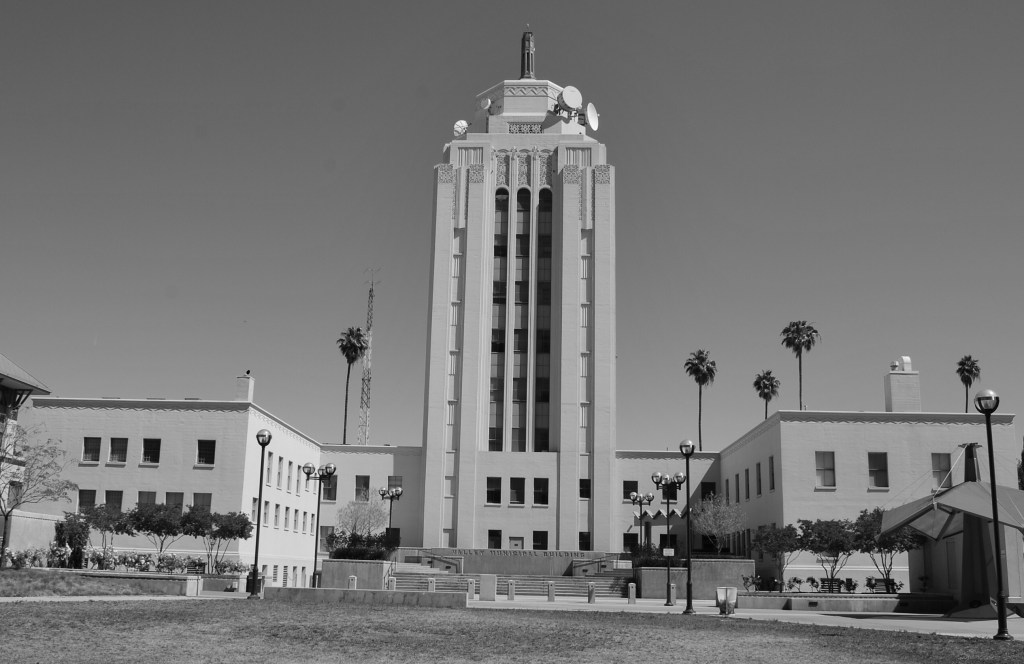
A 1930s view of Van Nuys, along Sylvan Street, towards the Valley Municipal Building, shows diagonally parked cars and a “Safeway” store.

On another postcard, showing the Encino Country Club, a Model T is parked under a shady oak in a verdant landscape of hills and orange trees.

IMG_0012

It may be too much to extrapolate truth and fact from these postcards. They were advertisements for businesses, meant to promote and sell.

But my heart tells me that Encino, Van Nuys and the rest of the Southland were magical back then.