Densmore and Stagg, N. of Saticoy.


Drive west on Saticoy St., past the 405 and turn right/north, onto Densmore Avenue. 

You are still, according to Google Maps, in Van Nuys. (all apologies to Lake Balboa, which seems to have some fourteen boundariesaround its neighborhood.)

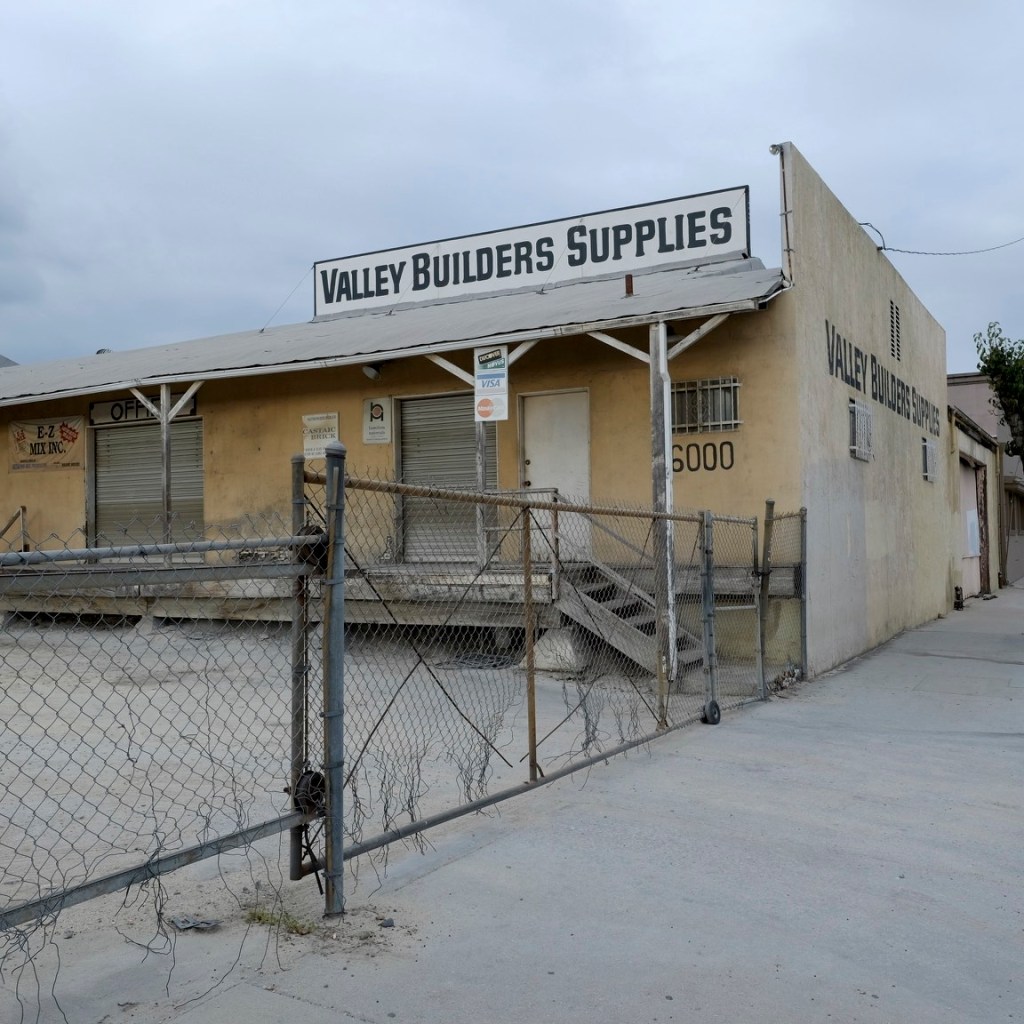
On Densmore, near Stagg, you’ll find, as I did, a neat, monotonous, hard-working district of small companies; mostly hidden behind bricks and barred windows.

Creative Age Productions at 7628 Densmore is there. They publish beauty magazines. Nailpro, Eyelash and Dayspa are some of their best-known publications. These titles are often competing with mirrors for customer attention.

They are neighbors with: Superior Shipping Supplies, New Rule Productions, Regency Fire Protection; and Kedem Properties, 7752 Densmore, which sounds like a Kosher wine but is actually a commercial property company. 

Black Sheep Enterprises, at 15745 Stagg, manufactures theatrical and stage drapery, a specialty one cannot buy off the shelves of Target.

The Katsu-Ya Group at 15819 Stagg owns nine sushi restaurants around the Southland. They are incongruously housed in a white and brown brick Mexican style building with arched designs.

Katsu-Ya Headquarters at 15819 Stagg St.

And the American Rubber and Supply Co. at 15849 Stagg St. has been in business since 1947 and is a supplier of industrial rubber products. Your car mat, your yoga mat, and your kitchen mat, next to the kitchen sink, might have all come from here.

New Rule FX at 7751 Densmore makes special effects props and supplies for movies, TV and theater. If you need piles of fake US currency, realistic cheeseburgers in rubber, or a room full of exploding balsa wood furniture , then this is the place to shop.  Their free-floating, fantastical, imaginative fantasies are constructed behind a dismal, prisonlike façade of white cinderblocks and steel bars.

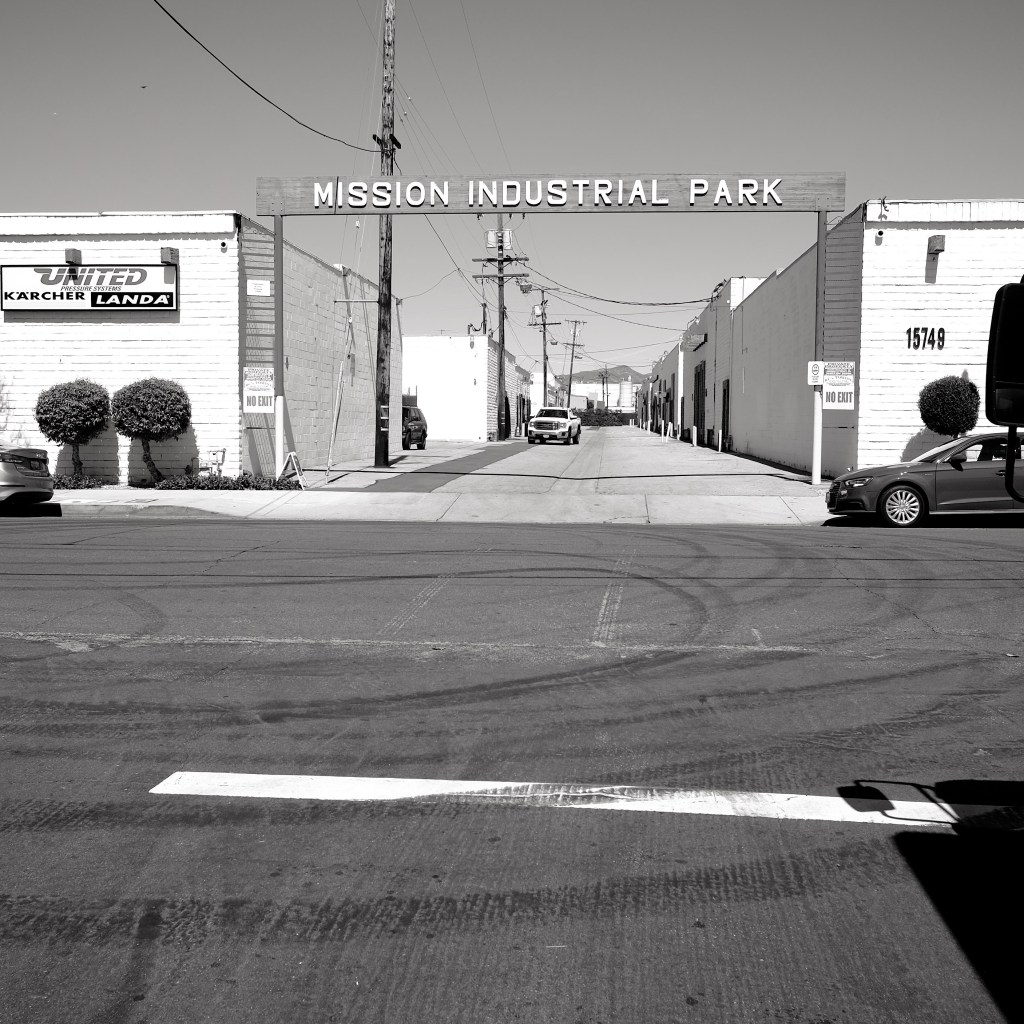
Where Stagg St. bisects Densmore Ave is Mission Industrial Park, announced by a two-posted, two-fisted, old Western kind of sign with raised letters on a wide wooden board hung 20’ high over the street.  It welcomes you to a white-walled alley of various buildings presumably under one owner who felt compelled to establish an identity for her vastly unremarkable assemblage.

Mission Industrial Park.

We went all around here, on public sidewalks, a few days ago, to shoot some photos for a mens’ fashion brand called Magill Los Angeles.  

James and Carter were the models.

Along Densmore Av. Carter (L) and James.

James was 19 and had long blonde hair and said he was born in South Los Angeles but had moved with his father to North Dakota. He was now living in New York City and visiting Hollywood to strike up a modeling career. He had the dazed and confused 70s aura from juvenile and stoned Reseda. He works at McDonalds now but may well be famous in 2029.

Carter, actor, came from North Carolina and was well-read, articulate and sensitive to both words and pollen.

James

The day was sunny, the wind was blowing, the boys were happy and we went to eat tacos later at Tacos Hell Yeah which they said was their best ever meal in LA.

Tacos Hell Yeah
7607 White Oak Ave, Reseda, CA 91335

____________________________________________________________

Those industrial compounds, like the Stagg/Densmore District, are the hidden places in the San Fernando Valley that nobody knows about. 

Tidy, productive, industrious, they are the old lifeblood of Los Angeles, where your late Uncle Bernie, with the cigar in his mouth and the bad gallbladder, set up shop after the war and bought a three bedroom, rock-roofed ranch up on Zelzah Avenue with a delightful kidney-shaped pool.

He had little patience for tears, or men who didn’t know the difference between a wrench or a pliers, having served up ice cream at Montgomery Ward until he enlisted in ’42 and saw action at Guadalcanal. He was never bored, because he was always busy, and you vowed you would never become Uncle Bernie but you’ve done quite worse, haven’t you? He had work and a family, and a company, and a paid for house and you made fun of it, but now life laughs at you.

Aside from the work that goes on inside these shops, there is nothing to do in this area for someone in search of stimulation. Densmore and Stagg and parts around here are boring, without street life. Yet men and women in these enterprises are engaged in work, absorbed in inventions, and creating products that are, in many respects, quite interesting.

Along Stagg St.

Magill: Target/N. Van Nuys
(Not near the Densmore/Stagg/ Mission Industrial District)
James on the Raymer St. Bridge, Van Nuys, CA.

Option A: Just Plain Places


This blog has written 13 other times on “Option A”, a Metro LA proposal by the public transportation agency to wipe out 33 acres of industry in Van Nuys, near the junction of Oxnard and Kester, and replace it with a light rail service yard. It would destroy 1,000 jobs, displace 186 businesses and flatten 58 buildings.

Though the scheme has been public knowledge since September 2017, property owners, workers, renters and the neighbors near here still stand on thin ice, awaiting official June 2018 word whether this whole district is sentenced to death, or if another site (B, C, or D), near the Metrolink tracks up on Raymer Street will be chosen instead.

A photo walk around here yesterday, along Oxnard, Aetna, Bessemer and Calvert, to document some buildings that may be gone in a few years, was also an opportunity to show that this area has great potential beyond its current light industrial use.

In gravel yards, on cracked and broken asphalt, under decaying wood, on treeless, depopulated and narrow roads, there are ingredients for a nice urban area of some new housing, some new cafes, some places where trees, lighting, discreet signage and pavement of cobblestones could bring an infusion of 24/7, urban, walkable, bikeable activity to the neighborhood.

It is already an incubator of creativity with makers of exquisite decorative hardware, superb custom cabinetry, music recording studios, Vespa and Mustang restorers, stained glass makers, welders, boat builders, and kitchen designers. These businesses, incidentally, are staffed by mostly local owners and workers, many of whom are but minutes away, or take the bus or even walk to work.  Rents are currently affordable, often 50 cents, $1 or $2 a square foot.

MacLeod Ale, maker of fine British style beers, since 2014, is on the north side of Calvert and is not threatened with demolition but its existence and success is a testament to the potential for innovation in this area.

Ironically, the very wonderful addition of a landscaped bike path and the Metro Orange Line bus in 2005 is now threatening the area because of future conversion to a light rail system. Yet the “Option A” district is thriving, even if it is shabby in places, because it is a work zone of skilled, employed, productive people.

Politicians who often talk ad nauseum about “diversity”  should come here with mouths closed and observe men and women: Mexican, Armenian, Norwegian, German, Persian, Guatemalan, Salvadoran, Irish, Scottish, Israeli-Americans, all the hyphenations of ethnicity and gender, who don’t care about where anyone came from, but only about where they are going in life.

This is Los Angeles. This is diversity. This is economic prosperity. This is within walking distance of “downtown Van Nuys.”

Yet short-sighted officials, bureaucratic ignoramuses with grandiose titles, flush with public money, would consider wiping out the very type of neighborhood whose qualities are needed, wanted and venerated.

Option A must not happen. This is what it looks like now.

Imagine what it could look like with the right, guiding hands of investment, preservation, planning and protection.


SaveSaveSaveSave

SaveSave

Option A: An Open Letter to Ms. Sheila Kuehl


“Sheila James Kuehl (born February 9, 1941) is an American politician and former child actor, currently the member of the Los Angeles County Board of Supervisors for the 3rd District. In 1994, she became the first openly gay California legislator and in 1997, she was the first woman to be named Speaker pro Tempore in California.[2] Kuehl most recently served as a Democratic member of the California State Senate, representing the 23rd district in Los Angeles County and parts of southern Ventura County. A former member of the California State Assembly, she was elected to the Senate in 2000 and served until December 2008. She was elected to her supervisorial post in 2014. In her capacity as Supervisor, she also sits on the Metro Board, First 5 LA, and is the County appointee to the South Coast Air Quality Management District.” – Wikipedia


Thursday, October 26, 2017

Metro Los Angeles Board

Re. Metro “Option A” Plan for Light Rail Yard in Van Nuys


Dear Board Members:

As you are aware, Metro Los Angeles is planning to erect a light rail service yard in Van Nuys. “Option A” is one of four sites proposed by the agency.

“Option A” would seize land NE of Kester and Oxnard, along four blocks, covering 33 acres, and demolish 186 buildings straddling the Orange Line Busway. For the purpose of this letter the area will be called “Kesterville.”

We are vehemently opposed to this plan. Here is why:


  • 186 small, family run businesses, employing an estimated 1,500 workers, occupying affordable, mostly rented space would be destroyed.
  • It would leave a gaping hole of emptiness blocks from downtown Van Nuys, obliterating plans for a denser, walkable area.
  • Option A will take out yet another engine of well-paying, highly skilled jobs and products, made in America, employing many immigrants and local residents.
  • It needlessly destroys a successful, close-knit pocket of creativity and commerce, manufacturing, and makers of unique goods and services found nowhere else in Los Angeles.
  • It will reduce fair priced, rentable industrial space in a city starved for it, in an area that is already served by public transport and contains more affordable housing.
  • Option A will subtract from the city what it is seeking to promote region wide: affordability, mobility, economic innovation, small business, local industry, ethnic diversity, and community cohesiveness.
  • The Van Nuys Neighborhood Council opposes Option A.


Within this dense, vital district are found a historic music recording studio, a maker of top quality metal hardware utilizing 3-D printers and advanced machinery, several fine custom cabinet builders and their craftsmen, an expert stained glass artisan whose work embellishes homes, churches and historic buildings, a restorer of Vespa motorbikes whose facility is the only one of its kind east of Pennsylvania, and a 20,000 SF shop where vintage Mustangs are serviced and restored. There are painters, carpenters, builders, and experts repairing racing boats, and several professional recording studios for musicians.

MacLeod Ale, a craft brewer of UK style ales, opened in 2014 and has become a highly successful and respected beer maker. They are located on Calvert St. adjacent to the Option A area.

Kesterville is a place of creativity, productivity, sustainability and viability. Organically, without government coercion or corporate ownership, it is an incubator of ideas and products. It has been alive for decades, growing more prosperous and doing well in the heart of the oldest part of the San Fernando Valley.

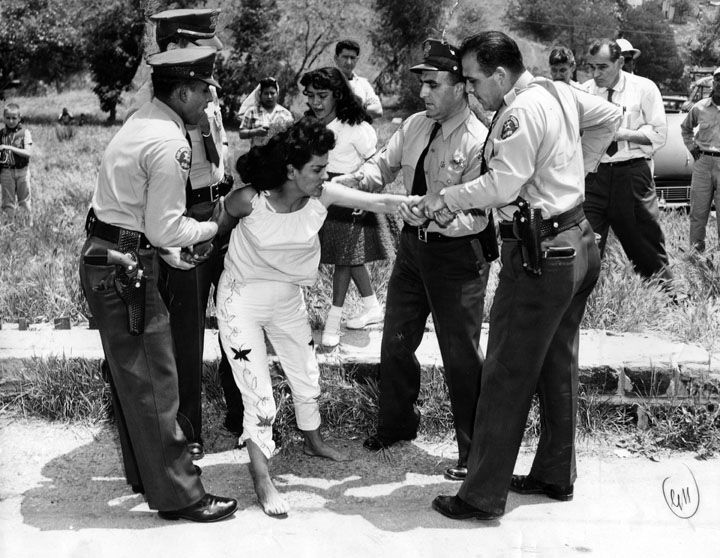
If Kesterville is destroyed, it will recall the most heartless obliterations in Los Angeles history: the razing of Chavez Ravine for Dodger Stadium, the flattening of historic Bunker Hill for corporate behemoths, and the bulldozing of West Adams for the Santa Monica Freeway.

Dodger Stadium, 1961. On land formerly housing poor Mexican families at Chavez Ravine.

1959:Evictions from Chavez Ravine.

1959: Families are Forcibly Evicted from Chavez Ravine to Make Way for Dodger Stadium.

1935: Boys in Chavez Ravine

Van Nuys has already suffered social, economic and environmental neglect. Why compound the injury by robbing it of yet another burgeoning and blossoming area that could become a new district of small businesses, restaurants, cafes, and even urban, in-fill small housing?

We urge you to respond to this civic emergency by opposing “Option A” and the demolition and eviction of sound businesses that support many thousands of families struggling to survive in a brutal time of economic insecurity.

We are in favor of light rail, and public transportation in general, but ask that it be constructed with greater sensitivity to the community so that it is compatible within the urban landscape and causes the least amount of damage to communities within our city.

Sincerely,

The Business District of “Option A”

Van Nuys, CA

91411


Option A: “Where Will We Go?”


A new mural, painted by Guy Ellis, on the side of Showcase Cabinets at 14823 Aetna St. Owner Peter Scholz (L) and Artist Guy Ellis.

The proposed Metro Los Angeles scheme (“Option A”) desires, through eminent domain, to flatten 186 small businesses employing some 1,500 workers just steps from downtown Van Nuys.

The 33-acre area extends from Oxnard St on the south to Calvert St on the north, Kester St. on the west and Cedros on the east. In this area, rows of shops straddling the Orange Line will be extinguished by 2020.

Light rail is coming, the trains need a place to freshen up, and here is their proposed outdoor spa.

The engine of public relations is roaring. Mayor Garcetti needs to remake LA for the 2028 Olympics. He has gotten the city into full throttle prepping for it.

It is comforting to think that property owners will be reimbursed for their buildings, that businesses “can relocate”, that the city will take care of those who pay taxes, make local products, and employ hundreds.

But most of these lawful, industrious, innovative companies only rent space. Yes, they are only renters, and they face the dim, depressing, scary prospect of becoming economic refugees, chased out by their own local government. Some of these men and women have fled Iran, Armenia, Guatemala, El Salvador, and Mexico, places where war, violence, corruption, drugs and religious persecution destroyed lives and families.

Others were born in Van Nuys, those blue-eyed, blonde kids who went to Notre Dame High School and grew up proud Angelenos, driving around the San Fernando Valley, eating burgers, going to the beach, dreaming of making a good living doing something independently with their hands.

They all expressed shame, disappointment, anger, and betrayal against Councilwoman Nury Martinez and the Metro Los Angeles board for an action of insurmountable cruelty: pulling the rug out from profitable enterprises and turning bright prospects into dark.

Scott Walton, 55, whose family purchased the business Uncle Studios in 1979, said, “I think I’d sell my house and leave L.A. if this happens. I would give up on this city in a blind second.” His mother is ill and his sister has cancer. His studio now faces a possible death sentence.

What follows below are profiles of three men, who come from very different industries, but are all under the same threat.


Bullied at the Boatyard: Steve Muradyan

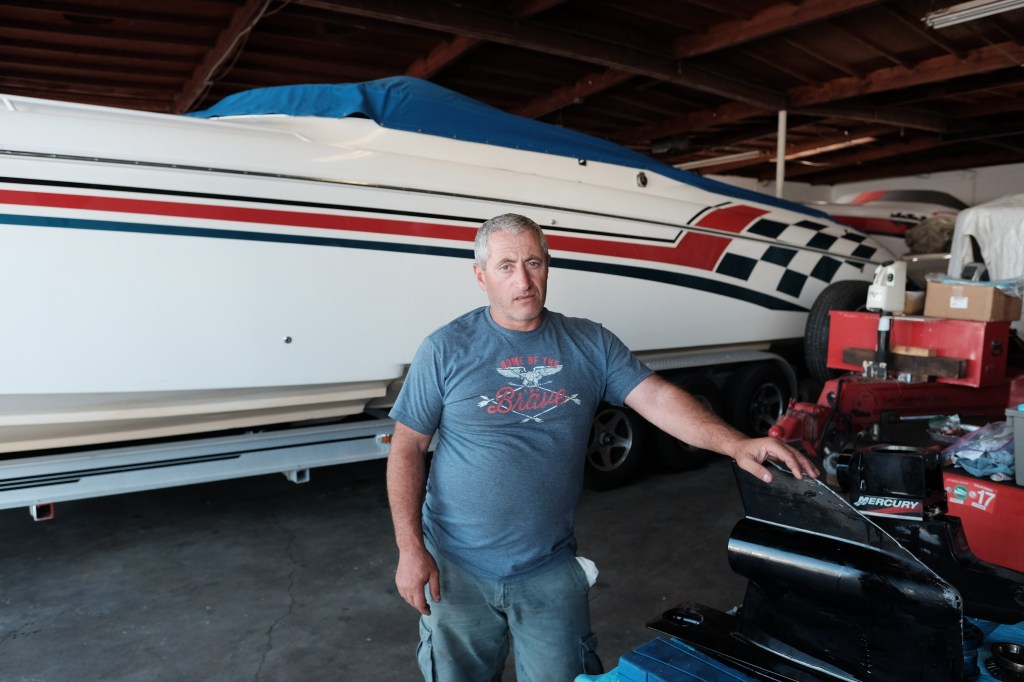
Steve Muradyan

At BPM Custom Marine on Calvert St., Steve Muradyan, 46, services and stores high performance boats at a rented facility. Here are dozens of racing craft costing from $500,000-$1 million, owned by wealthy people in Marina Del Rey and Malibu. The boats winter in Van Nuys, where they are expertly detailed, inside and out.

Mr. Muradyan, a short, broad-shouldered, sunburned man with burning rage, threw up his hands at the illogic of his situation. He takes care of his wife, two children, and aging parents. He pays 98 cents a square foot in 5,000 SF and he cannot fathom where he might go next. A wide driveway accommodates the 50 and 70-foot long boats. And he can work late into the night drilling and towing, without disturbing others.

He once ran an auto repair shop on Oxnard. Later he had a towing service. Then he started his boat business in 2003. He had raced boats as a young man, and this was part of his experience and his passion. Why not?

He deals with all the daily stress of insurance, taxes, payroll, equipment breakdowns, deadlines, customer demands, finding parts, servicing the big craft. He worries about his business, his family, his income. And now this impending doom, dropped from the skies by Metro. He prays it will not happen to him. He cannot fathom losing it all, again.


Art and Soul in Stained Glass: Simon Simonian 

Over at Progressive Art Stained Glass Studio, 70-year-old architect and craftsman Simon Simonian rents a small unit on Aetna where he designs and molds exquisite stained glass for expensive homes, churches, synagogues and historic buildings.

He knows all the local businesses, and often he sends customers to the cabinetmakers and metal honers steps away. There is true collaboration between the artisans here.

A kind, creative man with a penetrating gaze, Mr. Simonian, with his wife and young son, came from Tehran in 1978 to study in Southern California and escape the impending revolution in Iran. He speaks Farsi, English and Armenian.

He is an Armenian Christian and his family was prosperous and made wine. His father had escaped the turmoil in Armenia when the Communists took over after WWII, which was also preceded by the massacre by Turkey of 1.5 million. His people have suffered killing, expulsion, persecution, and the loss of dignity in every decade of the 20th Century.

The Simonian Winery was doing well in Iran in 1979. And then the Islamists came to power and burned it down. By that time Simon and his wife and son were in Southern California. He begged his father to come but the old man stayed in Tehran and died five years later.

Tenacity, survival, and intelligence are in his genes.

“I love what I do. I have loyal customers. The location is excellent. I know all my neighbors here. I want to stay rooted. I don’t want to have to start all over again. Where can I find space like this? Where will I go?” he asks with the weary experience of a man who has had to find another way to proceed.


The Man from Uncle: Scott Walton

55-year-old Scott Walton looks every bit the rocker who runs the recording studio. He is longhaired and lanky. With a touch of agitation and glee, he slips in and out of the dark, windowless rehearsal spaces of Uncle Studios, where he has worked since 1979.

His father, with foresight, loaned $50,000 to his two sons, Mark, 20, and Scott, 17 to buy a recording studio. Here the boys hosted thousands of aspiring musicians including Devo, The Eurythmics, Weird Al Yankovic, Weather Report, Yes, Black Light Syndrome, No Effects, The Dickies, Stray Cats, and Nancy Sinatra.

When Scott first started he didn’t play any music. He learned keyboard, classical piano and he also sings. He went on the road, for a time, in the 1980s, playing keyboard for Weird Al Yankovic. He also plays in Billy Sherwood’s (“Yes”) current band.

Despite the proximity to fame, talent, money and legend, Uncle Studios is still a rental space where young and old, rich and poor, pay by the hour to record and play music. Something in the old wood and stucco buildings possesses a warm, acoustic richness. Music sounds soulful, real and alive here, unencumbered by the digital plasticity of modern recordings.

But Scott Walton is also a renter. He does not own the building bearing his business name. If his structure is obliterated, he will lose the very foundation of his life, his income, and his daily purpose. He will become an American Refugee in the city of his birth.


This is only a sampling of the suffering that will commence if Metro-Martinez allows it. The Marijuana onslaught is also looming.

On the horizon, Los Angeles is becoming dangerously inhospitable to any small business that is not cannabis. Growers are paying three times the asking rental price to set up indoor pot farms for their noxious and numbing substance. There may come a time when the only industry left in this city is marijuana.

The new refugees are small craftsmen running legitimate enterprises. Some may not believe it. But I heard it and saw it on Aetna, Bessemer, and Calvert Streets.

The pain is real, the fear is omnipresent and the situation is dire.

SaveSave

SaveSave

SaveSave

Option A: Silencing the Sound of Mustangs.


Just east of Kester, on the north side of Bessemer,  Mustangs, Etc. has been servicing, restoring and selling that model of Ford since 1976.

They occupy three buildings. Two are rented, and one is owned.

There are 20,000 square feet, in total, of vintage parts stacked high and piled thick, inside cavernous, narrow, metal-shelved rooms with wood-framed ceilings, some punched out with skylights. Dusty light pours down through decades of spider webs to illuminate every small, medium and heavy part that might go into any Ford Mustang built since 1964 1/2.

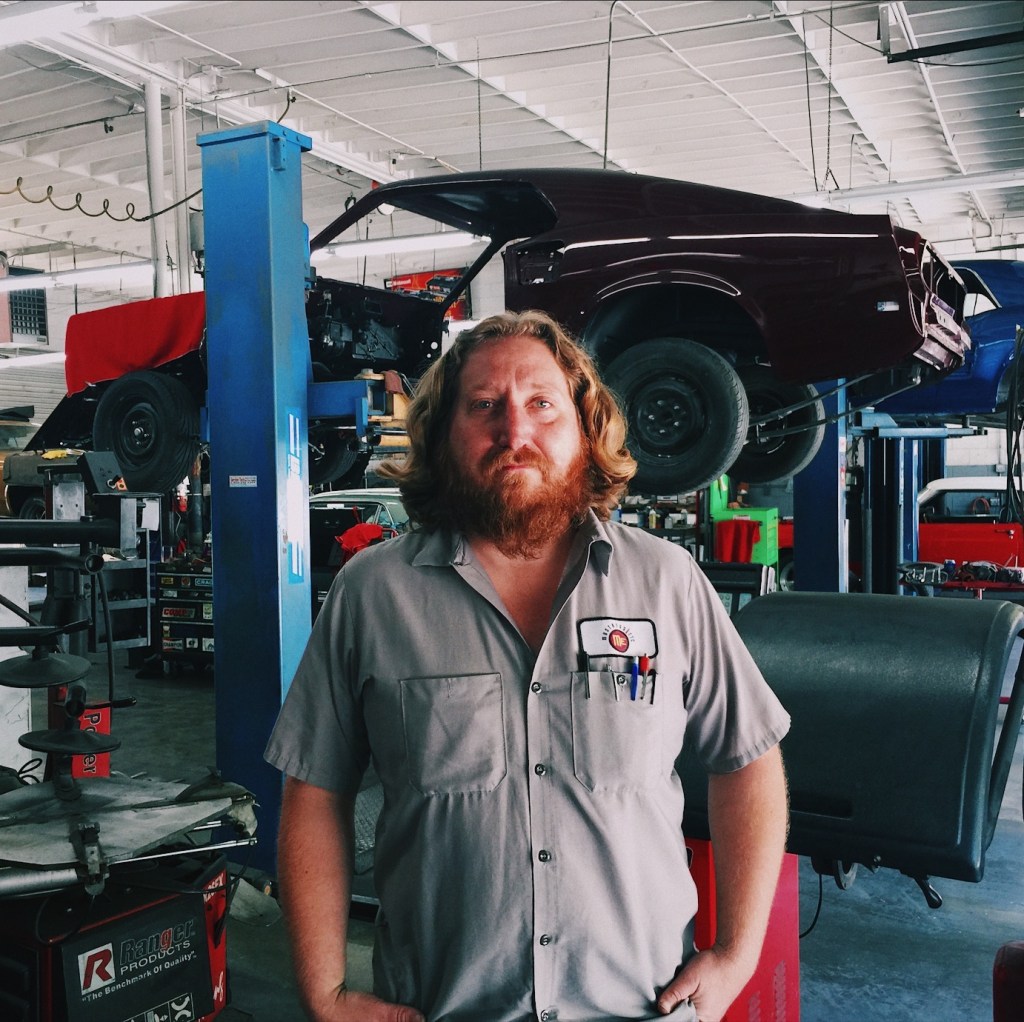
Garrett Marks, 37; musician son of the founder, Arnold, 76; lead me on a tour of their facility. Thoughtful, quiet, bearded, limping somewhat from a two-year old accident, he wears his red hair long and speaks softly and knowledgeably about his family business.

“I feel like a historian, an archaeologist, and an investigator,” he said, as we walked past rows of steel tire rims, drive shafts, 14″ Spun Aluminum Air Cleaners, spark plug cables, brake pads, fuel pumps, stainless hood hinges, ’67 Mustang air conditioning vents,auto lamps, hydraulic hose lines, Bendix Radios, and stacks of vintage dashboards with fuel, oil and speedometer instrument panels.

We passed those extra-large, circular Mustang gas covers from the early 1970s.

Mary Tyler Moore, are you still on that highway to Minneapolis?

Inside the parts office there was a straight-haired young woman who sat in front of a computer screen. Her digital device seemed out-of-place in a fluorescent lit, wall-paneled room overflowing with volumes of instruction manuals: 1969,70, 71, 72, 73 Wiring and Vacuum Diagrams, 1959 Edsel Maintenance, and a glass case with headlights, key chains and other ephemera seemingly mixed up and tossed about by mischievous ghosts.

A few buildings down the block I toured the service garage.


It is expansive, bright and light filled. Jocular young men in dark blue uniforms with retro names (Scooter, Steve, Mike, and Gil) worked on vintage Mustangs and mocked one another in friendly terms.

It was like a scene out of old Kansas somewhere in a small town. I thought the boys might get a lickin’ if Auntie Em or Uncle Arnold came onto the floor. It could play out like “The Wizard of Oz.”


               AUNT EM

Here, here, what’s all this jabber-wapping when there’s work to be done? I know three shiftless farm hands that’ll be out of a job before they know it!

               SCOOTER

     Well, Garrett was walking along the —

               AUNT EM

     I saw you tinkering with that contraption, Scooter. Now, you and Steve get back to that wagon!

               SCOOTER

     All right, Mrs. Gale. But some day they’re going to erect a statue to me in this town, and —

               AUNT EM

     Well, don’t start posing for it now. Here, here — can’t work on an empty stomach. Have some crullers.


A few jaunty, groovy autos were positioned high, held up on hydraulic vehicle hoists. Each mouth-watering, metallic Mustang body was a different color: deep red, orange, blue, and misty green. Each evoked a sensory flood of memories, for me, that fast time, 50 years ago, when people drove fast and unbelted, and every car you passed in Malibu had women in short skirts with long hair and big sunglasses smoking. Everyone you saw was 18, smooth-faced and sat in the sun and went to the beach every chance they got.

Those Mustang Dreams were getting renewed in present day Van Nuys. Their exteriors polished, their engines tuned up, their interiors sewn and repaired and given a yearly dose of immortality denied to their owners. A freshly restored Mustang gallops like an unbridled pony. It embodies youth, fury, energy, and a temporary escape from any debt, duty or obligation.

Just outside the garage, out on the black top, Ray was demonstrating a 1967 Lincoln Convertible Sedan whose top unfurled electronically and was stored in a giant steel trunk that opened to receive it and seemed ominously capable of holding five dead gangsters comfortably.

I met Arnold, the founder, and we sat in his office as he spoke.

He was born in Detroit in 1941. His father was a skilled auto mechanic. They came to South LA after the war, and Arnold came of age during Kennedy’s New Frontier when the Presidency was still profound and its occupant quotably inspiring.

“Ask not what your country can do for you, but what you can do for your country.”

The young idealist Arnold wanted to teach. He got his certification, and he went down to South Central where he encountered disheartening road blocks: a disdain for education, broken families, poverty, and children who passed around bullets in class for amusement. In those schools, at that time, before busing, there was no order, no discipline, no respect, so he soon went to find another way to work.

He got smart and retrained as an auto mechanic. By luck, he found another spot near Kester, and began his operation in 1976. His rent was $900 a month so he had to hustle. He found that his specialty in Ford Mustangs was dear to many, including celebrities such as Jay Leno, and Miley Cyrus among others.

Like all business owners in Los Angeles, he found that he had to fight, not only for customers, but against appalling social conditions in the neighborhood. There was illegal dumping, homeless encampments, drug dealers, drug addicts, thefts, and murders.

Arnold with Miley Cyrus.

The expansion and landscaping of the Orange Line (2005), with its lush trees, bike trail and dedicated bus route also ironically hampered the operations of Mustangs, Etc. For now Bessemer Street was narrower, there was no room for tow trucks to drive. The leaves from the many shade trees blew into the property, creating a fire hazard, necessitating removal.

Arnold does not believe “Option A”, the plan to destroy his business and hundreds of others for a Metro Light Rail Service Yard, will happen. “If we are evicted where will we go? There are no other affordable, convenient places for a small business. Many of our customers come from Hollywood or over the hill, so they aren’t going to drive to Pacoima.”

Mike

General Manager Mike thinks the plan to demolish 33 acres of industrial Van Nuys will create some huge environmental problems as decades of discarded oil, poisons, liquid metals and other bio-hazards, once willfully dumped, buried into the soil, are released back into the air. Adjacent homes will see clouds of dust blow over them as bulldozers, jack hammers and shovels unbury deadly toxins entombed in dirt since the 1940s.

If Mustangs, Etc. and other businesses survive this threat, a piece of historic but still functioning, producing, contributing, industrial Van Nuys will have had a small triumph. These family owned companies, mostly employing locals , walking to work, or living nearby, these places of quiet accomplishment and enduring fortitude shall not perish from this Earth.

SaveSave

SaveSaveSaveSave

Love in an Inhospitable Place.


DSC_8322

The railroad tracks have been here a long time, at least since 1937, when they came to California from Tennessee.

They were hammered down through orange groves and alongside citrus packing facilities.

They are still here, near Raymer and Sepulveda, in an inhospitable place, now settled with high security storage containers, barbed wire fences, metal recyclers, auto repair, and a crooked, concrete-walled river surrounded and imprisoned by tall, spiked iron.

All Aboard Mini Storage

DSC_8319

DSC_8356

W. of Raymer St. BridgeVan Nuys, CA.

At sunset, when the heat has broke, on a summer evening, you may come up here and trespass, viewing Van Nuys from its backside, learning its ways by seeing it in its golden gruesomeness. If any planner had sought intentionally to build monstrosities that defy humane and civil urbanity, he could do no better than emulate this dystopia.

Raymer Street Bridge is a pedestrian bridge, perhaps the world’s ugliest, deformed and graceless, a steel structure reeking of urine and feces, trashed with discarded beer bottles and marked with violent paint in glowing hues. From atop the bridge at late day, the panorama of hazy mountains and the valley are at last tamed into something soft, artistic and implausibly romantic.

Young friends, or lovers, skateboarders and strollers, they come here to talk and to kiss, to ride their boards on the glass-sharded concrete; to ponder and dream in a landscape where nothing is ennobling or spiritual. They are defiant in their gentleness, renewing love and humanness, while all around them, an indifferent, mean and feared section of Los Angeles tells them, in so many words, welcome to hell.

DSC_8382

Raymer St. Bridge

CSC_8411