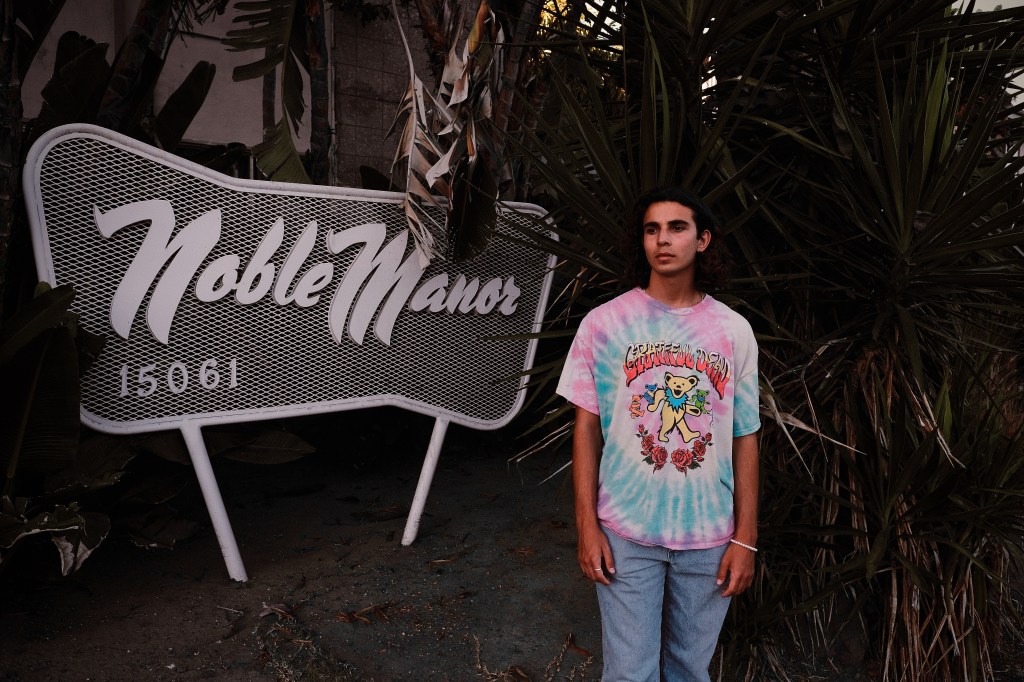
Portraits of Dovid K. and “Kester Ridge.”


Actor Dovid K. was raised in Los Angeles, and he came over to our neighborhood last week for some agency photos.

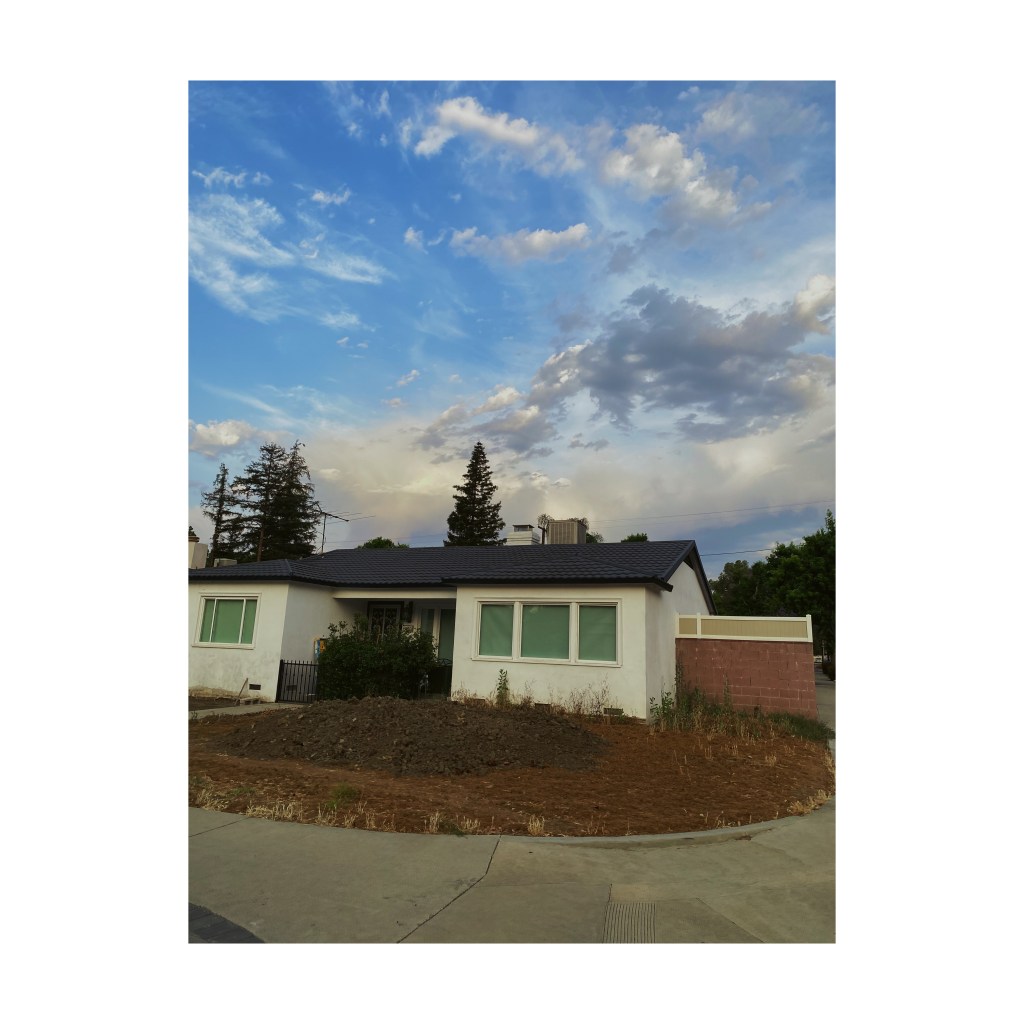
The houses in our area (Victory/Kester/Columbus/Vanowen) were built in the 1950s, and due to the modesty of the neighborhood, many look roughly the same. There are the criss-crossed windows, the board and batten siding, the pastiche of architectural decorations that mid-century developers affixed to facades to make them warmer and more appealing.

The vintage styles have weathered six or seven decades and endured as archetypes of the San Fernando Valley. This section of Van Nuys was ideal because it was walkable, just across the road from the high school, near the shopping centers along Sepulveda. Those were the days when children rode bikes and walked to school and there was always someone home to greet them at 3pm.

Times change. Children don’t walk, they are driven.

Behind the house on the right someone is building an ADU out of an old garage. They installed solar panels like many of their neighbors.

This sign belongs in the archival collections of Valley Relics.

This totem statue was erected by a previous owner and still stands.

This house will have a new ADU in front, an adaptive revitalization of a classic Valley ranch house from the early 1950s.

There is something about the middle 1950s that endures in many of the houses, a cozy casualness of not so big houses with big lawns, semi-circular driveways, trees, hedges, and decorative lampposts. A lot of it is not so up-to-date. If this were Studio City or Brentwood these houses would have been long gone, demolished and replaced with white faced behemoths and tall gates and enormous SUVs on every property.

Sadly, many of these houses sell for over a million and are not quite starter homes. But they are home for many who inherited them from parents, with low property taxes and little or no mortgage payments. For the lucky ones who got lucky, this is kind of a paradise, guarded by NextDoor and patrolled by helicopter, seemingly an American paradise on the ground.

And it makes a good backdrop for a young man who channels the 1960s.

The Folks Who Moved in Next Door.


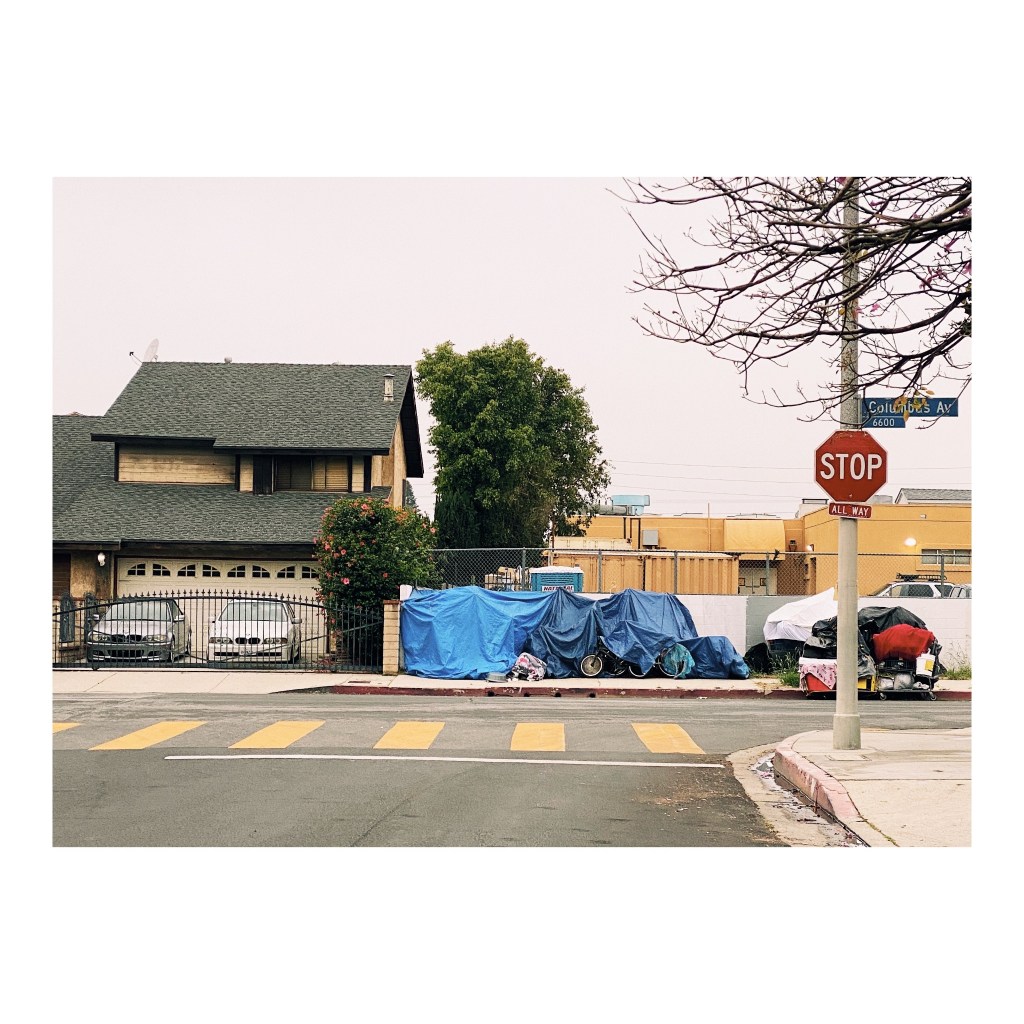
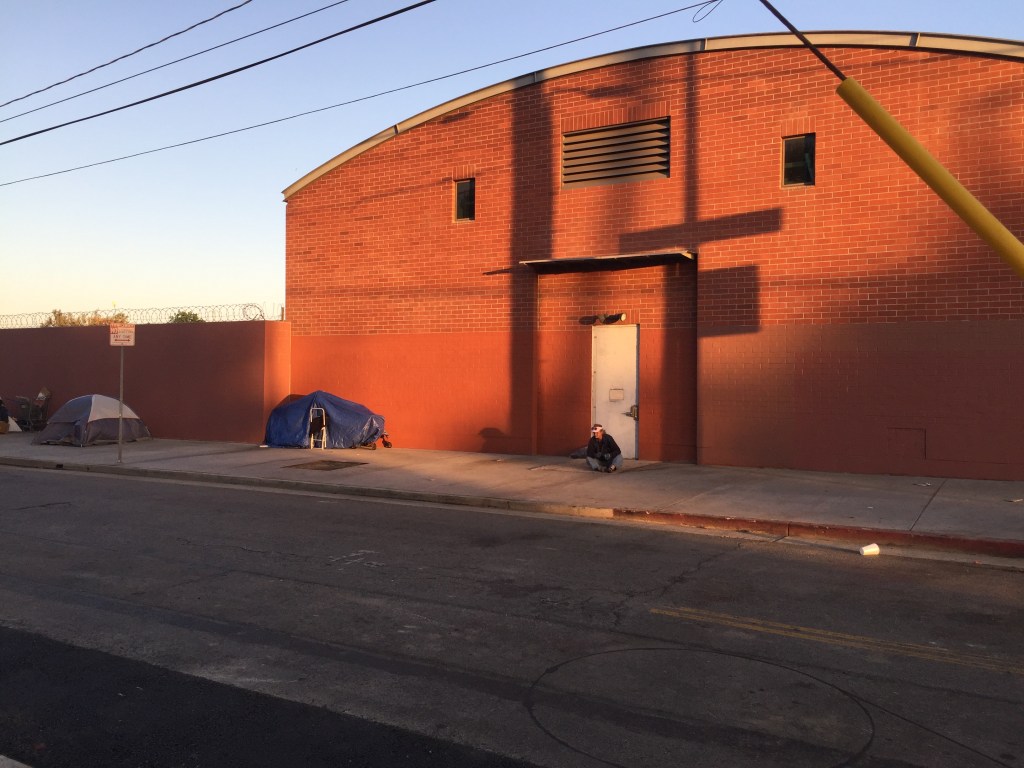
For about five years, an encampment of vagrants, with cars and trucks full of bikes, shopping carts, electronics, blankets, and various junk, spread their filthy circus along the corner of the Vanowen and Kester.

There were men and women in parked cars, and drugs, and women in the back seats of the vehicles. The sidewalk was taken over by them. They had complete autonomy and seemingly the blessing of the city to live outside.

Our senior lead officer, whose name I don’t care to name, cleared them away. He appears monthly on a Facebook chat room to brag about the latest clearance. “Happy to say they are gone,” he will say on Zoom.

But the camp of tramps always comes back.

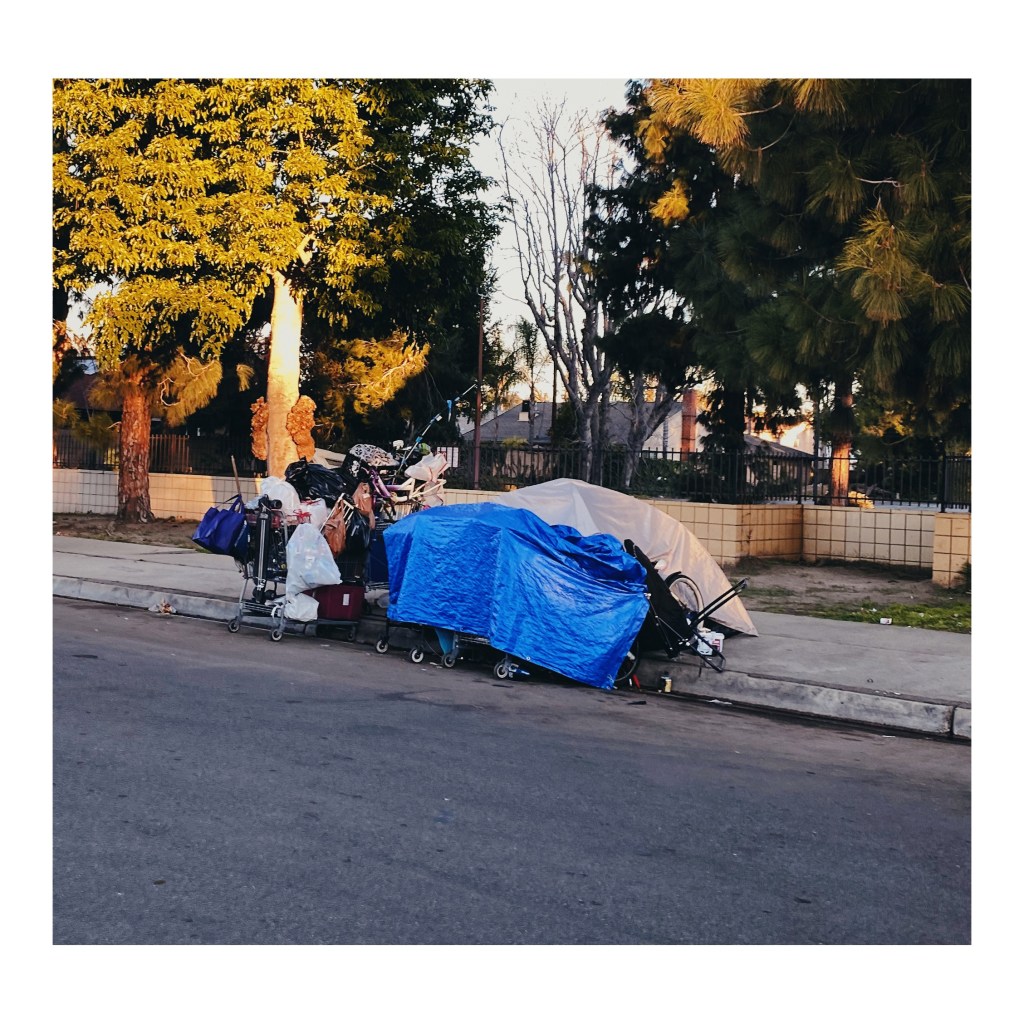
They next set up their junk show on Lemay, in a quiet residential area, where they lived along the parking lot that borders the Casa Loma College.

Day and night they sat out on lawn chairs or slept on mattresses behind trees. One man danced with his dick out for an 8-year-old girl who rode her bike past. Complaints flooded LA311. Ms. Nury Martinez, Latin-X Councilwoman, got letters, emails, phone calls. LAPD Van Nuys was called numerous times. Yet the trash camp endured.

Outdoor urination, pot smoking, liquor, prostitution, dumping, disorder, noise, none of it mattered. It stayed in place, just like the homeless circus that has played on for 3,000 days and nights at the NW corner of Gault and Sepulveda. 

After six months, their crap was cleared. 

Two weeks later the tarps and the shopping carts went up along Lemay near Norwich. That took dozens of calls to remove. Then it was gone.

Then they came back to Saloma and LeMay. That lasted a few months.

Now they have reappeared along Columbus Avenue across from the grammar school. While it’s doubtful anyone is actually learning grammar in that one-starred rated school, what’s certain is that the garbage camp is illegally set up in full view. 

When people wonder what drives Angelenos mad, it is this: there is no control on the disorder and criminality of this city and state. 

San Francisco, true jewel of the west, has gone to hell.

Los Angeles, costume jewel of the west, has followed suit.

And when mayoral candidates go on podcasts and talk ad nauseum about their humane and expensive solutions for the poor people who are homeless, you want to scream!

Why should the suffering of private persons, their addictions and mental illness, be allowed such a prominent and destructive place in the lives of all law-abiding citizens in the State of California?

“One of my proposals is to create a $1 billion revolving private equity fund with which to build permanent supportive housing. That’s housing that’s been costing $600,000-800,000 a unit. That can be cut to a third of that cost using a private equity model that has worked on the streets of Los Angeles,” says Mayoral Candidate Mike Feuer.

Is anyone knocked-up on drugs and alcohol going to sober up in a new, unsupervised housing unit?  

Here’s an idea: use the billions in homeless funds to send $100 Visa gift cards to legally housed residents, home owners and renters, who report trash camping in their neighborhoods. Top off the yearly payments to those who report the vagrants at $2,000. Thousands of Angelenos, short on money for gas and groceries, would be impelled to report vagrancy and clean up dumps that have destroyed our city.

Do the people burning down parks and sleeping under tarps on bus benches care to move into a new studio apartment? 

Trash camping?

Don’t permit it. Don’t allow it. Don’t normalize it.

Burning parks, setting fires along freeways, camping out on public sidewalks and streets. This is the state of California, the most technologically advanced region on the planet.

So much money, so much talk, so little results.

Lemay, west of Kester


On Lemay St. just west of Kester, a trash camp has been removed, then put back, then removed, then allowed back.

Residents of this tidy and pleasant section of Van Nuys know their area is not unique in the suffering brought on by government negligence.

Countless calls, emails, Zoom meetings and tweets have not changed a thing. The trash camps are a steady reminder of how far California has fallen, how pathetic the situation of law and order is.

Three months ago, the LAPD Van Nuys division held their monthly talk and all the Senior Lead Officers spoke. Our man proudly stated he had removed this trash camp, which previously was unhoused on the SE corner of Vanowen and Kester.  The camp then moved itself, shopping baskets and cars, to Lemay.

I don’t blame him or law enforcement for “allowing” the trash camps. This one, like many, has been cited for prostitution, drug dealing, and indecent exposure. The police are handcuffed by law.

A neighbor on NextDoor wrote that her granddaughter was playing outside when one male vagrant came up to the little girl and pulled his pants down.

He allegedly still lives in a tent along Lemay. Why?

There are many reasons to be depressed about life in Los Angeles today. In fact, progressive, thoughtful, sensitive Councilman Mike Bonin, who famously allowed murders, trash fires and thousands of vagrants to camp out and cause mayhem during the pandemic, has said he will not run for reelection, citing his personal battles with depression.

Bless him. But let him be gone to serve his emotions first so millions in our city can awaken happier tomorrow. 

Lest people who read this essay think I am advocating against the Democrats or liberalism, I instead am posturing for a middle ground of care for the addicted, and housing for the lost and beaten down. 

You can arrest them, jail them, deport them, or kill them, but only if you live in China or Russia. For those of us who still believe in American ideals, the law constrains us from revenge, even as we seethe in anger and contempt for the disorder and crime around us. 

But we also need local laws that apply to the entire city. We cannot stop enforcing with exceptions. Like near a school or hospital or homeless services building.  

It categorically must be completely illegal to camp out and live in a public park, on a public sidewalk, to urinate and defecate outdoors. Anywhere.

We cannot parse our laws to such inanities as prohibited “within 500 feet of a school.”

Imagine if we said you could drive blindfolded, stone drunk at 100 miles an hour, if you never drove past a school?

One of the bitter ironies of Los Angeles is the amount of wasted space that exists where civilized, regulated and sanitary communities could be erected to house the unhoused.

Next to the encampment on Lemay is the sprawling parking lot of the Casa Loma College which used to be a building that was the home to the American Automobile Association.

99% of the time the parking is empty. The entire lot, building and parking, is 112,994 square feet, 18 times larger than a 6,000 square foot “single family lot.”

Home Depot sells a backyard studio building that is 10’x 12’. It costs about $45,000.

Even if that is overpriced, imagine if within the bounds of the Casa Loma parking lot an agency or non-profit built 25 of these and there was a full-time security officer overseeing this community? What if this model town became a blueprint for other humane towns throughout Los Angeles?

There are, to be sure, many objections to this, but they are often imaginary, created in the minds of fearful residents who object to new types of supportive communities which are actually superior to the “free market” ones that currently exist.

The Skid Row Housing Trust is an exemplary non-profit which “provides permanent supportive housing so that people who have experienced homelessness, prolonged extreme poverty, poor health, disabilities, mental illness and/or addiction can lead safe, stable lives in wellness.”

They built 13604 Sherman Way, designed by architect Michael Maltzan, in 2014. It is houses 64 people but was bitterly opposed by the community before it went up. Yet it is perhaps the most attractive building built in the entire San Fernando Valley in the last 50 years.

But there is not enough of the good stuff. The trash camps are more numerous than these white paneled residences.

For now, the trash camps along Lemay, and everywhere else in the city, are a daily dose of depression for millions who live in Los Angeles and a barbaric and cruel way to treat people who must, through choice or circumstances, live under plastic tarps along the road. 

Columus Day.


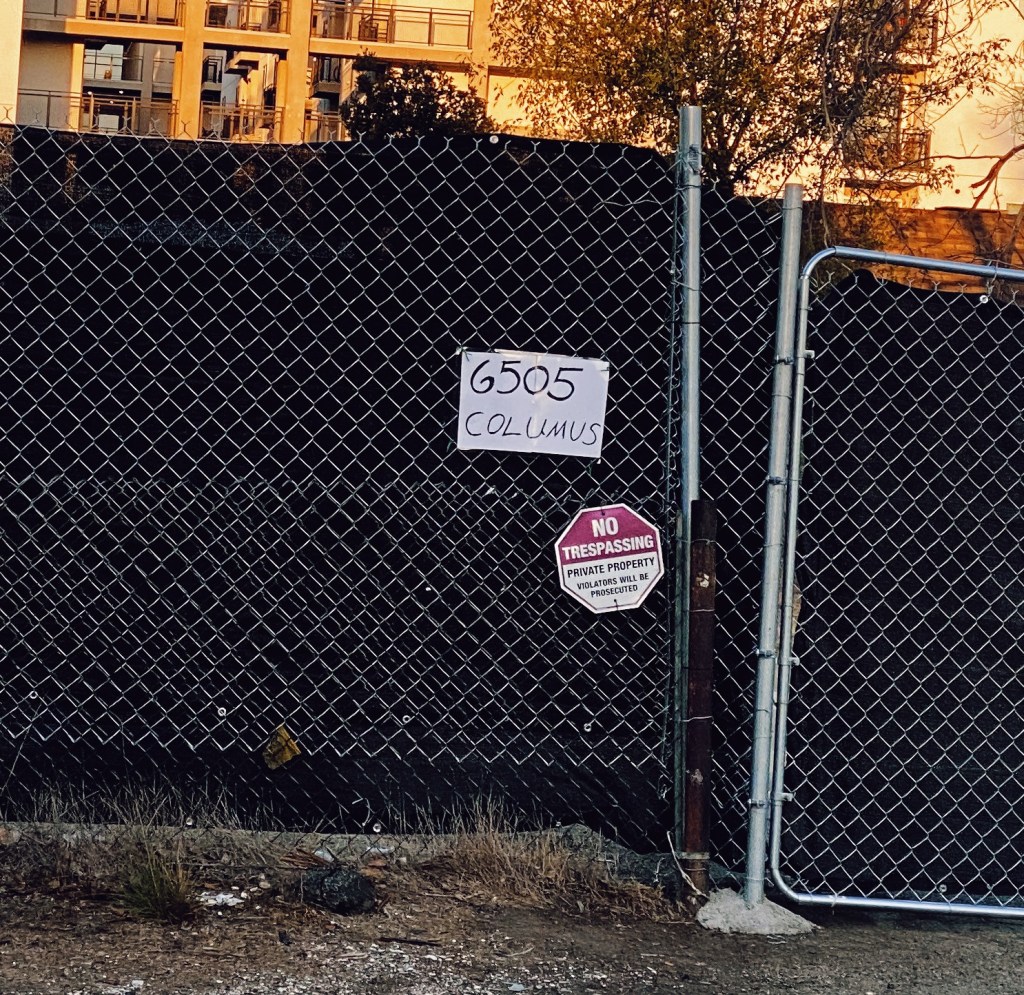
There is new construction fencing and green tarps in front of 6505 Columbus. A building permit has been created for a new single-family house on the one-acre site of the former Rancho Perfecto which I wrote about in 2019. 

The idea that the land will be graced with just one single house is ludicrous. Every property in the neighborhood is stuffed to the gills with accessory dwelling units, vehicles or marijuana gardens. And, in 2021, any one house on a given lot in Los Angeles must self-procreate.

The property is near the corner of Columbus and Hamlin. It is across the street from the blue sign, “Columbus.” Mrs. Tweddle, a writing teacher, resides opposite this lot and runs a school for writers, You Tell Yours . A couple of blocks north is the Columbus Avenue School. All around there are signs, schools, teachers and the word Columbus

Columbus is everywhere.

But the new sign is 6505 Columus.

A bad omen for that architectural phrase: God is in the details.

Given the paucity of refined signage what will the new house look like? 

I expect high walls, cinderblock and iron, and a lot of concrete to park large vehicles, Hummers, SUVs, dump trucks, and monster trucks. There will be high security cameras and floodlights all around, and perhaps a triple story, double front door leading into a vast marble hallway with plastic seating and a pool table. The style will be Home Depot on the Range.

This was once a pretty nice place to live, before the city and state went to hell.

On January 15, 1950, this property and original house was listed in the LA Times at $22,500. 

Large 6 rm ranch type with 1 ½ ba. plus guest house, rumpus room & bath, laundry house, tool house, large double garage with storage closets. Patio, lighted badminton court, bbq and plenty of shade and fruit trees and roses. 

Does anybody these days desire a badminton court?

Maybe badminton would improve the neighborhood.

Middle of June


It is only mid-June but already the extreme heat has landed in Southern California.

Every week there is another “record breaking” temperature in thousands of places, not only here but around the world.

To an older Angeleno, June once meant days of haze, overcast and cloudy.

The Pacific Ocean was cooler, even cold. The truly hot times did not start until late August.

Now the ocean is warmer, semi-tropical, and the clouds that emanate from the sea are the clouds we see in the sky, and they are the clouds one sees in places like Miami and Houston. There is “monsoonal moisture” and the air is thick, even in the morning, making the heat more intense.

I’m not a meteorologist but something is very strange in the skies these days.

This is what the “Kester Ridge” neighborhood looked like around 6:30 am today.

Around the Neighborhood.


Since the pandemic began, in earnest, last March, one of our routines is the morning walk around our neighborhood.

The fact that most of us live and work at home, self-incarcerated by choice or duty, has produced a strange life. Beside the societal disasters that befell our nation in 2020, the ordinary existence of the citizen is to wander out and wander back in.

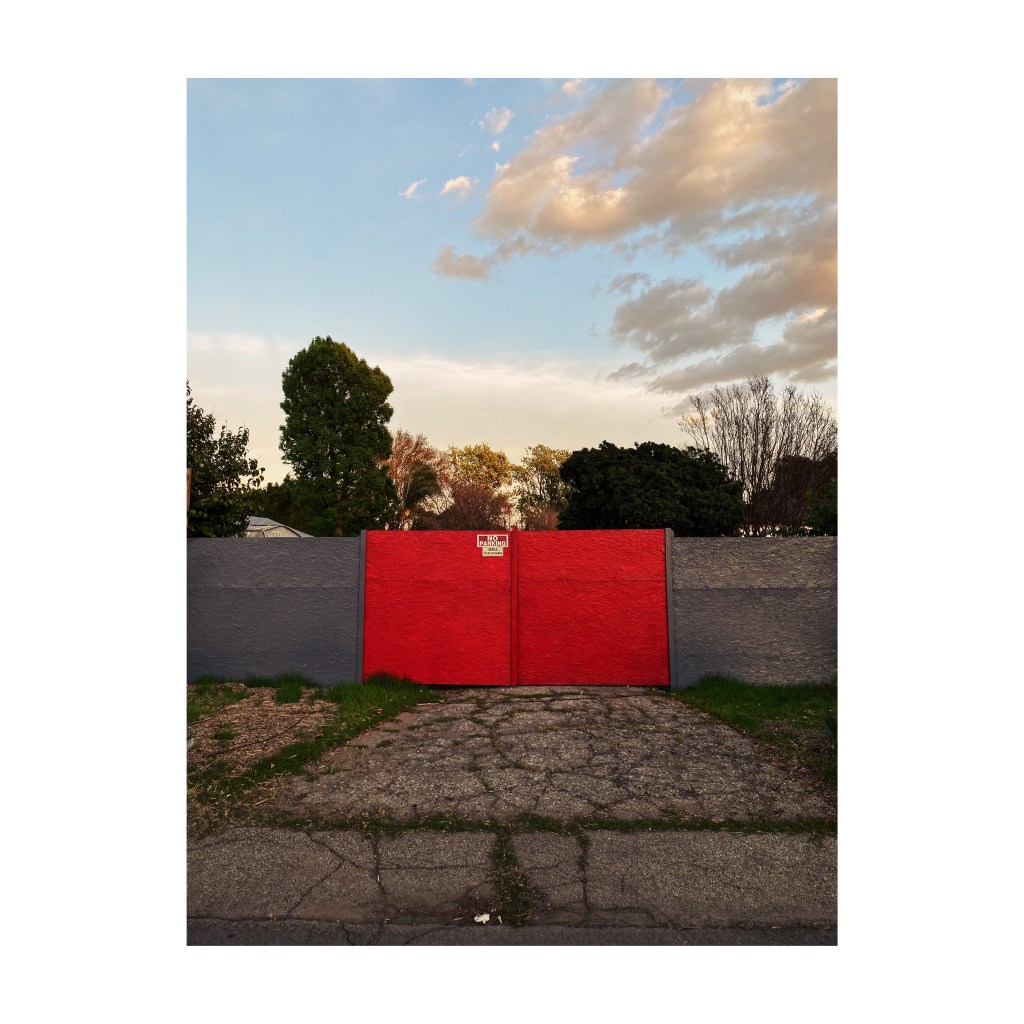
Wandering out, in the morning, or when the light is beautiful in the late afternoon, I captured some images of our area with my mobile and edited these on VSCO.

Kester Ridge is basically a 1950s creation of good, solid ranch houses between Victory and Vanowen, Sepulveda and Kester. On Saloma, Lemona, Norwich, Noble, Burnett, Lemay and Archwood the houses have endured, and only a few have been completely demolished or aggrandized. 

But the persistent trend is the ADU, the conversion of garages and backyards to multi-family dwellings. Many of these houses are rentals, and the ones that are owned also rent to others who may live beside the owners.

A few years ago this seemed problematic, and the idea that our backyard behind would sprout a second house four feet from our property line was unimaginable. But now we also have a gray box 4 feet behind us, 30 feet long and 15 feet high and we are OK with it, as long as the dogs, the noise, and the marijuana don’t also move in. 

Meanwhile, the ranch houses, the sidewalks, and the garages without cars stand silently and passively, unaware of their portraits.