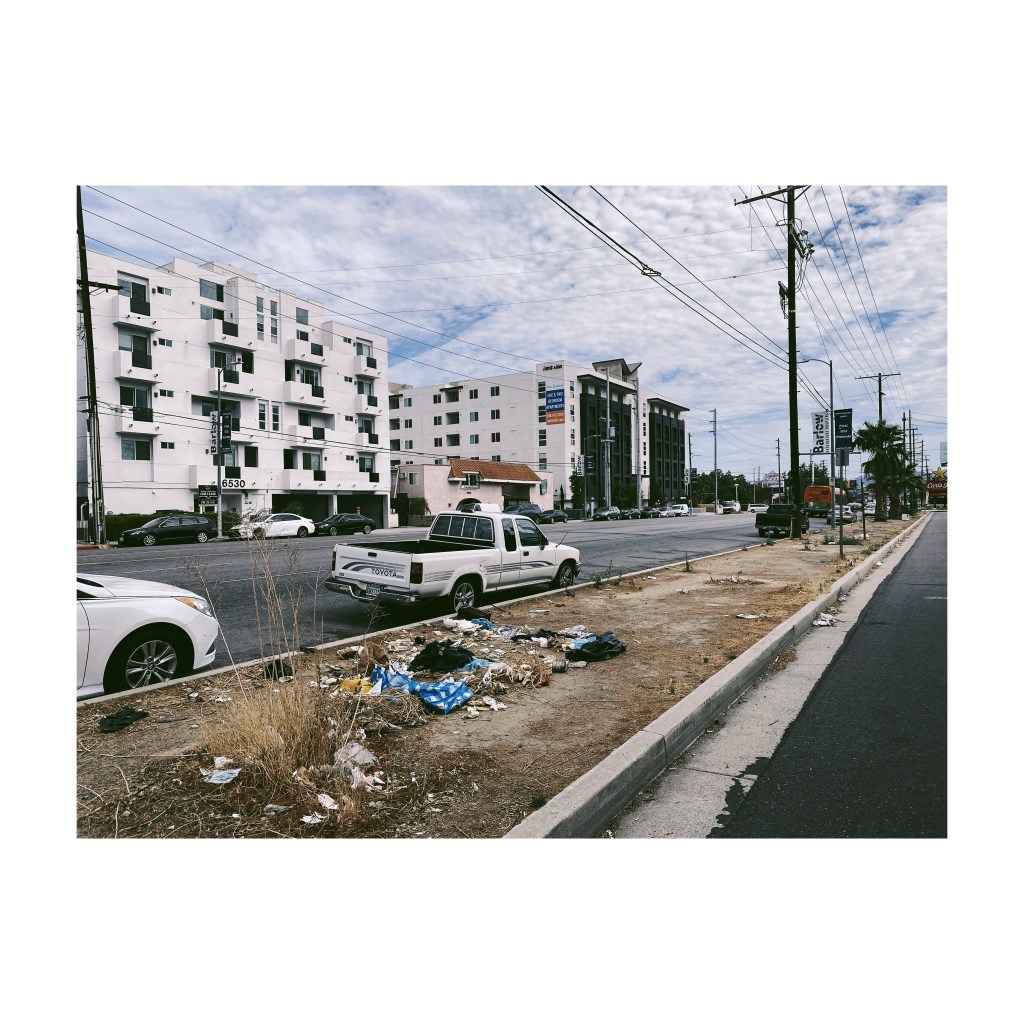
El Crappo


Running along the west side of Sepulveda Boulevard, from Haynes to Lemay Streets, is a traffic median, allegedly planted with trees, but mostly serving as a local dump for household refuse, a refuge for old couches, toys, luggage, mattresses, beer bottles, etc.

Nearby are new, gleaming, white paneled developments, including the rental apartments at IMT 6500, “with easy access to golf courses, tennis courts, jogging, bike paths and boating on the Balboa Lake.” With lush photographs and bucolic descriptions, one might mistake this online fantasy as Zurich, Switzerland.

Ugly before the pandemic, hideous now, it seems that the many unfortunate events of the last year will provide a generation of politician’s excuses for the deplorable environment Angelenos endure. Add in the presence of thousands of homeless, the daily fires in Balboa Park, the rancid smell of sewage, global warming, ever present violence, property crime, speeding cars and crashes, fireworks and pipe bombs,  and you have a drama that surpasses the worst conjurations of Hell.

But do not judge this district from the worst examples. There are lovely places nearby.

Just one block from here, at 15351 Haynes St. a home recently sold for almost two million dollars. 

On nearby Orion Avenue, a studio set neighborhood of picket fences, rose bushes and white houses earns many residents tens of thousands of dollars each month for commercial filming. And some of these glorious residences, worth millions, many inherited, pay less than $2,500 a year in property tax.

But few who live in the privileged homes venture out at night to stroll past Jiffy Lube, Dunn Edwards or Jack in the Box. And nobody has a picnic on the median. The pleasant events all happen behind tinted windows, in air-conditioned homes and vehicles, there is no pretty nature other than the yards dressed up for commercials.

And there is never any connection between the public, civic realities of life in Van Nuys and the private dreamscape of those fortunate enough to own a piece of paradise.

You end up in a mansion or dumped along the road.  Roll the dice.

The Incarcerated City.


_ABH2013 On these winter days, when the streets are emptied of cars, and the skies are filling with rain clouds, our neighborhood of Van Nuys cools down and empties out, revealing a strange amalgam of enormous parking lots; as well as businesses and homes surrounded by iron gates and fences.

In its entirety, these fortifications evoke prison: a high security, patrolled, guarded, and fearsome place where criminals and children are kept back by a fortress of steel and iron.

_ABH2050 _ABH2047 _ABH2032 _ABH2042

For sixteen years I’ve lived here, always imagining that every New Year will bring an imaginative, humane and socially comprehensive new architecture into Van Nuys.

I fantasize that the parking lots will be torn up and rows of orange trees replanted in the soil. I think someone will see the enormous plots of land, now taken up with blight and decay, and see this as the new place to construct walkable communities with native plants and organic gardens surrounding little residential communes.

That is the dream, shared by some of my neighbors.

Reality is something else.

_ABH2029 _ABH2030

On Sepulveda, between Archwood and Lemay, the hellish Ridge Motel is on Death Row, surrounded by fencing and covered with graffiti and garbage. It had long outlived its usefulness and functioned only as a prostitution and drug outlet, blighting its surroundings and neighbors.

Across Sepulveda, Fresh and Easy has closed, taking with it moldy produce and difficult checkouts. But sometimes I’d come here, and liked its convenience, its weird combination of English, Indian, Spanish and Asian foods, its overpriced milk, eggs and breads. And I miss that friendly manager who always smiled and helped me.

One Thanksgiving, about 2012, we bought our entire meal here and ate it back home with my mother, a pre-made, plastic topped collection of containers with sweet potatoes, mashed potatoes, stuffing, cranberries and turkey. My father had recently died, and my mother was to die two years later, and the holiday meal had a morose sadness intensified by the microwaved artificiality of our victuals.

Fresh and Easy is gone, but what remains are those walls and gates around it, and that big parking lot in front, and a reminder that even when there is no business, or no people, we will still live in an incarcerated city, a place where entrances and exits are controlled, and guarded from either imagined or real, chaos and crime.

_ABH2016 _ABH2018 _ABH2022 _ABH2023

And those vast spaces of nothingness that are spread all over, those too are outdoor jail yards of lifelessness, neither urban or rural, human or natural.

These are the prisons that keep us captive and hold our imaginations and our existence hostage.

_ABH2037 _ABH2036


The Local Sweeties and Public Safety.


IMG_9555

Courtesy of a community minded neighbor, we folks gathered tonight in a computer lab inside Casa Loma College on Kester to hear Senior Lead Officer Erica Kirk, Gang Officer DeLeon and a man from the Los Angeles Department of Building Safety speak about property crimes, prostitution and gangs.

The people were mostly older, largely white, and on friendly terms with one another. Before the speakers began, two chatted up about church, “I don’t hear the bells ringing any more!” and on grandchildren, “My granddaughter still works in Woodland Hills for a sod broker!”

Around the building, within spitting distance, ghetto apartments were sprayed with gang signs, prostitutes walked freely, speeding cars plowed through red lights, and old refrigerators and couches were dumped alongside the road.

But inside the room, reassuring voices of authority, festooned with badge and pistol, spoke of laws and arrests, patrols and progress against criminal activity.

Abandoned houses, trashy front yards, barking dogs at 3am, explosions, gunfire, helicopters, stolen cars, discarded marijuana containers, dumping, ubiquitous sex trade, stinky winds that blow sewage smells into the bedroom, none of these facts of life in Van Nuys would soon disappear, but some attendees were damn angry and determined to speak up and put a stop to the madness.

“Why don’t you arrest these prostitutes and ship them up to Nevada where it’s legal!” one man yelled. “They’ve been at it for forty years on Sepulveda.” And I pictured a sad whore, walking in the sun since 1975, wrinkled, abused and hated by local homeowners.

Another new arrival to Orion came with his pretty wife and spoke about his accounting of the used condoms found on streets around his beautiful estate.

“Since August 1st I’ve counted 33 condoms on Blucher, 44 on Langdon, 53 on Peach Avenue and 27 on Blucher!” he announced. My mind, always visual, imagined a sticky, gooey condom near a peach. For his wife, inviting the grandchildren into the front yard while a sex act was going on in front of the roses and white picket fence was quite appalling.


Some gentle people seemed innocent as to the fact that they lived amongst violence and anarchy. “The Mexican Mafia? What’s that?” a woman asked.

Another older woman spoke of her son coming home at 3am and passing three young men tagging a stop sign near Valley Presbyterian Hospital. “He stopped his car and rolled down his window and asked them why they were doing that,” she said. Officer DeLeon advised that it was, perhaps suggestible, not to confront three taggers at 3am in Van Nuys.

If Donna Reed and her family were transported to tonight’s meeting they would fit right in. That old time Angeleno, who came of age after WWII, whose life was formed in a sea of childish televised wonderment , made an appearance tonight, as delightful and improbable as Walt Disney meeting the Devil.

The local sweeties who came for this meeting were the nice ones who make up the silent and invisible and powerless backbone of Van Nuys. They cannot compare, in numbers or influence, these citizens, to the 180,000 who are in Van Nuys illegally, and whose presence regularly is spoken of in terms reverential and pandering, as when immigration reform comes up, as if we as a nation are commanded to do something to break the system further and destroy national sovereignty in the name of political correctness.

These people who gathered here tonight are regularly told there is not enough money for law and order, but when I spoke up and asked the crowd if they would pay fifty cents a gallon tax on gasoline to double the size of the (13,000) LAPD and bolster it, nobody raised their hand. “Why don’t you tax cigarettes?” a female cancer patient asked.

There will no doubt be more community meetings in the future, but the prospect for improvement in Van Nuys is dim. Without leadership, even the best intentioned community group, even the best cops on the beat, cannot hope to overcome the nonsensical and insane carnival of crime that dances all around us day and night. IMG_9557 IMG_9552


Border Crossing.


screenshot_236

DSC_6671

DSC_6744

In North Hills, at Plummer, west of Sepulveda, the old and new San Fernando Valley sit side-by-side, stretched out on hot flat roads baking in sun.

North of Plummer, along asphalt and stone paved Orion Avenue, remnants of large properties sit in dry decay, pits of impoverished ranches behind dumps of rusted old cars, tarp covered boats, obese RVs, piles of wood, barking dogs, torn up sofas and iron gates. Un-watered and un-loved, once young and lush, now mangled and vandalized, blocks of withering draught, many acres of empty ruin, sit neglected and forgotten beside the roaring 405.

Rural delivery mailboxes, elderly Aloe Vera clumped and planted along the road, sawed stumps of logs, green Valley Oaks on yellow grasses, tall and proud wooden utility poles, cyclone fences; the San Fernando Valley of 1945 awaits its final pronouncement of death on this stretch of Orion.

9000 Orion Ave

Quesadillas & Hot Dogs %22Maria%22

And then there is a border crossing at Plummer.

South of here, the streets are crowded, full of cars, pick-ups, street food, apartments, children, fat women in black spandex, tagged walls. The hum of traffic and the sound of Spanish, the ringing bells of ice cream on wheels, the smoke and smells of taco trucks, the improvised milk crates set up al fresco in a church parking lot for cheap and exhausted dining, the young fathers and mothers pushing strollers and herding children along, the food signs for pollo, jarritos, sodas, asada; in the churches, on the faces, behind the apartment doors: the presence of Jesus in every corner. Selling food, fixing cars, repairing tires: industrious, solicitous, hard-working people find a way to earn a dollar in myriad ways.

A poor barrio of exiles pushes its agonies and joys along, making new babies, holding onto life in the dust and noise, a small vital, gritty corner of the San Fernando Valley, feared and despised, loved and appreciated, rejected and courted, here for good.

DSC_6718

Azteca Tires

On Rayen St.

Rose Days


DSC_6662

DSC_6661

6610 Orion Ave

DSC_6648

DSC_6628

Along the pretty streets in the lush neighborhood north of Victory, west of Sepulveda, on Peach, Orion, Firmament, and Lemay Streets, there are numerous roses at the peak of bloom.

The flowers sit on properties with big lawns, round driveways, mature trees, picket fences; all-American looking estates, many dating from the 1940s.

Most still retain an open appearance, but on Peach, especially, the iron walls of garish and hostile security fences have broken up the grand openness and quaint neighborliness that once marked this district.

DSC_6607

DSC_6594

Valerio, Orion and Cohasset Streets.


If they ever decide to revive Van Nuys, they might come up to Valerio, Orion and Cohasset Streets, north of Sherman Way, West of Sepulveda, East of the 405, an old place on the map where big estates sit in semi-ruins next to newer neighbors carved up and gated in.

The old Valley comes and goes here like a dying patient, brittle but breathing, broken-down, evoking another time. Behind peeling picket fences, on big dried out lawns, under shingled roofs, among the orange trees, someone’s dream home still stands, tended to by an old woman with a watering hose who sweeps her driveway with a corn husk broom.

DSC_4268

On Valerio at Orion, high hedges obscure a flat-roofed, two story high bungalow, casement windows and divided French pane doors. Silent, mysterious, dignified, it might have stood alone among many acres of groves in rural Van Nuys. Across from it stands another two-story house, probably built or related to it.

All the dreams and history of Southern California since the 1920s are packed into this pocket: the Spanish house, which gave way to the 1930s and 40s storybook sprawling ranch, which yielded to the 1950s and its bizarre angularities, culminating in the ostentatious 1980s and 90s when concrete, gates and columns joined guns and burglar alarms in defining suburban living.

DSC_4279

All the eccentricities and domestic styles are on display.

DSC_4287

At 7433 Orion, a 1960 (?) a two-tone blue and white Buick coupe sits on the driveway in front of a red ranch.

DSC_4296

DSC_4297

At 15148 Cohasset, a broken down picket fence stands guard in front of a long Spanish/Moderne ranch house, in fast decay but wearing its old metal, wood and vinyl windows in mismatched dignity.

DSC_4302

At 15351 Cohasset, an elegant red brick gate, atop which stands a leaning lantern, guards a big white ranch with double hung windows, the kind you see in Beverly Hills or Studio City. A copper bell is daintily affixed for ringing arrivals.

DSC_4273

At the corner of Wyandotte and Orion, dazzling horticultural brilliance of California covers a Spanish house guarded by a massive Date Palm under which a profusion of aloe, oranges, cacti, succulents, and vines climb, crawl and cover.
DSC_4313

And finally it ends where I started walking at 15414 Valerio, an English cottage which has a cryptic sign hanging over the front entrance: SNAKES LANE.

This is Van Nuys too. And it is hidden away and forgotten, gently existing somewhere beyond false perception and demonizing stereotype.

DSC_4295