In Southern California, we are so used to living under full sun with no clouds, that the presence of an impending storm is a revelation. The illumination inside our house changes, and there are real shadows hitting the walls and the sofa again just as there are in other real cities around the globe.
Introspection and thoughtfulness, a pause in the frantic, occluded light, the end of the year.
It takes days for the rain to come. We know it’s coming, the way we knew the virus was coming in February 2020, like a slow-motion freight train. But precipitation, no matter how meager, is a benevolent threat we can get excited about.
Yesterday we were still in the midst of a refreshing cycle of weather: cold nights, cool days, sun and partial sun, rain and no rain.
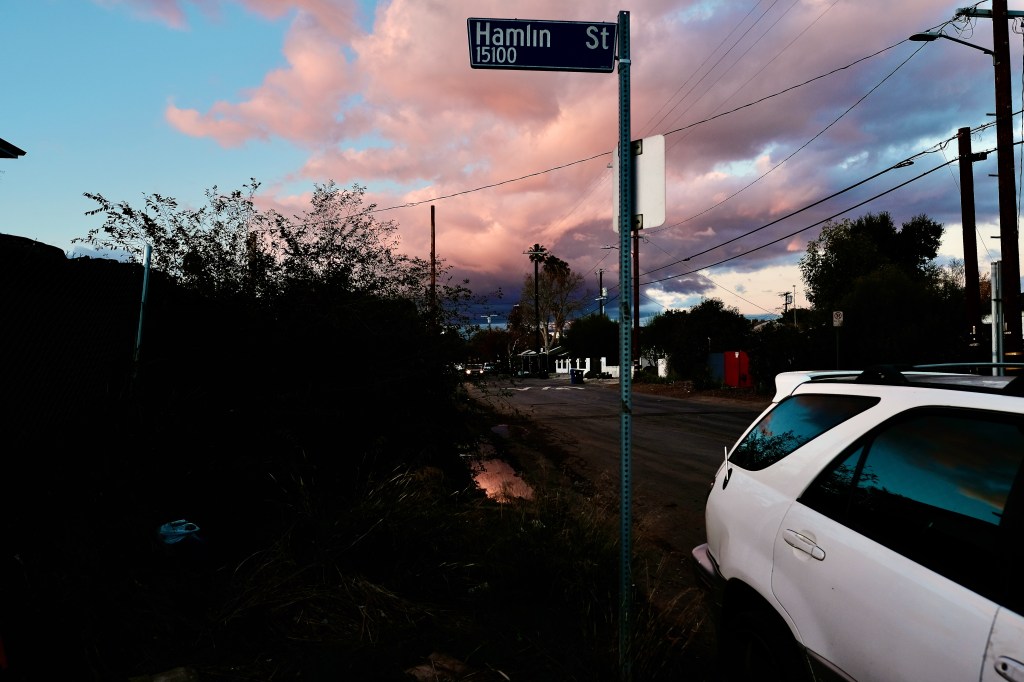
Around 4 pm I looked outside and saw a stunning sight of a gold leafed tree against a blue, pink, and gray sky. It would only last a few minutes so I grabbed my XE3 camera and ran out.
It was a strange hour. There was a menacing helicopter chopping up the sky, and reckless, going back home drivers speeding down Columbus and Hamlin in monster trucks.
Death was just beyond my driveway so I wandered out cautiously.
Somewhere along crudely unpaved Columbus, where there are no sewers or curbs, I could see the vast sweep of the northern sky and those fantastic clouds miles away.
For ten years a dead external hard drive lay abandoned in our garage, a device that once backed up our desktop computer from 2007-2012 and then suddenly died.
We cleaned our garage last month and found the dead drive. We took it to a tech in Toluca Lake who retrieved everything for $150.
Now we have tens of thousands of revived photos, seemingly taken yesterday, but actually 14 years old. I’m going through the files now and labeling them.
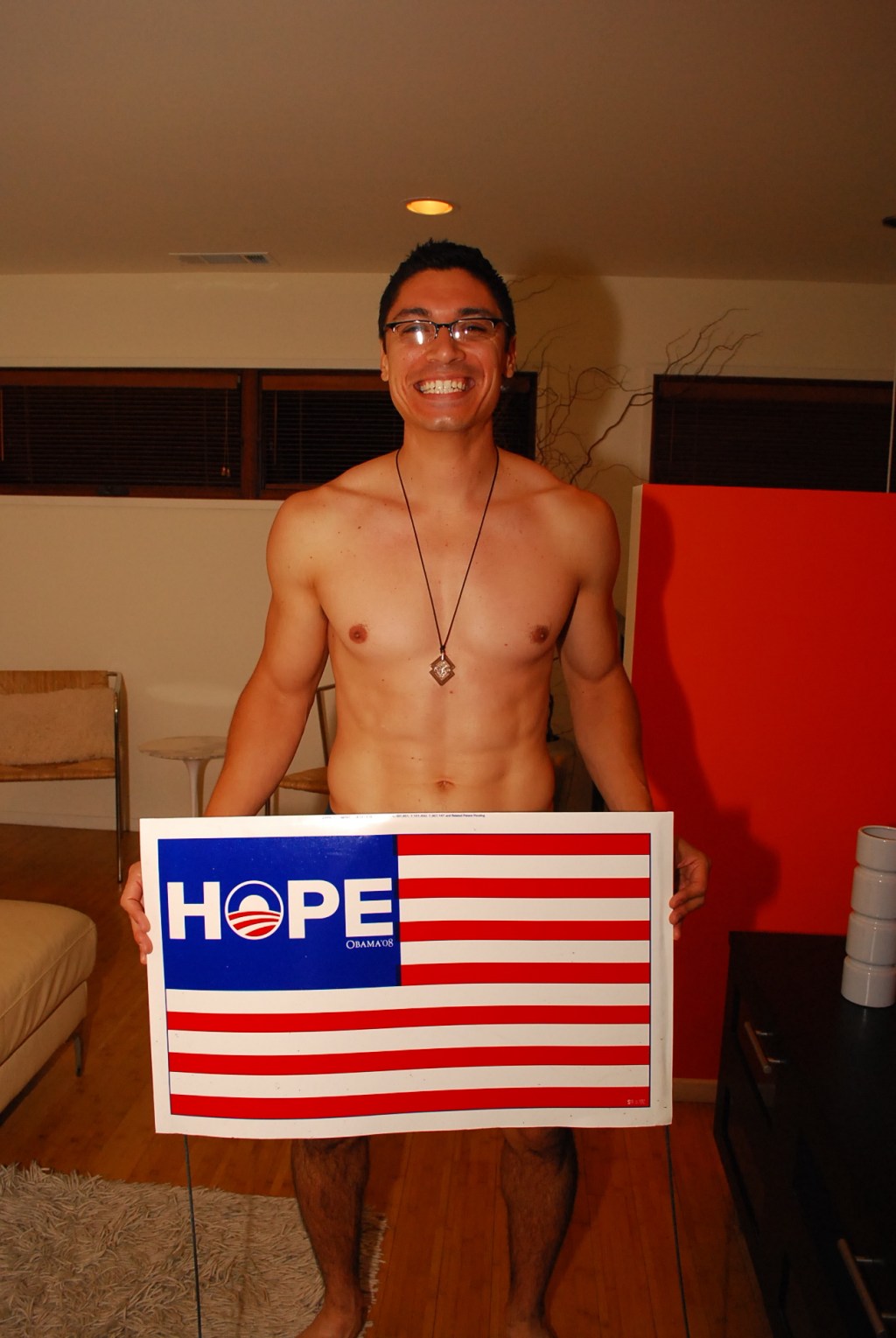
One folder contained a memorable evening from October 4, 2008.
On that night, we attended an Obama fund raiser at a private home in Silver Lake along a winding street above Sunset.
There is my 36-year-old brother Rick with his wife, Pri, and her 27-year-old sister Rue. Muscular, smiling, shirtless Jeremiah and his girlfriend Ivy.
There are good friends and acquaintances in floor dragging denim and long t-shirts under short ones. Fun includes John McCain, Sarah Palin and Dick Cheney piñatas, lots of Shepard Fairey designed HOPE t-shirts with Obama’s face, and me in an Obama mask. There are masks of Biden too.
There is food and drink and Ivy in with her Smart Women Vote Obama button.
The crowd is gay and straight, black, white, asian, male, female. There are high tech devices like digital cameras that are strictly digital cameras, not smartphones.
There are cute young kids and old dogs snuggled up on the sofa.
What I remember most from the event is that one of the guys there wanted to sleep with me, and a woman who had a high position in production wanted to hire me for photography but never hired me.
Through time all the famous faces from that night are connected in our long political show that never ends, jumping from event to event, begging for analysis, but often falling into irrationality, emotionality and missed opportunities.
Down on the streets, LA is a mess, a tent city of encampments, trash, shopping carts, RVs and civic disorder.
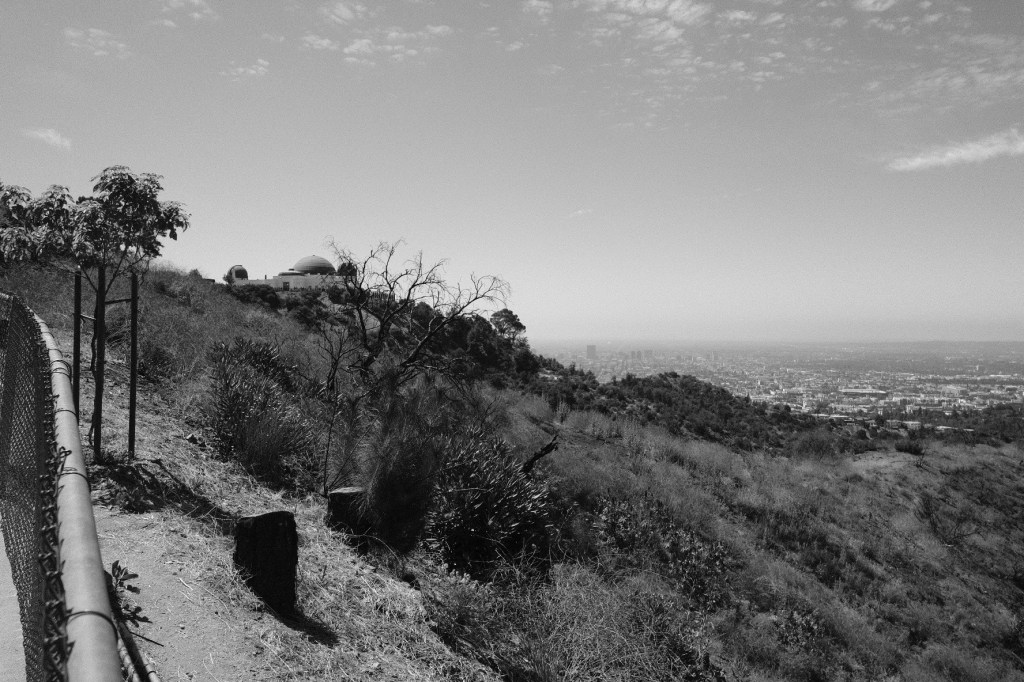
But on the way up the trail to Griffith Observatory, the city assumes its old panorama of possibilities.
Filtered out of these photographs are the humans and their rulers who make this city so perplexing.
Here is the white cloud sky, the one lone palm on the hill, the pine tree, the arid and rocky slope descent, the dome of an Art Deco landmark, the white buildings in the distance, the hiking trails, the Hollywood sign, the graceful Grecian frieze on the cylindrical tower of the observatory.
Here is Los Angeles aspiring to a vision of grace, aesthetics, science and civic ennoblement.
Here is where the young visit vowing to move to start their adulthood. They’ll stand along these vistas and dream of tomorrow.
“Just wait, you’ll see, I’m going to make it!”
Griffith Park, Griffith Observatory,“Rebel Without a Cause,” James Dean and Natalie Wood, Hollywood Stars; and the stars in the sky: Sirius, Canopus, Arcturus, Alpha Centauri.
Look back, look down, look up, look out.
Griffith Observatory was finished in 1935, in the midst of the Great Depression.
Think of that year, 1935: thin in resources, rich in imagination, practical in execution.
That’s why this was all built, not only Griffith Observatory, but the entire project called the City of Los Angeles.
Down on the streets, LA is without leaders, a tent city of encampments, trash, shopping carts, RVs and civic disorder.
But up here are found the better angels of the City of Angels.
In 1954, architect Culver Heaton’s design for the Van Nuys Savings and Loan, with interior murals by artist Millard Sheets, rose at 6569 N. Van Nuys Bl.
Along with other financial institutions such as Jefferson Savings, Lincoln Savings, Great Western Bank and Bank of America, they served the local community of hard-working people who opened accounts that paid 3% or 4 1/2% interest and where polite tellers, dressed in pearls and high heels, addressed customers by their last (never their first) name.
Photographer Maynard Parker shot these images of the bank exterior and interiors. They bespeak a dignified and progressive institution whose architecture was as up-to-date as its vision of a prosperous, safe Van Nuys. A sign on the outside of the building reads “The Home of Security” leaving no doubt to depositors about the solidity of the S&L.
Mr. Sheets was a prodigious artist whose work can be seen all over Southern California, most notably on the exteriors of many of those white, marble clad, Home Savings of America buildings that resemble mausoleums.
Architect Culver Heaton designed many Mid 20th Century churches in Southern California in a style of expressionistic eccentricity long departed from our stripped-down imagination. His Chapel of the Jesus Ethic in Glendale (1965) is almost campy in form with its prayerful red roof, rising like hands, above a turquoise reflecting pool and a statue of Jesus on water fashioned by Herb Goldman.
Photo by Michael Locke
In the 1980s, there was a national scandal and shakeout in the savings and loan industry and many closed down. The de-industrialization of Van Nuys, and its decline as a manufacturing and commercial center, coincided with a tremendous increase in immigration from Central America.
Today, a Guatemalan market, La Tapachulteca, occupies the old bank property.
2014/ Image by Andy Hurvitz
But last year, in a hopeful sign of better times, Boaz Miodovsky of Ketter Construction, who is the new owner, plans on demolishing the old bank which has now been degraded from its original condition. His company will design and erect a multi-story apartment house with ground floor retail. The front, on VNB, will be five stories tall and taper down to three stories in back.These illustrations, which he sent to me, are preliminary and will be further refined to include landscaping and additional detail.
Nostalgist and Van Nuys Neighborhood Council member John Hendry, who grew up and still lives in Van Nuys, alerted me to the impending demolition and asked me to research the origins of the historic structure. Quirino De La Cuesta, another VNNC member, stepped in and purchased these images from the Huntington Library.
And Mr. Miodovsky, in a nod to the old murals, will have new artwork painted within the new structure. It will be created by local artists and reflect the continuing development of Van Nuys which hit its bottom and is now climbing out parcel by parcel.
Browsing through the archives of the Huntington Library, I came across a set of photographs by Maynard Parker. They depict the inside and outside of a new home, one of 119 in a 100-acre development called Royal Oaks, south of Sepulveda, near Ventura, in 1950.
Back then there was no 405, no 101.
Sepulveda Blvd. was a two-lane road whose serpentine forms slithered through the Santa Monica Mountains, an undeveloped area of oaks, grasses, hills and clear skies. A 1939 view from Magnolia looking south shows its verdant ruralness.
1939/ USC Digital Library
The 1000-acre estate of General Sherman was subdivided into various tracts, and given a pretentious name: Royal. There would be Royal Oaks and Royal Woods and Sherman Woods. These luxury homes in California Ranch, Early American, English Tudor and other styles would nestle in the low foothills of Sherman Oaks and usher in a new chapter of suburban life for the socially upward class of settlers.
The first subdivision, Royal Oaks in Sherman Woods, was a $1,100,000 investment in land and construction cost. 100 acres and 119 sites were priced between $6500-$9500 each and “fully improved with paved streets, sewer and water systems, underground wiring and ornamental street lighting.”
A December 4, 1949 LAT advertisement assured that the “smog-free” estate community was carefully restricted and protected against harmful encroachments.
Ironically, this same community today lives amidst the biggest encroachment of all time: the concrete, noise, fumes and traffic of the 405 and a furiously angry pack of speeding, distracted women in SUVs whose disregard for life and law afflicts and curses the roads 24/7.
Let us exit 2016, and return to the peace and quiet of 1950: less cars, no freeways, and dappled sunlight peaking through the marine layer……
The house in the photos, a model home, is, even by today’s standards, a substantial and beautiful place. There are large oak trees and a gently sloping lawn caressing a copiously large and expansive house of strong and graceful lines.
Un-ornamented and quietly self-assured, the architecture is ahistorical and gracious. A three-car garage, casement windows, large overhanging roof and a newly paved street proclaim affluence without ostentatiousness.
Inside, there is a dining room wallpapered in faux stone and a modern ceiling fixture -not a chandelier- hanging over a light wood table with low backed chairs. Even in 1950, California design was advanced. Who, in West Hollywood today, would not kill for this room?
In the living room, there is a large, abstractly printed, sectional, rattan leg sofa. It sits against a wall of sheer drapes and floor-to-ceiling windows. An Oriental coffee table, low-armed chairs, dark shaded lamps, and a wood paneled ceiling effortlessly meld the West Coast with the Far East.
Cigarette anyone?
The kitchen is charmless but functional, all in white metal, illuminated by flush ceiling fixtures, and equipped with double ovens, work stations, and a sit-down, countertop desk with an upholstered chair and a dial telephone.
Try these peanut butter and celery canapés. They’re marvelous.
There is an indoor/outdoor casual room, probably the only type of room we don’t make anymore, paved in brick; furnished in metal, washable chairs, and served by an open brick passage where food and drinks might be passed from kitchen maid to seated guests. A hanging starlight fixture and a large, potted metal tree reference nature and the outdoors.
Back when we were on Leyte Island killing Japs we never thought we’d be sitting here a few years later drinking Mai-Tai’s!
A guest room has shag carpeting, pleated drapes and sliding glass doors. There is wall-to-wall carpeting. And twin day beds with an L-shaped coffee table topped with a ceramic dove and a bowl of wax fruit, a writing desk with drawers and a decorative lamp. Here, visiting niece Helen or Uncle Homer or the Haynes Sisters stayed for weeks on end after arriving at Union Station from Chicago or Kansas City or Grand Island.
If you need anything from the linen closet ask Beulah and she’ll get it for you.
The presentation of an ideal lifestyle, the yearning for comfort and luxury, the conception and presentation of a story, these are those elements of fantasy wrought into reality and sold to us by imaginative and innovative builders, architects, designers, decorators, marketers and public relations professionals.
These are the images on the surface of Maynard Parker’s black and white photographs.
The untold story, left out of these gorgeous photos from 66-years-ago, is the enslavement of work, the onerous debt, the ecological destruction and the wanton wasting of the Golden State’s open spaces, all sacrificed under the altar of material house dreams. When we have it all how do we know when we have it all?
We still want to live here. We are just lost getting here.
The Getty Museum is one of those destinations in Los Angeles tourists come to see. I played a tourist yesterday and went there.
I entered into the parking lot via a new automated system where one pays at the end of the visit and no interaction with a human is necessary. It cost $15.
A tram transports you to the top. You ride up in it, like a European, secure in its cleanliness, safety and recorded instructions.
The plazas and the sculptures and the architecture are still here, but the water had been turned off, in deference to the drought.
There were two exhibitions going on which I walked through quickly. One was full of drawings and paintings from the studio of Andrea del Sarto who lived in early 1500s Florence. Exquisitely wrought chalk portraits reminded me of what my father, who studied at the Art Institute in Chicago, used to aspire to.
“Light, Paper, Process: Reinventing Photography” was an exhibition of various experimental, often abstract, tactile printed photographs from dozens of artists. Blotches on one print read, “chromogenic print soaked in Rainbow Lake water.” Another showed concentric circles, still another was shadows, and another drops of black splotches.
These were selected by experts, curated by intelligentsia, and worked in their incomprehensible oddity to expel me quickly.
The rooms where the prints hung were crowded and hot. Suffocation soon got the better of me and I ran out into the light and air as I always do when I visit the Getty.
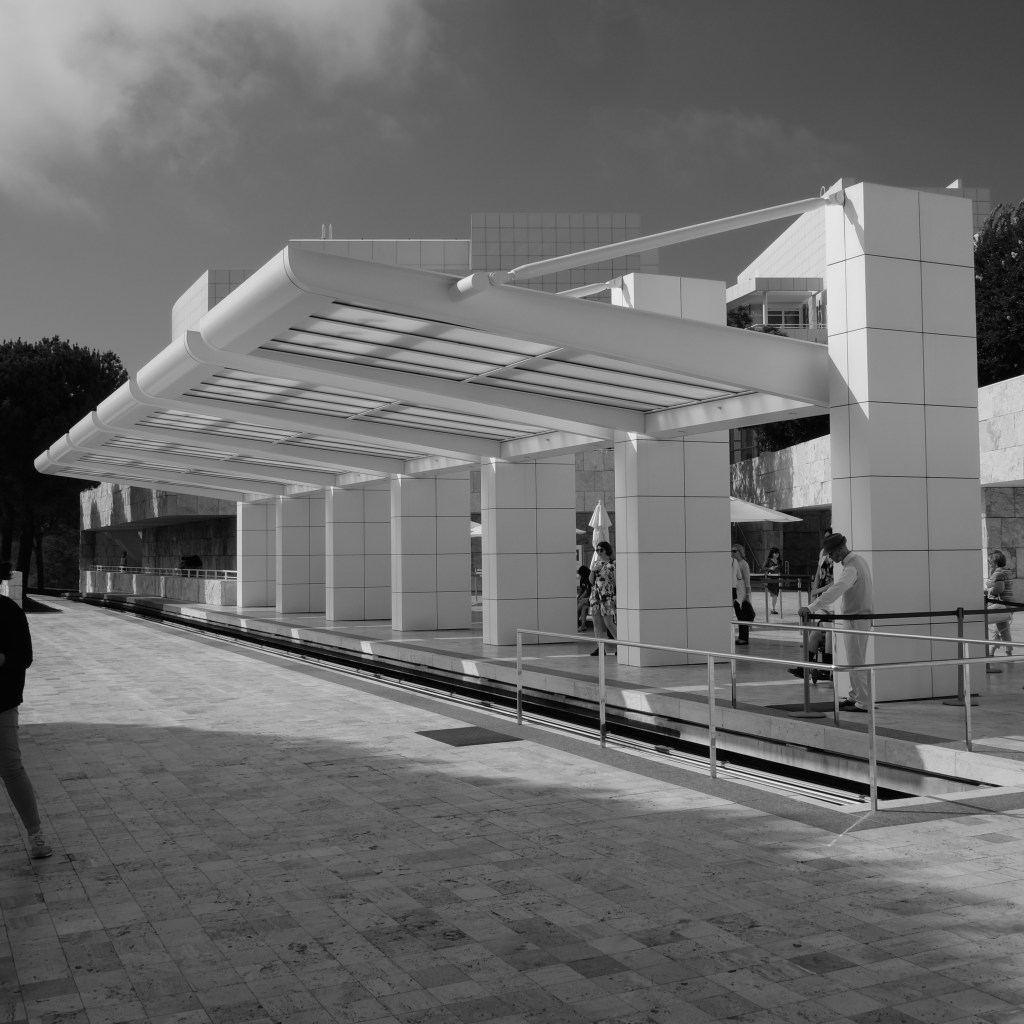
Better to me than seeing French tapestries in dark rooms is to walk outside and observe the light, line and textures of the Getty buildings and grounds.
The Getty design is now more than 20 years old, and just as a 1955 design looked old to 1975 eyes, so the architecture, with its squared and rectangular lines, seems dated in our present biomorphic era of computer generated forms and origami like skins.
Perched on top of the Sepulveda Pass in arrogant modesty, the buildings transformed the rural aura of the pass into something of a gaudy parade of wealth, equaled by the Skirball and its cold, pink, granite towers.
Students from Brazil.
David Cu
The $1.3 billion dollar Getty, whose funds might have worked to transform a gritty neighborhood in South Central into something better, was also used to plant thousands of oak trees along the hillsides. The lands around the museum are now verdant and shaded.
$1.3 billion was spent on the museum. And twenty years later people sleep on the streets of Los Angeles. But art is safe, secure and protected.
Such are our priorities.
But that is another discussion.
There are still, to the photographic eye, many lines and textures and shadows dancing all over the buildings and grounds of the Getty.
You must be logged in to post a comment.