Riots of Color


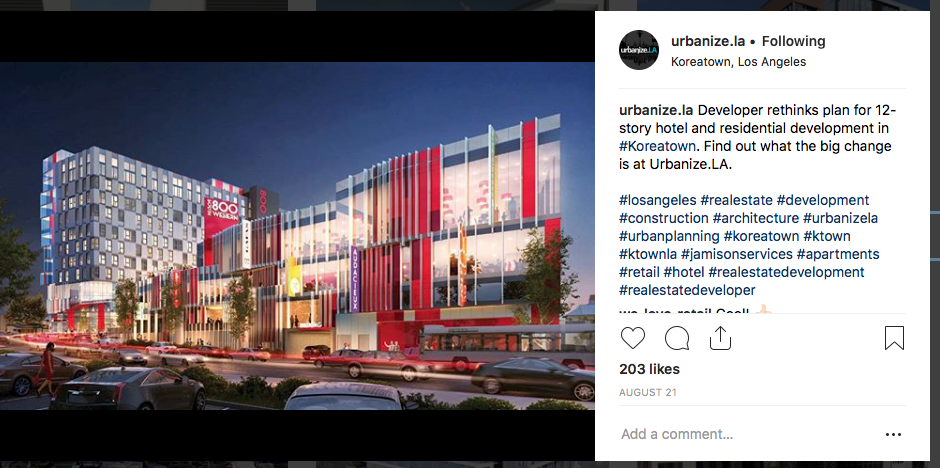
Urbanize LA is a website showing new development around our city. I get updates from them and see what architecture is going up and what it looks like.

In residential multi-family buildings, modernism is triumphant.

Today, every building is uniquely ahistorical, without any reference to past classical styles, which, in a way is good. Los Angeles, especially in the San Fernando Valley, suffered from 20 years of Neo-Mediterranean buildings, a style that still afflicts much of residential, single-family Beverly Hills.

But the modern styles going up are nervous, jittery, full of multi-colored sections of various colors, so that many buildings do not exude calm or confidence but insecurity. Sections of four, five, or eight story apartments are broken up into light/dark/red/green/white/blue/wood/yellow/purple….. sometimes on one building.

I’m not sure how to psychoanalyse the stylistic quirks of mediocre apartment architecture. I think some of it is due to trying to sell buildings to neighborhoods which are hostile to them. By dividing up larger buildings into many colors, the effect is to reduce the apparent total size.

An apartment building with 40 windows on a wall 160 ft. long in one color appears large. 40 windows in 8/20-foot long sections with 8 different colors seems smaller.

Compare these two examples below. The new Expo Line is 7-stories, while the older one is 5-stories.

Sycamore apartments, northwest corner of North Sycamore Avenue and Beverly Boulevard

An Ugly Example at a Prominent Corner

One of the ugliest of the newer buildings is the retail/apartment built on the SE corner of Wilshire/Labrea which is not only multi-colored but cheap looking as well. LA Curbed called it “possibly LA’s most hated” in 2013. “The building’s facade is a jumble of balconies and discordant frontal planes with the northern and eastern faces designed differently, united by a central tower that seems to lack any elegance or even much design,” wrote Julie Grist of Larchmont Buzz. “It’s a shame the design team couldn’t at least try to borrow some of the sleek lines from other streamline or deco architecture still standing along Wilshire Boulevard.”

Tragically, it occupies an important corner of Los Angeles but has an H&M quality where a fine building belongs.

LA architects and builders built one color apartments from roughly the 1920s through the 1960s with no degradation to the aesthetic fabric of the city. How was that possible?

Southwest corner of Pico Boulevard and Union Avenue
Sycamore apartments, northwest corner of North Sycamore Avenue and Beverly Boulevard
Apartments_on_Grand_Avenue_Bunker_Hill
Guardian_Arms_Apartments_Hollywood
Brynmoor_Apartments
Whitsett Av. Studio City, 1964.
New_apartments_West_Adams
Gaylord_Apartment_house_front_view, 1924

The Van Nuys State Office Building


6150 Van Nuys Bl.

The Van Nuys State Office Building is that 4-story, yellow and green building on the east side of Van Nuys Boulevard right on the corner of Calvert.

It has strips of windows, and a long, blank wall that fronts Van Nuys Boulevard, ensuring that no retail activity will ever enliven its frontage.

What is the State of Van Nuys you may ask? Is that not a ridiculous name? Was it named that to confound and confuse and further alienate us from government?

How about: “The State of California Building in Van Nuys”?

It cost $15 million dollars 34 years ago and was dedicated on February 8, 1985. It was considered a marvelous way to save taxpayer money because it consolidated all state agencies under one, open-air, courtyard roof.

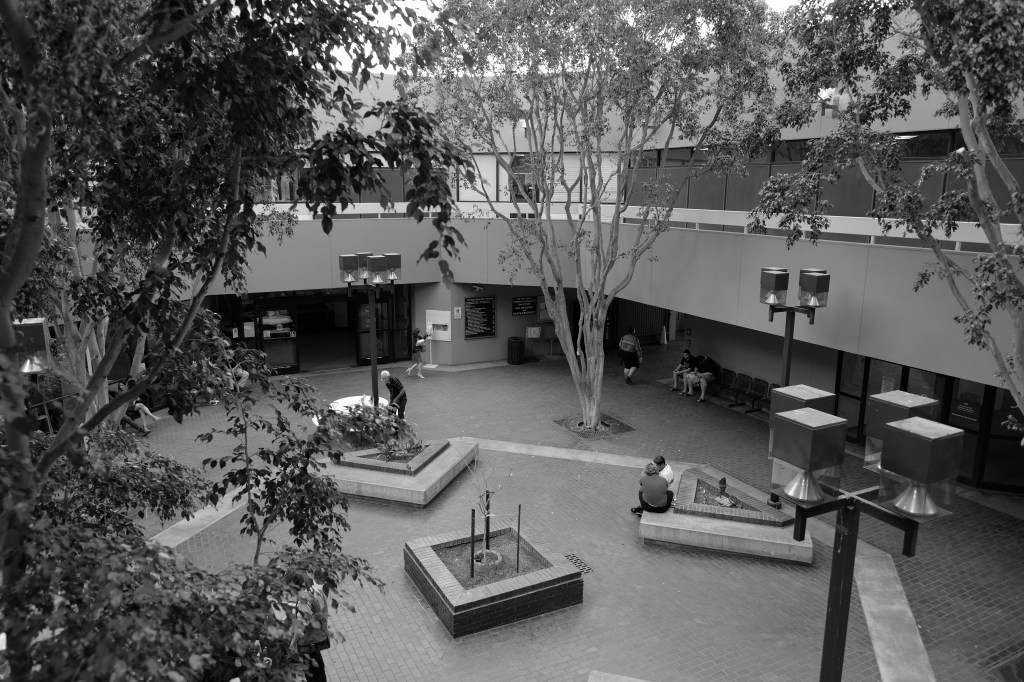
I walked, for the first time, inside the courtyard today, and was surprised to feel a cool, calming, restful place, shielded from the harsh sun and torrid humidity exhausting our city in recent days.

A directory lists such agencies as the Department of Alcoholic Beverage Control, The Department of General Services, The Department of Industrial Relations, and The Division of Occupational Safety and Health. Senator Robert M. Hertzberg has an office here as does Assemblyman of the 45th District, Democrat Jesse Gabriel of Encino who is not to be confused with the Assemblyman of the 46thDistrict, Adrin Nazarian who also has an office here but is not listed on the directory.

The architecture is of the 1980s with lots of diagonal lines, a virtue signaler from that era of advancement beyond the Bauhaus Box.

Walk up the diagonal stairs and look down on a paved brick courtyard planted with Ficus trees and rectangular streetlights a year or two away from hipster respect and admiration.

Most striking in this building complex is the steel and canvas roof with its stadium like effect, a trellis covering that keeps out rain and direct light, but provides, from upper floors, views out to the Valley in every direction.

At the top of the building, one can survey all the grandiose emptiness of civic Van Nuys with its vacant post office, its courthouse buildings and its enormous presence of government that seems to blanket and stifle the old town under a bureaucratic dead weight of concrete, windows and open plazas.

Never have so much accomplished so little for so few.

From 40 feet in the air Van Nuys still wears a costume of respectable commerce and responsive government.

But back down on the street, the crazies are in control: homeless, addicted, angry and desperate. We are expected to always step aside and allow schizophrenic, unwashed, lost and marginal people to camp out everywhere, to doze off at Starbucks, to sleep outside of the LAPD, to vomit and defecate on bus benches.  They live on the sidewalk and then if you photograph them on public property they scream, “You don’t have my fuckin’ permission to take pictures ass hole!”

Road rage is also in evidence, as seen in this video where an angry driver followed my neighbor home from this area in Van Nuys and threw a rock at her car.

Homeless Tents Near Busway and Van Nuys Bl.

This is an emergency that requires a military like mobilization to set up tent cities and wood houses and barracks on land to house people who cannot house themselves. Who does not understand this?

Nobody, not one person, should be allowed to live on the street. At all.

A registry of homeless people should be set up. 12,000 spaces for homeless who will receive housing, food and sanitation and in return will clean garbage, paint houses, sweep sidewalks and be paid $12 an hour and work six hours a day with one hour for lunch. It is humane and reasonable.

We live in a topsy-turvy city that prioritizes the rights of the insane, the criminal, and the alien over all. It is a sanctuary state where July 4thfelt like the middle of Syria during a bombing.  We come here, liberal and open-minded, and then we are asked to excuse everything that is wrong and against the law and understand that the dysfunction of the city is merely an expression of the highest humanitarian values of compassion and tolerance.

Van Nuys is failing because it exemplifies everything in the preceding paragraph.


SaveSave

SaveSave

SaveSave

Resurrection Through Colorization.


I’m not the first person to happen upon these colorized photographs of old black and white images. But I’ll write about it anyway.

“Imbued With Hues” is Patty Allison’s project to bring to life vintage photos and somehow breathe new life into dead people and lost places. 25,000 follow her on Facebook.

She is in her mid 50s, and lived in Portland, ME where she worked as a dog groomer, but now resides in Long Beach, CA. She has been doing her special hobby for four years and she has a special affinity for old cars. This information I learned from a 2013 article about her.

A lot of her color choices are guesses, especially when it comes to clothing.

But the results are glorious.

Below are some selections, heavily weighted towards Southern California.


1937 Cord 810 Phaeton – Marsha Hunt with director producer Cecil B. Demille
1932 Packard Twin Six 905 Coupe Roadster with Clark Gable
1929 Cadillac V8 2-Door Convertible Coupe with Body by Fisher, Style #8680 at Bullock’s Wilshire, Los Angeles, photo taken in 1938.
1932 Packard Sport Phaeton and owner actress Jean Harlow
Parade of Progress.
February 1956 – E Street, San Bernardino, California, Old Route 66.
1937 – Riette Kahn at the wheel of an ambulance donated by the American film industry to the Spanish government. Grauman’s Chinese Theater in the background.
1929 – Cord front wheel drive in front of National Auto School, Southern California.
1927-28 Model L Lincoln Limousine
Golden Gate Bridge, San Francisco, CA, early 1950s.

Tom Cluster’s Van Nuys (1955-1962).


map
Cluster Home: 6944 Columbus south of Marlin Pl.

A few weeks ago I received a lovely email, and some photos from Tom Cluster, a reader of this blog.

Here is one excerpt:

Dear Andy,

I just discovered your blog about Van Nuys.  I’m entranced by it.  I’m almost 70.  Our family moved to 6944 Columbus Avenue in the summer of 1955.  It was a small tract of new homes.  We moved from Westchester (near LAX).  A lot of people moved from Westchester to the Valley because the airport was expanding and streets were being eaten up.  Our new neighborhood was between Kester, Vose, Sepulveda, and Vanowen.

andy_devine

Andy Devine (1905-77)

The local celebrity was Andy Devine, who still lived in his big house on 6947 Kester, down near Basset.  At Halloween he’d hand out small boxes of Sugar Pops.  There was an old swimming pool across the street that he had built years before – the Crystal Plunge – and we’d swim there in the summer. We had smog alerts in those days and if there was a big rain we wouldn’t go to school because Kester St. would flood.

There was a family on Vose who sold eggs from their chickens – the mother and father had survived the Holocaust and had the tattooed numbers on their forearms.

[Then as now] It would get hot and there was no air conditioning, not at Valerio School (which in 1955-1956 was at the corner of Kester and Valerio, consisting entirely of temporary buildings with a dirt playground) and not in our homes.  Still, I have fond memories of Van Nuys.

Valerio St. School June 1956

The area where the Presbyterian Hospital is now was a big empty field full of tumbleweeds – we’d make forts and paths there.  When the hospital was built it was small compared to what it is today.  It was just two circular wings designed by William Leonard Pereira. (1909-1985) of  Pereira and Luckman.

March 18, 1957 reads "Discussing modern innovations of Valley Presbyterian Hospital, nearing completion at 15107 Vanowen St., are Mrs. Barbara Holt, member of hospital's board of directors, and from left, J. H. Wray, Jim Cross and Walter Rueff, members of San Fernando Automobile Dealers Association committee for hospital's fund drive."  (LAPL)
March 18, 1957 reads “Discussing modern innovations of Valley Presbyterian Hospital, nearing completion at 15107 Vanowen St., are Mrs. Barbara Holt, member of hospital’s board of directors, and from left, J. H. Wray, Jim Cross and Walter Rueff, members of San Fernando Automobile Dealers Association committee for hospital’s fund drive.” (LAPL)
Valley Presbyterian Hospital, 15107 Vanowen Street, Van Nuys, designed by Pereira & Luckman. Photograph dated January 15, 1964 Ph: Geo. Brich
Photograph caption dated February 20, 1961 reads "Larry Peskin, 17, left, 10038 Noble St., Sepulveda, completes hospital course. Fellow graduate examining syringe is Warren Wilkinson, 17, 9439 Louise Ave., Northridge." The young men completed a 20-hour training course to become volunteers at Valley Presbyterian Hospital in Van Nuys. Ph: Jon Woods
Photograph caption dated February 20, 1961 reads “Larry Peskin, 17, left, 10038 Noble St., Sepulveda, completes hospital course. Fellow graduate examining syringe is Warren Wilkinson, 17, 9439 Louise Ave., Northridge.” The young men completed a 20-hour training course to become volunteers at Valley Presbyterian Hospital in Van Nuys. Ph: Jon Woods
January 5, 1959 reads "Janet Kellenberger, 15, and Jackie Suess, 17, members of Candy Stripers, from left, aid Sea Scouts Bob Wheeler, 17; Steve Bidwell, 16, and Mike Strange, 15, in volunteer cleanup program of Valley Presbyterian Hospital. Sea Scouts, auxiliary of Explorer Scouts of America, and other organizations volunteer work hours for Van Nuys medical center."
January 5, 1959 reads “Janet Kellenberger, 15, and Jackie Suess, 17, members of Candy Stripers, from left, aid Sea Scouts Bob Wheeler, 17; Steve Bidwell, 16, and Mike Strange, 15, in volunteer cleanup program of Valley Presbyterian Hospital. Sea Scouts, auxiliary of Explorer Scouts of America, and other organizations volunteer work hours for Van Nuys medical center.”

(Valley Presbyterian Hospital images courtesy of LAPL)

If you look at a map, you’ll see that Noble, Burnett, and Columbus extend from Basset to Marlin Place – the 6900 block.  The houses from 6900 up to 6932 were built in 1951, the houses beginning at 6932 were built in 1955.  Our houses (6932 and up) were in an old walnut grove, so there was plenty of shade.

I’ve attached a picture out front of our house.  The older end of the street didn’t have walnut trees and it always seemed hot.  What we didn’t understand was that the walnut trees would all soon die because sidewalks and asphalt and lawns aren’t good for them.  At that point our end of the street got hot and the trees that had been planted at the other end of the street grew up and gave it shade.  We moved out in 1962.  The people who bought our house are still there – probably the longest residing family in that block of Columbus.

1955-dec-burningleaves dec55sarahrakingleaves

My beautiful picture

If you look at Street View for 6944 Columbus you’ll see that it’s perfectly manicured.  The builder of our little tract was named Arthur Guyer – he built tracts throughout the Valley.  He built 15153 Marlin Place for himself in about 1957.

There was another local celebrity on that street, although he wasn’t famous then.  The Cerf family lived at 6932 Columbus, and Vinton Cerf, the oldest son, was attending Robert Fulton Jr. High.  Vinton is famous as the “father of the Internet”.  He and a buddy invented TCP/IP while at UCLA. The Cerfs left Van Nuys about the same time we did.

I won’t bore you with my memories of all the commercial establishments, but I will mention that Kenny’s Automotive at 14852 Vanowen, near Kester, was there in the 1950’s, just as it is today.  Another hold out from the old days is Lloyd’s Market, at 7219 Kester.  It was called Lloyd’s even back then, and we’d stop there every day when we walked home from Valerio.

More to come…..


Dreaming of Exile


DSCF2360Even if you have given up on LA, cursed its tackiness, screamed at its traffic, revolted from its inanities, choked on its air and dreamed of exile from its toxicities, you might be seduced on Sunday afternoon, as I was yesterday, by a place hidden away that seems like a small town in the Poconos.

I accompanied a friend on an errand. She manages properties, and was cleaning up after renters at a small house on a street called Lake Shore Avenue.

East of Glendale Blvd, south of the 2, west of Elysian Park, it sits snuggly into a hill that blocks the setting sun. Shady, built with little bungalows, it bisects, at Effie, an institution: Gateways Hospital and Community Mental Health Center.

A mid-century sign sits at the entrance to the facility.

Egregious, garishly lettered in big vertical typeface, it announces, creepily, its authoritative medicinal mission (rehabilitation, research, hospital) as if they were triple feature films from the 50s like “I Want to Live”, “The Creature from the Black Lagoon” and “The Blob.”


DSCF2348

DSCF2354

DSCF2351

We parked on Effie and looked ahead at a wide dirt path climbing up a steep hill where nets were laid down to trap water and debris that may pour down here fiercely.

My friend went to work on her property, and I climbed up the trail.

Around me were dried, parched grasses, the remnants of homeless blankets and bags of clothes, and, at the top of the hill, a stucco shack of a house, with a pitted asphalt driveway, and a wooden deck. It was guarded by ziggurat cinder block walls and reinforced steel window bars.

The dilapidated home was a find, unusual in its state of disrepair. For we live in a city of brutally competitive property investment, where every top elevation has been captured by someone richer. This mountain hideaway lacked the hidden cameras, the expensive cars, the pool, and the pretense to architecture. An eccentric hermit might inhabit it.

Moby if he had no money might live here.

Its views stretched out to Silverlake, downtown, and tall radio towers across the way. Yet it was an uneasy isolation. It felt dangerous, not reassuring.

Bucolic and rustic in Los Angeles never exists in purity.

Helicopters and sirens in the distance, the threat of fire, the presence of people without homes, the surprise of events that might end our life erupting from the deepest earth, or from a violent intrusion through an open window. These are the sights, sounds and conjurations of the imagination haunting happy moments.

That is how that house and hill felt.


DSCF2361

Back down on Lake Shore Avenue I walked past institutional houses, illuminated by industrial floodlights, set along the street, behind gates. Two older men were on the stoop of one place, smoking. They nodded to me and I waved back.

Outside the property of Gateways, dominating the bright part of the hill on Lake Shore Avenue, was a tall, two-toned, red and white brick house looming over a row of old garages. Homely, graceless, squinting in the sun, it refuted the lovely myth that everything historic is charming. The white “sanitary” bricks, glossy and washable, were often used in the 1920s on building facades for bakeries and cleaners.

A small signifier of community well-being, a landscaped traffic circle, ended my walk up Lake Shore.

That idea that a street could come together in a circle, unified by architecture, common purpose, cafes and conversation, there was something of that here, but I saw no other pedestrians. The only movement was daylight in retreat, shadows moving over the street.

After walking around, I came back to my friend’s property and went inside. We stacked dishes in the dishwasher, carried out bags of food from the refrigerator, and a basket of dirty towels. She turned on the alarm and locked the door. We got in the car and left to return to the real city beyond.


Westwood in the 1970s


Kim Bunje
Kim Bunje
Norm Neal
Norm Neal
Bill Gabel
Bill Gabel
Bill Koegler
Bill Koegler
Jay Jennings
Jay Jennings
Bobby Cole
Bobby Cole
Arnold Freeman
Arnold Freeman

On Facebook (of course) there is a group called “Westwood Village in the 70s and 80s.”

Photos used in this post come from that page and are duly credited.

I wasn’t there back then, so I cannot attest to the apparent excitement, vibrancy, energy and entertainment that existed in that district forty years ago. All I know is that many say Westwood is in decline.

Los Angeles is a faddish city. Nobody in the 1970s would have thought Eagle Rock, Highland Park, Atwater Village, Downtown Los Angeles or Third Street Santa Monica to be cool. They were dead places back then, not yet discovered or annointed as the haven for young consumerism.

And remember Melrose and its heyday in the 1980s? That street has largely been forgotten, its stores a seedy and tacky collection of crap.

But Westwood, and its empty stores, its empty sidewalks, is more of a mystery since it is surrounded by afffluence, and set in a historic, climate- controlled pleasantness with a veneer of historic architecture.  One would think that walkable Westwood would still draw in the crowds.

Will the new subway along Wilshire help? Transit and new development have revitalized Hollywood, brought it up from its fifty year slump, and turned it into a crowded destination again. Who, even twenty years ago, would have imagined Hollywood as it is today with gleaming tall buildings, many restaurants, clubs, bars and packed with crowds day and night?

The cyclical nature of Los Angeles, its glib and shifting tastes and shallow urbanism is also a reason for hope. What is down and out today can become the new destination of up and coming tomorrow.

Van Nuys anybody?