The Return of Light Rail


Screen_Shot_2017_09_05_at_6.57.53_AM.0Electric_car_in_North_HollywoodVan_Nuys_only_37_years_ago_a_grain_field_in_1911Early_view_of_Van_Nuys_BoulevardVan_Nuys_Boulevard copyVan_Nuys_BoulevardFor the future we now return to the past.

The black and white photos all show how Van Nuys Bl. looked in the period from 1911-1957.

Yesterday there was announcement from Metro.

Metro will build a 9-mile-long light rail down the center of Van Nuys Boulevard, stretching from Sylmar to the Orange Line Van Nuys station near Oxnard St.

The light rail service yard for train maintenance will be built near Raymer St along the Metrolink tracks in the “Option B” area. “Option A” near Oxnard and Kester, that would have destroyed 58 buildings, 186 businesses and 1,000 jobs will not happen.


From the inception of Van Nuys in 1911 until the late 1950s, an electric rail car connected Van Nuys, North Hollywood and Hollywood and provided a means of public transportation from this part of the San Fernando Valley to the rest of Los Angeles.

The modernization of Los Angeles, which always put the car before anything else, led to the ripping out of the rail and its replacement with an enormously wide boulevard of ten lanes of asphalt.

Van Nuys Boulevard today is probably in its worst state of economic and social decline in its history. With its empty stores, shabby buildings, homeless men and women and neglected properties it stands as a civic disgrace.

DSCF3189

dscf2649dscf2605dscf2661dscf2640

Hopefully, the light rail will lead to a change in the betterment of Van Nuys, though local leaders, such as Councilwoman Nury Martinez are often lukewarm about public transportation, painting it in fearful terms of criminality and danger, or still characterizing it as a cattle car for maids and dishwashers to get to work, rather than as a means of transportation for every single citizen of Los Angeles to use.

Any incident of crime is unacceptable on a Metro train.

But how many private cars break the law every single day by speeding, running over pedestrians, going through red lights, and taking part in car chases, drive-by-shootings, hold-ups and child kidnappings?


Here is an article from Curbed LA describing the new project:

“Metro is moving forward with plans for a new rail line in the eastern San Fernando Valley.

One of the 28 projects that the agency plans to have up-and-running in time for the 2028 Olympics, the East San Fernando Valley Transit Corridor would run from the Orange Line station in Van Nuys to the Sylmar/San Fernando Metrolink station, about 9 miles to the north.

Metro had considered building the line as a rapid bus route, rather than rail, but on Thursday the agency’s board of directors approved plans that would advance the project as a light rail route similar to the existing Gold, Blue, and Green lines.

“I have long dreamed of a day when we would have more than two Metro train stops,” Stuart Waldman, president of the Valley Industry and Commerce Association, told the Metro board.

He called the line the “largest economic development project in the San Fernando Valley this millennium.”

Most of the line would travel along Van Nuys Boulevard, with trains traveling on tracks built in the center of the road. For the final 2.5 miles of the route, trains would travel on San Fernando Road to the northernmost stop.

Metro expects a trip from end-to-end would take about 29 minutes, and that the train could carry close to 50,000 riders per day by 2040. Eventually, the line could connect with a future transit project through the Sepulveda Pass.

That would give Valley residents significantly more options when navigating the city.

Since the line will be served by light rail, Metro will need to add a service station for trains that travel along the route. The agency had considered putting that facility on a parcel of land close to the Van Nuys station, but local property owners complained that the plan would displace hundreds of businesses.

Now, Metro plans to put that maintenance yard closer to the Van Nuys Metrolink station, where it would have to acquire fewer properties. Some businesses would still be displaced, and several business owners expressed concern Thursday that they could be forced to close up shop.

These businesses would be eligible for relocation fees, and on Thursday Metro Boardmember Sheila Kuehl also asked staffers to look into creating a fund to compensate business owners for disruptions caused by construction of the line.

The light rail tracks would serve 14 stations running through the communities of Van Nuys, Panorama City, Arleta, Pacoima, and the city of San Fernando. The entire project would cost about $1.3 billion to construct. Metro previously considered running a short leg of the line underground, but found that would more than double the project cost.

Now that Metro has settled on a design for the project, the agency will complete a final environmental review before preparing to begin construction.

Under the Measure M funding timelineapproved by LA County voters in 2016—the project would break ground in 2021. Construction is expected to wrap up by 2027.”

Option A is Off


The Metro Planning Board will not recommend the demolition of 33 acres of light industry near Kester and Oxnard that would have obliterated 58 buildings, 186 businesses and endangered 1,000 jobs within walking distance of downtown Van Nuys.

“Option A” was a proposed light rail service yard that would have serviced a 9.2 mile public transit train line that will be built from Sylmar/San Fernando to Van Nuys.

Instead, the board said “Option B”, a site around Keswick and Van Nuys Bl., near the existing Metrolink trains, is a better choice for the new site of the service yard.

Construction is anticipated to begin in 2021, with the line opening in 2027.

There are businesses in the “Option B” area that must relocate and they are, predictably and understandably, upset by the decision.

But the “Option B” district is not adjacent to a residential area, and has far fewer parcels, making it a cheaper and faster choice for Metro to demolish and compensate property owners.


Option A 

Imagine this as a beer garden, an outdoor restaurant, a park, or a site for new courtyard housing.

“Option A” runs along the Orange Line with its bike path and bus line slated for conversion to light rail.

It is a bustling and well-located area of affordably priced light industry which one day could also be used for inserting cafes, small retail stores, low profile apartments and multi-family dwellings, providing a new residential/work/recreation district in Van Nuys.

To lose it to the bulldozer would have been a tragedy, and let us hope that community activists, architects, investors and city planners will recognize the potential in the “Option A” area and design a new prototype for progressive living in Van Nuys.


One Day, Soon.


One day, soon, there will be a revitalization of Van Nuys Boulevard.

Gone forever will be the hopeless days when people laughed to mock it, or ran away in revulsion.

All the central gathering places that should be occupied by civilized things, all the lots that hold parking, all the empty buildings along Van Nuys Boulevard, will be replaced with vibrant, happy, upbeat, successful businesses and residents.

It will take nothing more than $5 billion dollars to invest in new transit, new apartments, new multi-family housing, new police officers, a new police station, an army of street cleaners, and law enforcement people who will ticket illegally parked cars, handicap placard abusers, unregulated street sellers, unlicensed signs, and unpermitted businesses.

The narrowing of Victory Boulevard, the planting of 200 oak trees from Kester to Van Nuys Boulevard, will bring about a revitalization of the formerly crappy strip of low rent mini-malls, slum apartments and empty stores. The LAPD Victory Precinct at the corner of Van Nuys Boulevard and Victory, and its drop-in center there will be open 24 hours a day, 7 days a week.

150 new LAPD officers, out of a police force of some 10,000 will be specifially assigned to the area.

Some 50 new apartment buildings, from Sherman Way to Oxnard, with 10,000 new apartments, will be built and 20% of them will rent for under market value.

Security cameras will enforce the law to prevent speeding, red light running, assault, vandalism, burglaries of properties and hold-ups on the street.

There will be decorative streetlights, three new parks, new benches, and thousands of shade trees planted along the boulevard to protect against temperatures that get hotter every year.

Bike lanes, light rail, automobiles and pedestrians will share a new Van Nuys Boulevard divided between all types of transport, from foot to motor to public.

And the architecture will be inventive, modern, and integrate environmentally such necessities as solar energy and district wide free wi-fi.

In a nod to the old Van Nuys, the first orange grove planted in the Valley in 90 years will be manned by formerly homeless men and women who will guard the orchards as they would their own children. There will be 10 houses planted around the grove to ensure the safety and security of the new urban agriculturalists.

The low industrial buildings in the neighborhood around Kester and Oxnard, all 33 acres, were preserved in 2018, and later became an incubator for creatives who settled in the area and built narrow houses near the Orange Line, and worked and lived next to artisans, musicians, brewers, car restorers and craftspeople of every skill.

All of this is possible.

The people who will decide whether this is fantasy or reality are reading this post.


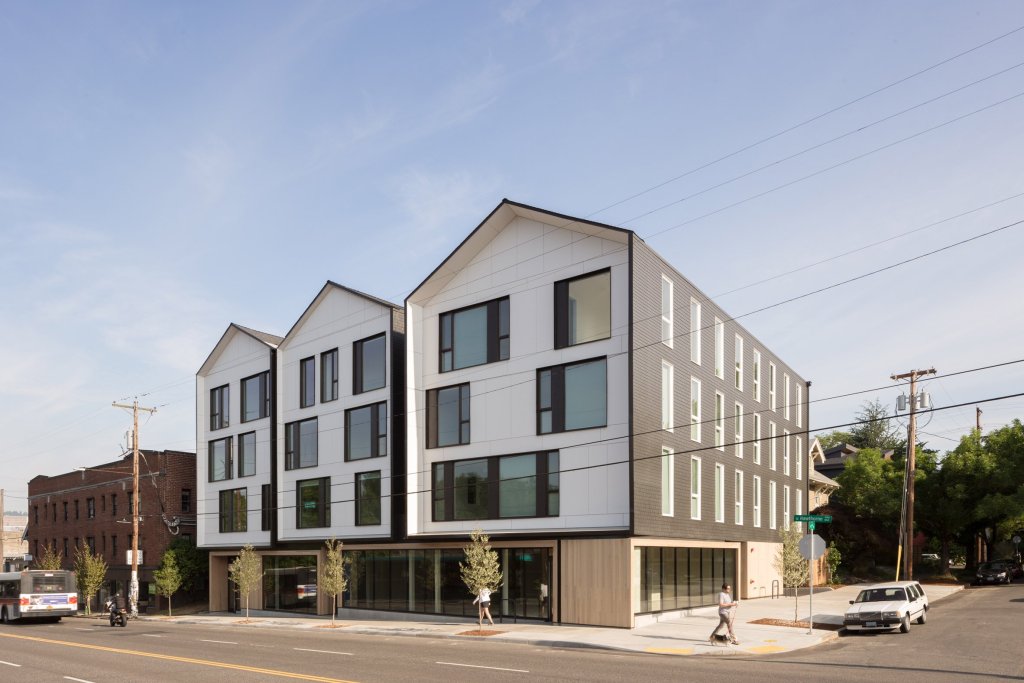
All photos courtesy of Architizer.

Architecture by Graham Baba.

SaveSave

The Janitors’ Light Rail.


nury-martinez-dn
Nury Martinez, 2012. (Hans Gutknecht/Staff Photographer)

“If you’re a housekeeper, janitor or dish washer, you need to get to work every day on time,” she said. “Buses don’t move as many people and as quickly as the light rail. That’s why we’re excited about the project that would serve people who are transit dependent.”[1]

“As a mom, I can tell you it’s terrifying to sometimes think of having to get on the Red Line. I won’t for that very reason,” she said. “I don’t have to see the data collection to know that if I feel unsafe to ride the train with my kid, that I’m just simply not going to use it.”[2]

-Councilwoman Nury Martinez


Why are these two quotes important?

What does it matter what Councilwoman Nury Martinez of LA’s City Council District #6, representing Arleta, Panorama City, Lake Balboa, and Van Nuys thinks about public transportation, light rail, who rides it and who needs it?

It matters, I think, because it shows a way of describing non-car travel as something used by people who are the lesser people of the City of Angels: maids, janitors, dishwashers and perhaps even criminals.

Can agents at William Morris, that actor who stars on that sitcom, Hancock Park attorneys, the conductor of the LA Philharmonic, and Dodger Clayton Kershaw also ride trains? I wish they all did!

Strange that a political culture that panders to PC should grossly stereotype transit riders.

The prospect that Van Nuys, long languishing, is under her jittery guidance, and limited vision, is not especially comforting.  A public official who denigrates public transportation is not doing the people’s business very well.

For in her remarks she shows a remarkably retrogressive and depressing view of public transportation as something which is sometimes terrifying, unsuitable for mothers with children, and only made for unskilled workers commuting to low paying jobs in the NE Valley.

There has been, for a long time, an idea that if you had enough money in Los Angeles you would surely travel by car. And today, we have the spectacle of 24/7 traffic produced by a culture conditioned to expect that every journey must begin and end in a car.

Even as plans for expansion of light rail go on all over Los Angeles, there is an equally strong pushback against it.

  • Uber and Lyft are making it possible to take short distance trips by dialing up a ride on your phone.
  • Amazon is delivering everything from chewing gum to sofas with fleets of trucks that are also clogging our streets.
  • Parents who rightly shudder at their children attending a low rated local school chauffeur their kids 25 miles away to “better schools.”
  • Housing is now a luxury commodity but every law that seeks to expand it runs into the “where will they park?” crowd who wants to stop new apartments, new granny flats, new retail stores and multi-family dwellings near trains.

And instead of public officials offering imaginative, innovative and futuristic ideas, we have a throwback to the car culture that is unsustainable.

Los Angeles! This is 2018! This is not 1975, 1965 or 1945!

Light rail and subways are not dangerous. They are not only for criminals. They are not only for the woman who scrubs your floor. Properly policed, intelligently managed, excellently maintained, they can be pleasant, quick and enjoyable.

They are the way we ALL will get around Los Angeles when gridlock by private vehicle renders this city dysfunctional.


[1] https://www.dailynews.com/2018/06/03/heres-van-nuys-through-the-eyes-of-mr-van-nuys/

[2] http://www.latimes.com/local/lanow/la-me-ln-martinez-metro-sexual-harassment-20180124-story.html

The Parking Police


Sorry, garage is full at this time.


A few years ago, informally, someone named our section of Van Nuys, “Kester Ridge” even though there is no elevation here, only a continuation of the same elevation that runs from Victory to Vanowen and from Kester west to Sepulveda.

But everyone believes and uses the imaginary name, invoking it to conjure up community coherence.

The area is generally well-kept, anchored by grander houses along Hamlin St. that were built in the late 1930s when 18 acres were carved out of walnut groves. Now many of these homes are being carved into concrete ranchettes with car repair in the garage, and backyards denuded of trees and replaced with driveways and black Hummers. But the bucolic air of the recent past still remains if you drive down Hamlin without looking right or left.

To the north are well-maintained, solid ranch houses along such streets as Kittridge, Haynes, Saloma, Lemona, Norwich, Noble and Burnet.

These are tree-lined streets and the people who live here try to keep their homes clean. The average price of a house is somewhere around $800,000, though they rarely go over a million or less than $600,000.

Most houses have security cameras and alarms, and almost every home has been burglarized, but people are vigilant.


The recent developments along Sepulveda, the tearing down of old prostitution motels like The Voyager, would seem to foretell something positive, but new, 200 unit apartments, five stories tall, with hundreds of new parking spaces and modern, looming architecture, has instead created unease and worry in this area.

Last night, at Valley Hospital, in the community room, representatives from Councilwoman Nury Martinez’s office and a gentleman who works for the City of Los Angeles government and advises on parking restrictions, spoke about potentially creating permitted parking on our single-family residential streets.

This action would, homeowners hoped, stop the proliferation of cars and other vehicles that are now crowding the curbs, especially on streets closer to apartment buildings.

But in order for the licensed, fee-based system of placards and registration to take place, 75% of all the residents in the area would have to agree that paid parking by permission only was their preference.

That blew the gasket and infuriated attendees. They now understood that 75% of apartment units on Victory, Sepulveda, Vanowen and Kester would have to join in the clean curb party and sign a petition saying they wanted to rent out annual permits to park along formerly free streets. That will never happen.

Apartment dwellers depend on nearby streets to store their cars at night and get to work in the morning. Just like everyone who stays in a house.

There is no way to reason with people in Los Angeles who want unclogged streets, nobody parking on their street, the ability to get downtown in 20 minutes, and enough parking for every trip to the gym, Costco, 99 Ranch Market and Trader Joes.

Explain to them that $4,000 a month rental houses and $3,000 a month apartments will require perhaps four or five adults to split the rent, each with their own car.  The less rentable housing that exists, the less apartments that are built, the more these rents will increase.

Victory Bl. east of Sepulveda, Van Nuys, CA 5/10/18

Why are some people sleeping in tents? Or cars? Or RVs?

Every political and social problem evaded ends up costing us in other ways.

Along Victory Boulevard, west of Sepulveda, as along many other streets, I witness the morning rush hour of single occupancy drivers sitting still as they wait for the light to change at Sepulveda, right in the midst of “Midvale Estates” where there are only single-family houses.  If apartments cause congestion, why is this picket-fenced bastion of Ozzie and Harriet clogged?

As for parking, there are very few people who still park their car inside their garage. The garage is now a storage unit for boxes, belongings, etc. The cars that are once sat inside are now on the driveway, and perhaps the curb.

Sorry, garage is full at this time.

A tiny, white house is rented. And the people who live there have four cars, and none of them are parked inside the home.

There is also conspicuous consumption in this city, a style of showing off cars that means that vehicles are put outside where everyone can see you are making it with your BMW and Mercedes even though you haven’t held a full-time job in three years.

That is repeated all over Los Angeles.

Los Angeles is the second largest city in the United States, yet many who live here cling to the vision that it should function like an efficient, low-density town in the Midwest.

The car should be everywhere, at our disposal every hour of the day, yet it should somehow disappear if it belongs to someone else.

When visionaries present a city of road diets, bike lanes, denser housing near transit lines, that’s when the panic starts.

And we go back to planning our lives around everything for the car. And idle in rage.

SaveSave

SaveSave

SaveSave

Option A: Just Plain Places


This blog has written 13 other times on “Option A”, a Metro LA proposal by the public transportation agency to wipe out 33 acres of industry in Van Nuys, near the junction of Oxnard and Kester, and replace it with a light rail service yard. It would destroy 1,000 jobs, displace 186 businesses and flatten 58 buildings.

Though the scheme has been public knowledge since September 2017, property owners, workers, renters and the neighbors near here still stand on thin ice, awaiting official June 2018 word whether this whole district is sentenced to death, or if another site (B, C, or D), near the Metrolink tracks up on Raymer Street will be chosen instead.

A photo walk around here yesterday, along Oxnard, Aetna, Bessemer and Calvert, to document some buildings that may be gone in a few years, was also an opportunity to show that this area has great potential beyond its current light industrial use.

In gravel yards, on cracked and broken asphalt, under decaying wood, on treeless, depopulated and narrow roads, there are ingredients for a nice urban area of some new housing, some new cafes, some places where trees, lighting, discreet signage and pavement of cobblestones could bring an infusion of 24/7, urban, walkable, bikeable activity to the neighborhood.

It is already an incubator of creativity with makers of exquisite decorative hardware, superb custom cabinetry, music recording studios, Vespa and Mustang restorers, stained glass makers, welders, boat builders, and kitchen designers. These businesses, incidentally, are staffed by mostly local owners and workers, many of whom are but minutes away, or take the bus or even walk to work.  Rents are currently affordable, often 50 cents, $1 or $2 a square foot.

MacLeod Ale, maker of fine British style beers, since 2014, is on the north side of Calvert and is not threatened with demolition but its existence and success is a testament to the potential for innovation in this area.

Ironically, the very wonderful addition of a landscaped bike path and the Metro Orange Line bus in 2005 is now threatening the area because of future conversion to a light rail system. Yet the “Option A” district is thriving, even if it is shabby in places, because it is a work zone of skilled, employed, productive people.

Politicians who often talk ad nauseum about “diversity”  should come here with mouths closed and observe men and women: Mexican, Armenian, Norwegian, German, Persian, Guatemalan, Salvadoran, Irish, Scottish, Israeli-Americans, all the hyphenations of ethnicity and gender, who don’t care about where anyone came from, but only about where they are going in life.

This is Los Angeles. This is diversity. This is economic prosperity. This is within walking distance of “downtown Van Nuys.”

Yet short-sighted officials, bureaucratic ignoramuses with grandiose titles, flush with public money, would consider wiping out the very type of neighborhood whose qualities are needed, wanted and venerated.

Option A must not happen. This is what it looks like now.

Imagine what it could look like with the right, guiding hands of investment, preservation, planning and protection.


SaveSaveSaveSave

SaveSave