You March That Way, You’ll Live This Way


1955.

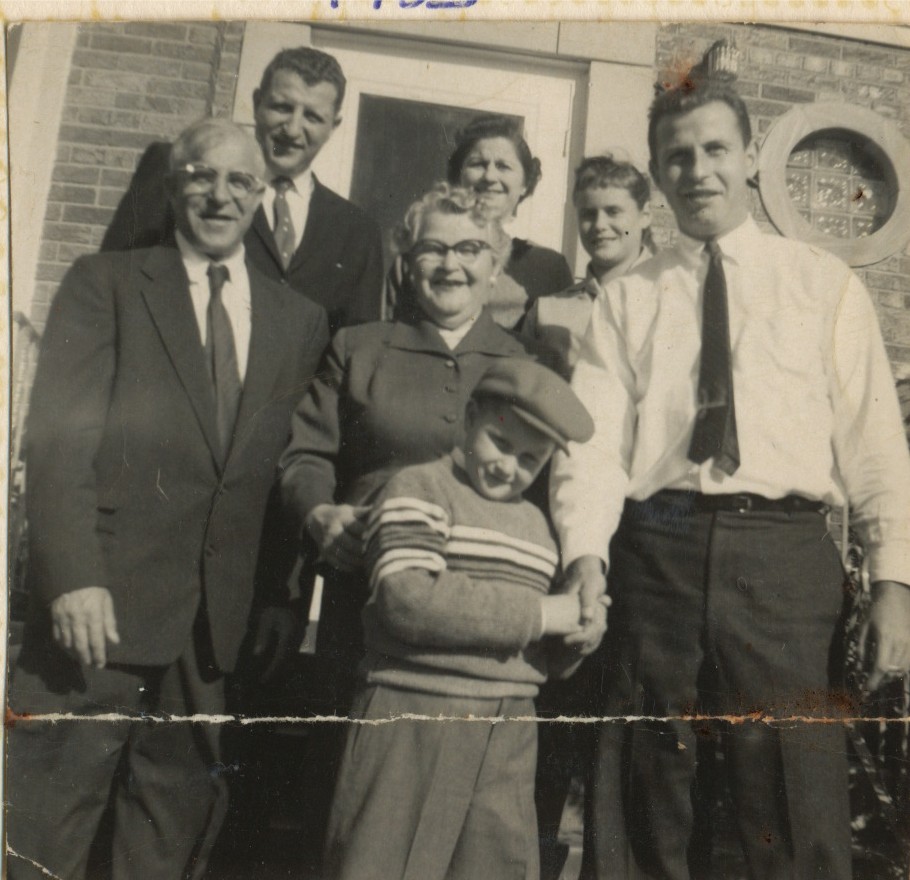
Once upon a time, my father’s family lived on the South Side of Chicago.

Grandpa Harry and Grandma Fanny had their little house on 88th and Clyde, a squat brick home built in 1950 with a back porch and a spotless kitchen. 

Uncle Paul, Aunt Frances and Barry lived on Luella, not far from Grandpa Harry.

And Uncle Harold and Aunt Evie lived with their children, Adrienne, Michael and Bruce in expansive, grand old apartments overlooking Lake Michigan along the South Shore.

Harold and Paul had both been soldiers during WWII, married young, and came back home. Harold was an engineer, so he started a heating/air-conditioning company that installed systems in many buildings in Chicago. Paul (1921-), veteran of Iwo Jima and the Battle of Leyte, worked as a plumber and electrician. He is still alive at 99 and lives in Woodland Hills, CA.

In 1968, after the assassination of Martin Luther King Jr., there were nationwide riots. And the stores on the south side were burned down and looted. And my grandfather’s new 1968 Chevy Impala, parked on the street, had its antenna broken off by a vandal. That’s when everyone sold their houses and moved up north to Rogers Park and Lincolnwood, North Lake Shore Drive, Deerfield and Highland Park. 

Because they were safe there. 

There were federal investigations by the Kerner Commission, whose findings were released in 1968, to get to the root causes of rioting from 1967, the year before. And they found, (surprisingly!), that segregation, poverty, discrimination, poor jobs and broken families contributed to unhappy lives. 

_______________________________________________________________________-

After every insurrection, after every march, after every episode of mass looting, there comes a vow to move forward and make certain that this time, this time for sure, these events will not happen again.

So the streets in major cities were renamed Martin Luther King Jr., and on television Norman Lear created “The Jeffersons” and “Good Times.” And Hollywood and the media proclaimed that justice would reign over all the land.  See the diversity!

And then there is a reaction, a call for law and order, new laws for harsher sentencing, new reforms for welfare, and progressive ideas to rebuild the cities (Brooklyn, Venice, South End Boston) by making everything safe for tech and shopping and historic renovations, and guess who will be removed again? 

Giuliani is the king. Love what he’s done! This city is the best it’s ever been. We’ve been through 9/11 and now we are never going to be down and out again!

_____________________________________________________________________

Who gets shot and who goes to fight the wars and who dies in the streets and who dies on the battlefields and whose population is dying today of Covid-19 and why is it always the same answer?

Why is it still terrifying to drive through the west side of Chicago before you reach Oak Park and tour Frank Lloyd Wright’s houses? Who lives there and who kills there and who suffers there? It’s always the same answer.

Let the looting and fires and protests begin! America don’t you see what’s going on! 

You are violent by custom, and this is another type of violence. How dare they smash shop windows and steal what isn’t theirs!

___________________________________

Note:

Estimated U.S. military spending is $934 billion. It covers the period October 1, 2020, through September 30, 2021. Military spending is the second-largest item in the federal budget after Social SecuritySource.

That works out to about $2,838 per person in the US. Or about $236 a month for every man, woman and child in the country.

We aren’t even at war. But you could argue we are always at war.

__________________________________

People of pinker pigmentations are again woken up and made to face the suffering of some of their fellow, darker citizens. And every year the same old story is retold, just with new clothes, new celebrities, new movies, and now, a new hashtag, #oscarsowhite or #blacklivesmatter. 

And a silent majority, one whose all-white room I sometime inhabit, deplores criminality, violence, and looting; and I’m locked in there in that all-white room; I can’t get out, because I like the all-white décor that tells me that some people are violent and barbaric and have the wrong values. I feel better about myself, in that all-white room, knowing I’m law abiding and that should be end of the discussion. I’m suffocating in there, I can’t breathe, but I am relaxed in my self-assurance and high self-esteem.

Because if you get in trouble you are a troublemaker. 

_________________________________________________________________

Where I came from is some of who I am.

I grew up in 1970s Lincolnwood, IL and there were no black people other than domestics who worked in people’s homes. 

In 2017, Lincolnwood was racially composed of 57% whites, 30% Asian, and 6.2% Latino or other.  I didn’t see a mention of African-Americans.

There was once a way to run away from troubled places, and seek refuge in a safer neighborhood, but I think we have run out of hiding spots.

They have come to Beverly Hills and Buckhead and Santa Monica, and they is us. 

In 1992, I worked in the Polo Ralph Lauren mansion on 72nd and Madison in New York. There was no social media, no Twitter or What’s App, only rumor.

So as Los Angeles burned, New York City trembled, and rumors of mobs attacking Herald Square and other locations were falsely spread. There was not mass violence or destruction in New York City, that year, and it remained largely in Los Angeles, mostly, infamously, in South LA and Koreatown.

The Polo Store had wooden doors with glass windows, and the security guards pulled the cloth window shades down. They turned the lights off, and we all went home around 3pm on Friday, May 1, 1992. I walked through Central Park in my linen suit and back to my little apartment on West 96th St. to sit in the air-conditioning and wait out the troubles. 

Until this past week I thought we lived in a new time of toleration and nobody was that angry and the times I saw horrendous videos of police brutality seemed the exception and not the rule. And I lived, because I am allowed to do so, in a bubble of wishful thinking and fantasy, in a country that mistreats others but not me.

I thought Barack Obama was the pinnacle of we shall overcome. 

And I was wrong. Dead wrong. 

I was naïve. 

Me? 

Naïve? 

No. 

Just white.

I’m protected from the injustices perpetuated by a system designed to give me a boost up, a feeling of betterment, because others are down there, and can’t be as good as me, no matter how spectacular they are, by virtue of their inherited DNA.

That’s really the truth. Because you might have an MBA, or be the CEO of a company, and if you go running as black you might be shot dead. So why bother to be the best if your country already decides you are the worst? That is the quandary of racism, it rips down the individual to a category, incarcerating her within a foul story of failure. 

It takes a remarkable concentration of effort for the protagonist to overcome her role as the demon in a bad fairy tale.

Like an Obama or Oprah or any father or mother of color in North America.

______________________________________________________________

We are at a point that is not only about the murder of the man by copper knee in Minneapolis. 

There is the small matter of our chief executive, a corrupt ignoramus, who came to power, by questioning the birth certificate of our black president.

We are sick, we are unemployed, we are uninsured, we are scared. 

We were kept home, kept in fear, brought out in mask, and indoctrinated to wash hands. We stayed home and got our groceries delivered, and got a check from the government, and some people got sick, some died, and the nation looked in vain for a leader who could not lead, a savior who could not save, and today we are waking up in the wreckage of our homeland.

A virus still stalks the Earth and lives in our saliva.

When Los Angeles was at its richest and most prosperous, three months ago, there were 100,000 homeless. And that was permitted, by the leaders, the citizens, and the public. 

When Los Angeles was at its most diverse, the whitest among us drove our children to school districts that were majority white, and our morning and afternoon traffic was largely made up of children riding to and from whiter schools with their parents. 

And that was toxic and unjust, racist and unfair, blatantly racist. When you think about it.  Public schools where no children walk to school. Public schools, not of neighborhoods, but of magnets propelled to collect like particles to adhere with.

And what have we done to change education, health inequalities, housing shortages, racism itself? Because it all circles back to race when you ask people where they want to live or go to school.

We have an invisible problem right before our very eyes. 

Our feet stand on blood-soaked soil. But we don’t see under our white sneakers.

We are striving to succeed, we want our children to succeed, but what is personal success if our nation is a failure?

So many marched, that way this week, holding up signs: impassioned, motivated, angered.

It was a religious fervor of moralism sweeping the country. 

But nothing has changed, really. Stores are burned and looted, cops get down on their knees, mayors and governors call for a new dawn of tolerance and kindness.

The new plate glass windows go up, the tags scrubbed off the buildings, and surely Oprah will find a new heartwarming book to promote by a young black author.

Instagram will black out, and hash tag, and celebrities will proclaim they stand with the oppressed and the hated, and vow that a new day is here.

And new laws will get passed. And everyone will listen to great podcasts about race and police. And eventually the marchers will not march. They will go home, or get jobs, or go back to school, and the national hibernation will end, and the fast, furious ambitious race to get more for me will resume. 

The next time someone dies unjustly, Our God, Lord Smartphone, will record it. 

But Lord Smartphone cannot right a wrong. Only we can.

We marched that way, but we’ll live this way.

July 28, 1962: Youth Shot to Death in Van Nuys Apartment


Clearly, there was crime and murder in Van Nuys in 1962.

In great staccato shorthand a woman is described as “a 22-year-old divorcee and dime store manager” (doesn’t that say it all). Divorced and managing a dime store. Things could be worse at 22.

Miss Colleen K. Mitzel was alone, in her apartment, and called police from a bedside phone when she heard an intruder, later identified as Leonard A. Farmer of Glendale, aged 19, ripping her living room screen.

She kept her revolver but did not use it, waiting for the police to come.

When cops arrived, the suspect was ransacking the apartment and then barricaded himself in a bathroom. After he refused to come out and surrender, Officer Dale Baker and his David Spickles fired through the door and killed him.

The intruder died in a stranger’s bathroom in Van Nuys. An ignomious way to depart this world.

He had a police record and had served time in a Florida prison.

Option A: That First Email.


Some six weeks ago, I went to MacLeod Ale and learned about an impending “slum clearance” in Van Nuys.

I was shown a sheet of paper in the owners’ office, laying out the destruction of the industrial neighborhood, just to the south of the brewery.

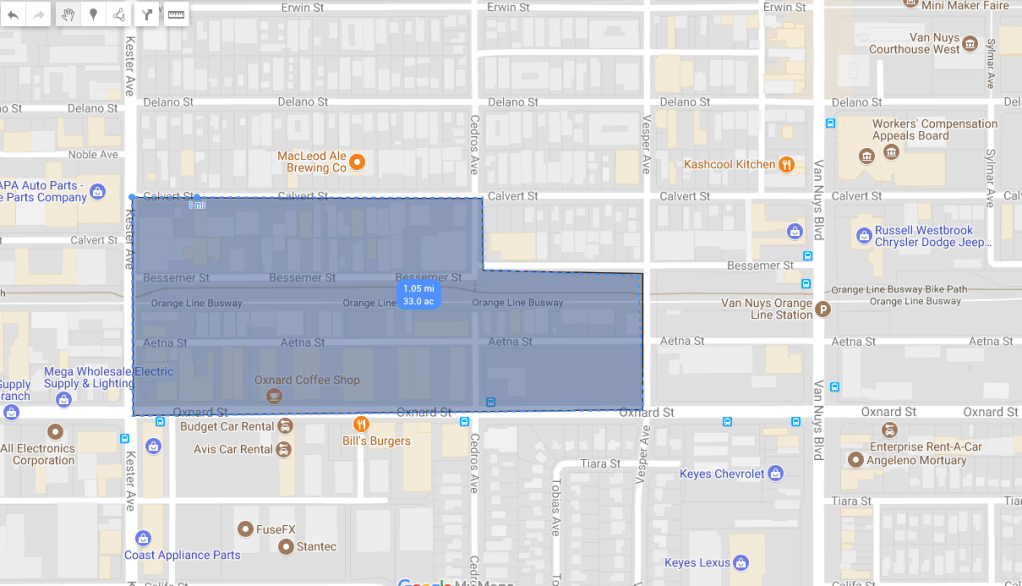
“Option A”, by Metro, planned to demolish 33 acres, stretching from the north side of Oxnard to the south side of Calvert, a hunk of real estate containing 186 businesses, 58 buildings, and 1,000 jobs.

A light rail maintenance yard would cover the area.

I had no idea what that meant, in terms of people and their livelihoods. I didn’t know anyone who worked there.

In my narrowly focused mind, MacLeod was, happily, not on the death list.

So I went back to my Better Days beer and forgot about Option A.

That First Email

A few weeks later, I opened a jabbing email from a stranger named Ivan Gomez.

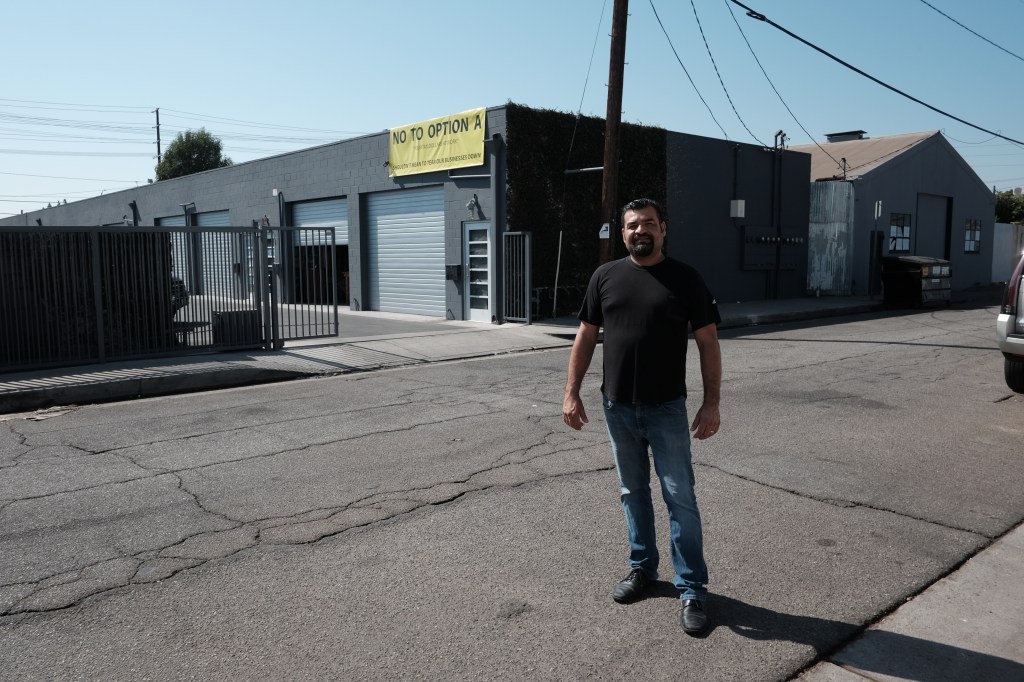
He said he owned a business called Pashupatina on Aetna near Kester. “You seem to walk around our industrial community constantly looking for the worst possible things,” he wrote, possibly referring to a recent satire I wrote denigrating a certain low self-esteem street.

He said he was not wealthy, but “maybe you are.” He had plans to construct artist lofts. And he had just bought and renovated a blighted building. He described his plight of betterment:

“Sure there are a lot of missed opportunities with certain slumlords that own properties in the area. Don’t judge a book [by its cover]. Perhaps you can tell the stories that our buildings cannot. You can look inside and see we are all Van Nuys. We want to see change and if you are patient the change will come soon. If you are wealthy and can afford the price of admission than you will jump aboard the light rail gravy train. I proposed an alternate site that would save our manufacturing communities but that dream hit a bump in the road today. I urge you to reach out and help us tell our story. Hell, you might be able to make a difference,” he wrote.

He said he was slated for demolition and was fighting to keep his property and his district intact, to save jobs, and businesses, and dreams.

“I invite you into my facility to meet with a few of the people on Aetna, Bessemer and Calvert Streets who are trying to make a difference with the little resources we have to keep our area clean and safe.”

He said he had avoided the darkest aspects of life from gang violence to police brutality.

“I am Barrio Van Nuys, Pacoima Flats, San Fernando, Echo Park, Silver Lake, Angelino Heights, Lake Balboa,” he said.

His combative but challenging email intrigued me. I made an appointment to meet him, tour his place and the surrounding area.

Ivan Gomez of Pashupatina


Crossing Oxnard, North of Kester

Driving on Kester, near Oxnard, some of what one passes include day laborers on the sidewalk; the open sand and gravel yard of Valley Builders Supply; an al fresco used tire shop, Hamati Enterprises; Pat’s Liquors (check cashing, cold beer) asphalt parking lot and tall, ungainly, steel-posted plastic sign. And a big, looming billboard above it all; there is the shabby, tan painted, stucco entombed Uncle Studios, and Euro Motors’ turquoise doors and Virgin Mary mural.

In this blighted area, settled by the old Southern Pacific tracks, now the Orange Line, pickup trucks carry lumber, pipes, and sheets of glass. Sombrero hatted adults ride children’s bikes, others push shopping carts with belongings, addicts sleep and stare into space, buy cans of beer, and others reside in groups beside the bike trail. There are parked taco trucks serving lunch and many signs for auto repair, collision, bodywork, and smog certification. You are either working hard or hard up.

Hidden from view are many artisans, craftsmen, and skilled persons, working in fields from cabinet making to stained glass, from vintage auto and bike restorations to custom metal work. There are welders, boat mechanics, sauna installers, and music recording studios. Most rent fairly priced industrial spaces.

A sinister idea, it seems, would be trying to revitalize Van Nuys with light rail by wiping out this cloistered, unique, walkable, diverse, and industrious area.

Van Nuys, CA


Pashupatina

 Switzerland on Aetna St.

Pashupatina, at 14829 Aetna St. is an unmarked, pitched roof, building painted in cool shades of green and gray. A steel door is in front. But the preferred entrance is around the side.

You walk up a narrow driveway, paved in white gravel and concrete, squeezing between two cars, and enter a facility whose orderly, airy, bright, industrious and technically equipped rooms evoke some expert machine shop in a Swiss mountain village.

They are a manufacturer of custom decorative hardware, whose brass and bronze knobs, hinges, handles and levers hang inside some of the most expensive homes in Los Angeles. Boxes of surplus custom work, from recent projects, sit in the storage room on shelves labeled with Bel Air streets: Stradella, Casiano, Chalon.

Established 1997, the shop name comes from a most sacred Hindu temple in Nepal, Pashupatinath, dedicated to the god Shiva. Believers go there to die and be reborn in a holy place.

To a young Mexican-American, raised in Van Nuys during its most violent and convulsive years, escaping its lethal menace by sheer persistence, this name, this creation, must have multi-layered meaning.

Laid out on the floor, in orderly procession, on glazed concrete, are an array of metal lathe machines, electronically programmed, finely calibrated devices that drill to exacting standards for clients who are able to pay $1,000 for a single, museum worthy door knob.

There is a $50,000 Alaris 3D printer capable of processing CAD images and carving them into polymer models. This is where you will often find Ivan, at his computer, turning out those highly detailed or modern sculptural pieces that will be used as templates for custom metal hardware.

Pinned by magnets to the steel walls are enlarged architectural blueprints with the location of each piece of hardware designed, manufactured and installed by Pashupatina. The size, the detail, the scope seems on the scale of a museum or medical facility. But these pieces will go inside 40,000 square foot homes and 15,000 square foot guest houses.


Pashupatina: Ivan and Daniel Gomez in their shop which they completely renovated with their own hands and money in 2015.

At work at Pashupatina. Programming and designing intricate metals for decorative hardware.

 Remember what you thought the Option A area was and then step inside here to be disabused of your ignorance. Think of all the princes, all the captains of industry, all the movie moguls, rappers, tech billionaires and their third wives who could not open a drawer or close any one of their 30 bathroom doors without Pashupatina.


Natalie and Ivan, Cambodia, 2004.

Ivan Gomez, 45, his architect wife Natalie Magarian, 45, and his brothers Daniel, 42 and Manuel, Jr., 48 are all here, working.

Natalie and Ivan live in Lake Balboa, and Daniel and Manuel commute from Van Nuys and Canoga Park.

“Daniel and I are inseparable,” Ivan said. There is an affinity and closeness between them.

Daniel is thin, bearded, cheerfully fidgety with a rock-solid work ethic. He and Ivan rebuilt Daniel’s 1971 Corvette Stingray. It sits under canvas cover on a steel, 4-post lift just below Ivan’s 1971 Buick LeSabre, two cars, like two brothers in a bunk bed. A 1969 Plymouth Roadrunner, also owned and restored by Ivan, sleeps somewhere else.

“Daniel doesn’t put up with shit,” Ivan told me. The no-bullshit brother also owns a 40-acre home up in the desert near Palmdale where he can blow off steam and have fun. In 1994-95, to get away from LA for a while, Daniel and Ivan rented a home in Llano, CA. If they are ever at each other’s throats I imagine it’s one gently holding a razor and the other getting a hot lather shave.

The brothers (and Natalie) were renting another space nearby when Ivan saw a $500,000 building with 4,000 SF for sale. It was in poor condition, but they put in an offer. It was accepted and they got to work.

The entire structure, from the floor to the rafters, from the plumbing to the industrial grade electrical system, from the roof to the walls, to the driveway outside, the design, execution and construction, every last bit of it, was undertaken and completed by Ivan, Daniel, Natalie and other capable family and friends.

5/27/14-before

Ivan and his daughter Corina.


2/21/15-Ivan Dreaming and Doing

All their business comes from referrals. They don’t really have an online presence because they are too busy working.

They plan to one day have a retail line of their own, just like PE Guerin, a Manhattan company maker of exclusive, by appointment only, custom hardware.


Ivan and Daniel Gomez late 1970s

Registering with the INS. 

Ivan was born, by chance, in Mexico, when his parents were back there visiting. His siblings, Manuel, Jr., Cynthia, Daniel and Angel are all American born.

As a child legal alien, and then as an adult, Ivan had to register with the INS every few years. He became a US citizen in 2002.

In 1980, the family moved from Pacoima, where gang warfare had made life intolerable. They settled on Friar St. near downtown Van Nuys, at a time when the last white, Irish, working-class families still lived there.

Drive By Shooting in Van Nuys; North Hollywood Boy, 14, Shot to Death in Front of School.

Ivan was intelligent, curious, and industrious. He would buy popsicles from La Paletería, and resell them to his schoolmates.

He found employment with his neighbors: Tim Monaghan and his janitorial company, and with Richard Taylor who made miniature wooden piers for collectors that he constructed in his garage. Later on, Richard Taylor would hire Ivan to work in his custom hardware shop in West Adams. Ivan would become a professional locksmith, but unofficially, he was earning his masters in metal work in the four years he spent there. “Richard was a Shaman,” Ivan said in praise.

Ivan also worked as a boy janitor in an Oxnard St building a few hundred feet from Pashupatina. Always finding a way…..

Manuel Gomez, Sr. Ivan’s reserved, hard-working father, drove a Cadillac and worked as a punch presser at Zero Corporation in Burbank where they made metal stamped suitcases for the military. After Zero closed, Manuel worked at Just Dashes, a custom shop in Van Nuys.

Teenage Ivan also had a job at Bargain Books in Van Nuys where he was paid $2 an hour along with some used books. An autodidact, he often read up on mechanics or design.

The children were baptized Catholics, but their freethinking parents never pushed their children into any dogma or practice. By chance, the family joined the Salvation Army which treated the kids to summer camp and provided a social and support network.


 Wilbur Avenue Elementary School, Tarzana.

Ivan was enrolled for two years at Wilbur Avenue Elementary School in Tarzana.

He met south of Ventura Boulevard kids, many of whom came from affluent, white families. They listened to Pink Floyd and Led Zeppelin.

It was the mid 1980s and by that time Van Nuys was hit with a large increase in immigration, followed by plant closings (GM-1991), gang wars, drive-by-shootings, drugs, and the fleeing of white families from the disorder they saw all around them.

“I knew we were poor,” Ivan told me. He remembered having a rock thrown at him when he was three years old. He was shot at six or seven times before he was 25. One time he played dead in Panorama City and fooled his gun-wielding assailants.

He was Mexican-American, a target of cops who presumed guilt by ethnicity. He talked back to law enforcement when he thought they were wrong. He was handcuffed and targeted. He saw people in his neighborhood die from gangs, suicide, and shootings. He walked away from drugs and said he was a straight-arrow punk. As random acts of violence exploded all around him, he inoculated himself by diving into work, education, and music.

One day, at Van Nuys High School, a petite girl with a punky-pink haircut walked by Ivan and his friend. “Do you know her?” Ivan asked. “Yes, I do,” his friend said. He decided to write the girl a letter.

She was Natalie Magarian, born and raised in Lebanon. She came from a well-educated, well-to-do, Armenian family who left a war-torn land to live with relatives in Van Nuys. She spoke Armenian, Arabic, French, and English. She was interested in architecture and music. But she was odd-looking too.

“People said I dressed like I just got off the boat,” Natalie recalls.

Though Ivan claims to have seen her first, Natalie said, “Ivan liked me less than I liked him.” They came from wildly different backgrounds. Their respective families were kept in the dark about their relationship. “I think my parents wanted me to meet a nice Armenian boy,” Natalie said.

After graduating high school in 1990, Natalie went to study architecture at Woodbury University.

Also in 1990, Ivan went to work in a custom metal hardware factory owned by his Van Nuys neighbor Richard Taylor. The Jefferson Park Collection in West Adams is where Ivan would learn the craft that he would eventually master, emulate and reinvent into his own business.

Natalie and Ivan got married at the Transamerica Building in downtown Los Angeles in 1998. Architectural and secular and completely Angeleno, just like the couple.

They later found time to travel and explore Mexico, Cambodia, Singapore, Czech Republic, Portugal, Thailand. They lived in Silver Lake and Echo Park.

Years later they would come back to here in Van Nuys. And Lake Balboa.


 1991/1992

Rodney King was a black motorist beaten by four LAPD cops after a high-speed chase on March 3, 1991. A video, shot by a witness, George Holliday, captured the whole bloody event.

In that era, before smart phones, video recording of crimes was rare. The effect of seeing this brutality in action infuriated many who saw it as racism in action. Others thought the police were justified, and that toughness was the only way to stop crime.

The acquittal of the four white officers by a Simi Valley jury on April 29, 1992 lead to the worst rioting in Los Angeles ever seen.

“The riots, beginning the day the verdicts were announced, peaked in intensity over the next two days. A dusk-to-dawn curfew and deployment of the California Army National Guard eventually controlled the situation.[32]

A total of 64 people died during the riots, including eight who were killed by police officers and two who were killed by guardsmen.[33] As many as 2,383 people were reported injured.[34] Estimates of the material losses vary between about $800 million and $1 billion.[35] Approximately 3,600 fires were set, destroying 1,100 buildings, with fire calls coming once every minute at some points. Widespread looting also occurred. Stores owned by Koreansand other Asian ethnicities were widely targeted.[36]

Many of the disturbances were concentrated in South Central Los Angeles, which was primarily composed of African-American and Hispanic residents. Less than half of all the riot arrests and a third of those killed during the violence were Hispanic.[37][38]

 Images from that time include Korean shop owners on Western and Vermont Avenues wielding guns atop their roofs, and helicopter vantage footage of a white driver, Reginald Denny, being dragged from his truck and hit on the head with a brick, his skull cracking 91 times, beaten by a mob of youths.

The early 90s were an explosively violent time in Los Angeles. This was the era of the drive-by-shooting. A terrified city saw random killings spread into formerly safe areas, such as Chatsworth, Sherman Oaks and Westwood.

Korean-Americans Defend Their Shops During LA Riots, 1992.

LA Riots/Peter Turnley, Corbis.

2 28 91 Trying Times

Once a refuge from urban crime, the SFV, had, by 1991, become plagued with it. Robberies increased to 6,638 up 40% from the year before. There were 142 homicides, a record.[1] Bad place names like Sepulveda, Canoga Park, North Hollywood and Van Nuys gave birth to North Hills, West Hills, Valley Village and Lake Balboa. Change the label and you will escape the consequences, or so the thinking went.

Flare-ups of sudden violence became normal.

On April 20, 1993, a disgruntled MCA employee, standing in a parking lot, used a Remington 700 hunting and target shooting rifle aimed at the Black Tower in Universal City. Seven employees were wounded by a 35-40 bullet barrage that shattered glass, caused mayhem and injuries, none life threatening, yet completely terrifying.

In June 1994, OJ Simpson was accused of murdering his wife Nicole Brown Simpson and Ronald Goldman. His Ford Bronco chase on the 405 has entered the pantheon of legend. He was later found not guilty, despite so much incriminating evidence, on October 3, 1995. The verdict was thought by many to be payback to the LAPD for its mistreatment of minorities in Los Angeles.

Former tenants Joan DeWolf and Gary Benoit carry suitcases to salvage possessions from the Northridge Meadows Apartments. July 15, 1994. (Los Angeles Daily News file photo)

Uncaused by humans, but just as devastating to them, was the January 17, 1994 6.7 magnitude Northridge Quake which caused $49 billion in damage and killed dozens of Angelenos.

 “Among the wreckage were some 90,000 destroyed or damaged homes, offices and public buildings, according to the state Office of Emergency Services, with 48,500 homes cut off from water and roughly 20,000 without gas. Some 125,000 residents were rendered temporarily homeless.

When the dust settled, 57 people had died — including 33 from fallen buildings. Of those, 16 were killed when the 164-unit Northridge Meadows apartments collapsed atop its downstairs parking garage.

The fatalities included Los Angeles Police Officer Clarence Wayne Dean, whose police motorcycle plunged 40 feet off a collapsed section of the Antelope Valley Freeway. The Highway 14/Interstate 5 interchange was later renamed in his honor.

More than 9,000 people were injured, including hundreds treated outside a topsy-turvy Northridge Hospital Medical Center. Twenty-one preemies from its neonatal ICU were airlifted to other hospitals.”[2]


 Ivan In the Time of Turmoil

 The best thing that happened to us was the underground dance music scene from 1989-93. It allowed us to get away from the Valley into safer places. We met a lot of cool people and spent time up in the Hollywood Hills,” Ivan told me.

While the city and his neighborhood, were racked by violence, Ivan took refuge in the music world, and in his work.

He was up in Sylmar one Sunday, skateboarding in the wash, when he met a guy Rey Oropeza who had a hardcore, rap political band called Social Justice (later Downset) who in turn introduced Ivan to hundreds of different writers and artists from all different walks of life.

Ivan was working at Aahs and so was Darren Austin and Cameron. They had an idea to start a band so Stikman was born, an idea that Ivan came up with. He was the vocalist, Cameron, a white dude, drummer and Michael Glover, a black kid, played bass. And Darren, another black guy, was a guitarist.

Ray, Darren and Michael were all graffiti artists part of a crew known as Under the Influence (UTI).

In the parlance of that time these were a “mixed race” group of musicians. Music, and people, at that time had more fixed boundaries of race, and culture, and human beings in Los Angeles also often self-categorized themselves into racial classifications, immutable and ridiculously rigid. But Ivan and his friends were in the vanguard of the new mashup city we live in today.

A photo of five of them, circa 1990, shows young Ivan, smooth-faced, hair band around his forehead, dressed in a black, boat necked shirt, holding what looks like sheet music, a large necklace around his neck.

He is, in that photo, modern but timeless.

His flat nose, his jewelry, his stance, his gentle, warrior aura beating tribal, evokes pueblos indígenas de México. He stares insightfully at the camera, as if he directed fate and not the reverse.

Stikman, Ivan recalled, sounded like Nirvana, which someone once told him, “stole your sound.”

The band was young, exotic, and got a following. They were adventurous, driving after dark to dangerous places along the orange, mercury lit streets. They would break into empty warehouses, guerilla style, near downtown, setting up impromptu concerts and raves.

After high school (1990), Ivan Gomez also had jobs in retail. He worked at Tower Records and Aahs a novelty store, both on Ventura Bl. in Sherman Oaks, west of Van Nuys Bl.

Some of his musical influences were AC/DC, Black Sabbath, Pink Floyd, Led Zeppelin, Iron Maiden, Cure, Echo and the Bunnymen, and The Sugarhill Gang, a late 1970s hip-hop group.

Stikman’s great moment of glory: they played Raleigh Studios in 1993 in front of 3,000. They had arrived in Hollywood and got inside the gates.

They were together and making music. And then they were not. The band broke up in 1993.

Later Michael committed suicide.


Ivan and his friends were getting off work at Aahs around 10pm one evening in 1993. They ran into some homies from BVN in the alley behind the store. The gangsters were delighted to see Ivan and happily showed him a trunk full of weapons. Ivan thought it was time to say good night. As the gang car with guns drove off, another car, full of a white gang, started shooting at Ivan and his friends and yelled “Gumbies 13!” Ivan and friends ran for cover and could see BVN speed after Gumbies 13. The white gang, from Ivan’s recollection, crashed and BVN “took care of them.”

Then LAPD arrived in the alley to interrogate Ivan and his friends. They were lined up and interrogated. They were pretty ruthless and one pointed a gun at Ivan’s head, he recalls.

To those too young to remember, violence was unrecorded by smart phones before 2007. Cops and criminals, and criminal cops could do pretty much anything they wanted to without being filmed.

Like religion today, you either believed the tales told from the pulpit of police record or you didn’t.


Atelier Pashupatina

Pashupatina employs eight highly skilled men and women who work together to execute designs in a shop where there are deadlines, machines, stress, and sometimes arguments and conflict. But the environment is soothing, cerebral, edifying, more like an atelier, an artist’s studio, than a factory.

The layout is architectural, drawn up by Natalie. She had worked in Frank Gehry’s firm. She still has other international and domestic gigs. Her influence in creating an architectural stage set is not accidental, and comparisons to lofty, elitist creative spaces in Culver City and Venice are warranted.

Pashupatina does not have furnaces. The caustic, burning, smokey parts of the metal making process are sent out. The dirtier and harsher and more primal parts of casting, blasting, and plating are outsourced. But machining, and drilling are done here, and buckets of bronze and brass scrap metal, grindings, collect in big quantities and are sold to recycling.


Should I Be Doing More?

“Technology is not an image of the world but a way of operating on reality. The nihilism of technology lies not only in the fact that it is the most perfect expression of the will to power … but also in the fact that it lacks meaning.”

Octavio Paz (1914-98), Mexican poet. “The Channel and the Signs,” Alternating Current (1967)

President Obama once described America as the one indispensable nation in the world. Ivan, in his family and work, seems to share that characteristic, as a man, that Obama subscribed to the USA.

“Everyone puts the burden on me,” he said.

Ivan spoke as a married man, with two small children and a thriving, technically advanced company, with many responsibilities, worries and duties.

And yet he ponders if he should be doing more.

He was thinking, perhaps, of our ruthless, opportune, robotic time.

He was acknowledging that the wealthiest people, his clients, hoard money and power, leaving a gap, enormous and hollow, in this nation, this state and this city.

Here was this “job creator”, this self-made person, embodying all the hoary clichés of America: the idea that if you have the will, the guts, the ambition you can do anything.

But he is also the Mexican, the immigrant, the other, who was once despised, feared, and whose people still battle, daily, to convince this nation that they are just as American as other Americans.

Ivan, like all of us who live here now, sees the suffering.

Van Nuys, CA 90401 Built: 1929 Owners: Shraga Agam, Shulamit Agam Source: losangeles.blockshopper.com/property/2241014012/6224_cedros/ Biography: lakestechnologies.com/m_agam.html

Raymer St. Van Nuys, CA.

Homeless on Aetna St. Feb. 2016


For the community of Van Nuys

For the people who are still struggling

For the ones who are roaming the streets

For the people who are poor, neglected, or lost

For the addicted, the suicidal, the abused, the unemployed

For the undocumented, the deported, the incarcerated, and the damned

You are overlooked but you will not be forgotten

There will come a day again of brightness, hope and redemption

Here is a man who has used technology to advance his life and create paid work for which he is proud. But he is still asking: what does it all mean?

It is a valid question that a particular type of moral thinker will ask.

Is there anything greater to give back?


Kesterville: Seen and Heard

Last week I learned a new word:

Enjambment

The running on of the thought from one line, couplet, or stanza to the next without a syntactical break.

It came, courtesy of Dictionary.com, in their daily email and the arrival was fortuitous because I grabbed that word and pinned it on Ivan Gomez.

He is ebullient, gushing, buoyant, effusive, often pouring out with a million ideas and directions at once. His first email to me was a screed of run-on-sentences, accusations, pleas, suggestions, offerings, come-ons and inventions of both reality and fantasy.

He will dream it and do it and make it and sell it and seek it and reinvent it.

Meeting Ivan and the people who work in Van Nuys, the metal workers, the wood workers, the stained glass maker, the Vespa restorer, the musicians, the boat yard mechanics, all the hard workers who wear grease stained aprons, breathing dust, inhaling paint fumes, crawling under machines to screw in parts, all of them made me both proud and ashamed.

I was ashamed, indulging in self-pity and living inside my imagination, while others were working and sweating in shops making real things, utilizing skills and tools and machines I had never operated, or learned or knew anything about.

What did I have but words and photos and opinions and artistic license?

When I joined up to fight for the folks on Option A’s Death Row I had no idea how much life existed in Van Nuys inside the metal walled shops, behind the garage doors, down the streets where the sound of the bus roared nearby, under the unmarked, steel roofed packing houses.

I thought I was educated but I was so dumb.

I was lassoed out of my solipsism.

I like to think I did something good in Van Nuys to preserve something meaningful. It all started with that first email from Ivan.


In January 2018, Metro will make an official announcement about where the new light rail service yard will go. Councilwoman Nury Martinez now opposes Option A and others were told, unofficially, that other powerful people now agree that Option A is a bad idea whose time has come and gone.

Options B, C and D are all located near the Metrolink train tracks not far from Van Nuys Boulevard. They would not be nearly as destructive as Option A.

#   #   #

[1] 1991: A Look Back: Review: The Rodney G. King beating, development … HENRY CHU TIMES STAFF WRITER
Los Angeles Times (1923-Current File); Dec 30, 1991;

[2] http://www.dailynews.com/2014/01/11/northridge-earthquake-1994-quake-still-fresh-in-los-angeles-minds-after-20-years/

Option A: International Affairs, A Back Story.


Perhaps the quintessential Option A story grows out of the life of Ivan Gomez (b. 1972) the owner of Pashupatina, a fine custom decorative metal shop on Aetna.

He was born in Mexico, by chance. His other four siblings (one sister and three brothers) were all born in the USA.

They were raised in Pacoima and later Friar St. in Van Nuys. Ivan experienced the turmoil and insecurity of being a little boy who had to register with the INS every few years.

He later went to school in Tarzana, and saw the other world of privileged children. Never bitter, always ambitious, he worked in Van Nuys at Bargain Books, devouring books on design and mechanical art. He graduated from Van Nuys High School where he met his current wife, a Lebanese immigrant, Natalie Magarian. He did not go to college, but worked at Tower Records, and Aah’s on Ventura Bl.; Taco Bell, and most importantly, at a cabinet shop in South Central where he learned about the manufacturing, design and installation of custom woodwork.

Ivan formed a band called Stikman (1989-92) and they often played in the dug out ruins of old factories near downtown Los Angeles. He went to raves, but remarkably, he remained clean of drugs. His strong character resisted violence, self-destruction and falling into the traps of depravity all around him.

He does not smoke or drink. He has a wife, two children, a thriving business, a home in Lake Balboa. And both sets of in-laws live nearby.

I thought it instructive and interesting to explore the city of Los Angeles in the first 20 years of Ivan’s life, to give some context for what it felt like to be a young immigrant absorbing all the culture, music, crime, drugs, police brutality that fell atop the intelligent, observant, fervent, creative mind of Ivan Gomez.

All statistical facts in this article are from original sources and are footnoted.


The Idyll

Photo by John Divola

In 1970, there were some 966,240 persons in 26 San Fernando Valley communities in Los Angeles. The population was young. And the average age was 29.

There were small percentages of racial minorities in every community in the Valley, except Pacoima where 33% were black. 4% of Sun Valley was minority, mostly Mexicans.

In Woodland Hills, the average rent was $172, the highest in the Valley. And the minority population was 1%, the same as in Tarzana.

Encino had the most expensive homes, averaging $50,000 in value.[1]

Many worked in the defense-aerospace industry, 348,000 jobs in Los Angeles County. Some of the San Fernando Valley employers: Lockheed in Burbank, Boeing Co.’s Rocketdyne Propulsion and Power in Woodland Hills, Hughes Missile Systems in Canoga Park. Bendix Aviation, Ramo-Woolridge Laboratories, Litton Industries, RCA, Atomics International and Bunker-Ramo. [2]

There had also been cutbacks in the defense industries, ironically due to the Vietnam War. Research and development, which was a large part of defense contracting work, took a back seat to output and manufacture of weapons. When the war was on, rockets and planes were needed, fast. Employment fell from 616,000 in the state in 1967 to 400,000 in 1972. 70% in Los Angeles still depended on aerospace to earn their living. [3]

Military attack aircraft, surface to air missiles, rockets, bombs, satellites, electronic controls for weapons systems, defense-related communications systems, The Stealth and the P-3 antisubmarine craft, were only some of the advanced weaponry produced here.

All these weapons of war, sent around the world, would ignite and fuel conflicts that one day would come back to the San Fernando Valley and upend the placidity, the normality, the blessed banality of pools, homes, burgers, convertibles and blond-haired boys and girls riding bikes around safe and clean neighborhoods.

ph: Mike Mandel, People in Cars, North Hollywood, 1970.
Photo by John Divola, San Fernando Valley, circa 1970.

If you were wealthy in 1972, and could spend more than $100,000 on a home, you might want to live in Brentwood.


A Confluence of Events

**ADVANCE FOR SUNDAY, JUNE 8–FILE** In this April 29, 1975 file photo, mobs of Vietnamese people scale the wall of the U.S. Embassy in Saigon, Vietnam, trying to get to the helicopter pickup zone, just before the end of the Vietnam War. (AP Photo/Neal Ulevich, file)

In the late 1970s, a confluence of international events; wars, revolutions, and genocides swirled around the globe. Under the umbrella of American anti-communism, military interventions produced results that eventually washed back up onto the shores of Southern California.

In Vietnam, in 1975, the fall of the Saigon government, the helicopter evacuation of the US Embassy, and the triumph of Ho Chi Minh brought a new influx of refugees to the US. At the same time, in neighboring Cambodia, Pol Pot captured Phnom Penh and instigated a deadly forced labor and collective farms movement causing the deaths of millions. Cambodians who could, got out.

In US allied South Korea, still developing its economy, an uneasy and tense truce lingered. Fearful of a new war, the government encouraged some citizens to emigrate to the US and send money back home. Millions left and settled predominately in Los Angeles.

Filipinos who had served in the US military during WWII were allowed to become US citizens, and many war brides came to America. Relatives of people already in this country were permitted to come here and gain citizenship.

Los Angeles also became home to the largest group of Thai people outside of Thailand.

The engine for all the changes in allowing new countries to migrate to the US came after 1965.

The U.S. Immigration and Nationality Act of 1965 (also known as the Hart-Cellar Act) eliminated national origins quotas and gave priority to immigrants with skills. In addition, the law allowed the spouses, unmarried minor children, and parents of U.S. citizens to enter as non-quota immigrants.[4]

Previously the law had favored northern and western Europeans. The involvement of the US in Asian affairs prompted Congress to change laws. The US needed to look magnanimous in Far Eastern eyes so that our role in Vietnam might be justified.

In Taiwan and Hong Kong, the prospect of American retrenchment and Red China’s rise fueled new immigration to the US. The San Gabriel Valley, once a bastion of whites, became a sprawling Chinese community.[5] Asian-Americans would become the largest immigrant group by 2014.

In 1979, the Shah of Iran, an ally of the US, was overthrown and replaced by an Islamic fundamentalist government. Fifty-two American diplomats and citizens were held hostage for 444 days (November 4, 1979, to January 20, 1981) after a group of Iranian students took over the U.S. Embassy in Tehran.

The Shah had been a large weapons purchaser and his regime was seen as a bulwark against Russian expansionism.

By miraculous coincidence, all the US hostages were freed on the very day of Ronald Reagan’s inauguration. An overjoyed nation overlooked what some might call collusion.

Persian immigration to Los Angeles spiked. Beverly Hills and Westwood became the heart of a new community of refugees from Tehran and vicinity. Christian Armenians, many of them living in Iran, also came to Los Angeles and settled in East Hollywood and later Glendale. The Soviet Union also eased up on restrictions and allowed many Armenians to leave the communist ruled nation.

Notable too was the Soviet Union’s invasion of Afghanistan in 1980. It lasted over nine years, from December 1979 to February 1989. Insurgent groups known as the mujahideen fought against the Soviet Army and the Democratic Republic of Afghanistan government. These groups, which later morphed into Al Queda, were backed by the United States and Pakistan, making it a Cold War proxy battle. Between 562,000[27] and 2,000,000 civilians were killed. [6]

In Lebanon, a power struggle between ruling Maronite Christians, Shia Muslims, as well as the influx of Palestinians, resulted in Civil War, lasting from 1975-90, killing 120,000. Wealthier Lebanese, many fluent in Arabic, French and English, fled the country.


The War Against Central America

John Hoagland, El Playon, El Salvador, a well-known location where bodies of the “disappeared” are often found, Sonsonate, 1980.

In Central America, civil war broke out in El Salvador (1980-92). The government, with the support of the US, fought against guerillas who sought to bring social justice reforms. 75,000 people died. And the US spent $6 billion to aid a repressive regime.[7] President Reagan made a stand against the expansion of communism in the Western Hemisphere by brutally ramping up the wars to contain it.

In neighboring Honduras, Contra Guerillas fought against socialist Nicaragua’s Sandinista Government. Reagan also supported the Contras. A secret plan, hatched up in the White House, used illegal weapons sales to Iran to finance anti-communist Nicaraguan guerillas.

In El Salvador, Honduras, Guatemala and Nicaragua, millions were killed, and the murder rate, even today, remains the highest in the world. By 2011, 564,000 Central Americans would live in Los Angeles.


Mexico: Our On Again, Off Again, Family.


Mexican workers await legal employment in the United States, 1954 (LAT)
Braceros working in US farm fields.

Mexico and the US have had a long love/hate relationship . The northern colossus relied on migrants to harvest crops, and allowed free, casually monitored movement of Mexicans who supplied low-cost labor to US industries.

A mercurial, schizophrenic, self-centered immigration policy alternated between friendly and hostile. The pawns were poor Mexicans on foot, seeking work, escaping poverty, exiles from two nations, never fully at home in either one.

In 1930, after the Depression hit the US, half a million Mexicans, including children born in the US, were deported.

Then in 1942, the Bracero Program was established to bring in Mexican agricultural workers to fill in for war workers sent overseas or into weapons manufacturing.

But in 1954, “Operation Wetback” launched by the INS, arrested 1 million Mexican immigrants at their workplaces and many were again sent back.

In 1986, President Reagan, now a lame duck, signed an amnesty bill into law for 3 million illegal immigrants. Half of these stayed in California. In Los Angeles, 33% were foreign born in 1990, compared to 11% in 1970.[8] By 1989, Los Angeles had the largest population of Mexicans outside of Mexico City.

How did this tidal wave of immigration happen in such a brief period of time in the 1980s? One explanation:

“Mexico, burdened by international debt, imposed economic austerity measures further hurting the poorest members of its society, which caused thousands to make the dangerous trek north for economic survival. Guides who could lead families across the border to a better life in “El Norte” were nicknamed “coyotes.” Signs along the northbound interstate freeway in San Diego County graphically warned motorists to avoid hitting families fleeing across the highway.

More than 2.3 million foreign-born Latino residents in the U.S. took advantage of this [amnesty] program, leading to naturalization and green-card status. However, most foreign-born laborers did not want to give up their Mexican citizenship, preferring to work in California on a temporary basis and then return home. The IRCA required people to make a choice. Most choose to stay in the U.S. and sent for their family to join them. Under Reagan’s leadership, Congress had tried to limit Latino immigration, but instead, they created incentives that would lead to its increase.”[9]

Last year, some in the Mexican-American community shrugged their shoulders at Trump’s invectives. It had always been that way.


Imagine this man, a make believe character, a true, fine, successful, once famous Angeleno:

Up on Mulholland Drive, east of Beverly Glen, sometime in 1980, there is an old, white songwriter, Len Shnauzerman, attended by his housekeeper Esmerelda, sipping wine on the deck of his estate, overlooking the Valley, purchased for $39,000 in 1949. He’s still collecting large monthly residuals for a few songs he wrote 35 years earlier (“Mippity-Dippity”,”The Cow Girl’s Serenade”, “Hoopy Doopy Waltz”, “Pretty Girls and Peanuts!”). He used to love LA, but it was now a cesspool. He is angry at those illegals, riding the bus to work, mopping floors, digging trenches, pouring concrete, those illegals collecting benefits in his country.

He may be fiction but there were plenty like him and perhaps there still are. Just because you worked hard, doesn’t mean you didn’t get lucky.


Plagues of the 1980s

The 1980s also became the high water mark of the Cocaine Era, much of it originating in Colombia and sent up through Central America. Crack-cocaine addiction destroyed poorer communities, and ended up with the arrest and incarceration of millions of black Americans.

The Angel of Death, AIDS, arrived just about 1980 mowing down the young, the brilliant, the innocent, the uninhibited.

The party was over.

Los Angeles would undergo challenges to its identity and survival never anticipated.

Suddenly the faces one passed on the freeway were strange, exotic, and menacing.

Cindy Brady was replaced by MS-13.


 Communism Ends

The fall of the Berlin Wall in 1989, meant the end of the Soviet Union, and the death of the Communist Revolution. Soon, client states like Cuba could no longer count on Russian help.

The end of the Cold War affected the military-industrial complex in the US. There was a decline in spending at the Pentagon, and this was felt, most deeply, in California, where defense industries were a backbone of the state economy.

Skunk Works, Lockheed, Burbank, CA.

Beyond the Beach


Life Magazine, 1970.

To the average Angeleno, politics in the late 1970s was something that only mattered when it came to local issues: freeway traffic, water rates, school boards, fire protection, crime and safety.

The chosen ignorance of the larger world, the anti-intellectualism of the American Mind, would come back to haunt pleasure loving California, which did not make the connections between the military-industrial-political-money machine, and its role in eventually undermining the peace and security of domestic life in the Southland.

Many loved the Republicans who were tough on crime, tough on communism, tough on deviants, tough on high taxes. They carried the flag high, and promised a restoration of law and order and the banishment of all enemies, foreign and domestic.

Insulated from international traumas, residing in a bubble of postwar prosperity, enjoying a beer and a cigarette on the beach, the people frolicked in the surf on the edge of instability, oblivious to the coming tsunami of social upheaval in Los Angeles.

The low point of it all came in the early 1990s when riots, an earthquake, the Rodney King beating, and the OJ Simpson murder case, seemed to encapsulate a region unhinged. Random people were murdered. There were drive by shootings every day, gang warfare, and a feeling that Los Angeles was just a giant cesspool of dystopian failure.

5/19/92 LA Times


The 21st Century: A New City of Many Nations.

Through all the tribulations of violence, economic hardship, racial injustice, environmental degradation, social dislocations, skyrocketing housing, education and health care costs, the Californian pushed ahead to forge new horizons in virtual reality, public transportation, immigration policies, social justice, police reform, housing codes, environmental, gender and age protections.

And the remaking of Los Angeles, painful yet exhilarating, a city that would once again embrace so many different people, living in so many unique ways, that future also came to pass, a hopeful passage into the future; creative, imaginative, innovative, multi-dimensional, internationally engaged.

All this brings me back to Van Nuys and Ivan Gomez.

More on his life, and the meaning of Los Angeles and here in Van Nuys, to come……

Pashupatina: Ivan and Daniel Gomez in their shop which they completely renovated with their own hands and money in 2015.


[1] Valley Population Near Million; Growth Slows

–LA Times, April 29, 1971


[2] AEROSPACE LAYOFFS: THE HUMAN TOLL

Gottschalk, Earl C, Jr

Los Angeles Times May 2, 1971;

[3] http://articles.latimes.com/1999/dec/18/local/me-45171

[4] http://immigrationtounitedstates.org/673-korean-immigrants.html

[5] http://www.nytimes.com/2013/04/29/us/asians-now-largest-immigrant-group-in-southern-california.html

[6] https://en.wikipedia.org/wiki/Soviet–Afghan_War

[7] https://www.huffingtonpost.com/theta-pavis/decades-of-us-interventio_b_5610684.html

[8] http://articles.latimes.com/1993-11-14/news/mn-56940_1_illegal-immigrants

[9] http://picturethis.museumca.org/timeline/reagan-years-1980s/mexican-american-culture/info

SaveSave

Imperiled


We are hosting, for the next few weeks, a family gathering. There are guests from Malaysia, Singapore and Switzerland, women all, except for the family patriarch, 83-years-old, who, despite his recent health setbacks, flew 19 hours to see his granddaughter graduate from business school and join the festivities.

The house is crowded and people are sleeping on futons, air mattresses and sofas. We bought sacks of sweet potatoes and Vidalia Onions and cartons of organic cherries, blueberries, and strawberries.

For mental health reasons, I stocked up on beer.

Because this is a Chinese-Malaysian family, I get to see and be a part of, close-up, the Hainan dialect, the Straits accented English, so sharp and so distinct;  and the laughter, and sometimes the arguments which I observe but do not partake in.

Prescriptive, advising, pedantic, loving, cautionary, understanding, this is the general aura. When you are in the embrace, you are looked after, and you look after others.

Around 3 O’Clock in the afternoon there are cakes and coffee and people gathered around the dining room table chatting and laughing and sending photos over mobile devices.


As an American, I take pleasure in people being awed by the things I never think about: the copious enormity of Costco, the directness of speech, the assertive and self-assured women, the large portions of food, the open vulgarity of sexual talk and provocative dress, and the friendly kindness of strangers.

On “The View”, a show blaring today, they were arguing and screaming about politics, and our guests, fully conversant in English, must have wondered about how we get away with saying what we want without fear of arrest or condemnation. There are sedition laws back in Malaysia and public discourse is held back, and one would not broadcast aloud against the government for long without inviting arrest.

Whoopi Goldberg could be a political prisoner there. Imagine that.

One of our guests liked the small chatter and joking banter she saw on the local KTLA news. It was so casual and relaxed she said; so un-like her country.  Target, Costco, Sam Woo…we really do have it all.

Nothing is so nice as being admired for banality.


We went to Vegas for a two-day trip to stay at room cheap, free parking for now Mandalay Bay and visit Hoover Dam.

In the casino, where machines insatiably swallow $20 bills, Liberty Bell shaped smokers waddle through. The smell of second hand smoke wafts through the air like hay in a stable.

We drank at Red Square during their happy hour and had two whisky cocktails for $24. Later on we ate Japanese food where a fist-sized piece of salmon goes for $49. When I went to withdraw cash from the ATM they took a $6.99 fee.

At the elegant Japanese restaurant at Mandalay Bay, men wore Affliction T-shirts and baseball caps or square toed dress shoes with cargo shorts.

DSCF3778

At Terrible’s Gas Station on The Strip the attendant who rang me up called me honey and at the Market Grille Café in North Las Vegas I was darling and I was sir and sweety at the Mizuya Lounge. Vegas is nothing if not affectionate to strangers.


DSCF3790

DSCF3794

DSCF3783

On our way back from Las Vegas yesterday morning, we stopped in the Mojave Desert to see the world’s tallest thermometer, use the restrooms and buy some water.

Hardscrabble, windy and roasting, Baker is significant in its nothingness: a strip of dilapidated and defunct motels, a country store selling hot sauces and craft sodas, and the home of the Mad Greek Diner, occupying a key corner off the highway.

We parked first at the thermometer, which was cool at only 93. We were looking for bathrooms, but we couldn’t find any there. Instead there was a metal and stone monument featuring an egg in a frying pan.

As we made our way down to the country store where urinals and toilets awaited, one uncle received a text from the young woman about to graduate. She was in her classroom at UCLA and her school was in lockdown after a shooting. A gunman, or possibly two, was on the loose.

The uncle told me, but we kept the knowledge of the unfolding events from the mother, the elderly father, and the aunt.

We got back in the car, and were stopped in the middle of the desert by road construction. The temperature outside was about 100 and the air-conditioning was blasting. The two aunties and their father were sleeping in back.

So I turned on the LA news, KNX 1070, and gradually the terrifying words filled the car: police, shooting, FBI, active shooter, two dead, locked in the classrooms, students, LAPD, bomb squad, SWAT team. The mother, napping in back, awoke, and gradually, without us saying anything, realized her youngest daughter’s school was now a crime scene.

A few more texts came from our girl. She said they were hunkered down in darkness. But she was all right.

We are all in our classroom with locked doors and the lights off. I think they confirmed it’s a murder-suicide.

Worried, in suspense, we listened to every development at UCLA as reported by KNX. Why did I turn on that radio?

We inched along at 15 or 20 miles an hour. The traffic broke, and we continued west, now at 60 or 70 MPH into Barstow, and then that steep, disorienting angle into the brown cloud that filled the mouth of the Cajon Pass, and later travelling along the flat 210, in Rancho Cucamonga, we got relief.

We are being let out now.

Our loved one was OK. But someone else lost a son, a friend, a husband; and a killer died who was also someone’s child. Bullets, brains, and blood took their monthly seat alongside erasers and magic markers.

America! What is wrong with you? You have so much going for you! Everyone likes you! People are so impressed by you! Don’t fuck it up! Use your God-given talents! Just like my mother used to tell me.

I am still deeply in love with the United States of America. When foreigners say something against it to my face, I remember it. I want to present it and show it proudly.

Born, was I, in the Land of Lincoln, 97 years after, the 16th President, died.

Riding back from Las Vegas yesterday, a typical American morning unfolded for our guests from Malaysia. I wasn’t proud.

I was ashamed.

The Sun Came Up Slowly Above Sepulveda.


15200 Victory Blvd. 2 15200 Victory Blvd.Under dark, glassy, reflective, translucent, stormy, gray, inky blue clouds Van Nuys awoke today.

The hot sun and its aggression were held back. And the light came up slowly. The workers sat in their cars along Victory waiting for the red light to turn green.

Humidity, and the hint of rain, the blessed promise of water, hung in the air.

The Barn (in back)

DSCF1242

Bulldozers carried pieces of broken-up pavement in the Wendy’s parking lot as mechanical jackhammers tore into old asphalt. Construction workers attacked the building, skillfully peeling and nailing glossy, modern effects.

West down Erwin, old cars and overgrown bushes flank houses where age and decay cannot hide. The past and its four-wheeled rusty remainders sit on driveways.

Erwin Near Langdon  Victory, where quiet houses sit next to six lanes of traffic.

6300 Langdon Ave DSCF1252

Back on the corner of Sepulveda and Victory, right where the police shot a man to death after he broke their window with a beer bottle, the empty parking lots and bank buildings are mute, without feeling, marooned in a landscape of cheap indifference.

15249 Victory Blvd. Chase Bank DSCF1261

There is no civic center, no park, no church, no place to sit. The frenzy of cars and donut shops, office supplies and Jiffy Lube, this is one of the many centers of Van Nuys. But the center cannot hold. The consensus of American life is scattered here, as it is all over the land. Somewhere in the shadows, thousands of homeless are waking up in alleys, in their cars, behind buildings. The normality of life seems normal but things are awry.

When the traffic eases, people will speed past here, and some will run across the intersection to board buses, and the day and its distractions will obliterate the early morning calm.