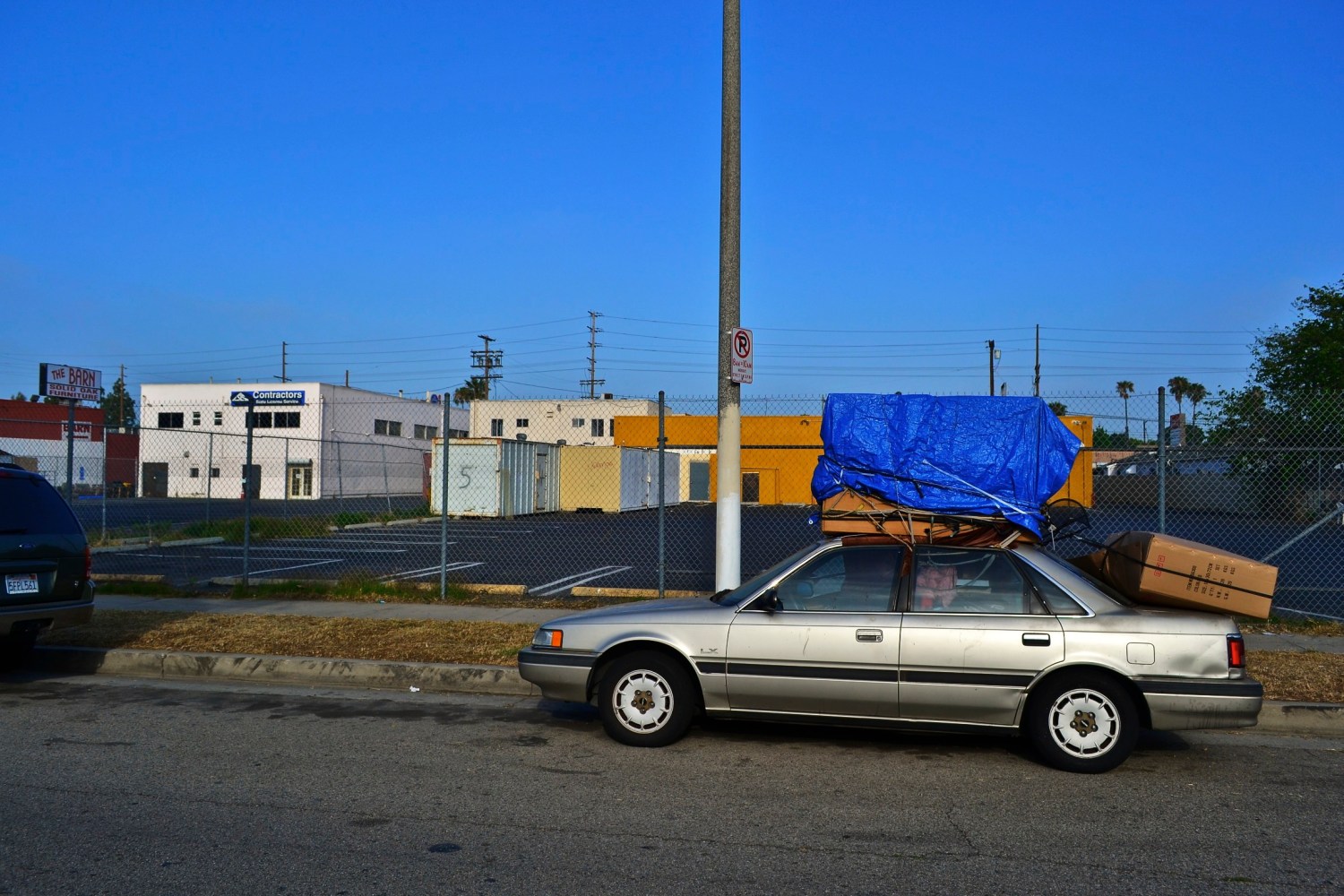
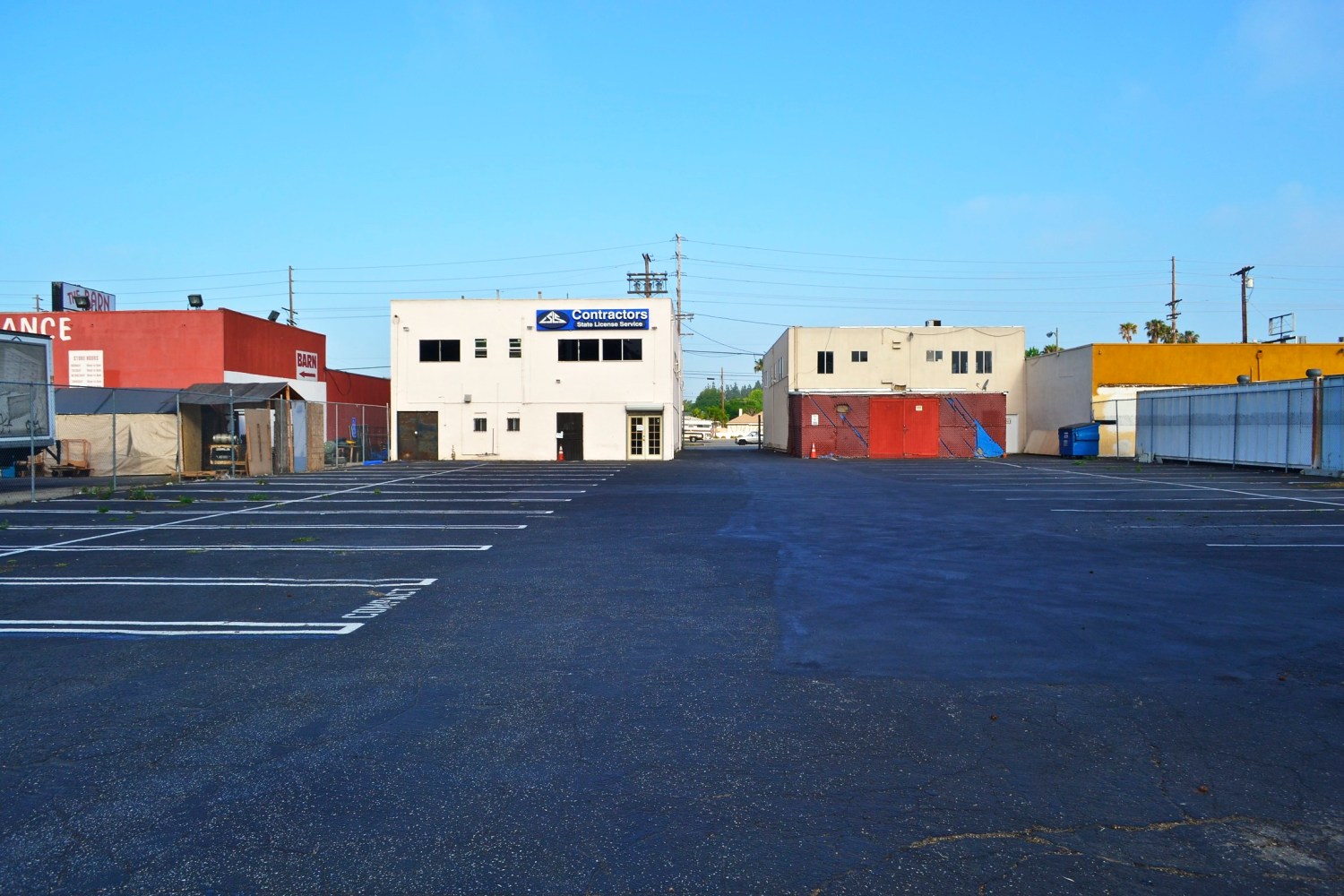
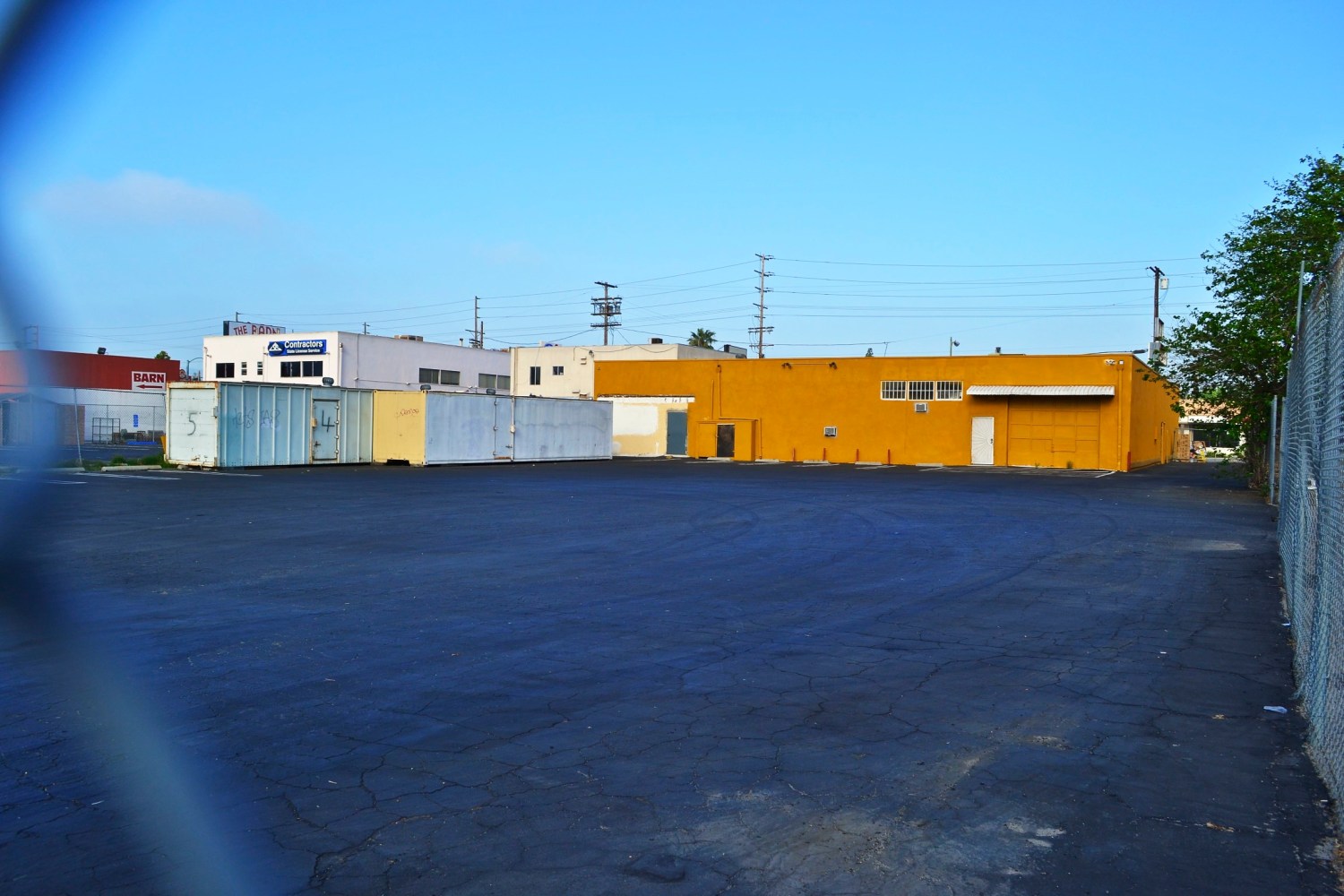
Large expanses of asphalt and black tar bake in sun day after day. These are the parking lots behind retail stores, many untenanted, forgotten and forlorn on the west side of Halbrent,north of Erwin, east of Sepulveda.
This area is chiefly known for two businesses: The Barn, a six-decade-old, red-sided furniture store and Star Restaurant Equipment & Supply advertised for 12 hours every weekend on KNX-1070by radio fillibusteress Melinda Lee.
The Barn uses its parking lot to store trucks. But next door to the north, lot after lot is empty.
I came here this morning with a camera, lens cap off, a provocative act in the bracero’s hood. In the shadows, undocumented workers hide behind doorways and look away when I aim my digital weapon at asphalt. I mean the Mexicans no harm or ill will.
Blithely walking and lightly thinking, daydreaming, I forgot that I have no business here amidst the enormity of emptiness and unproductivity.
I’m looking for a story, for an angle, for a job.
So many are out of work and so much can be done to employ mind and muscle and money.
There is such a wealth and a waste of land in Los Angeles, and America in general. Imagine what Tokyo or Bangkok would do with all these unused acres!
These empty spaces are within a five-minute walk from public transportation, Costco, LA Fitness, CVS and Staples as well as two grammar schools, three banks and an Asian supermarket.
This is a walkable place.
A well-financed visionary could build a low-rise, dense, green, urban farm upon these entombed soils, plant Oak trees, create a little garden with fresh fruits and vegetables, oranges, lemons, and asparagus.
This is a place of potential.
An architect could design some functional and modern attached houses, artfully shading them with native trees.
But for now, the parking lots suffer in silence; waiting for the day that California fires up its economy, wakes up from its long slumber and pushes progress.
I was back in Palm Springs yesterday, planted like a palm tree amidst the gorgeous oddness of its windswept spotless streets, sitting at Starbucks amongst groups of people who looked as if they were from an elderly Mid-Western tribe.
On this day I was acting, as I always do when working, as a videographer. A writer friend had invited me along to assist him for an interview with 94-year-old Leland Lee, a photographer, who had shot the concrete space ship Elrod House in 1969.
The Elrod House, designed by John Lautner in 1968, is a home so iconic and so very weird. Like the latter part of the decade in which is what built, The Elrod is unhinged and sybaritic, self-absorbed and spacey, built for joy and sex and parties, featured in a James Bond movie and now on sale for $14 million.
Giant egos surely must have matched horns in the desert, 43 years ago, when architect and client carved and bulldozed the massive circular house onto a high mountain overlooking Palm Springs.
Architect and client are long dead, but living, still very much alive, is short, smart, stylish and self-effacing Leland Lee, who was only born in 1918, and achieved Mid-Century acclaim for assisting Julius Shulman in the photography of Los Angeles at its Post-War acme.
I have always hated the title “assistant”, having worn the dog collar myself, but here was an accomplished individual whose body of work burned up in a fire 10 years ago, but who still carries himself with a noble kindness and generosity.
Brown leather pants, a white linen jacket and printed silk shirt with a purple necklace, this was what he was wearing yesterday, and if clothing can give some indication of character, than Leland must be an eccentric, artistic, self-confident person, and that is how he introduced himself yesterday.
We drove up a long road and passed guards who ushered us into a cave-like driveway, and we entered the dark, soaring, circular living room where Leland’s framed photographs hung on the walls, and where we would film him as he spoke about each image.
What emerged from the interview was his quiet verisimilitude and the dignity of a gentleman who, without exaggeration and with calm exactitude, spoke about his photography and his life; his triumphs and his tragedies, with focus, clarity, deliberation and observation.
I was there, almost to witness and maybe to absorb a moral lesson of life, one that I have to teach myself continually, that non-conformity and truth, the willingness to be honest and to avoid grandiosity, those qualities that I think I have, will not always pay-off monetarily in the end. The 94-year-old cheerfully admitted he had never signed a contract before, and he didn’t seem to live for legal and financial judgment.
I have been battling, for many years now, between self-destruction and self-creation, wondering whether my own self-expression, in print and photo, was endangering my future. For surely Googling “Andy Hurvitz” might reveal the truth of who I was.
And then I met Leland Lee yesterday, and saw a man who had got on and survived, and did it in his own way, not always triumphantly, but truthfully.
A photo I took, along with others, from a Thanksgiving weekend spent in the Palm Springs area.
Some people hate Palm Springs, saying it is too hot, too sterile, too artificial.
Perhaps it is, but at twilight, when the sun is setting behind the mountains, there is nowhere I’ve been that feels so calming, so warm, so otherworldly.
There is something special about the desert, even the irrigated desert, and along with the green golf courses and the stucco clone houses, there are also special and completely original neighborhoods, dating from the 1950s, where the fine art of strange architecture and sculpted plants transports one into a reverie of light and form, which I have tried to capture photographically.
The Almighty was merciful in creating only one place like Southern California. For better or worse….
And we who inhabit this imperfect, flawed and destructive region, we occasionally are seduced and awed by a light and a moment to realize that we are also blessed to live here amongst human creativity, human imagination and nature’s nature.
This was Palm Springs yesterday and this is the way it was and will always be.
The cold front, pounding rain and dark clouds that swept through Los Angeles this past weekend painted the sky with intense color. And a rare, invigorating chill gripped the Southland; quite appropriate for the end of daylight savings time.
California Lobster two-piece swimsuit, swim trunks, and man’s shirt Mary Ann DeWeese 1949 LACMA
Last week, mid-week, it rained. A storm started the way storms do in Southern California, by announcing its front three days before arrival.
It came down slowly, from the north, and the skies darkened, ever so perceptibly, on Sunday, and by Tuesday the rains poured.
When the storm blew out, on Wednesday, the air was clean and refreshed. And doughy white clouds marched across blue skies.
Three small trees, all oaks, arrived from the city, ready to plant. There was room for only one on our property: a Coast Live Oak, which will look quite magnificent on my 100th birthday.
The Puppy
I went down to my brother and sister-in-law’s house on Saturday and took photos and videos upon the arrival of their new brindle boxer puppy.
These are videos that will show a 2012 Prius on the driveway, and these are videos of my 7-year-old niece and my 5-year-old nephew and a two-month-old puppy.
In five years or ten or twenty years, people will watch these and marvel at unwrinkled and smiling faces of youth, beauty and innocence; days we all have and days we spend in childhood never knowing how ephemeral and passing and short it all is.
General Quarters
I left the Marina and drove east across Culver City on Saturday, along Washington, and turned north on Robertson and went east on Pico and ended up on La Brea at Blair Lucio’s store General Quarters.
Mr. Lucio, on his own, without partners, has opened a concrete floored, iron and corrugated steel men’s shop decorated with black and white photographs of motorcycles, Steve McQueen, and images of postwar life in Southern California.
He is a young, well-groomed man with impeccable taste and good manners who favors plain front khakis, single needle cotton dress shirts, worn leather and canvas knapsacks and pure pine athletic soap.
He worked at Nordstrom’s and that retailer’s high standards of etiquette and service seem to have been branded with a burning iron into Mr. Lucio’s character.
If I had more cash I would spend it here because everything is high quality, classic and well edited.
LACMA
LACMA has installed a show, Living in a Modern Way, devoted to the same place and era that Mr. Lucio adores: the post-WWII years, when California innovated in the arts, home furnishings, architecture, textiles, graphic design, automobiles and industrial products.
The exhibit has a full-scale reproduction of Ray and Charles Case Study House No. 8 in Pacific Palisades as well as an Airstream trailer and Avanti car.
Most interesting are the people who attend these events. They have artful, creative, charmed and haunting faces and they don’t look anything like the rest of the people who live in Los Angeles.
Wilshire Corridor
I went to see Luke Gibson’s architectural photography exhibit on the 8th Floor of the Wiltern on Saturday night.
It was dusk and the sun was setting and you could look north and see the Hollywood sign; and in the east the hills and houses were bathed in a sweet and gentle melon light.
The steel casement windows were open and I sat on an indoor ledge and looked down at a revitalized and busy Koreatown intersection with its new glass tower across the street and crowds pouring out of the Western/Wilshire Metro station; walking, using the city as a city should be used, on foot; with vigor, purpose and joy.
Luke’s aunt, an older and beautiful blond woman, came up to me and introduced herself. She was carrying an Ipad and remarked how proud her family was of their photographer nephew.
She had come up from Lake Forest in Orange County that evening, along with her daughter, son-in-law and two very tall young ladies, her granddaughters.
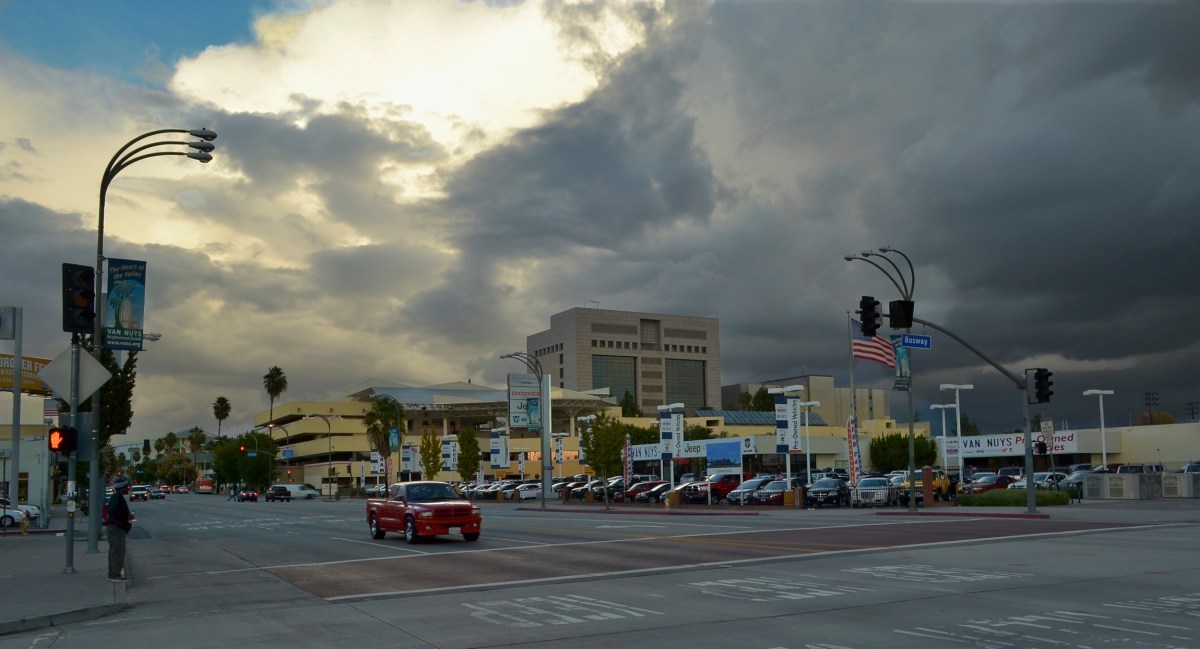
I told her that I lived in Van Nuys and she said she had graduated from Van Nuys High School. Her father had come from North Dakota and the family had lived on Ventura Canyon in Sherman Oaks.
We spoke about the mythical and magical days of yore, the California that really existed but really exists no more: orange groves and walnut groves; clean streets and unlimited opportunity for all. It was all gone now, except on DVDs and in our minds. And she was sweet and smart and savvy and even at seven decades, the ideal California girl.
And she knew how to how work that Ipad and had uploaded online Scrabble and Yelp.
Sunday
I had some work to do on Sunday and I went to meet someone at the Marriott across from the Burbank Airport, but before our meeting, I walked around Fry’s Electronics where the most advanced and latest technology is sold to the least educated and most obese.
Outside Fry’s, in the parking lot, the sun was brilliant, the heat was dry, the mountains were radiant, and the planes flew across the sky and down into airport, gliding into an atmosphere of calm, glistening, radiant, and intense light.
There was hardly any traffic on sun-bleached, treeless Empire Avenue, the service road that runs between the south side of the airport and the railroad tracks.
I thought of Amelia Earhart and Charles Lindbergh and all of the lesser-known war workers who once assembled planes here under a fake city blackout cover. Times past of productivity and progress.
After my meeting, I drove on that road, and over to Van Owen and down Vineland.
I was unaware that a few hours earlier, a distraught man, despondent over his finances, brandished a bb gun, called the police and told him he was armed. The cops came and asked him to disarm and when he refused, they shot him dead in front of his family.
The Madwoman
Hours later, I went to Ralphs on Vineland/Ventura to do some Sunday grocery shopping and got on the 101 at Tujunga, traveling west, back to my home here in Van Nuys.
I was in my Mazda 3, with my friend Danny, watching the road, navigating the heavy traffic, and preparing to exit the 101 near Sepulveda.
I wasn’t going fast or slow, just driving defensively, cautiously, courteously, speedily, not excessively, within reason, as one does when approaching an exit ramp.
And then the dissolve, the madwoman in the rear view mirror…
A wildly gesticulating female driver, in her white SUV, held up her two fingers in a double fuck you to me from her driver’s seat.
Her hands were making digit signs, signs that she emitted in a mad, contorted, deliberate, accelerating, irrational, insulting spastic performance. I watched her gesture fuck you, fuck you, and fuck you again from her car as we got off the ramp at Sepulveda.
And then I pulled up next to her. Again she pulled up her hands to signal numbers, fives and ones, supposing that I would know that she alone knew how fast I was going and it was not fast enough for her. And how angry, enraged and beyond reason she was. She was unashamed, unembarrassed, unhinged.
And tragically, she is what is called average or normal these days. An insane and out-of-control driver, furious when her 90-mile-an-hour motoring is temporarily impeded by another auto.
We waited at the light next to her. We yelled at her and my friend said she was “cuckoo” and then the light changed. And I turned right and she turned left onto Sepulveda, but I would not be lying if I said at that very moment I too was enraged. I was ready to assault or kill this woman who had destroyed my peaceful Sunday afternoon with her madness on the 101.
It has happened to me several times before when I was the target of a woman, always a woman, always white, always showing their fingers and their fuck-you on the road, behind the wheel, when I, obeying the law and doing absolutely nothing wrong, was just driving and being courteous.
I am not a person, I believe, who goes around with a vast arsenal of fury inside of me. I talk things out. I listen to Chopin and Bach and I exercise and run and drink wine and beer and laugh a lot.
But this is California these days. There are no rules for how to behave in public. The Grossest Generation: that is what this generation is.
She is the reason that I also sometimes hate Los Angeles and wonder if all of the nostalgia for the greatness of our past can make up for the uncivil awfulness that passes for civil society in the Golden State.
Well, at least we can remember how golden the Golden State once was.
It was a delightful weekend until I got on the 101.
Did you know there is something called A Month of Photography LA featuring exhibitions, lectures, and discussions? The Lucie Foundation is the organizer of many events for photographers and those whose livelihood (or lack of one) is connected to the visual world.
Last night, I drove down to Smashbox Studios in Culver City where black shirted PA’s were busy folding up many hundreds of folding chairs inside vast white-walled spaces. I’ve noticed that much of the long hours spent in production involves unfolding and folding up portable seats.
A panel discussion, attended by over 100 people, listened to “New Media” art directors, photographers, photo agents and a website blogger ruminate on how the “wonderful” new virtual world of photography is being remade by those who live inside Facebook, Twitter and Zineo.
There are many thousands of photographers and would be creatives in Los Angeles, most of who work at jobs and in areas completely divorced from their real passion. But the six persons on stage last night, have somehow made names and money for themselves by positioning their work in the front and center of digital imagery.
Rob Haggart was the moderator. He writes aphotoeditor.com
where he uses his background as the former photo editor of Men’s Journal to advise a photographer on how one might market herself in the iPad era. Soft spoken, silky haired, with a smooth face, black thick frame glasses and a plaid shirt, he radiated a confidence and heft earned from early success and posting daily bromides. He has a company that builds websites for photographers.
Jen Jenkins is the principal of Giant Artists, a photography agency. She has a roster of 8. Eight. Friendly, optimistic, youngish, she looks like a gal who you might meet in an Oakland muffin shop or making organic soap in Portland.
Ms. Jenkins’ clients were also on the panel, Jeremy and Claire Weiss, who shoot photos and blog and Twitter and Facebook and gallery themselves up in Highland Park.
The most corporate and seemingly the most business savvy on the panel was Heidi Volpe, former art director of the LA Times Magazine and now design director at Zinio. She seemed to actually hold and succeed at her corporate creative job, one in a long line of jobs where she chose and promoted and assigned professional photographers. Now she is showing National Geographic how to convert its vast name and assets into digital content.
Kiino Villand is a photographer who has launched an online magazine WSTRNCV. He reminded me of me because I could not exactly tell what exactly he does, what he is selling, or what he is aiming for. His magazine is unpronounceable, but I once turned it up by Googling for “Studio City and Laurel Canyon”.
It finally came around, after 1.5 hours, to open up the questions to the audience. Twitter and Facebook, like Catholicism and Islam, are the great keepers of the mind of man, but one agnostic uttered a blasphemous word: FLICKR.
We had been told for almost two hours about how much social media matters and about how Twitter and Facebook and YouTube are invaluable for photographers. But Flickr, the largest photography website on the Internet, an international creation which links and unites lovers of photography around the globe, is somehow considered lowbrow or “for housewives who post children’s party photos” on it.
The panelists seemed lost in explaining whether Flickr was a detriment or asset to a professional photographer. “Go ahead and do it” or “We deleted our Flickr account” were the answers.
The discussion ended and the crowd of many thin, stubbled-faced young poseurs assembled into slouchy and huggy groups of camaraderie and camera talk. An unusual number of people were handsome and pretty, leading me to speculate that photography, like acting, sex, and marriage, is something to be entered into with blithe ignorance and convincing fakery.
Tomorrow would come again and somewhere someone will be texting and typing, uploading and digitizing, shooting and posing, directing and lighting and trying to succeed without even knowing.




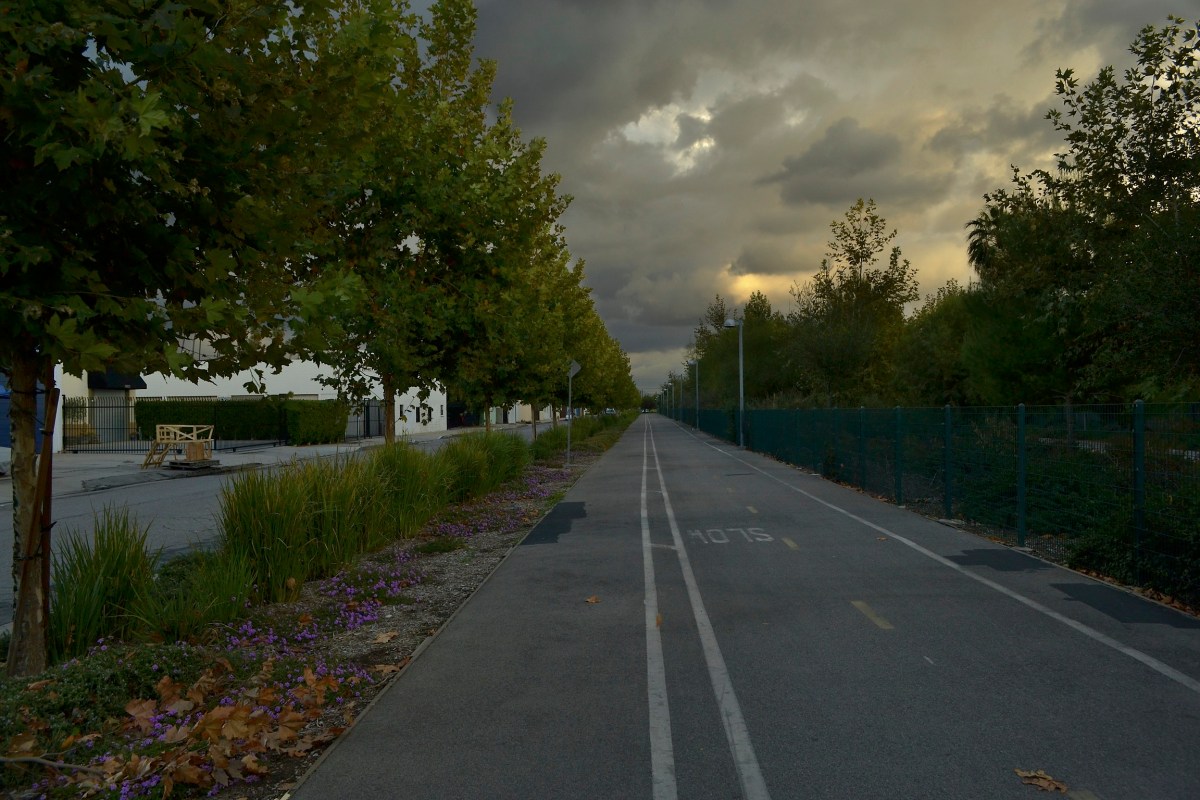





 Here in Van Nuys
You must be logged in to post a comment.