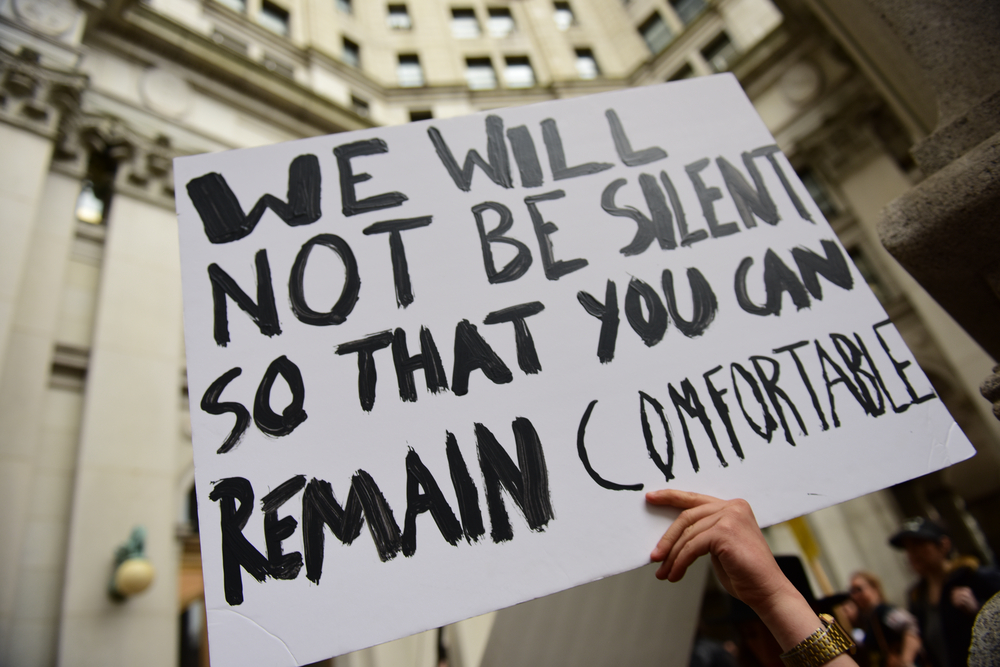
Single Family Home Protest.


Recently, our neighborhood found out that the owner of a vacant parcel of land wants to construct a single-family home in our area of single-family homes.

Frightened, angered, upset, scared were many longtime residents who saw the picture of the house with four bedrooms, three bathrooms and a two-car garage.

And rightfully so, for they have seen that single-family houses are a great blight. They produce divorces, affairs, bankruptcies, child abuse, and unemployment as owners struggle to pay mortgages.

LAPD is often called out, and has been for many years, to answer calls at single-family homes, many of which are occupied by people who are battling addiction, depression, and a lack of joy which comes from keeping up a single-family home.

Many of these single-family homes are contributors to traffic, with five, six or even seven vehicles registered at one house. They are environmental disasters with their wasteful use of water for landscaping, for pools, and for the many long showers people who live in these homes take.

On the news, fire season has seen the burning of these houses, and the many millions of dollars in resources it takes to protect houses. Firefighters and other first responders put their lives on the line defending single-family houses.

Unregulated procreation often occurs behind closed doors and draped windows which produces children who clog our schools and clutter our roads, impeding traffic.  Single family homes, with their many rooms, encourage child production, and this has a negative effect on our ailing schools with their bloated budgets.

News stories often feature drive by shootings at single family homes, as well as hostage taking, and there are neighborhoods all over the Southland which constantly are battling violent incidents at single-family homes.

Some single-family homes have unrelated adults living together in sober living houses, and other single-family houses even have unrelated adults sleeping under one roof, a clear violation of moral and ethical traditions. 

So we are organizing a demonstration next week to try and prevent yet another one of these despicable types of housing from blighting our neighborhood.

We will have a protest. And many people will come with signs and scream loudly so that we are not subjected to the unwanted intrusion of yet another home, for someone we don’t know and we imagine we will grow to hate.

Option A: “Where Will We Go?”


A new mural, painted by Guy Ellis, on the side of Showcase Cabinets at 14823 Aetna St. Owner Peter Scholz (L) and Artist Guy Ellis.

The proposed Metro Los Angeles scheme (“Option A”) desires, through eminent domain, to flatten 186 small businesses employing some 1,500 workers just steps from downtown Van Nuys.

The 33-acre area extends from Oxnard St on the south to Calvert St on the north, Kester St. on the west and Cedros on the east. In this area, rows of shops straddling the Orange Line will be extinguished by 2020.

Light rail is coming, the trains need a place to freshen up, and here is their proposed outdoor spa.

The engine of public relations is roaring. Mayor Garcetti needs to remake LA for the 2028 Olympics. He has gotten the city into full throttle prepping for it.

It is comforting to think that property owners will be reimbursed for their buildings, that businesses “can relocate”, that the city will take care of those who pay taxes, make local products, and employ hundreds.

But most of these lawful, industrious, innovative companies only rent space. Yes, they are only renters, and they face the dim, depressing, scary prospect of becoming economic refugees, chased out by their own local government. Some of these men and women have fled Iran, Armenia, Guatemala, El Salvador, and Mexico, places where war, violence, corruption, drugs and religious persecution destroyed lives and families.

Others were born in Van Nuys, those blue-eyed, blonde kids who went to Notre Dame High School and grew up proud Angelenos, driving around the San Fernando Valley, eating burgers, going to the beach, dreaming of making a good living doing something independently with their hands.

They all expressed shame, disappointment, anger, and betrayal against Councilwoman Nury Martinez and the Metro Los Angeles board for an action of insurmountable cruelty: pulling the rug out from profitable enterprises and turning bright prospects into dark.

Scott Walton, 55, whose family purchased the business Uncle Studios in 1979, said, “I think I’d sell my house and leave L.A. if this happens. I would give up on this city in a blind second.” His mother is ill and his sister has cancer. His studio now faces a possible death sentence.

What follows below are profiles of three men, who come from very different industries, but are all under the same threat.


Bullied at the Boatyard: Steve Muradyan

Steve Muradyan

At BPM Custom Marine on Calvert St., Steve Muradyan, 46, services and stores high performance boats at a rented facility. Here are dozens of racing craft costing from $500,000-$1 million, owned by wealthy people in Marina Del Rey and Malibu. The boats winter in Van Nuys, where they are expertly detailed, inside and out.

Mr. Muradyan, a short, broad-shouldered, sunburned man with burning rage, threw up his hands at the illogic of his situation. He takes care of his wife, two children, and aging parents. He pays 98 cents a square foot in 5,000 SF and he cannot fathom where he might go next. A wide driveway accommodates the 50 and 70-foot long boats. And he can work late into the night drilling and towing, without disturbing others.

He once ran an auto repair shop on Oxnard. Later he had a towing service. Then he started his boat business in 2003. He had raced boats as a young man, and this was part of his experience and his passion. Why not?

He deals with all the daily stress of insurance, taxes, payroll, equipment breakdowns, deadlines, customer demands, finding parts, servicing the big craft. He worries about his business, his family, his income. And now this impending doom, dropped from the skies by Metro. He prays it will not happen to him. He cannot fathom losing it all, again.


Art and Soul in Stained Glass: Simon Simonian 

Over at Progressive Art Stained Glass Studio, 70-year-old architect and craftsman Simon Simonian rents a small unit on Aetna where he designs and molds exquisite stained glass for expensive homes, churches, synagogues and historic buildings.

He knows all the local businesses, and often he sends customers to the cabinetmakers and metal honers steps away. There is true collaboration between the artisans here.

A kind, creative man with a penetrating gaze, Mr. Simonian, with his wife and young son, came from Tehran in 1978 to study in Southern California and escape the impending revolution in Iran. He speaks Farsi, English and Armenian.

He is an Armenian Christian and his family was prosperous and made wine. His father had escaped the turmoil in Armenia when the Communists took over after WWII, which was also preceded by the massacre by Turkey of 1.5 million. His people have suffered killing, expulsion, persecution, and the loss of dignity in every decade of the 20th Century.

The Simonian Winery was doing well in Iran in 1979. And then the Islamists came to power and burned it down. By that time Simon and his wife and son were in Southern California. He begged his father to come but the old man stayed in Tehran and died five years later.

Tenacity, survival, and intelligence are in his genes.

“I love what I do. I have loyal customers. The location is excellent. I know all my neighbors here. I want to stay rooted. I don’t want to have to start all over again. Where can I find space like this? Where will I go?” he asks with the weary experience of a man who has had to find another way to proceed.


The Man from Uncle: Scott Walton

55-year-old Scott Walton looks every bit the rocker who runs the recording studio. He is longhaired and lanky. With a touch of agitation and glee, he slips in and out of the dark, windowless rehearsal spaces of Uncle Studios, where he has worked since 1979.

His father, with foresight, loaned $50,000 to his two sons, Mark, 20, and Scott, 17 to buy a recording studio. Here the boys hosted thousands of aspiring musicians including Devo, The Eurythmics, Weird Al Yankovic, Weather Report, Yes, Black Light Syndrome, No Effects, The Dickies, Stray Cats, and Nancy Sinatra.

When Scott first started he didn’t play any music. He learned keyboard, classical piano and he also sings. He went on the road, for a time, in the 1980s, playing keyboard for Weird Al Yankovic. He also plays in Billy Sherwood’s (“Yes”) current band.

Despite the proximity to fame, talent, money and legend, Uncle Studios is still a rental space where young and old, rich and poor, pay by the hour to record and play music. Something in the old wood and stucco buildings possesses a warm, acoustic richness. Music sounds soulful, real and alive here, unencumbered by the digital plasticity of modern recordings.

But Scott Walton is also a renter. He does not own the building bearing his business name. If his structure is obliterated, he will lose the very foundation of his life, his income, and his daily purpose. He will become an American Refugee in the city of his birth.


This is only a sampling of the suffering that will commence if Metro-Martinez allows it. The Marijuana onslaught is also looming.

On the horizon, Los Angeles is becoming dangerously inhospitable to any small business that is not cannabis. Growers are paying three times the asking rental price to set up indoor pot farms for their noxious and numbing substance. There may come a time when the only industry left in this city is marijuana.

The new refugees are small craftsmen running legitimate enterprises. Some may not believe it. But I heard it and saw it on Aetna, Bessemer, and Calvert Streets.

The pain is real, the fear is omnipresent and the situation is dire.

SaveSave

SaveSave

SaveSave

Blight and Fear.


Van Nuys is sometimes and often justifiably known as a cruddy place.

It presents its public face, along Kester, Victory and Vanowen, as one of disorder: discarded mattresses and couches, tagged walls, empty storefronts, littered parking lots; and gelatinous, black spandex covered illegals pushing shopping carts and dragging water bottles to the corner market. Prostitutes walk day and night along Sepulveda. Gang graffiti is sprayed on white walls and then erased by angry property owners.

And then there are sections that seem out of another time, neighborhoods where commercials are filmed in front of picket fence houses, storybook cottages, lovely and well-tended.

At night the sirens and the helicopters come out often, waking up the sleeping residents.

And when day breaks, the streets are again quiet, but often sprinkled with discarded condoms, broken bottles and last night’s McDonalds wrappers.


West of Kester, north of Victory, we inhabit one of those “pockets” where there are mostly single family homes. Some of these houses are empty. Their owners have died, but their children do not choose to sell. Other houses are rentals. And many are owned by a variety of people: rich, poor, young, old, gay, straight, Mexican, Guatemalan, Armenian, Black; renters and homeowners, disabled and elderly, infants and young families.

The overriding theme of the area in which I have lived for 16 years is fear of blight and crime. We want our houses to stay well-tended, to keep up property values, to put up a wall against the overwhelming power of social forces beyond our control.

When news spread that The Village Family Services had purchased a single-family home at 14926 Kittridge, to house 6-10 “at risk” young people aged 18-24, something got the community galvanized.

How could this be allowed? Where was the great Van Nuys Neighborhood Council? Where was Councilwoman Nury Martinez?

Who would supervise, residents asked, half a dozen or more kids when everyone knows supervising even ONE teenager is often impossible. Answers from Village Family Services were after the fact, as if purchasing and setting up a bad business in a nice neighborhood, even a non-profit one, is OK as long as you have the bucks to put it in. No questions asked.

What business is it of yours, VFS seemed to say, asking how a non-profit drug and alcohol halfway house might not be a good addition next door.


Public records show that 4 bedroom, 3 bath 14926 Kittridge was in foreclosure in June 2014. It was owned by Jose A and Maria G. Mojica.

It sold to The Village Family Services for $540,000.00 in October 2014. 

A raucous and badly run Wednesday, November 19th meeting of the Van Nuys City Council, where members ate pizza as others in the audience yelled and screamed, and disorder predominated, was what some of our neighbors encountered when they attended .  Officials pronounced that the deed of purchasing the home, and the plan to move in the kids, was a done deal.  The only variance would be allowing even more to move in, possibly 10.

A friend of mine, who knows how these facilities are run, says it’s about profit. You can charge perhaps $900 a month to house each tenant, which multiplied by 7 or 9 might bring in as much as $8,000 a month, more than enough to pay a mortgage on a $540,000.00 house.The house itself is nice looking. I drove past it the other day and shot these photos.

DSCF0428 DSCF0427 DSCF0429

A community meeting and petition drive will be held at this house this Saturday, November 22, 2014 from 8:30-11:30AM. All concerned community members should attend.

With Man Goo Goo at Occupy Van Nuys


When I first heard that the burgeoning “Occupy” movement was moving into Van Nuys, and they were planning on pitching their tents behind the Marvin Braude Center, on the lawn of the Civic Center, under the piercing tower of the Valley Municipal Building, I must admit I got excited.

I imagined hundreds of young, yelling, incensed, angry, articulate, fertile, bearded and long-haired, tattooed men and women carrying protest signs, arguing with the cops and pointing fingers at authority; and then at sunset, when the grounds were closed, an enormous phalanx of armed LAPD officers, moving forward–on tanks, horses and siren-mounted, armor-clad bicycles– pushing and smashing and trampling the sleeping bags; blasting fire hoses full of water, setting loose ferocious and fanged German Shepherds tearing and ripping at running denim derrieres. The helicopters would churn up the air above, while on the dusty ground, cameras from every international news organization, and bloggers from every laptop, would record the brave and terrified OCCUPIERS fighting to stay their ground! To voice up for the voiceless and power up for the powerless and prove to the world…. once and for all…. that our great nation is doing something… something so terribly wrong! Because only one percent have everything and ninety-nine percent have nearly nothing!

But at five o’clock yesterday afternoon, Van Nuys looked as Van Nuys always does: dead under the sun.

There was lots of street parking on Sylvan Street, next to the Civic Center, and it was free (my apologies to Donald C. Shoup).

On the mall, behind the Valley Municipal Building, were gathered a college cameraman, tripod and video, interviewing a man. Perhaps a dozen people with a few signs were standing and chatting.

KTLA and KNBC news trucks were parked far away, their new technology and old reporters, ready to capture the non-event that was about to not happen.

And outnumbering the protesters, or the complainers or whatever or whomever they were; many navy shirted cops, standing on foot and on bike, looking bored and aimless and tired. The cops had been hyped up, no doubt, and sent out, no doubt, to fight and protect these hallowed homeless grounds from the invasive anti-Wall Street crowd whose lament has yet to be fully understood or properly articulated.

I was adjusting my camera when a tiny man carrying a tiny dog walked up. He handed me a sheet of protest music and introduced himself as “Man Goo-Goo”.

Man Goo-Goo is a musician and he will be appearing at Paladino’s next week where he will perform something, possibly musical or perhaps vocal, I could not ascertain.

His name, as he explained, is a derivation of Lady-Gaga.

There was not much to photograph besides Man Goo-Goo, so I left the strangely deflated protest and walked back to my car on quiet and unpeopled Sylvan Avenue.

Occupy Van Nuys has some noble aims, but when it came to Van Nuys, it unfortunately confronted something much larger than the inequity of wealth and the corruption of politics.

For Van Nuys itself has an almost mystical ability to destroy anything worthwhile, be it aesthetic, intellectual, commercial, developmental or progressive.

Under the hot sun, baked in acidic air, crowded with illegal occupiers; Van Nuys is anti-nature, for it does not abhor a vacuum, it creates one. These protesters, yearning for freedom and fresh air, had unwittingly entered a toxic and sulphurous environment of suffocation. Civic life died long ago in the atrophied heart of the San Fernando Valley. And these young hearted protesters had encamped, near dusk, in a dead twilight zone.

This is the town where a few months ago, dozens of lovely, mature Pepper trees were chopped down in front of the East Valley Animal Shelter so large posters could be seen advertising animal adoptions. New trees have since been planted to replace those inexplicably butchered.

And in a new “Only in Van Nuys” development more nature was killed recently near the intersection of Van Nuys Boulevard and Burbank.

The powers that be have torn out the ornamental grasses and agave that beautified the wide nothingness of the street, and they are now laying down sheets of astro-turf. Yes, the meridian in the middle, the only sign of nature amidst the car dealerships, will now have new artificial grass where living plants once thrived.

Occupy the 405.


The protesters who call themselves Occupy Wall Street are a disparate and varied group of progressives or leftists or anti-status quo men and women who are tired of our 30-year-old program to promote the interests of the very wealthiest and neglect the needs of the very poorest.


No nation stands still and watches its very core, the middle-class, sink into poverty, unemployment, joblessness, illness and idleness. Eventually, a nascent and small group of angry people takes action and sits down somewhere where they will be noticed. Now they are sitting down and speaking up right in the middle of the most powerful financial district in the world.


It’s long overdue, this growing anger at the legislative corruption of a Congress which prints money only to have it spent overseas on wars; a Congress that spends lavishly on tax breaks for companies who hire workers in foreign lands, while cutting health insurance and jobs at home.


America, we are told, cannot afford affordable education, health care, housing, public transportation, police protection and environmental preservation. But we somehow can spend trillions on sending private companies overseas to weaponize, fight, advise and spend American tax dollars in Africa, Asia, South America and Europe.


The Republican mantra says the government must not interfere at home. But overseas we can invade and rule. In fact, we must.


Very few of us fight and die in war these days. So the coffins which come back are not seen nor do many mourn the dead.  We live in a time that values convenience over justice.


And inconveniencing the wealthy and the privileged is the point.


Occupy the 405.


Protests need to move to the wealthy section of Los Angeles so that Beverly Hills, Brentwood, Westwood and Santa Monica also feel the pain. If protesters stopped traffic and brought cars to a halt, the news media would have a field day. Anderson Cooper would set up his rig right on Sepulveda and Wilshire and helicopters would swarm overhead as tens of thousands gathered to demand what all Americans need.


Stand on the Freeway.


SOTF.


Stand on the Freeway.


In Egypt, it seemed, at first, that the thousands who finally decided that they have had enough, were brought to their senses and onto their feet by Facebook and Twitter.

Oppressed, humiliated, tortured, spied on, forgotten; the ordinary Egyptian has no future to look forward to, no better life ahead, and only a vague sense that his individual life matters.

Over there, in the Middle East, Americans can see that a very small slice of the elite own everything, and that the vast majority of people cannot earn enough to even buy bread.

And, as Abraham Lincoln said, “You can fool some of the people some of the time, all of the people some of the time, but not all of the people all of the time.”

We Americans have been living in fiction here too. For thirty or more years, it has been normal for every single industrialized section of the nation to close down. Abandoned, emptied, unused: these are the very engines of the economy that are no more.

So we took flight into frivolity: speculating in houses, throwing money into stocks, dancing on credit card debt. We celebrated our “post-industrial” lifestyle. Bad art and self-indulgent decadence occupied factories that once produced good machines and solid income.

And we imagined that the world was somehow being remade under a new virtual lodestar, hung in the Silicon Valley sky, guiding the world’s peoples into a smart, technical, open, free and intelligent self-rule and entrepreneurial cornucopia.

While Apple may introduce a new product every six months, human behavior only changes every million years. These are the eternal conditions of this planet: power, exploitation, greed, oppression, hunger, violence, war.

So the people of Egypt are marching and screaming, tearing down their government and demanding some justice.

And so the American people are robbed by private corporations and must live in a crumbling land where good jobs have gone away and only texting and the internet suffice as community.

If only six hundred people in Los Angeles protested for single-payer, public option health insurance, by standing on the 405 Freeway under the Wilshire Avenue Bridge, the news media would take notice, the government would react and conditions in real life might change.

I ask you:

Which country is poorer: Egypt or America?

The answer:

The country with the most citizens willing to fight for a new and better day is the richer one.

Let the word go forth to a new generation:

Ask not what your government will do for you, but what you are willing to do for your country.

We must stand on the freeway. And it is not too late to act.