Some remarkable photographs from 1964 show openly Republican women, out and proud, at Sportsman’s Lodge in Studio City. They had gathered to support the candidacy of George Murphy for the US Senate. Dressed in flowered hats, mink stoles and gloves, the ladies, as they were referred to back then, held a luncheon in the heart of the now 100% liberal district.
Mr. Murphy won the election and served from 1965-71.
A Wikipedia entry describes a Reaganesque sounding entertainer:
“George Lloyd Murphy (July 4, 1902 – May 3, 1992) was an American dancer, actor, and politician. Murphy was a song-and-dance leading man in many big-budget Hollywood musicals from 1930 to 1952. He was the president of the Screen Actors Guild from 1944 to 1946, and was awarded an honorary Academy Award in 1951. Murphy served from 1965 to 1971 as U.S. Senator from California, the first notable U.S. actor to make the successful transition to elected official in California, predating Ronald Reagan and Arnold Schwarzenegger.[1] He is the only United States Senator represented by a star on the Hollywood Walk of Fame.”
At the time, marijuana and homosexuality were illegal, a woman needed her husband’s permission for a bank loan, a drunk sleeping on the street would be arrested, almost nobody was obese, tattoos were for sailors and people in the circus, and the Republican Party was the sworn enemy of Russia. Children walked to school and rode bikes, and most adults smoked at home, in the office, in movie theaters, and while driving in their cars.
How most Californians survived growing up with free tuition, plentiful jobs and cheap housing is beyond our imagination. We are fortunate to be living in a much more progressive and kinder era with homeless encampments and marijuana dispensaries in every neighborhood.
Courtesy of the Valey Times and the LAPL:
Photograph article dated January 28, 1964 reads, “At the kick-off of 1964 campaign activities of the Laurel Oaks Republican Women’s Club, more than 300 political leaders and Valley Republican women gathered to hear George Murphy, candidate for the United States Senate. Mrs. Edward Gephart was general chairman of the tea, which was held at Sportsmen’s Lodge, Studio City. Honored guests were California leaders of the Republican Women and Valley government officials. John Willis, television and radio newscaster, was master of ceremonies.” Mrs. Ben Reddick, wife of Valley Times publisher, serves tea to Mrs. Allen K. Wood, Sherman Oaks. Mrs. Wood also poured at the tea table.
The other day, I drove past the gray ranch with white casement windows at 4336 Teesdale, a house I briefly lived in for 4 months when I arrived in Studio City in May 1994. There was a for sale sign in front, so I stopped my car, got out and started to take photos for posterity.
A middle-aged Israeli, parked nearby, emerged from his SUV to ask me why I was taking photos of “his house.” I told him I had lived there many years ago. “I am on the neighborhood watch,” he said.
I explained that I knew the previous occupant and had lived here myself. I asked him how much the house sold for, but he would not say. He said he was a broker, but “I don’t like to call myself a broker. I’m more of a preservationist.”
He told me the house, most likely, would be torn down.
He seemed satisfied with my benign answers and he drove away.
Redfin, I saw later, listed it for $1,034,500.
In 1994, a college friend, “B”, was renting it for $1,200 a month. There were two bedrooms and one bathroom, 1168 square feet, built in 1938 for $3,200. I paid “B” $100 a week when I earned $500 a week as a PA.
“B” went away for the summer to work on “Woodstock ‘94” a twenty-fifth anniversary program of the rock festival. I stayed in the house and got a job at Greystone in Valley Village where the hazy air obscured the view of the mountains and everyone went across the street to get lunch at Gelson’s salad bar.
When “B” returned we fought over something silly and we never spoke again. And I moved out.
Everyone sees their life and their times in their own way. And we interpret our communities with stereotypes we overlay on them. And Studio City has stayed in my head as a certain place, regardless of fact or reason. It still exists in my imagination in that way I first encountered it that summer in 1994.
In the 1990s, there was a family type who lived in Studio City, not at 4336 Teesdale, but in many other homes. I often met them on runs when I worked at Greystone.
The mom was always named Linda. She was single and raising two teenagers in a two-bedroom ranch that looked like 4336.
She was 43-years-old, with a perpetual tan, curly dark blonde hair, living in a tiny house with many VHS cassettes, tons of books, two cats (Cat and Kitty), a bedroom with burgundy sheets, a leopard print comforter, brown velvet pillows and a chenille throw. Her fireplace mantle was stacked with scented vanilla candles and ornate gold-framed photos of her two kids who were always named Zoe and Adam.
There were three closets in the home, each 23 inches wide, and the front hall was stuffed with everything nobody would ever need in Southern California: waterproof boots, winter coats, sweaters in dry cleaner bags, hats, gloves, mittens, a file cabinet and an Electrolux Steel Framed Canister Vacuum.
Linda was always a writer/producer and had worked on documentaries about Nostradamus, the Titanic and “The World’s Most Amazing Dogs.” Her new boyfriend was always a bearded therapist named Robert or Steven and he had a dry, calm, objective, scientific and analytical view of everything from genocide to dieting to menopause. He was always rational and grown-up, in contrast to the immature first husband. He never lost his temper unless someone disagreed with him.
He ended most arguments with this winning argument: “Chomsky said it. I believe it. That settles it!”
He knew wine and he knew women. And he had classifications and opinions on both which he pontificated upon with his index finger waving in the wind.
Linda drank highly oaked Kendall-Jackson Chardonnay and treated herself to Wolfgang Puck’s pizzas topped with smoked salmon and caviar. After coming home, stuffed and intoxicated, she plopped down into her overstuffed sofa which took up almost her entire 10 x 12 foot living room.
She was divorced, always from David, who always moved to the beach, and they had joint custody of the kids whom he picked up on Friday nights, two times a month, in his Jetta Convertible. David was always an editor. He had once worked with Scorcese, but had a falling out. He was said to be bitter, but he still earned $5,000 a week working for NBC or Universal and had a 25-year-old girlfriend, who was always tall and always named Jennifer.
The broken up families of Studio City, twenty years ago, were always white, and they were always from different white backgrounds: Jewish and Irish, Jewish and Italian, Jewish and Atheist. They were always self-professed liberals and had always grown up in completely segregated, wealthy neighborhoods and were uniformly horrified at the downfall of their former hero Orenthal James Simpson.
They always came from back east, and had attended Ivy League schools, some earning MBAs, always with the intention of using their top-level education to write or produce Hollywood sitcoms.
Someone’s parents had always lent them $23,000 for a down payment on a $239,000 house off of Moorpark near Whitsett. “Your father killed himself saving this money for you so you would have it for this very reason.”
The parents were always difficult, but always present, in daily phone calls. When the phone rang at 6am, the parents back east never knew it was three hours earlier in California. Every August they mailed a check for $3,000 to pay for Adam and Zoe’s yearly tuition at Harvard-Westlake.
Long gone, are the struggles of 1994, those days of worry when you wondered how you would pay your $657 a month mortgage. The women who stayed put in those houses are now gray or white haired though most are still outwardly blonde. They are all passive millionaires who live in million dollar homes.
So many have sold their little quaint houses with the rope swing tied on the tree in the front yard. The picket fence, the one car garage, the kitchen with two electrical outlets and no dishwasher, the pink bathtub with plastic non-slip flowers, the glassed in back porch, the one bathroom shared by four people: all wiped off the map in Studio City.
In 2017, the new house is always white, always “Cape Cod”, always 5,000 or more square feet, always “amazing” (is there any other word?) with five bedrooms, five bathrooms, 15-foot high ceilings, with high security systems and cameras affixed around the exterior to catch squirrels, possums, robbers and send alerts day and night. The 89 windows are never opened and the air conditioning is always on. There are 100 overhead lights in the combined living/dining/den/kitchen/wine bar/library/pool/patio.
The walls are always white and there are no books, not a single one, anywhere, except if they are on the coffee table, and then they are photography books, and they sit in front of the 86″ Class (85.6″ Diag.) 4K Ultra HD LED LCD TV: $6,999.
(Text continues after egregious photos)
There are always two SUVs parked in the driveway, usually a Mercedes and a Lexus. They have Bluetooth and Wi-fi but every woman who drives one uses her handheld phone to talk while accelerating through red lights driving Sophia and Aiden to school safely.
Nobody cooks in the kitchens with the 50-foot long counters and the 10 Burner, $16,000 Viking Range. They just get takeout from Chipotle.
Inside these vacuous homes, nobody reads and nobody converses. They just look at their phones. Everybody has a spine like a banana and red, callused, sore thumbs.
The old Studio City, cramped life creatively lived, is fast under demolition and in its place something alien, gargantuan, empty, expensive and all-white fills in the empty lots on every quaint street like a new set of false, horse-tooth-sized dentures rammed into a 4-year-old girl’s mouth.
The bulldozers, I expect, will come soon for 4336 Teesdale. The 80-year-old house will be a pile of wood by lunchtime. And then a new lot will get dug, the new foundation poured, and stacks of lumber, men and tools will put up a new spectacular that looks like every other new spectacular in Studio City.
And upon completion, the realtors will smile, the banks will lend, the in-laws will underwrite, and some young family will be in debt for $2,500,000 for the next 30 years, if they are lucky.
“Trade For Print” is a new short story I wrote concerning an unscrupulous photographer who lures a postal worker into fraud by offering young love for sale.
The piece, entirely fictional, of course, takes place in North Hollywood and moves around on local boulevards and avenues: Chandler, Colfax, Bakman, Lemp and Lankershim. And includes such storied places as The Federal Bar, SGI Buddhist Center and the North Hollywood Post Office.
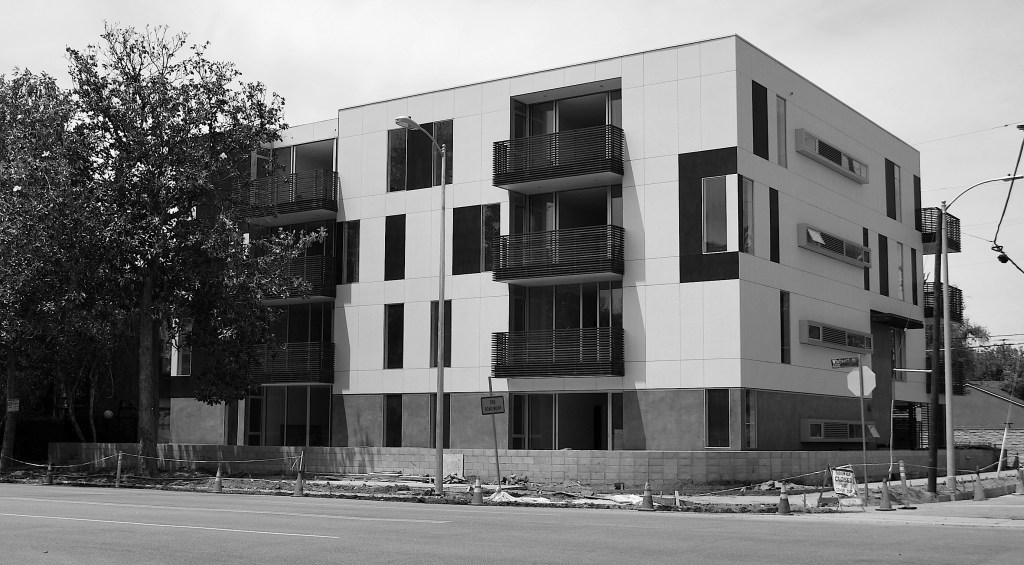
Driving down Moorpark St. in Studio City last week, I passed a notably austere and well-designed apartment under construction. I stopped and walked around and shot some photos of the building which had precise lines, solid forms and possessed an architectural sensibility of the 1930s.
I later looked up the architect online and wrote him an email. To my surprise, he responded in detail. Even more surprisingly, he is a man who has been practicing architecture for over 50 years.
Here is what he had to say about the state of planning and architecture in Los Angeles, especially as it relates to the San Fernando Valley.
I have not disclosed his name to protect his privacy.
Dear Andrew:
Thank you for the complimentary words regarding my apartment project. They are truly appreciated. I looked at your excellent blog.
Your involvement in trying to better the quality of life in Los Angeles is noble. I suspect, however that you are constantly faced with the frustration and anger of dealing with a Los Angeles bureaucracy that has become stifling and counterproductive.
The planning department has been a dismal failure as long as I can remember and has continually failed to address the real and important problems that have faced our city.
Old Montgomery Ward. Panorama City, CA.
I am sure you know the recent history of the Valley better than I do. I came to Los Angeles as a child in 1948, just after WW2 ended and lived in West LA.
A trip to the Valley was a bit of an adventure. Mostly open space. And it was hard to find a restaurant or much of anything. I did not realize then what we were soon going to lose. Tough-minded, enthusiastic, returning soldiers were coming to LA during this period wanting only to work and raise families in peace.
I was fortunate to have a few of these men as instructors at the U.S.C. School of Architecture. The Valley provided an abundance of cheap land on which to develop housing. And with the coming of these returning soldiers, a major Valley building boom began. Housing tracts and apartments were built as quickly and cheaply as possible. It was an exciting event to see a searchlight in the sky and drive towards it to find what new business opening it heralded.
Macy’s, North Hollywood, CA.
All of this was happening with virtually no master planning. One bland community rolled into another. As I drive the Valley today, I find it kind of fun to try to identify the architectural styles, if you can call them that, of each of the building booms in the 60 plus years since the end of the War. Thank God for the mature landscaping that is making the Valley environment somewhat more pleasant. I find myself, grudgingly, seeing a kind of quirky nostalgic beauty in whole thing. But enough rambling. No easy answers.
15300 Valerio St. Van Nuys, CA 91405
The specific problem you face in trying to elevate the quality of Architecture in LA is a tough one. It entails getting greedy bottom line developers to take an interest in the environments that they are building. They only ‘design’ that these developers relate to is that which they feel is necessary to rent or sale their product. This design is too often provided by their spouses or a friend with “good taste.”
A developer buddy of mine once exclaimed with the excitement of discovery that he had figured out how to build a modern building. It is simple he said – no details, white paint and a flat roof. He unfortunately built a number of large apartments in the Valley with his newly discovered understanding of modern architecture.
The developers must be taught that they have a moral responsibility to the community to provide good environment. Good luck on this one. Developers must also be taught that over time a well-designed building will make them more money.
Archwood St. near Van Nuys Blvd. Van Nuys, CA 91405
The bureaucracy must be scaled down and restricted on the number of code provisions and roles that they can enact without public input and approval.
I have acted as an Architect, owner builder, and small time residential developer in LA for over a half a century. In the early 1960s, both the California State Board of Architectural Examiners and the A.I.A. for being an “Architect-Developer” chastised me.
There was a conflict of interest they said, not understanding the value of having the Architect as the developer as to opposed to a bottom line businessman. I chuckled when some years latter I ran across an ad for a course called the ‘Architect as a Developer’ sponsored by the A.I.A.
Studio City, CA.
Yours is not an easy road to travel, but please keep it up.
If things are ever going to get better, and I am a pessimistic about this happening, it will take a rising up of the community, under leadership like yourself, to demand the changes you that you are seeking. Thank you for your efforts and good luck.
On the real and only 9/11, 15 years ago, I was at home, in my house in Van Nuys, watching, as I did then, “The Today Show”. My partner had gone to work in Beverly Hills, and I was on the couch as Katie Couric and Matt Lauer described how a plane had just hit the World Trade Center.
I went out after that, unaware of the unfolding calamity, to the old LA Fitness on Oxnard and Sepulveda, up on the second floor of a mirrored glass office building set back from the street with a landscaped entrance, a metal sculpture and a semi-circle of palm trees.
The gym had a row of treadmills, and above them, televisions tuned to the disaster. And I was back near the barbells, and saw our trainers, their hands over their disbelieving mouths, gather in front of the TVs and watch more planes crash into the Pentagon and Pennsylvania.
I had no mobile phone back then, so I went home and called my partner who told me he was coming back to Van Nuys. Nobody at work stayed at work unless it was necessary. Because everything, everywhere seemed as if it might be a target.
“They might target Rodeo Drive! Or even Sav-on Drugs!”
I called my parents who were still alive and living in Woodcliff Lake, NJ . They had gone up to Blueberry Hill, an elevated road in their borough with a distant view of New York City 17 miles away. And they could see smoke rising from the island of Manhattan. Of course they were safe. They always were safe back then.
That September, I went to work, (because there was still work in 2001), for a television production company in offices on Radford Street in Studio City in a little bungalow, since demolished, next to other little bungalows, with operable windows, wooden stairs and unit air-conditioners, now occupied by new apartment buildings.
For days after September 11th, I would step out into the alley for a break and look up into silent skies whose aerial routes usually carried deafening jets into Burbank Airport. Becalmed by government order, the aviators absence left us with an eerie, calm, quiet; deathly but somehow memorializing, like a moment of silence that lasted for many weeks.
Shocked, Studio City still carried on in its insipid, distracting duties: washing and grooming dogs, painting and cutting human toenails, selling postage stamps, rehearsing commercials, changing tires; producing television, sushi, donuts and Koo Koo Roo chicken. Work, school and time slogged slowly and people walked with their heads down along Ventura Blvd. Without smartphone or selfie, life was allowed to unfold meaninglessly without electronic self-affirmation. Not everything was a picture. You just looked out with your eyes and moved on.
On Valley Heart Drive, where the concrete river snaked by, the sun baked the eucalyptus trees along the banks and heated up winds filled with mourning cries from back east.
That day of death, fifteen years ago, ushered in an infant century damaged and disfigured by a father of war and a mother of religious conflict. What transpired later, in Iraq, and around the world, has been an eclipse of enlightenment, a pulling down of darkness on intellect, and its supplantation by superstition and conspiratorial falsehood.
The feel-good lie has since won the war.
And whenever truth appears in public life, it is dug out of the grass sod of public opinion like an errant weed and replanted with artificial grass.
“At The Wagmor we understand that your dogs are your children. We go above and beyond the normal expectations and look for ways to make your dogs experience special. Being away from you can be traumatic and we understand that. We provide a calm, loving and supportive environment and always use products that are chemical free. We use the quietest dryers with heat control to ensure the comfort and safety of your pet. We use top of the line shampoos and conditioners and we take pride in being one of the first dog spas to offer Oxygen treatments and Aroma Therapy. While your dog is with us we will make sure he or she is happy and content. We hope you will become part of The Wagmor family.”
At The Wagmor in Studio City, the family dog can get a specialty haircut for $100, oxygen treatment for $18 or de-matting “for severe cases” at $60.
Across the street from the Wagmor, at Wylder’s, pet services include sonic teeth cleaning, acupuncture, massage therapy and psychic pet readings.
Further down Ventura, Healthy Spot offers nutrition consultations, non-anesthetic teeth cleaning, wellness clinics, pet photography and a grooming salon.
To those who are terrified of pet food impurities, Healthy Spot assures, “we understand that dogs are more than just pets; they are family. That’s why we’re committed to providing, even the most discerning pet owners, with a full range of wholesome, organic food lines as well as a wide selection of safe and eco-friendly toys, treats, training tools, grooming products, and services. We track every pet food recall and stock only the highest quality products. Rest assured, if it’s Healthy Spot approved, it’s safe.”
There are good people, moral people, and compassionate people in Los Angeles.
Some of these people might support gay marriage, universal health care, affirmative action, gun control, and organic food labeling. They are aghast at Mr. Trump’s comments about female anatomy, disabled reporters, Muslims and Mexicans. They nuture their children. They teach them tolerance. They tell them that a transgendered teen deserves respect and understanding.
Yet what in God’s name is going on with seeing and ignoring human beings living, sleeping, eating, defecating, and wandering the streets of Los Angeles, and all around Studio City, while dogs are being treated to luxury spas and psychotherapy?
There is a woman who has lived on Ventura Boulevard making her home on a bus bench for the last year! Her home is in front of two banks, Citibank and Union Bank.
People are eating out of garbage dumpsters.
They are going around unwashed and unfed.
They have mental health issues that are not treated.
They sleep in alleys, under bridges, alongside railroad tracks.
They make beds in parking lots and sleep on the asphalt.
And there are many dogs in Los Angeles who live better lives than people.
How can we drive our Range Rovers up to the pet spa and spend $200 on canine hair stylings when we can’t take care of a man or a woman on the street?
How sick and misplaced, decadent and dehumanizing are our priorities?
You must be logged in to post a comment.